
Disclaimer
This article is for informational purposes only. Nothing in this article is intended to replace legal advice from a competent attorney or be considered legal guidance for anybody's specific legal situation. Nobody should rely on information in this article in making legal decisions without such consultation.
The word "irrevocable" is one of the most misunderstood terms in the legal world because it doesn’t actually mean permanent. You might feel trapped by a trust document that no longer serves its purpose, fearing that you’re stuck with outdated terms or facing high legal fees for a lost cause. If you’re searching for an attorney to change a trust in California, you’ve likely realized that life changes much faster than the law sometimes suggests. It’s common to feel overwhelmed by the technical differences between revocable and irrevocable rules, but a "broken" trust isn’t a dead end. If you’re still asking yourself can an irrevocable trust be changed under California law, the answer is often yes — and this guide explains exactly how.
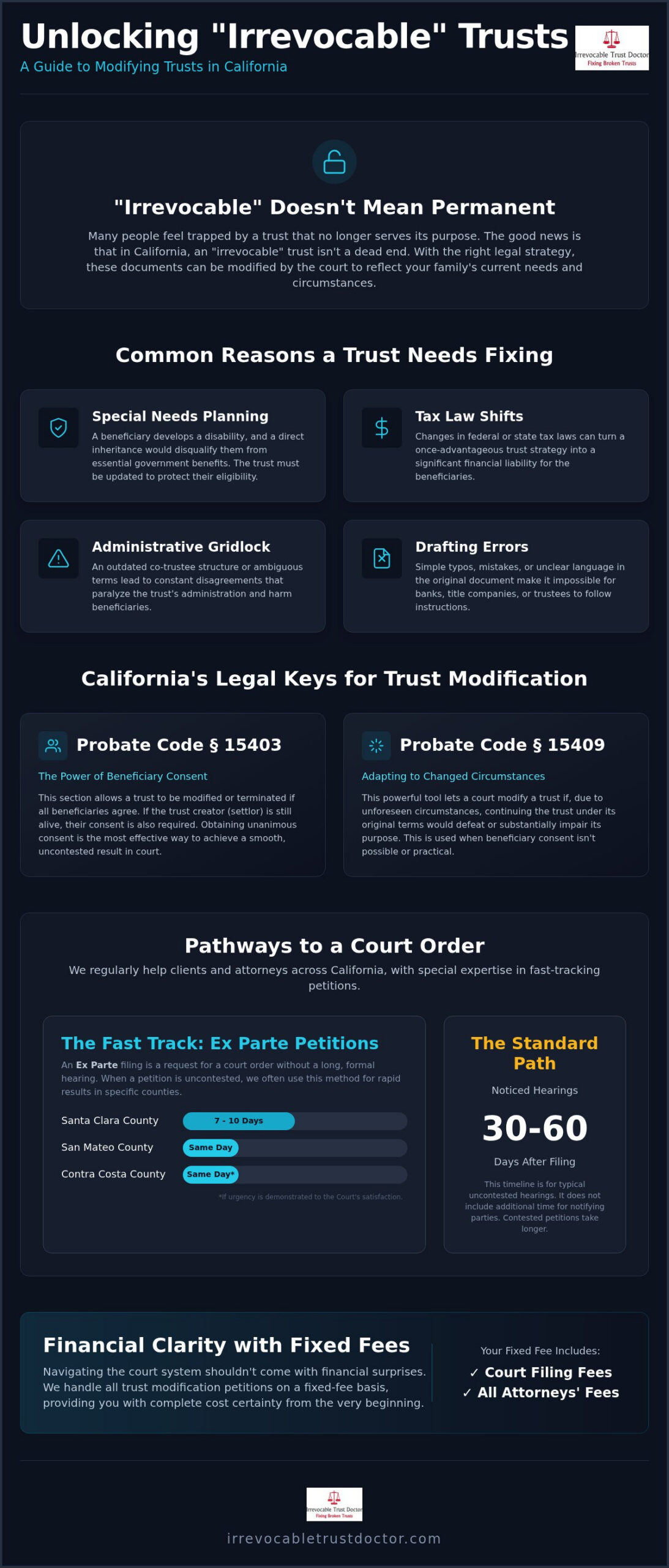
I’ve spent decades acting as a specialist fixer for these documents, helping both individuals and their existing counsel navigate the California Probate Code. We’ll look at how Section 15403 and Section 15409 allow us to petition the court for changes that reflect current needs. You’ll learn why I often file these petitions ex parte, which is a way to request a court order without a long, formal hearing. In Santa Clara County, we typically see results in 7 to 10 days, while San Mateo and Contra Costa can often be handled the same day. This guide breaks down the timelines for noticed hearings and explains why our fixed-fee model provides the cost certainty you deserve.
Key Takeaways
- Discover why “irrevocable” trusts are often modifiable through the court system when the original terms no longer align with your current family needs.
- Learn how to apply Probate Code Sections 15403 and 15409 to update trust provisions by gaining beneficiary consent or addressing unforeseen circumstances.
- Find out how a specialized attorney to change a trust in California can use “ex parte” filings to secure court approval without the need for a long, formal hearing.
- Identify the specific procedural advantages of filing in counties like Santa Clara, San Mateo, or Contra Costa to potentially secure a court order in just a few days.
- Gain financial clarity with a transparent fixed-fee structure that covers both your professional legal representation and all required court filing fees.
Understanding the Role of a California Trust Law Attorney in Modifying Trusts
Amending a revocable trust is a straightforward task, usually involving a simple document update signed by the person who created it. However, once a trust becomes irrevocable, that flexibility vanishes. You can’t just sign a new amendment page. Instead, you must engage the legal system to make any meaningful changes. This is where an attorney to change a trust in California becomes essential. I act as a specialized fixer, using the court petition process to repair documents that have become dysfunctional, obsolete, or legally "broken."
The court petition process is a formal request asking a judge to exercise their authority to rewrite or terminate a trust. It’s a technical procedure that requires a deep understanding of the California Probate Code. Whether I’m assisting a family directly or working as a consultant for their existing estate lawyer, my role is to diagnose the legal friction and apply the correct statutory remedy. We handle these petitions with fixed fees, ensuring you have total cost certainty before the process begins.
When Does a Trust Become Irrevocable?
Most trusts become irrevocable automatically upon the death of the settlor, the person who created the trust. Other trusts are designed to be irrevocable from the start to achieve specific tax planning or asset protection goals. Once a trust reaches this stage, the standard power to amend is gone. If the document contains drafting errors or instructions that no longer make sense, you can’t simply ignore them. You must secure a court order to modernize the terms.
The "Broken Trust" Syndrome
A broken trust is one that no longer fulfills the settlor’s original intent due to external changes. Life moves significantly faster than the law, and even the best-laid plans can fall apart over time. If a trust is gridlocked or harmful to its beneficiaries, it’s considered broken. Common examples include:
- Special Needs: A beneficiary develops a disability, and a direct inheritance would disqualify them from essential government benefits.
- Tax Law Shifts: Changes in federal or state tax codes turn a once-clever strategy into a financial liability.
- Administrative Gridlock: An outdated co-trustee structure leads to constant disagreements that prevent the trust from functioning.
- Drafting Errors: Simple mistakes in the original document make it impossible for a bank or title company to follow the instructions.
Legal Grounds for Change: California Probate Code 15403 and 15409
While the term irrevocable sounds final, the California Probate Code provides specific "keys" to unlock these documents. If you’re working with an attorney to change a trust in California, they’ll likely point you toward two primary statutes: Section 15403 and Section 15409. These laws allow a judge to modify or even terminate a trust if certain conditions are met. The goal isn’t to ignore the original intent of the person who created the trust, but rather to ensure the trust remains a functional tool rather than a legal burden.
The court’s primary concern during this process is whether the proposed change defeats a "material purpose" of the trust. For example, if a trust was specifically designed to keep a beneficiary from accessing funds until age 40 to protect them from youthful indiscretion, a judge might deny a request to distribute the money at age 25. However, if the change helps fulfill the settlor’s goals under new conditions, the court is often willing to step in. If you’re unsure if your situation qualifies, you can schedule a trust petition consultation to review the specific language of your document.
Probate Code 15403: The Power of Beneficiary Consent
Under Section 15403, a trust can often be modified if the settlor and all beneficiaries agree. If the settlor has passed away, the beneficiaries can still petition the court, provided they all consent to the change. This can become complicated if a beneficiary is a minor or lacks the legal capacity to sign off. In these cases, the court may appoint a representative to evaluate whether the change is in that person’s best interest. Getting everyone on the same page is the most effective way to secure a smooth, uncontested result. For a detailed breakdown of how beneficiary consent works in practice, including the 2026 virtual representation updates that can simplify the process, read our comprehensive guide on California probate code 15403 and modifying irrevocable trusts by beneficiary consent.
Probate Code 15409: Adapting to Unforeseen Circumstances
Section 15409 is the remedy for the "unexpected." It allows for modification when circumstances have changed in a way that the settlor did not anticipate. This is frequently used when tax laws shift significantly or when a specific investment strategy outlined in the 1980s is no longer viable in today’s market. To grant this petition, the court must be convinced that the change will further the original purposes of the trust. It’s about correcting the course when the original map no longer matches the terrain. For a comprehensive look at how this statute works as a legal "emergency exit" for failing trusts, read our detailed guide on California probate code 15409 and modifying irrevocable trusts for changed circumstances.
The Court Petition Process: Timelines for Santa Clara and Beyond
Once we’ve identified the legal grounds for modification, the focus shifts to the procedural mechanics of the court system. Navigating the bureaucracy requires more than just knowing the law; it requires understanding the specific preferences of local probate departments. Choosing the right attorney to change a trust in California means finding someone who knows the shortcuts that the law allows. My practice, known exactly as The Irrevocable Trust Doctor, specializes in accelerating these results by using the most efficient filing methods available for both clients and their existing counsel.
Ex Parte vs. Noticed Hearings
In the California probate system, there are two primary ways to have a petition heard. A noticed hearing is the standard route, but it often takes 30 to 60 days to get a court date. You must also factor in the time required to formally notify all interested parties, which can add weeks to the process. If a petition is contested, the timeline extends even further. For uncontested matters where everyone agrees, I prefer to file ex parte. This means we’re asking the court for an order without a formal, scheduled hearing, which significantly cuts down on waiting time. To understand the complete court procedure from start to finish, our step-by-step guide on how to fix an irrevocable trust in California walks through each stage of the process in detail.
Local Expertise in Bay Area Courts
Success in trust modification often depends on which county has jurisdiction. Each court has its own rhythm and procedural quirks. For instance, petitions filed ex parte in Santa Clara County are typically granted in 7 to 10 days. In San Mateo County, we can often file, have the petition heard, and receive the granted order on the same day. Contra Costa County offers similar speed, where petitions can frequently be granted the same day if we demonstrate "urgency" to the court’s satisfaction. To see how these timelines apply to your specific case, you can book a trust petition consultation to discuss your filing strategy.
Understanding these local nuances is what allows us to turn a potentially months-long ordeal into a quick resolution. Whether you’re dealing with a simple drafting error or a complex shift in beneficiary needs, the goal is to get the trust back on track as quickly as possible. We handle the heavy lifting of the court process so you don’t have to worry about the procedural hurdles.
Navigating the Modification: Fixed Fees and Expert Support
Finding the right attorney to change a trust in California often comes down to two factors: clinical precision and financial transparency. Many people hesitate to fix a broken trust because they fear an endless cycle of hourly billing and court delays. I’ve structured my practice to remove that uncertainty. By focusing exclusively on trust modification petitions, I’m able to offer a streamlined process that prioritizes speed without sacrificing the technical accuracy required by the probate court. Whether you’re a beneficiary feeling trapped or a trustee facing administrative gridlock, the goal is a clean, permanent resolution.
Predictable Costs for Legal Remedies
Hourly billing can create significant anxiety, especially when you’re dealing with the complexities of the California Probate Code. To solve this, I handle all uncontested trust modification petitions using a fixed-fee model. This single, transparent price covers both the professional legal services and the required court filing fees. You’ll know exactly what the investment is before we file a single document. This approach ensures that your focus remains on the resolution rather than the ticking clock of a lawyer’s stopwatch. You can review more details about our fees and costs to see how we maintain this transparency.
Consulting with a Certified Specialist
Experience matters when you’re asking a judge to modify a permanent legal document. As a Certified Specialist in Estate Planning, Trust, and Probate Law practicing since 1980, I’ve seen nearly every type of "broken" trust scenario. The Irrevocable Trust Doctor doesn’t just work with individual clients; I also frequently assist other estate planning attorneys who need a specialist to handle the technical petition process for their own clients. My role is to act as the "specialist fixer" who knows exactly how to navigate the local nuances of Bay Area courts.
If you’re ready to start, the first step is to gather your current trust document and any existing amendments. Identifying the specific provisions that are causing friction is the key to a successful petition. You can contact The Irrevocable Trust Doctor for a feasibility review to determine if your trust is a candidate for modification. For a deeper look at the specific types of trusts we repair, read our sibling article on California Irrevocable Trust Modification Attorney: Fixing ‘Broken’ Trusts in 2026.
Restoring Order to Your Irrevocable Trust
An outdated or dysfunctional trust doesn’t have to be a permanent burden on your family. California law provides specific mechanisms, such as Probate Code Sections 15403 and 15409, to modernize documents that no longer serve their intended purpose. Whether you are addressing a beneficiary’s special needs or correcting an old drafting error, these statutes offer a clear legal pathway to resolution. By engaging a specialized attorney to change a trust in California, you can navigate the court’s procedural requirements with confidence and move toward a functional outcome.
I serve clients and fellow legal professionals throughout the state as a Certified Specialist in Estate Planning, Trust, and Probate Law. My practice is built on transparency, offering fixed fees that cover all filing and legal costs to eliminate the stress of unpredictable billing. If you are ready to move from a state of uncertainty toward a clear, actionable conclusion for your legal matter, you can schedule a consultation with The Irrevocable Trust Doctor to fix your broken trust. From my base in San Jose, I assist families across all of California in restoring order to their estate plans.
Frequently Asked Questions
Can an irrevocable trust be changed in California without going to court?
Generally, you cannot change an irrevocable trust without a court order. Unlike revocable trusts that allow for simple private amendments, irrevocable documents require a formal petition to the probate court. Even if all family members agree on the new terms, third parties like banks and title companies usually won’t recognize the changes unless they are backed by a signed court order. This process ensures the modification is legally binding and protects the interests of all parties involved. For a complete 2026 legal overview of your options, our guide on whether an irrevocable trust can be changed in California covers every available pathway in detail.
How long does it take for a California court to approve a trust modification?
The timeline depends on the county and the type of petition filed. If you work with an attorney to change a trust in California who uses ex parte filings, results can be very fast. In Santa Clara County, these are typically granted in 7 to 10 days. San Mateo and Contra Costa Counties often grant petitions the same day they are filed. If a noticed hearing is required, expect a timeline of 30 to 60 days to account for court scheduling and legal notice requirements.
What is the difference between Probate Code 15403 and 15409?
These two codes serve different legal purposes. Section 15403 is used when the settlor and all beneficiaries consent to the change; it relies on total agreement to modify the trust terms. Section 15409 is used for "changed circumstances" that the settlor didn’t foresee, such as new tax laws or a beneficiary’s disability. This section allows a judge to step in and fix the trust even if the original document didn’t account for these specific life shifts.
Can I change the trustee of an irrevocable trust if they are not performing well?
Yes, you can petition the court to replace a trustee who is causing administrative gridlock or failing in their duties. If the trust document doesn’t provide a clear path for removal, we use the court petition process to appoint a more suitable successor. This is a common service provided by an attorney to change a trust in California, especially when an outdated trustee structure prevents the beneficiaries from receiving their intended support or causes unnecessary financial friction.
Do all beneficiaries have to agree to change an irrevocable trust in California?
Total agreement isn’t always required, though it does simplify the process. While Section 15403 generally requires consent from all beneficiaries, Section 15409 allows a judge to modify a trust based on changed circumstances even if there is a disagreement. If the modification doesn’t defeat the trust’s material purpose and is necessary to fulfill the settlor’s original intent, the court has the authority to grant the petition. Contested matters naturally take longer than uncontested ones, but a resolution is still possible.

Article by
Robert P. Bergman, Attorney at Law
Attorney Robert P. Bergman ("Bob Bergman") has been a Board-Certified Specialist in Estate Planning, Trust and Probate Law since 2011, as certified by the California State Bar Board of Legal Specialization. For several years, Bob has assisted families and the clients of other attorneys with obtaining court orders through trust modification petitions to make necessary modifications to existing irrevocable trusts. Bob is friendly, very approachable, and believes in explaining complex legal topics in clear ordinary language so that his clients understand exactly what they're doing and why they're doing it.
Bob is often able to assist clients throughout California who are in other counties than his home county of Santa Clara through his approach to trust modification petitions.