
Disclaimer
This article is for informational purposes only. Nothing in this article is intended to replace legal advice from a competent attorney or be considered legal guidance for anybody's specific legal situation. Nobody should rely on information in this article in making legal decisions without such consultation.
In California, the word “irrevocable” is a legal starting point rather than a permanent dead end. If you are managing a trust with terms that have become impractical due to compressed 2026 tax brackets or shifted beneficiary needs, you likely feel the weight of a document that no longer serves its intended purpose. It’s common to worry about personal liability when drafting errors or outdated provisions make daily administration nearly impossible. Engaging an experienced California irrevocable trust modification attorney is the first step toward restoring order to a dysfunctional estate plan.
You deserve a solution that aligns with current legal standards, including the $435 statewide filing fee and new virtual representation rules under AB 565. This article explains how a Certified Specialist can navigate the California Probate Court to successfully amend trust language or terminate a trust that has become uneconomical. We will examine the specific mechanics of Probate Code Sections 15403 and 15409, providing you with a roadmap to modernize your trust while protecting all parties involved. By understanding these judicial diagnostic tools, you can move from a state of uncertainty toward a clear, actionable resolution.
Key Takeaways
- Learn how California Probate Code Sections 15403 and 15409 provide specific legal pathways to modify or terminate trusts that have become impractical or uneconomical.
- Understand why partnering with a California irrevocable trust modification attorney is essential for conducting a precise diagnostic review of your trust to identify and fix drafting errors.
- Distinguish between judicial reformation, modification, and decanting to determine the most efficient strategy for updating your trust’s administrative or distributive provisions.
- Discover the step-by-step judicial petition process required to successfully navigate the Probate Court and align your trust with modern tax laws and beneficiary needs.
- Gain clarity on how a court-approved modification can resolve administrative nightmares and protect trustees from personal liability when original trust terms no longer function.
Can an Irrevocable Trust Be Changed in California?
Many people believe that once a trust is labeled “irrevocable,” its terms are set in stone forever. In the context of California Probate Law, an irrevocable trust is simply one that the settlor cannot unilaterally revoke or amend. However, the term is often a misnomer. As legal landscapes shift and family dynamics evolve, these documents can become “broken.” This means they no longer function as intended or create administrative nightmares for those in charge.
When a trust becomes dysfunctional, it requires the intervention of a specialized California irrevocable trust modification attorney. In 2026, we’re seeing a surge in cases where trusts drafted decades ago collide with modern realities. Whether it’s a change in the tax code or a beneficiary’s health status, the law provides specific mechanisms to fix these issues. You don’t have to be trapped by outdated language that no longer serves your family’s best interests.
Common Triggers for Trust Modification
Specific triggers often necessitate a formal petition. In 2026, the highly compressed federal income tax brackets for trusts, where the top 37% rate applies to retained income over $16,000, make many older accumulation trusts tax-inefficient. Other common triggers include a beneficiary qualifying for Medi-Cal, where asset limits for individuals are currently $130,000; drafting errors that create ambiguities; or unforeseen changes in a beneficiary’s ability to manage money. These factors can turn a well-intentioned estate plan into a liability.
The Role of the California Probate Court
The California Probate Court serves as the final arbiter for these changes. While some non-judicial fixes like decanting exist, a court order provides the highest level of protection against personal liability for trustees. Judges must balance the original “settlor intent” with the current practicalities of the situation. If a trust’s purpose has become impossible or excessively expensive to achieve, the court has the authority to step in. A California irrevocable trust modification attorney acts as a legal diagnostician, presenting the evidence required to show that a modification is a necessity for the trust’s continued viability.
California Probate Code: Legal Grounds for Modification
Successfully amending a trust requires a clinical understanding of specific statutes. As a California irrevocable trust modification attorney, I guide clients through two primary pathways provided by the state: beneficiary consent and changed circumstances. Each path has distinct requirements and evidentiary hurdles that must be cleared to secure a court order. These legal frameworks are designed to provide relief when a document’s original language no longer aligns with reality.
Modification by Consent (PC 15403)
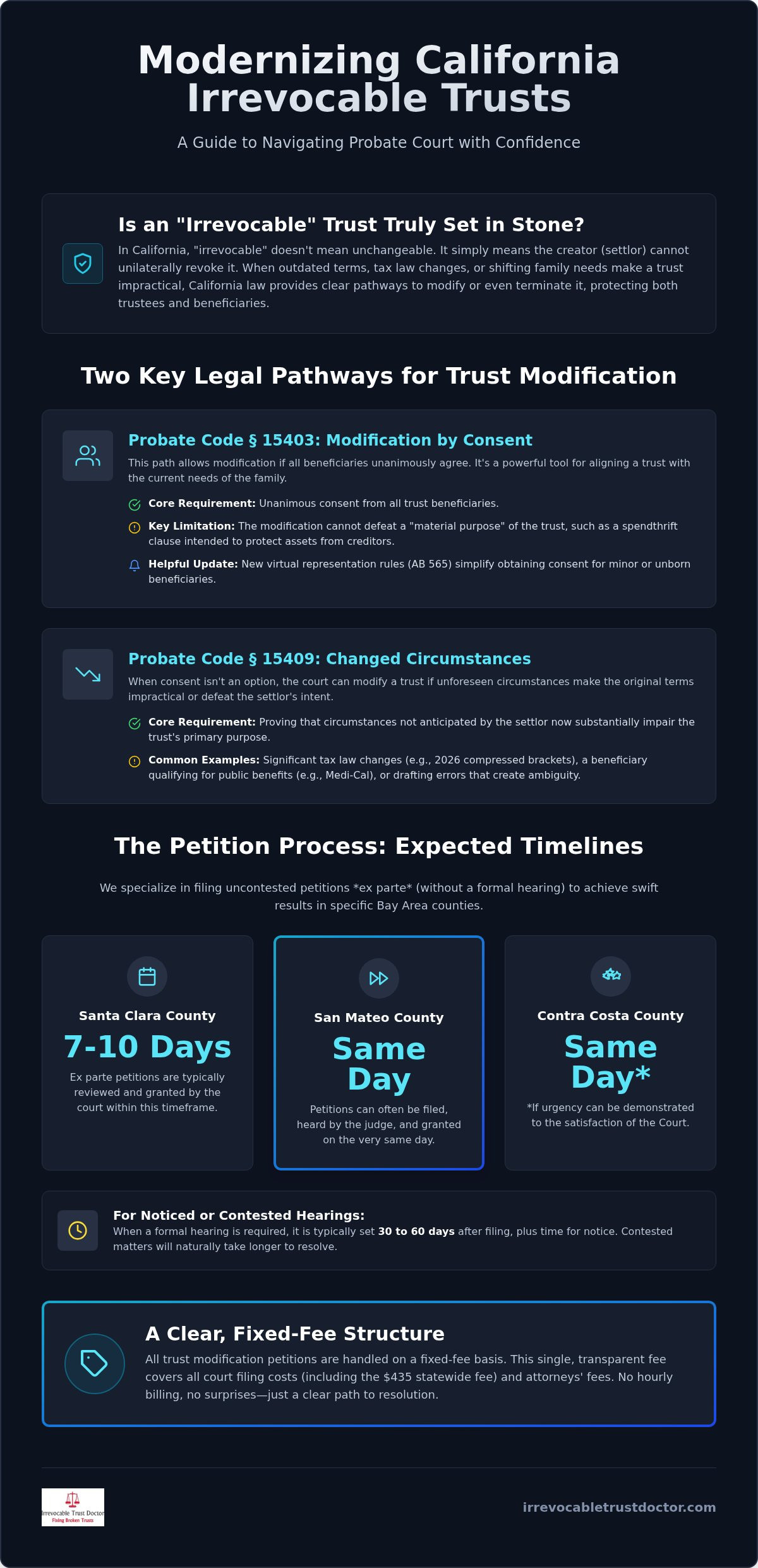
California Probate Code Section 15403 allows for modification if all beneficiaries agree, provided the change doesn’t defeat a material purpose of the trust. If a trust includes a spendthrift provision to protect a beneficiary from creditors, the court may refuse a modification that allows for a lump-sum distribution, as this would violate the settlor’s core intent. However, if the settlor is still living, Section 15404 offers even more flexibility. If the settlor and all beneficiaries agree, the trust can be modified or terminated regardless of whether a material purpose is defeated. In 2026, the new virtual representation rules under AB 565 have simplified this process by allowing parents or guardians to represent the interests of minor or unborn beneficiaries.
Changed Circumstances (PC 15409)
When consent isn’t possible or the settlor’s intent is being hindered by unforeseen events, California Probate Code § 15409 serves as the primary tool for fixing outdated trusts by allowing modification due to changed circumstances. The court may intervene if the trust’s purpose is substantially impaired by events the settlor never anticipated. Common examples of “substantial impairment” include the 2026 reinstatement of Medi-Cal asset limits for eligibility or significant shifts in federal tax brackets that make trust accumulation prohibitively expensive. Engaging a California irrevocable trust modification attorney ensures that your petition is drafted with the precision needed to satisfy the court’s scrutiny. If you aren’t sure which statute applies to your situation, you may want to discuss your trust document with a specialist to identify the most effective legal strategy.
Reformation vs. Modification vs. Decanting
Choosing the right tool to fix a “broken” trust requires a precise legal diagnosis. If you are a trustee or beneficiary dealing with an outdated document, you must determine if the problem is a drafting error, an administrative hurdle, or a fundamental change in circumstances. A California irrevocable trust modification attorney evaluates these factors to decide whether reformation, modification, or decanting is the most effective path forward. Each method carries different burdens of proof and levels of judicial oversight.
When to Choose Reformation
Reformation is a surgical procedure used to correct specific “scrivener’s errors” or typos that occurred at the time the trust was drafted. If a document contains an ambiguity or a mistake that contradicts the settlor’s original intent, the court can reform the language to reflect what was actually intended. For example, if a drafting attorney accidentally omitted a specific tax-saving clause, reformation can restore it. However, you must provide clear and convincing evidence of the settlor’s true goals, which often requires external documentation or witness testimony. The burden of proof is significantly higher for reformation than it is for other modification types.
The Pros and Cons of Trust Decanting
Trust decanting is the process of “pouring” assets from an old, restrictive trust into a new trust with more favorable administrative terms. Under California’s Uniform Trust Decanting Act (UTDA), a trustee with discretionary authority over principal distributions can often perform this without a court order, provided they give all beneficiaries a 60-day notice. This can be a faster way to modernize a trust’s investment powers or add a successor trustee provision.
Despite the apparent convenience of decanting, it has strict limitations. You cannot use decanting to eliminate a beneficiary’s fixed right to distributions or to change the ultimate remainder interests. For many, a formal court petition handled by a attorney to change a trust in California remains the superior choice. A court order provides a definitive legal shield for the trustee, effectively blocking future litigation from beneficiaries who might otherwise challenge an out-of-court decanting years later. If the trust involves high-value assets or complex family dynamics, the protection of the Probate Court is a vital safeguard against personal liability. For families managing cross-border interests, the Israel Cross Border Law Firm offers specialized expertise in facilitating business and investment between Israel and the United States.
The Judicial Petition Process in California
The path to fixing a dysfunctional trust begins with a rigorous diagnostic review. As a California irrevocable trust modification attorney, I first examine the existing document to identify the specific clauses that are causing administrative friction. Once we pinpoint the failure, we draft a formal Petition to Modify or Petition to Terminate. This document is then filed in the probate court of the county where the trust is being administered, accompanied by the $435 statewide civil filing fee required in 2026. For a comprehensive walkthrough of each stage in this process, our step-by-step guide on how to fix an irrevocable trust in California provides detailed guidance on every procedural requirement.
After filing, we must provide formal legal notice to all interested parties. This includes all current and contingent beneficiaries, as well as any trustees named in the document. This step is critical. If notice is not served correctly, the court cannot grant the relief you seek. The process culminates in a court hearing where a judge reviews the evidence to ensure the proposed changes align with California law and the settlor’s ultimate goals. If the judge finds the evidence sufficient, they will issue a court order that legally amends the trust’s terms.
Preparing the Evidence for the Court
Success in the probate court depends on the quality of your evidence. We gather detailed declarations from beneficiaries and trustees to demonstrate why the current terms are no longer viable. For instance, if you are seeking a modification due to tax inefficiency, we document how the 2026 federal tax brackets, which tax trust income over $16,000 at 37%, are depleting the trust’s principal. If a beneficiary requires Medi-Cal, we provide proof of the $130,000 individual asset limit to justify moving assets into a special needs sub-trust. A well-drafted legal memorandum of points and authorities is essential to connect these facts to the appropriate probate codes.
Timeline and Expectations
While every case is unique, a standard trust modification petition in California typically takes four to nine months from the initial filing to the final court order. This duration depends largely on the court’s current backlog and whether the petition is unopposed. If a beneficiary objects to the modification, the timeline can extend as the court requires additional briefings or mediation. Once the judge signs the order, it becomes a final, binding document that updates the trust’s administration. To begin this diagnostic process for your own document, you can schedule a trust petition consultation to review your specific legal grounds.
Why Hire a California Irrevocable Trust Modification Attorney?
If your trust has become a source of stress, you need a specialist fixer rather than a general practitioner. Engaging a California irrevocable trust modification attorney ensures that your petition is built on a foundation of technical accuracy and decades of courtroom experience. At the Irrevocable Trust Doctor, we focus exclusively on court petitions to fix or terminate trusts that have become administrative burdens. This specialized focus allows us to navigate the procedural nuances of the California Probate Code with a level of clinical accuracy that general practitioners often struggle to match.
Choosing the right representation is especially vital when dealing with high-stakes litigation or complex tax implications. To navigate the technical demands of such cases, legal teams can discover Trustpoint.One for specialized eDiscovery and managed review support. It’s common for individual trustees to feel overwhelmed by the technicalities of a judicial petition. By relying on a California irrevocable trust modification attorney to handle the heavy lifting, you protect yourself from personal liability while ensuring the trust’s assets are handled according to the best possible legal strategy.
The ‘Certified Specialist’ Advantage
Robert P. Bergman has been practicing law since 1980 and is a State Bar of California Certified Specialist in Estate Planning, Trust, and Probate Law. This designation is not merely a title; it represents a rigorous vetting process and a deep mastery of the probate system. In fact, fewer than 1% of California attorneys hold this specific certification, making it a rare credential that signals a high level of expertise to the court. Because of this niche focus, generalist estate planners often refer their most difficult “broken” trust cases to our firm for resolution.
Statewide Expertise with Local Court Insight
While our approach is methodical and instructional, we understand that every county probate court in California has its own local procedural rules. Whether your case is in San Jose, Los Angeles, or any county in between, we provide statewide representation backed by over 40 years of experience. We assist individual trustees and beneficiaries, and we also provide consultation services for other legal counsel who need a specialist’s eye on a complex petition. If you are ready to restore order to your trust, you should Schedule a Consultation with the Irrevocable Trust Doctor to begin your diagnostic review.
Modernize Your Trust and Protect Your Legacy
A “broken” trust doesn’t have to remain a permanent administrative burden. As we’ve examined, California law provides robust mechanisms under the Probate Code to modify or terminate irrevocable trusts that no longer align with current tax realities or family needs. Whether you pursue a petition based on beneficiary consent or unforeseen changed circumstances, the goal is always to restore the document’s functionality while honoring the settlor’s ultimate intent. Navigating this judicial process requires a methodical approach that only a seasoned practitioner can provide.
Robert P. Bergman has been practicing since 1980 and is a State Bar of California Certified Specialist in Estate Planning, Trust, and Probate Law. By partnering with a California irrevocable trust modification attorney who offers statewide representation, you ensure that every procedural detail is handled with clinical precision. If you’re ready to move from a state of uncertainty toward a clear legal resolution, you can Request a Trust Modification Case Review to begin your diagnostic evaluation. You have the power to fix what’s broken and secure a more stable future for your beneficiaries.
Frequently Asked Questions
Can an irrevocable trust be changed after the settlor has died?
Yes, an irrevocable trust can be modified after the settlor’s death by petitioning the California Probate Court. While the settlor can no longer provide consent, beneficiaries can agree to changes under Section 15403, or a trustee can cite changed circumstances under Section 15409. The court must ensure that the proposed modification does not defeat a material purpose of the original trust document.
What is the difference between trust modification and trust termination?
Trust modification involves changing specific administrative or distributive terms while keeping the trust structure intact. In contrast, trust termination ends the trust entirely and requires the immediate distribution of all remaining assets to the beneficiaries. Termination is often sought when the trust’s principal has dropped so low that the ongoing administrative costs, such as professional trustee fees, make it uneconomical to continue.
Do all beneficiaries have to agree to a trust modification in California?
Under Probate Code Section 15403, the consent of all beneficiaries is typically required to modify a trust without the settlor’s involvement. However, if some beneficiaries don’t agree, the court may still grant a modification under Section 15409 if changed circumstances substantially impair the trust’s purpose. Additionally, new 2026 virtual representation rules allow certain parties to represent the interests of minor or unborn beneficiaries to satisfy consent requirements.
How much does it cost to petition the court to change a trust?
The baseline cost includes a $435 statewide civil filing fee required by California Probate Courts as of January 1, 2026. Beyond the filing fee, total costs depend on the complexity of the case and whether any beneficiaries object to the petition. While standard trust administration fees in California often range from $3,000 to $15,000, a specialized attorney to change a trust in California can provide a clearer estimate based on a diagnostic review of your specific document.
Can a trustee be sued for trying to modify an irrevocable trust?
A trustee can potentially face litigation if they attempt to alter a trust’s terms without proper judicial authority or if the modification harms a beneficiary’s interests. This is why obtaining a formal court order is the safest procedural route. A court order provides a legal shield that protects the trustee from personal liability, as the judge has already determined that the modification aligns with California law and the settlor’s intent.
What is California Probate Code 15409?
California Probate Code Section 15409 is the statute that allows the court to modify or terminate a trust due to circumstances the settlor didn’t anticipate. If the current terms of the trust would defeat or substantially impair the accomplishment of the trust’s purposes, the court may intervene. This code is the primary tool used by a California irrevocable trust modification attorney to fix trusts that have become outdated due to legal or financial shifts.
How long does the trust modification process take in California?
The judicial process for modifying an irrevocable trust generally takes between four and nine months from the date the petition is filed. This timeline depends on the specific county court’s calendar and whether any interested parties file an objection. If the petition is unopposed and the evidence of changed circumstances is clear, the court may issue the final order on a more accelerated schedule.
Can I change an irrevocable trust to save on taxes in 2026?
Yes, you can petition to modify a trust to improve tax efficiency, especially given the compressed 2026 federal income tax brackets. If a trust is currently required to retain income that is now taxed at the top 37% rate once it exceeds $16,000, the court may allow a modification to distribute that income to beneficiaries in lower brackets. This change is often justified under the doctrine of changed circumstances or through the consent of all beneficiaries. Trustees and beneficiaries who want to understand the full range of available remedies can review our detailed resource on how to fix an irrevocable trust using California’s specific court procedures.

Article by
Robert P. Bergman, Attorney at Law
Attorney Robert P. Bergman ("Bob Bergman") has been a Board-Certified Specialist in Estate Planning, Trust and Probate Law since 2011, as certified by the California State Bar Board of Legal Specialization. For several years, Bob has assisted families and the clients of other attorneys with obtaining court orders through trust modification petitions to make necessary modifications to existing irrevocable trusts. Bob is friendly, very approachable, and believes in explaining complex legal topics in clear ordinary language so that his clients understand exactly what they're doing and why they're doing it.
Bob is often able to assist clients throughout California who are in other counties than his home county of Santa Clara through his approach to trust modification petitions.