
Disclaimer
This article is for informational purposes only. Nothing in this article is intended to replace legal advice from a competent attorney or be considered legal guidance for anybody's specific legal situation. Nobody should rely on information in this article in making legal decisions without such consultation.
The word “irrevocable” doesn’t mean your trust is written in stone, even if the original document claims otherwise. It’s a common misconception that once a trust becomes permanent, you’re trapped with its terms forever, regardless of how much your family’s needs or California tax laws have changed. If you feel like you’re struggling with an obsolete legal framework, working with a specialized irrevocable trust modification attorney Alameda County can provide the remedy you need. I understand the anxiety that comes with a “broken” trust, especially when you’re worried about high hourly fees or complex court requirements.
You’ll learn how California law, specifically Probate Code Sections 15403 and 15409, provides clear paths to update, amend, or even terminate a trust that no longer serves its purpose. I assist clients and fellow attorneys throughout California by filing petitions to remove unsuitable trustees or correct drafting errors. We’ll explore how I use ex parte petitions in Santa Clara to get results in seven to ten days, or in San Mateo and Contra Costa for same day orders when urgency is shown. This guide previews the exact timelines and fixed-fee structures you can expect when restoring order to your legal affairs.
Key Takeaways
- You’ll see how California law provides specific legal tools to “heal” a broken trust when it no longer reflects your family’s current reality.
- Consult with an irrevocable trust modification attorney Alameda County to understand how Probate Code Sections 15403 and 15409 allow for legal amendments.
- Learn how “ex parte” filings can sometimes secure court approval in as little as one day, bypassing the typical months-long wait for a formal hearing.
- Discover the benefit of a fixed-fee structure that includes all filing costs, providing you with financial certainty from the start of the process.
- See why working with a Certified Specialist ensures your petition is handled with the precision required to meet strict California court standards.
Can an Irrevocable Trust Be Changed in Alameda County? The ‘Broken Trust’ Reality
Many people believe that once a trust is labeled “irrevocable,” it is locked away in a legal vault that can never be opened. This is a common misconception that causes unnecessary stress for families in the East Bay. In reality, an irrevocable trust is often more flexible than the document’s rigid language suggests. I often describe these situations as “broken trusts.” This happens when the original document, drafted years or even decades ago, no longer aligns with current tax laws, family dynamics, or the settlor’s original intent. If you find yourself in this position, an irrevocable trust modification attorney Alameda County acts as a legal diagnostician to identify the specific “fractures” in your document and prescribe a precise court petition to fix them.
California law provides specific pathways to update these documents without the need for aggressive litigation. My role is to help you understand the mechanics of a California Irrevocable Trust Modification Attorney: Fixing ‘Broken’ Trusts in 2026. We look at the trust not as a permanent barrier, but as a living instrument that may require a surgical adjustment to function properly again. Whether you’re a beneficiary trying to remove an unsuitable trustee or a successor trustee struggling with unclear instructions, the goal is restoration, not conflict.
Common Reasons for Seeking a Trust Modification
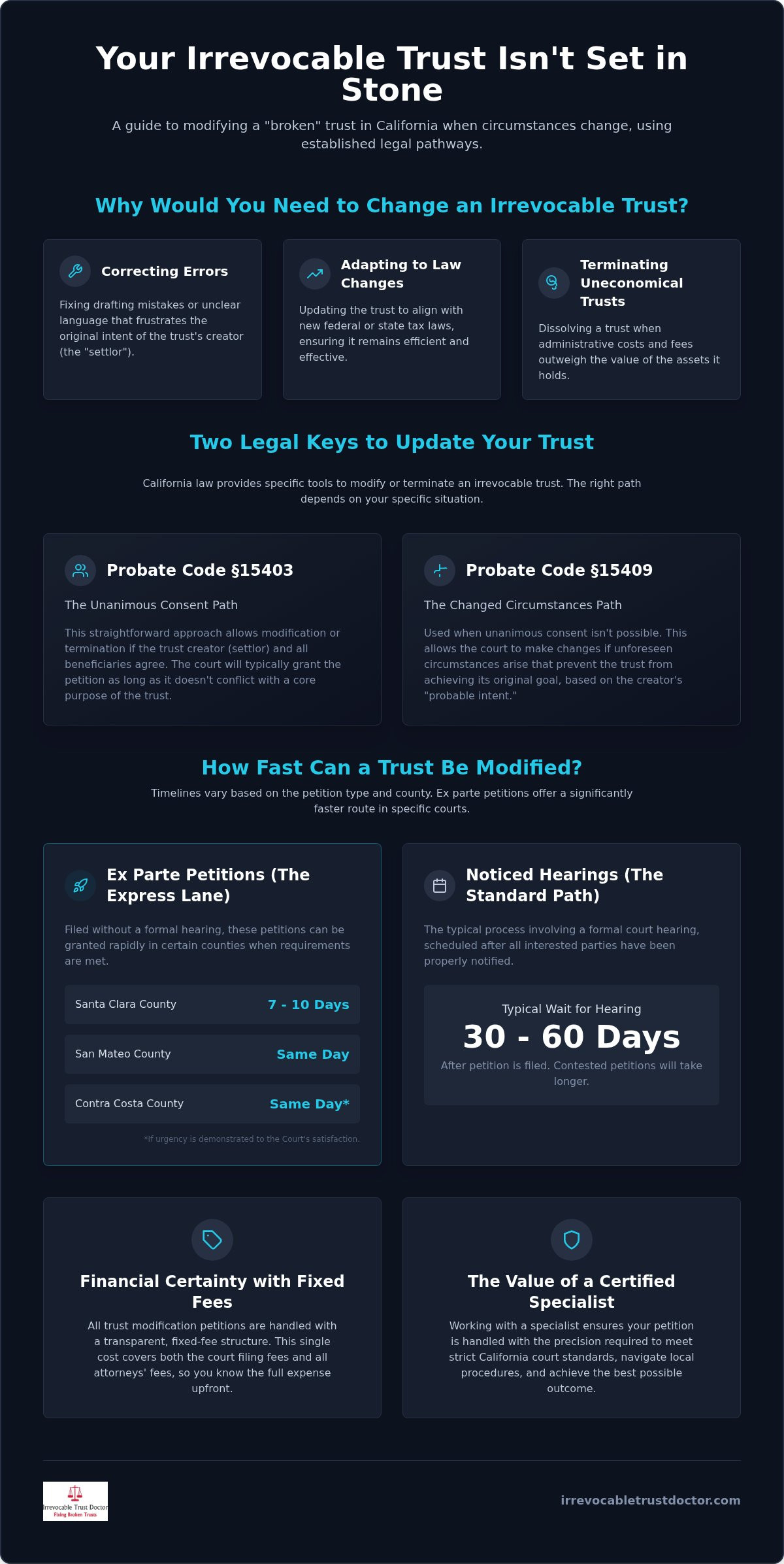
- Correcting Technical Errors: Even the most carefully drafted documents can contain mistakes. If a drafting error frustrates what the settlor originally intended, a petition can clarify those terms to ensure assets are handled correctly.
- Adapting to 2026 Tax Law Shifts: Federal and state tax codes are constantly evolving. For example, recent changes like Assembly Bill 565 have introduced “virtual representation,” which can simplify how minor or unborn beneficiaries are represented in court. If your trust doesn’t account for these modern frameworks, it might be obsolete.
- Terminating Uneconomical Trusts: Sometimes the cost of maintaining a trust exceeds the value of the assets inside it. If the administrative fees are draining the inheritance, California law allows us to terminate the trust and distribute the remaining funds directly to the beneficiaries.
The Legal Framework: California Probate Code 15403 and 15409
Modifying a permanent legal document requires more than just a good reason; it requires a specific statutory foundation. In my practice as an irrevocable trust modification attorney Alameda County, I rely primarily on two powerful sections of the California Probate Code to “heal” trusts that have become dysfunctional. These laws provide the court with the authority to step in when a trust no longer works as intended. Understanding which path applies to your situation is the first step toward a resolution. If you aren’t sure which code section fits your needs, you can schedule a consultation to review your document.
Probate Code Section 15403 is the most straightforward path. It allows for the modification or even the total termination of an irrevocable trust if the person who created the trust (the settlor) and all the people receiving assets (the beneficiaries) agree to the change. Even if the settlor has passed away, the beneficiaries can often still move forward under this section. The court will typically grant the request as long as the modification doesn’t interfere with a “material purpose” of the trust, such as protecting a beneficiary from their own financial mismanagement.
When unanimous agreement isn’t possible, we turn to California Probate Code 15409. This statute allows the court to modify the administrative or dispositive terms of a trust if “changed circumstances” exist that were not known or anticipated by the settlor. Section 15409 serves as a vital safety valve for trusts facing unforeseen obstacles that would otherwise prevent the trust from fulfilling its original goal. To succeed here, I must demonstrate to the judge that the proposed change carries out the settlor’s “probable intent,” meaning it’s what they would have wanted if they had known about the current problem.
Consent vs. Changed Circumstances
The strategy we choose depends largely on the level of cooperation among your family members. If everyone is on the same page, we use Section 15403 to streamline the process and present a united front to the court. However, if one person is hesitant or cannot be located, we pivot to Section 15409. In these cases, a specialist petitions the court to bypass the document’s “irrevocability” by proving that the trust’s very purpose is threatened by outdated language or high administrative costs. My goal is to navigate these bureaucratic obstacles so the trust can finally do its job again.
Fast-Tracking the Petition: Local Court Timelines and Ex Parte Filing
One of the most significant concerns for families is how long the legal process will take to resolve. If you are working with an irrevocable trust modification attorney Alameda County, you don’t always have to wait months for a court date. For uncontested modifications, I often utilize an “ex parte” petition. This is a specialized procedural tool that allows us to present a request to a judge without a formal, months-long hearing process. It’s essentially a fast track for trusts that need immediate attention under California Probate Code § 15409.
If the petition requires a noticed hearing, the timeline is more structured. You can typically expect a window of 30 to 60 days after the initial filing. This timeframe includes the necessary period to provide legal notice to all interested parties. It’s also important to understand that if a beneficiary or trustee objects, the case becomes “contested,” which will naturally extend the procedural timeline. To help you plan with confidence, I handle these matters using fixed fees that cover both filing and attorneys’ fees, ensuring you won’t face unexpected costs regardless of the court’s schedule.
County-Specific Speed for Trust Petitions
- Santa Clara County: In Santa Clara, my ex parte petitions are typically granted in just 7 to 10 days. This rapid turnaround is ideal for fixing technical errors or updating trustee language quickly.
- San Mateo County: This jurisdiction is exceptionally efficient for well-prepared petitions. In many cases, these can be filed, heard, and granted on the same business day.
- Contra Costa County: Same-day grants are also possible here. However, we must demonstrate a level of “urgency” to the Court’s satisfaction to bypass the standard calendar.
Every county has its own local rules and expectations for probate filings. If you want to know which procedural path is best for your situation, you can book a consultation to discuss your petition timeline and explore the fastest options available in your jurisdiction.
Why Choose a Certified Specialist for Your Trust Modification?
Robert P. Bergman is a Certified Specialist in Estate Planning, Trust, and Probate Law. This isn’t just a title; it represents a level of technical mastery that few practitioners achieve. When you hire an irrevocable trust modification attorney Alameda County, you need someone who understands the nuances of the court system from decades of direct practice. Since 1980, I have focused on solving complex trust problems that generalist attorneys often find overwhelming or too specialized for their standard practice.
My practice operates as a statewide service hub from San Jose. While your trust might be administered in the East Bay, the legal principles governing modification apply across California. I regularly assist both individual families and their existing legal counsel with high-level petitions. If your current attorney is unsure how to navigate the specific requirements of the probate court for a modification, I can step in as a “specialist fixer” to ensure the petition is drafted and filed correctly the first time.
Fixed-Fee Transparency and Predictable Costs
I believe that legal fees should never be a source of additional stress during a trust crisis. Most firms charge by the hour, which creates a conflict where the client fears every phone call or email will increase the bill. I have replaced that outdated model with a clear, fixed-fee structure for all trust modification petitions. This ensures you aren’t watching the clock while we discuss the future of your family’s legacy.
This single fee is all-inclusive. It covers your initial diagnostic consultation, the drafting of the legal petition, the court filing fees, and my full representation in court. Whether we are utilizing the rapid timelines in neighboring counties or a standard noticed hearing in Alameda, you will know the exact cost before we begin. To take the first step toward resolving your legal obstacles, Book your trust petition consultation with The Irrevocable Trust Doctor and receive a clear roadmap for your case.
Restore Clarity and Function to Your Trust
You don’t have to remain stuck with a legal document that no longer reflects your family’s needs or the current tax landscape. California law provides specific mechanisms to amend or terminate trusts that have become obsolete through the court system. By partnering with an irrevocable trust modification attorney Alameda County, you can navigate these complex requirements with confidence. I use my status as a Certified Specialist to identify the most efficient path forward, whether that involves a 30 to 60 day noticed hearing or a rapid ex parte petition.
I provide total financial and procedural certainty for every client. I assist individuals and fellow attorneys throughout California using a fixed-fee model that covers all filing costs and legal fees. Whether you need a same-day order in San Mateo or a 10-day resolution in Santa Clara, I have the expertise to bypass traditional bureaucratic delays. Don’t let a “broken” trust create unnecessary stress for your beneficiaries or trustees.
Book a Trust Petition Consultation to Review Your Case and discover how we can align your trust with your current goals. You have the legal right to fix what feels permanent.
Frequently Asked Questions
Can an irrevocable trust be changed in California after the settlor has died?
Yes, you can modify an irrevocable trust after the settlor has passed away. In fact, many “broken” trusts only become problematic once the original creator is no longer here to manage the assets or interpret the language. Under Probate Code Section 15403, if all beneficiaries agree, the court can grant a modification. If there isn’t total agreement, Probate Code Section 15409 allows a judge to intervene if circumstances have changed in ways the settlor didn’t expect.
How long does it take to modify a trust in Santa Clara or Alameda County?
The timeline depends heavily on the county and whether the petition is contested. In Santa Clara County, an ex parte petition is typically granted in 7 to 10 days. For a noticed hearing in Alameda County, you should expect a timeline of 30 to 60 days to allow for proper legal notice to all interested parties. Consulting an irrevocable trust modification attorney Alameda County can help you determine if your case qualifies for a faster procedural track.
What is the difference between trust reformation and a trust modification petition?
Trust reformation is used specifically to correct a technical mistake so the document reflects the settlor’s original intent from the start. Trust modification is a broader tool used to update or change terms because of new tax laws or shifting family needs. While reformation looks backward to fix a drafting error, modification looks forward to ensure the trust remains functional and effective for the current beneficiaries under the California Probate Code.
Do I need a formal court hearing to change the terms of my irrevocable trust?
You don’t always need a formal, months-long court hearing to update your trust. For uncontested matters, I regularly file ex parte petitions, which are often handled without a standard hearing. In San Mateo County, these can be filed, heard, and granted on the same business day. In Contra Costa County, same-day grants are also possible if we demonstrate urgency to the court’s satisfaction, allowing you to bypass the standard 60-day wait.
What happens if one beneficiary refuses to consent to the modification?
If a beneficiary refuses to consent, you can still seek a modification under Probate Code Section 15409. This law allows the court to change the trust terms even without unanimous agreement if we prove that changed circumstances are frustrating the trust’s purpose. While contested petitions take longer than uncontested ones, a judge has the final authority to “heal” the trust if the modification carries out the settlor’s probable intent. I handle these petitions with fixed fees to provide cost certainty.

Article by
Robert P. Bergman, Attorney at Law
Attorney Robert P. Bergman ("Bob Bergman") has been a Board-Certified Specialist in Estate Planning, Trust and Probate Law since 2011, as certified by the California State Bar Board of Legal Specialization. For several years, Bob has assisted families and the clients of other attorneys with obtaining court orders through trust modification petitions to make necessary modifications to existing irrevocable trusts. Bob is friendly, very approachable, and believes in explaining complex legal topics in clear ordinary language so that his clients understand exactly what they're doing and why they're doing it.
Bob is often able to assist clients throughout California who are in other counties than his home county of Santa Clara through his approach to trust modification petitions.