
Disclaimer
This article is for informational purposes only. Nothing in this article is intended to replace legal advice from a competent attorney or be considered legal guidance for anybody's specific legal situation. Nobody should rely on information in this article in making legal decisions without such consultation.
What if the word “irrevocable” didn’t actually mean your family trust was set in stone? Many beneficiaries and trustees feel trapped by outdated language or tax provisions that made sense decades ago but create a financial burden today. It’s frustrating to watch assets lose value or family conflict grow because of a document the original creator can no longer change. If you’re struggling with a trust that no longer serves its intended purpose, California probate code 15409 offers a specialized legal “emergency exit” for trusts that are failing due to circumstances the creator never could have anticipated.
This article will teach you how to legally modify a “broken” irrevocable trust when life throws a curveball that makes the original terms impossible or inefficient to follow. You’ll learn about the specific legal grounds required for a successful modification petition and how to navigate the court process efficiently. We’ll examine the mechanics of updating these documents to reflect current tax laws and beneficiary needs, providing a clear roadmap to restore order to your family’s estate. By understanding these procedural codes, you can find a path to fix the trust quickly and affordably with the help of a seasoned practitioner who knows how to navigate these bureaucratic obstacles.
Key Takeaways
- Understand how the “Changed Circumstances” rule allows you to update a trust when the original creator’s intent is no longer being met.
- Discover how California probate code 15409 serves as a legal mechanism to fix trusts rendered obsolete by shifting tax laws or unexpected financial volatility.
- Learn the procedural differences between a standard notice and an “ex parte” filing, which can significantly accelerate the modification process in certain jurisdictions.
- Identify why partnering with a Certified Specialist is essential for navigating complex court petitions and ensuring the modification is handled correctly and affordably.
What is California Probate Code 15409?
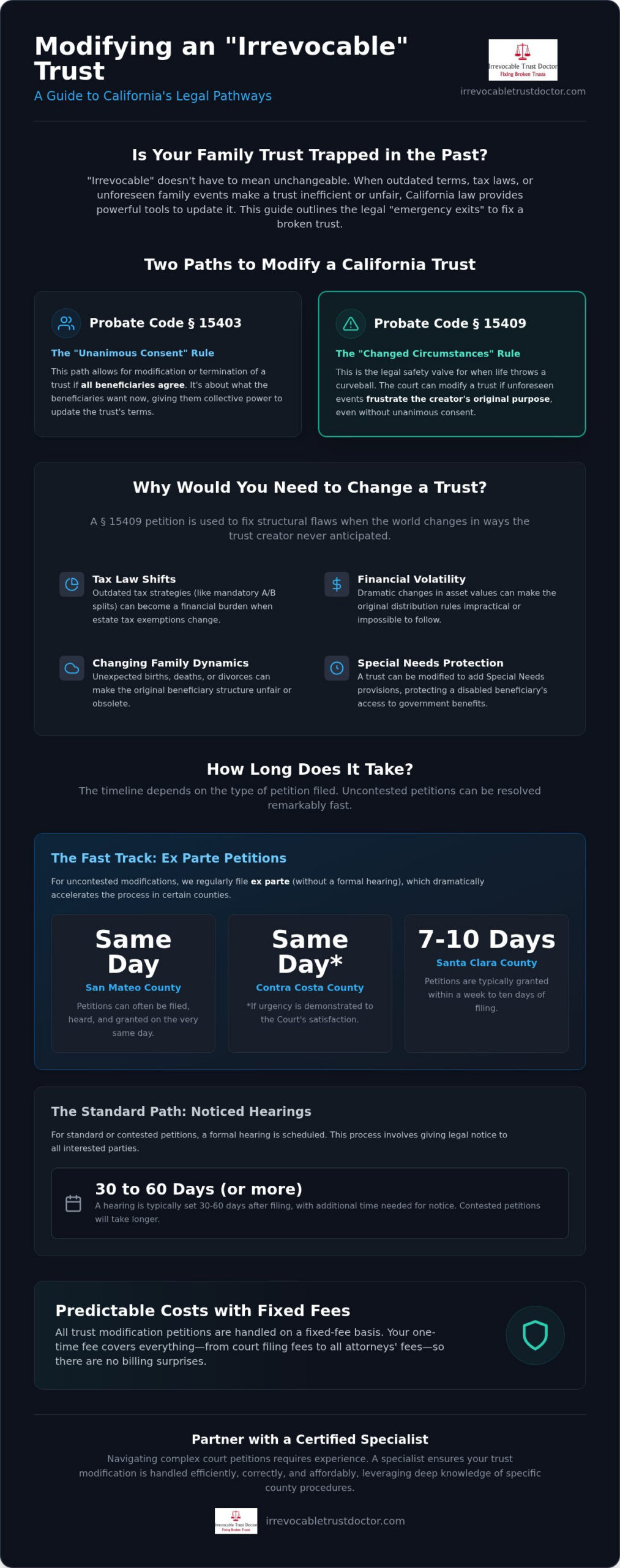
California probate code 15409 is often described as the “Changed Circumstances” rule. It serves as a necessary legal safety valve for irrevocable trusts that have become dysfunctional due to events the original creator could not have foreseen. While the term “irrevocable” implies a permanent, unalterable arrangement, the law recognizes that the world moves in ways that can render even the most carefully drafted documents obsolete. This specific code allows a court to modify or terminate a trust if the change will further the original purposes the creator intended.
The court’s primary focus remains the settlor’s intent. Judges look at the underlying goals of the trust and determine if current language is now obstructing those goals. This typically involves two categories of modification:
- Administrative changes: These updates focus on how the trust is run. This might include changing a corporate trustee to an individual or updating outdated investment powers to better manage modern assets.
- Dispositive changes: These are more significant updates regarding who receives assets and when. If a beneficiary faces an unexpected medical crisis, the court might move up a distribution date to provide for their care, even if the trust originally set a later age.
When ‘Irrevocable’ Doesn’t Mean Unchangeable
To succeed with a petition under California probate code 15409, you must demonstrate that the current situation was unknown and unanticipated by the person who created the trust. This creates a different legal threshold than Probate Code 15403, which relies on the unanimous consent of all beneficiaries. While Section 15403 is about what the beneficiaries want now, Section 15409 is about what the creator would have wanted had they known what the future held. If you’re searching for an attorney to change a trust in California, understanding this distinction between the two code sections is a critical first step.
The Role of Spendthrift Clauses
Many irrevocable trusts contain a “spendthrift clause,” which is a provision that restricts a beneficiary’s ability to transfer their interest. Under Section 15409(b), these clauses don’t automatically block a modification. The court has the power to override these restrictions if the proposed change is necessary to fulfill the trust’s purpose. It’s a balancing act where the court protects the beneficiary while ensuring the trust doesn’t become a rigid cage that fails to provide support when life changes.
Common Grounds for a 15409 Trust Modification Petition
Establishing a trust in one decade only to have it fail in the next is a common reality for many California families. Under California probate code 15409, the court looks for specific “grounds” where the original trust terms now clash with current reality. These petitions aren’t about simple preferences; they are about correcting structural flaws that threaten the trust’s viability. If you suspect your trust is no longer functioning as intended, you might benefit from a trust petition consultation to evaluate your specific grounds for modification.
Common issues that justify a petition include:
- Tax law shifts: Changes in federal estate tax exemptions can turn a once-brilliant tax strategy into a modern accounting nightmare.
- Financial volatility: If the trust’s primary assets have changed drastically in value or type, the original distribution rules may be impossible to follow.
- Family dynamics: Unexpected births, deaths, or the onset of a beneficiary’s disability can make a “standard” distribution plan feel broken or unfair.
- Special Needs protection: A petition can modify a trust to include “Special Needs” language, ensuring a disabled beneficiary receives support without losing vital government benefits.
Proving ‘Unanticipated Circumstances’ to the Court
To succeed with a petition, you must provide evidence that the current situation was truly unanticipated by the settlor. It isn’t enough that the beneficiaries want a change for convenience. California judges apply the “defeat or impair” standard, meaning they must be convinced that continuing the trust under its current terms would substantially hinder or completely prevent the creator’s original purpose from being achieved. In cases where all beneficiaries are in agreement, California probate code 15403 offers an alternative consent-based path to trust modification that may be faster and less burdensome than a contested Section 15409 petition. When both the settlor and all beneficiaries are available to provide mutual consent, California probate code 15404 provides yet another powerful avenue for modifying or terminating an irrevocable trust that families and their attorneys should consider.
Case Study: The Outdated Tax Shelter
Consider a trust drafted in the 1990s when estate tax exemptions were much lower. Many of these documents require a mandatory “A/B” split upon the first spouse’s death, a strategy that now creates complex filing requirements and higher taxes for the surviving spouse without providing any real tax shelter. Using California probate code 15409, a specialist can petition the court to modernize this language. This effectively removes the mandatory split, simplifies the survivor’s life, and preserves the family’s wealth for the next generation.
The Process: Filing Your Petition in California Courts
Successfully navigating the procedural requirements of the court is where many encounter significant delays when attempting to use California probate code 15409. To modify a trust, you must follow a methodical four-step process designed to provide the judge with a clear legal roadmap for the requested changes. This isn’t a simple administrative update; it’s a formal legal intervention that requires precision.
- Step 1: Drafting the Petition. This formal document must detail the specific changed circumstances and explain why they impair the trust’s original purpose.
- Step 2: Selecting the Hearing Type. You’ll need to determine if your situation qualifies for an “ex parte” filing for speed or if you must provide standard “notice” to all beneficiaries.
- Step 3: Filing. The petition is filed in the probate court of the county where the trust is currently administered.
- Step 4: Securing the Order. Once the judge reviews the evidence and signs the order, the modification becomes legally binding.
If you’re ready to move forward with a filing, you can Book a Trust Petition Consultation to ensure your paperwork meets the court’s strict standards.
Ex Parte vs. Noticed Hearings: Understanding the Timeline
The “ex parte” advantage is the primary reason many clients seek specialized assistance. In Santa Clara County, a well-prepared ex parte petition under California probate code 15409 is typically granted in 7 to 10 days. For truly urgent matters in San Mateo or Contra Costa counties, same-day results are often possible. If your case is non-urgent or likely to be contested, you’ll follow the noticed hearing route, which generally takes 30 to 60 days depending on the court’s calendar.
Local Rules and County Variations
Expertise in specific Bay Area courts is critical because local rules vary significantly between jurisdictions. For example, Contra Costa County requires a high threshold of demonstrated urgency to secure a same-day order. A seasoned practitioner understands these nuances and can tailor the filing to meet the specific expectations of local judges, ensuring a smoother and more predictable outcome than a generalist might achieve.
Why You Need a California Trust Modification Specialist
Navigating California probate code 15409 requires more than just a general understanding of estate law; it demands a clinical precision that only comes from decades of specialized practice. Robert P. Bergman is a Certified Specialist in Estate Planning, Trust, and Probate Law with over 40 years of experience. This deep expertise is vital when you’re asking a judge to modify an irrevocable document. While general practitioners might handle a broad range of cases, a specialist focuses on the procedural nuances that ensure a petition is granted without unnecessary delays or costly revisions.
Fixed Fees: Eliminating Financial Uncertainty
One of the most significant stressors in legal matters is the unpredictability of hourly billing. We address this by offering fixed fees and transparent costs for trust modification petitions. This model covers the attorney’s time and the associated filing fees, providing you with a clear financial roadmap from the start. If your case is a standard modification, a fixed fee is almost always superior to hourly billing because it aligns the attorney’s goals with your own: achieving a rapid, successful resolution without billing for every phone call or email.
Statewide Support for Attorneys and Families
Our practice isn’t limited to a single local court. We provide statewide support for families and act as special counsel for other law firms from San Diego to Sacramento. Many estate planning attorneys are excellent at drafting trusts but don’t specialize in the petition process required by California probate code 15409. In these instances, we step in as the “specialist fixer,” handling the complex court filings while the original attorney maintains their relationship with the client. This collaborative approach ensures that every family has access to top-tier expertise, regardless of where their trust is administered.
If you’re ready to fix a broken trust, the first step is a diagnostic review of your situation. You can prepare for a Trust Petition Consultation by gathering your original trust documents and any evidence of the changed circumstances. We’ll help you determine the most efficient path forward to restore the trust’s intended purpose and protect your family’s future.
Restoring the Purpose of Your Irrevocable Trust
Life doesn’t stop moving once a trust is signed. When outdated language or unforeseen financial shifts threaten to “break” a trust, California probate code 15409 provides the legal mechanism to fix it. You’ve learned that “irrevocable” isn’t an absolute barrier and that the court prioritizes the creator’s original intent over rigid, outdated phrasing. By understanding the distinction between noticed hearings and rapid ex parte filings, you can take control of a dysfunctional situation and move toward a resolution that protects your family’s assets.
I’m here to help you navigate this complex landscape with the authority of a Certified Specialist in Estate Planning, Trust, and Probate Law. My practice offers fixed-fee pricing for all modification petitions, ensuring you have financial clarity while we seek to restore order to your estate. Whether you’re in the Bay Area or elsewhere in California, we can leverage ex parte filings where possible to achieve the results you need. You don’t have to remain trapped by the past when the law provides a clear path forward.
Book Your Trust Petition Consultation with a Certified Specialist
Frequently Asked Questions
What is the difference between Probate Code 15403 and 15409?
Section 15403 requires the consent of all beneficiaries to modify a trust, whereas California probate code 15409 focuses on circumstances the creator didn’t anticipate. If you can’t get every beneficiary to agree but can prove the trust’s purpose is being defeated by new events, Section 15409 is your primary legal path. It allows the court to prioritize the settlor’s underlying intent over the specific, outdated language of the document. For families where all parties are aligned, learning more about modifying an irrevocable trust through beneficiary consent under California probate code 15403 may reveal a faster, less adversarial route to the same outcome.
Can an irrevocable trust be modified if the settlor has passed away?
Yes, an irrevocable trust can absolutely be modified after the settlor has passed away. In fact, most petitions under California probate code 15409 occur after the creator’s death because that’s when outdated provisions often clash with modern tax laws or beneficiary needs. The court steps in to ensure the creator’s underlying goals are still achieved even though they aren’t here to update the document themselves.
How long does it take to get a court order for a trust modification in California?
The timeline depends on your specific county and whether your situation qualifies for an expedited hearing. If you file an ex parte petition in Santa Clara County, we regularly achieve turnarounds of 7 to 10 days. For standard noticed hearings in other jurisdictions, or for non-urgent cases, the process generally takes between 30 and 60 days for the court to review the petition and sign the final order.
Do all beneficiaries have to agree to a modification under Section 15409?
No, unanimous beneficiary agreement isn’t strictly required under this section of the code, though it can certainly simplify the process. Since the legal standard focuses on the settlor’s intent and unanticipated changes, a judge can grant the modification even if a beneficiary objects. The court simply must be convinced that the change is necessary to prevent the trust’s purpose from being impaired or defeated by the current circumstances.
What are the typical costs for filing a trust modification petition?
Costs for a trust modification petition typically include court filing fees and professional attorney fees. While we use a fixed-fee model to provide price transparency, the total investment depends on whether the case is handled as an ex parte filing or a standard noticed hearing. You should also account for county-specific filing fees, which vary by jurisdiction and are subject to periodic adjustments by the California court system.

Article by
Robert P. Bergman, Attorney at Law
Attorney Robert P. Bergman ("Bob Bergman") has been a Board-Certified Specialist in Estate Planning, Trust and Probate Law since 2011, as certified by the California State Bar Board of Legal Specialization. For several years, Bob has assisted families and the clients of other attorneys with obtaining court orders through trust modification petitions to make necessary modifications to existing irrevocable trusts. Bob is friendly, very approachable, and believes in explaining complex legal topics in clear ordinary language so that his clients understand exactly what they're doing and why they're doing it.
Bob is often able to assist clients throughout California who are in other counties than his home county of Santa Clara through his approach to trust modification petitions.