
Disclaimer
This article is for informational purposes only. Nothing in this article is intended to replace legal advice from a competent attorney or be considered legal guidance for anybody's specific legal situation. Nobody should rely on information in this article in making legal decisions without such consultation.
Imagine looking at an irrevocable trust document written decades ago and realizing its rigid terms no longer fit your family’s modern reality. You might feel stuck with a legal structure that creates more anxiety than security, especially if you are worried about the high costs and long delays of the court system. It’s a common frustration, but you don’t have to remain trapped by an outdated document. Under California probate code 15403, you have the power to modify or even terminate an irrevocable trust if all beneficiaries provide their consent.
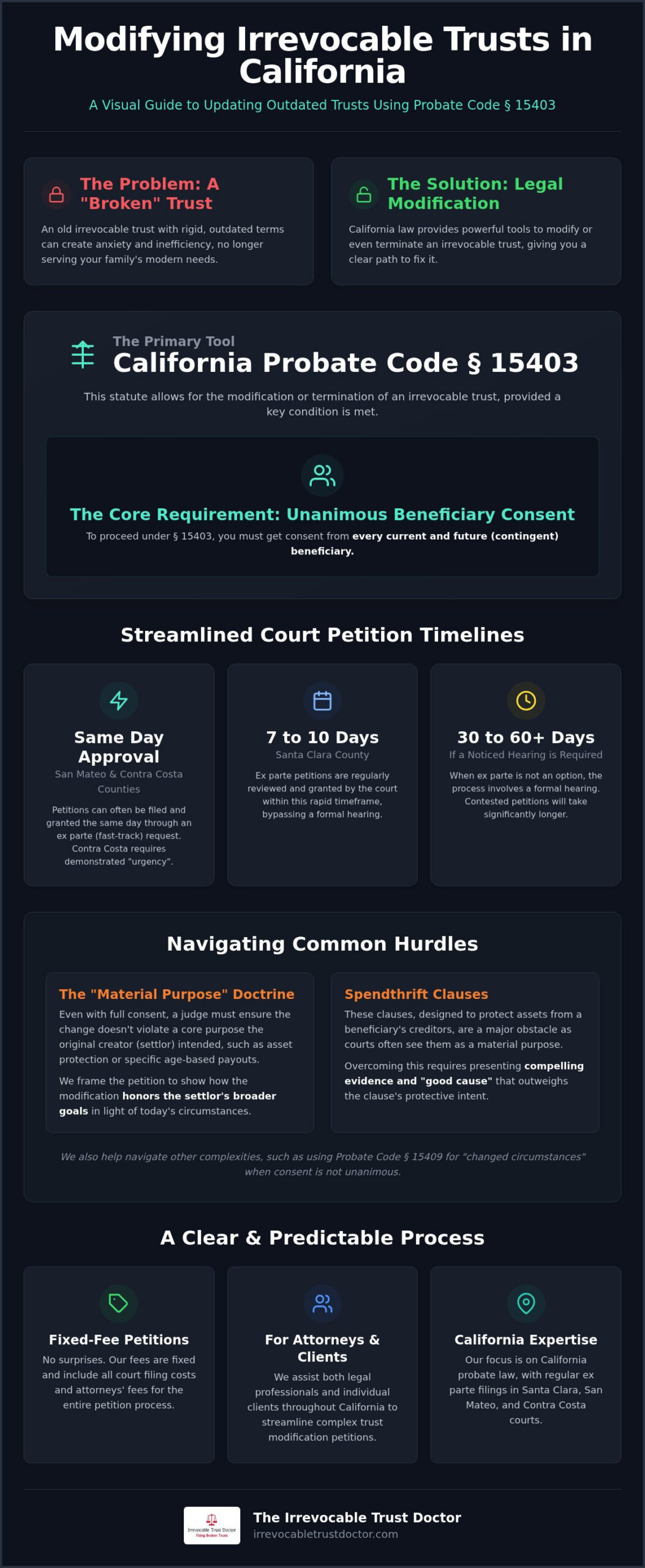
We help both attorneys and clients manage Trust Modification in California by simplifying complex requirements like the "material purpose" doctrine. By utilizing the 2026 virtual representation updates, we can often bypass traditional delays. In fact, we regularly secure court orders in just 7 to 10 days in Santa Clara County (available to other counties as well), and often on the same day in San Mateo or Contra Costa Counties. This guide will show you how to fix a "broken" trust using our fixed-fee approach, which includes all court filing and legal fees. You will learn exactly how to streamline the court process and gain the confidence that your trust can finally serve its intended purpose again.
Key Takeaways
- Discover how California probate code 15403 empowers you to modify or terminate an irrevocable trust when every beneficiary agrees to the change.
- Learn how to address the “material purpose” doctrine, ensuring your petition respects the core intent of the trust while adapting to your current needs.
- See how ex parte filings (fast-track requests without a formal hearing) can secure results in as little as 7 to 10 days in Santa Clara County or even the same day in San Mateo and Contra Costa Counties.
- Benefit from a transparent, fixed-fee model for an irrevocable trust modification petition in California that includes all court filing and legal costs.
What is California Probate Code 15403?
California probate code 15403 is a specific legal tool that allows you to modify or terminate an irrevocable trust when every beneficiary agrees to the change. While trust law in the United States often views irrevocable trusts as permanent, this statute provides a pathway to update documents that have become dysfunctional or outdated. It’s distinct from Probate Code Section 15409, which focuses on "changed circumstances"; instead, Section 15403 relies primarily on the power of unanimous consent. This makes it an ideal solution for updating administrative terms, changing trustees, or closing out small trusts that are no longer economically viable.
Even when everyone signs off, a judge must still approve the petition to ensure the modification doesn’t violate a "material purpose" of the trust. We assist clients and their attorneys with Trust Modification in California, often using "ex parte" procedures to bypass long waits. In Santa Clara County, we typically see these petitions granted in 7 to 10 days, while in San Mateo and Contra Costa Counties, they can often be filed and granted on the same day if we can demonstrate urgency.
The Requirement of Unanimous Beneficiary Consent
To succeed under Section 15403, you must obtain consent from every current and contingent beneficiary. A contingent beneficiary is an individual who is entitled to receive trust assets only if a specific condition is met, such as the death of a primary beneficiary. If beneficiaries are minors or unborn, we can often utilize the "virtual representation" rules effective in 2026 to streamline the process. This allows parents or other representatives to provide consent, potentially avoiding the need for a court-appointed Guardian ad Litem.
Modification vs. Termination under Section 15403
You might seek a modification to fix "broken" administrative terms, such as replacing an uncooperative trustee or updating tax provisions to reflect current law. Alternatively, if a trust’s assets have dwindled to the point where administrative costs outweigh the benefits, you can petition for full termination. When the settlor is still living, another powerful option is to pursue modification under California probate code 15404, which allows the settlor and all beneficiaries to mutually consent to changes. We handle these cases with a fixed-fee approach that includes both court filing fees and attorneys’ fees, providing a predictable resolution for families across California.
The "Material Purpose" Hurdle and Spendthrift Clauses
Gaining unanimous beneficiary consent is only the first stage of the process. The court must also determine if the proposed change interferes with a "material purpose" of the trust. According to California Probate Code § 15403, a judge can deny a petition even if everyone agrees if the modification would defeat a core reason the settlor established the trust in the first place.
Common examples of a material purpose include asset protection, age-based distribution schedules, or specific tax planning objectives. When the settlor is no longer living, the judge must evaluate their original intent by examining the language within the trust document itself. If the trust was designed to keep assets away from a beneficiary’s creditors or to ensure they reach a certain level of maturity before receiving funds, the court will likely view those as essential goals that cannot be easily bypassed.
Identifying the Settlor’s Original Intent
Our role as specialized fixers is to analyze the trust for restrictive language and find a path forward. We often argue that the proposed modification actually supports the settlor’s broader goals. If the current trust structure has become so inefficient that it drains the very assets meant for the beneficiaries, changing those terms is often the only way to honor the settlor’s wish to provide support. By carefully framing the petition, we show the court that the modification is a restoration of the settlor’s intent, not a deviation from it.
Overcoming Spendthrift Provisions in California
A spendthrift clause, which restricts a beneficiary’s ability to transfer their interest, is a significant legal obstacle. California courts generally assume that such a clause represents a material purpose of the settlor. To overcome this, we must present compelling evidence that there is "good cause" for the modification that outweighs the protective intent of the spendthrift provision. If you are facing these complex barriers during a Trust Modification in California, you might want to book a trust petition consultation to discuss the specific language in your document.
The Process of Filing a Trust Modification Petition in California
Filing a petition under California probate code 15403 requires a methodical approach to ensure the court accepts your request without unnecessary delays. We begin by drafting a formal petition that clearly outlines the legal grounds for the change and includes the written consent of every beneficiary. This document must prove to the judge that the modification is both necessary and consistent with California Trust Laws. Whether you are a beneficiary looking for a resolution or an attorney who needs a specialist to handle the probate court filings, we provide a streamlined roadmap for the entire process. For cases involving outdated tax strategies or drafting errors where court intervention is required, a judicial modification of trust in California under Probate Code Section 15409 may offer an alternative path when unanimous consent is not available.
All of our trust modification petitions are handled with a transparent, fixed-fee structure. These fees are inclusive of both court filing fees and attorneys’ fees, providing you with financial certainty. We assist clients throughout the state, acting as a "specialist fixer" to resolve complex trust issues that general practitioners may find overwhelming.
Ex Parte Petitions vs. Noticed Hearings
If your matter is uncontested and all beneficiaries have signed off, we often file an "ex parte" petition. An ex parte petition is a fast-track request that allows the court to review and grant the order without a formal, scheduled hearing. This is the most efficient way to resolve a "broken" trust. If the court determines that a more thorough review is needed, or if there are complex issues like minor beneficiaries, a noticed hearing may be required. A noticed hearing is a standard court proceeding that typically takes 30 to 60 days to schedule, plus additional time for legal notice to be served to all interested parties.
Timelines for Trust Modification in California Counties
The speed of your case depends heavily on where the petition is filed. In Santa Clara County, ex parte petitions are typically granted within 7 to 10 days. If you are filing in San Mateo or Contra Costa Counties, we can often have the petition filed and granted on the same day, though Contra Costa requires us to demonstrate a specific "urgency" for the request. For clients in Los Angeles, San Diego, or the Central Valley, timelines vary by local court capacity, but we manage the process statewide to ensure your petition moves as quickly as possible. If you are ready to begin the process, you can book a trust petition consultation today to get a clear timeline for your specific county.
How The Irrevocable Trust Doctor Fixes Broken Trusts
We position ourselves as the legal diagnosticians for trusts that no longer function as intended. Led by Robert P. Bergman, a Certified Specialist in Estate Planning, Trust, and Probate Law, our firm brings a level of clinical accuracy to every petition. While many firms handle general estate matters, we focus specifically on the complex mechanics of California Probate Code 15403. This specialization allows us to serve as a vital resource for other attorneys who may not have the niche experience required to navigate the material purpose doctrine or spendthrift obstacles effectively.
One of the most significant pain points for our clients is the fear of unpredictable legal bills. We address this by offering a Trust Modification Petition in California on a fixed-fee basis. This single price includes both our professional services and the required court filing fees. You won’t face billable hour surprises or hidden costs. Instead, you get a clear roadmap toward a resolution with a predictable financial commitment from the very start.
Expert Consultation for Complex Modifications
Every case begins with a specialized Trust Petition Consultation. During this session, we evaluate the feasibility of your 15403 petition before any formal filing occurs. We analyze the trust instrument to determine if the proposed changes are legally sound and if we can realistically overcome potential court objections regarding the settlor’s intent. This diagnostic phase ensures that you don’t waste time or resources on a petition that lacks a clear path to success. In cases where the settlor is still alive, we also evaluate whether an approach under California probate code 15404, which requires mutual consent from both the settlor and all beneficiaries, may offer a more direct route to modification.
Statewide Service for Attorneys and Beneficiaries
Our reach extends across the entire state. We handle filings from San Francisco to San Diego, ensuring that distance is never a barrier to fixing a broken trust. If you already have a trusted family lawyer, we can collaborate with your current legal counsel to manage the specialized probate court process. This partnership ensures a smooth transition and allows us to apply our expertise in local court procedures, such as the rapid ex parte filings we manage in Santa Clara, San Mateo, and Contra Costa Counties. If you’re ready to move from uncertainty to action, you can reach out via our contact page to begin the process.
Take the Next Step Toward Restoring Your Trust
A trust that no longer serves its beneficiaries doesn’t have to be a permanent legal burden. By leveraging California probate code 15403, you can align an outdated document with your family’s current needs through unanimous consent. We’ve explored how to navigate the "material purpose" doctrine and how our ex parte filings can secure results in days rather than months in counties like Santa Clara, San Mateo, and Contra Costa. Whether you’re an attorney seeking a specialist or a beneficiary feeling stuck, the law provides a clear path forward.
As a Certified Specialist in Estate Planning, Trust, and Probate Law, Robert P. Bergman provides the specialized expertise needed to fix even the most complex "broken" trusts. We assist clients with Trust Modification in California using a transparent, fixed-fee model that covers all court costs and legal fees. You don’t have to face the probate court system alone or deal with unpredictable billable hours. We are here to bring order and clarity to your legal situation. If you’re ready to see if your trust qualifies for modification, Book a Trust Petition Consultation with a Certified Specialist today. Your path to a functional trust is closer than you think.
Frequently Asked Questions
Can an irrevocable trust be modified if the settlor is dead?
Yes, you can modify an irrevocable trust after the settlor has passed away. In fact, most petitions filed under California probate code 15403 occur after the settlor’s death, as this is when the trust’s terms often become rigid or outdated. Since the original creator is no longer there to make changes, the law allows the beneficiaries to step in and request modifications through the court system, provided the core purpose of the trust remains intact.
What happens if one beneficiary refuses to consent under Section 15403?
If a single beneficiary refuses to provide written consent, you cannot use Section 15403 to modify the trust because this specific statute requires unanimous agreement. In this situation, we would evaluate whether your case qualifies under Probate Code Section 15409 instead. Section 15409 allows a judge to modify a trust based on "changed circumstances" that the settlor did not anticipate, even if some beneficiaries disagree with the change.
Does a spendthrift clause automatically prevent trust modification in California?
No, a spendthrift clause is not an automatic deal-breaker, but it does require extra legal effort. A spendthrift clause is a provision that prevents a beneficiary from spending their future inheritance or losing it to creditors. While courts often view this as a "material purpose" of the trust, California probate code 15403 allows a judge to approve a modification if you can demonstrate a compelling "good cause" that outweighs the original protective intent of that clause.
How long does a petition for Trust Modification in California take?
The timeline for your petition depends heavily on your local court and whether the matter is contested. For uncontested ex parte petitions, we typically see approvals in 7 to 10 days in Santa Clara County. In San Mateo and Contra Costa Counties, we can often have these granted the very same day. If the court requires a noticed hearing, the process generally takes 30 to 60 days plus time for legal notice, while contested cases will naturally take longer.
Are the fees for trust modification petitions fixed or hourly?
We handle all trust modification petitions using a transparent, fixed-fee structure. This approach eliminates the anxiety of billable hours and ensures you know the total cost from the start. Our fixed fees are inclusive of both the mandatory court filing fees and all professional attorneys’ fees. We provide this certainty so that families and attorneys throughout the state can focus on fixing the trust rather than worrying about mounting legal expenses.

Article by
Robert P. Bergman, Attorney at Law
Attorney Robert P. Bergman ("Bob Bergman") has been a Board-Certified Specialist in Estate Planning, Trust and Probate Law since 2011, as certified by the California State Bar Board of Legal Specialization. For several years, Bob has assisted families and the clients of other attorneys with obtaining court orders through trust modification petitions to make necessary modifications to existing irrevocable trusts. Bob is friendly, very approachable, and believes in explaining complex legal topics in clear ordinary language so that his clients understand exactly what they're doing and why they're doing it.
Bob is often able to assist clients throughout California who are in other counties than his home county of Santa Clara through his approach to trust modification petitions.