
Disclaimer
This article is for informational purposes only. Nothing in this article is intended to replace legal advice from a competent attorney or be considered legal guidance for anybody's specific legal situation. Nobody should rely on information in this article in making legal decisions without such consultation.
Most people believe that once a trust is labeled "irrevocable," it is permanently etched in stone, regardless of how much the world changes around it. You might feel stuck with a document written decades ago that no longer reflects your family’s current needs or today’s tax laws. It is frustrating to watch a trust’s purpose be undermined by outdated terms or unexpected life events like the 2026 Medi-Cal asset limit changes. However, a changed circumstances trust modification in California provides a specialized legal remedy to fix these issues and restore the trust’s original intent.
In this guide, I will show you how California Probate Code 15409 and Section 15403 allow us to update trust terms when life or the law takes an unexpected turn. Whether you are an attorney or a private client, you will discover how to reduce tax liabilities and administrative burdens while protecting your beneficiaries. I will explain our methodical approach to filing petitions in counties like Santa Clara, San Mateo, and Contra Costa, where we often secure court orders in as little as 24 hours. We will also cover the specific timelines for noticed hearings and how our fixed-fee structure provides clarity in a process that often feels overwhelming.
Key Takeaways
- Learn how California Probate Code Section 15409 allows you to update “irrevocable” trusts when unforeseen events threaten the settlor’s original goals.
- Discover why a changed circumstances trust modification in California is often the fastest way to fix outdated trust terms, especially when using our specialized ex parte filing process.
- See how you can bypass months of waiting in counties like San Mateo, Contra Costa, and Santa Clara, where petitions can often be granted in just days or even the same day.
- Find out how our fixed-fee model removes financial uncertainty by covering both attorney fees and court filing costs for your trust modification petition.
Understanding Changed Circumstances in California Irrevocable Trusts
In the context of U.S. trust law, many people assume that "irrevocable" means "unchangeable." In California, this isn’t strictly true. A "changed circumstance" refers to an event or situation that the person who created the trust, known as the settlor, didn’t anticipate when they first signed the document. If these new realities frustrate the trust’s original purpose, the law allows for a changed circumstances trust modification in California. Think of it as a legal corrective lens; it adjusts the trust’s focus so it can clearly see and address today’s problems rather than those from twenty years ago.
Why "Irrevocable" Does Not Mean Permanent
California courts prioritize the settlor’s intent above all else. This intent is the "North Star" of any trust. If a rigid rule in an old document prevents the trust from helping a beneficiary as originally intended, the court can intervene. Under Probate Code Section 15409, we can ask a judge to modify the trust because the current terms no longer serve their purpose. It’s about preserving the spirit of the gift, even if the letter of the document must change to reflect modern laws.
Common Signs Your Trust Needs a Modification
You might have a "broken" trust if you recognize these common scenarios:
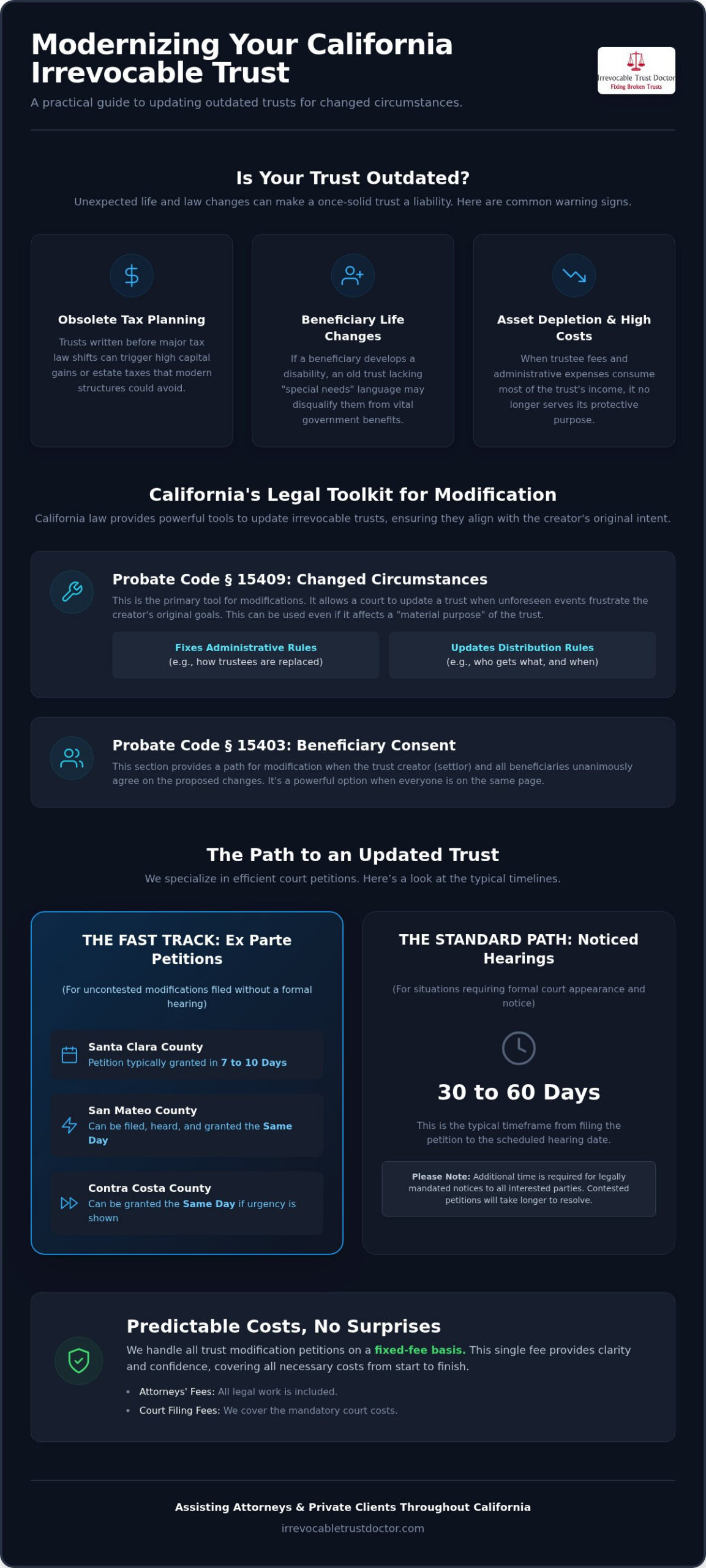
- Beneficiary Life Changes: If a beneficiary now has a disability and needs government benefits, an old trust structure might disqualify them from aid because it lacks "special needs" language.
- Asset Depletion or High Costs: If the cost of filing taxes and paying professional trustees is eating up all the trust’s income, the trust is no longer a viable tool for asset protection.
- **No Asset Protection for Heirs: **Older trusts often leave an inheritance outright to heirs, without any asset protection from loss in the future.
If you find yourself in one of these situations, a judicial petition is your primary tool for restoration. I assist both attorneys and clients throughout California with these petitions, specifically using Probate Code Section 15403 and Section 15409. Whether you are in Santa Clara, San Mateo, or Contra Costa County, we can often resolve these issues quickly. Our practice involves filing uncontested petitions ex parte (without a formal hearing), which can lead to a granted order in as little as 7 to 10 days in Santa Clara, or even the same day in San Mateo and Contra Costa if we can show urgency to the Court. We handle these cases with fixed fees that cover everything from filing to attorney time.
Legal Grounds for Modification Under Probate Code Section 15409
To understand how to fix an outdated trust, we must look at California Probate Code § 15409. This is the primary statute for a changed circumstances trust modification in California. While Section 15403 is often used when all beneficiaries consent to a change, Section 15409 gives the court broader power to intervene even if a "material purpose" of the trust is affected. The court’s main requirement is that the modification must help achieve the trust’s original goals in light of new, unforeseen events. It is a powerful tool for restoration when the original document no longer works as intended.
This statute allows us to change both administrative and dispositive provisions. In plain English, administrative provisions are the ‘management’ rules, such as how a trustee is replaced or how assets are invested. Dispositive provisions are the ‘distribution’ rules, which dictate who receives money and when they get it. If an old rule about distributions is now hurting a beneficiary because of a life change, the court has the authority to fix it. The goal is to ensure the trust remains a benefit rather than a burden, and many families find that working with Strategic Asset Preservation, Inc helps them align their broader financial and tax planning with these critical legal updates.
The Power of the Court to Update Your Trust
Judges have the ability to "step into the shoes" of the person who created the trust. If we can prove that the settlor would have written the trust differently had they known about today’s specific situation, the court can fill those drafting gaps. This requires clear evidence of the change. We might present a new medical diagnosis for a beneficiary or proof of a drastic shift in the value of a specific asset. By providing this context, we allow the court to authorize changes that reflect the settlor’s true intent in a modern environment.
Tax Law Changes as a Catalyst for Modification
Tax laws are never static. With the 2026 sunset of several federal tax provisions, many trusts created a decade ago are now tax-inefficient or completely obsolete. A modification can pivot these structures to take advantage of current exemptions or to avoid unnecessary capital gains taxes. If your trust feels like a relic of a different tax era, you can book a consultation to see if a petition is the right remedy. As a specialist, I regularly file these petitions throughout California using a fixed-fee model that covers both filing fees and attorney’s fees, ensuring you have a predictable path to a better legal structure.
The Court Process: How to File a Trust Modification Petition
The journey to modify an irrevocable trust begins with a diagnostic review of the current document and the new circumstances. Once we identify the specific issues, we prepare a petition under Probate Code Section 15409 or Section 15403. I work with both individual clients and their existing attorneys throughout California to ensure these petitions are drafted with precision. The goal is to move from the initial consultation to a final Court Order as efficiently as possible. This procedural roadmap is essential for a successful changed circumstances trust modification in California.
One of the most effective strategies we use is the "ex parte" petition. This is a procedural method that allows us to file the petition and seek a ruling without a formal, scheduled hearing. It is ideal for uncontested matters where all parties agree on the necessary changes. By bypassing the standard court calendar, we can often solve complex trust problems in a fraction of the usual time.
County-Specific Timelines: Santa Clara, San Mateo, and Contra Costa
Filing procedures and speeds vary significantly by jurisdiction. In Santa Clara County, our ex parte petitions are typically granted within 7 to 10 days. San Mateo County offers even greater speed; it’s often possible to have a petition filed, heard, and granted on the same day. In Contra Costa County, we can also achieve same-day results if we can demonstrate "urgency" to the Court’s satisfaction. These rapid timelines allow you to resolve trust issues in days rather than months.
What to Expect During a Noticed Hearing
If an ex parte filing isn’t appropriate for your situation, we follow the noticed hearing route. This process involves a typical timeline of 30 to 60 days after filing. This window is necessary to provide proper legal notice to all interested parties, giving them time to review the proposed changes. If a petition becomes contested, meaning the parties disagree on the modification, the process will naturally take longer to resolve through the court system.
Regardless of the path taken, we handle all petitions with fixed fees that cover both the court’s filing fees and all attorney time. If you are ready to fix an outdated trust, you can book a trust petition consultation today to get started.
Fixing Your Trust with a Specialist Attorney
When you are dealing with a changed circumstances trust modification in California, the precision of the legal drafting is everything. A Certified Specialist in Estate Planning, Trust, and Probate Law has met rigorous standards that general practitioners have not. This specialized focus allows for a "surgical" approach to trust language. Instead of rewriting the entire document, we pinpoint the specific administrative or distribution rules that are no longer functioning and replace them with terms that align with the settlor’s original goals. This level of accuracy is vital when asking a court to alter an irrevocable document.
One of the biggest hurdles for families and trustees is the fear of open-ended legal bills. To address this, we operate on a fixed-fee model that covers both our attorney’s fees and the court’s filing fees. You won’t have to worry about hourly billing or unexpected costs as the petition moves through the system. This transparency allows you to focus on the resolution rather than the expense, providing a clear and predictable path to fixing a "broken" trust.
Assisting Attorneys Across California
I frequently act as specialist counsel for other lawyers who may not have extensive experience with the modification process. Whether you are an attorney in San Diego or Sacramento, I can handle the heavy lifting of the petition while you maintain your relationship with your client. Our practice is deeply rooted in the specific procedural nuances of every California county. This includes our regular use of ex parte filings in Santa Clara, San Mateo, and Contra Costa, where we can often secure results in as little as 24 hours to 10 days depending on the jurisdiction.
Taking the First Step Toward a Solution
A "broken" trust is not a permanent burden; it is a solvable problem. To begin the process, I recommend gathering your original trust document and any amendments for a thorough feasibility review. We will examine the specific "changed circumstances" to determine if they meet the criteria under Probate Code Section 15409 or Section 15403. If you’re ready to update your trust to reflect current laws or family needs, reach out for a Trust Petition Consultation today. We can help you move from a state of uncertainty toward a clear, actionable conclusion.
Take Control of Your Trust’s Future
You don’t have to remain bound by a trust document that no longer serves your family’s best interests. Whether you are dealing with shifting tax laws or a beneficiary’s new medical requirements, a changed circumstances trust modification in California provides a clear path to restoration. We’ve explored how Probate Code Sections 15403 and 15409 allow for precise updates to even the most rigid documents. By utilizing ex parte procedures, we can often bypass the standard 60 day wait, securing results in Santa Clara within 10 days or even the same day in San Mateo and Contra Costa.
With over 40 years of experience as a Certified Specialist, I provide the methodical expertise needed to navigate these bureaucratic hurdles efficiently. Our fixed-fee pricing ensures total transparency, covering both filing and attorney fees so there are no financial surprises. If you are ready to restore the original intent of your trust and protect your beneficiaries, it’s time to take the next step toward a solution.
Schedule Your Trust Modification Consultation Today to begin your feasibility review. You have the power to fix a "broken" trust and secure your family’s legacy with confidence.
Frequently Asked Questions
What qualifies as a "changed circumstance" for trust modification in California?
A changed circumstance is any event the person who created the trust didn’t foresee that now prevents the trust from working as intended. Common examples include the 2026 shifts in federal tax law or a beneficiary developing a disability that requires a special needs provision. These unforeseen shifts allow for a changed circumstances trust modification in California under Probate Code Section 15409 to ensure the trust remains helpful rather than a burden.
How long does it take to modify an irrevocable trust in Santa Clara County?
In Santa Clara County, an uncontested petition filed ex parte is typically granted within 7 to 10 days. This is significantly faster than a standard noticed hearing, which usually takes 30 to 60 days to account for mandatory legal notice requirements. If you need a rapid resolution to a trust error, the ex parte route in Santa Clara is a highly effective option for both attorneys and their clients.
Can an irrevocable trust be changed if all beneficiaries agree?
Yes, California Probate Code Section 15403 allows for modification if all beneficiaries consent, provided the change doesn’t subvert a "material purpose" of the trust. Even with full agreement, you generally still need to file a petition with the court to make the changes legally binding. This process protects the trustee from future liability and ensures the new terms are officially recognized by financial institutions.
Do I have to go to a court hearing to change my trust?
You often don’t have to attend a formal hearing if the petition is filed ex parte, which means "without a formal hearing." In San Mateo County, we can often file and receive a granted order the same day. Similarly, in Contra Costa County, a same-day grant is possible if we can demonstrate urgency to the court’s satisfaction. This approach avoids the stress and delay of a traditional courtroom appearance.
Is it expensive to file a trust modification petition in California?
Filing a petition involves court costs and legal fees, but we remove the price anxiety by using a fixed-fee model. This single fee covers the statewide filing cost and all of our professional time. By avoiding hourly billing, you know exactly what the changed circumstances trust modification in California will cost before the process even begins, ensuring total transparency for the family or the referring attorney.

Article by
Robert P. Bergman, Attorney at Law
Attorney Robert P. Bergman ("Bob Bergman") has been a Board-Certified Specialist in Estate Planning, Trust and Probate Law since 2011, as certified by the California State Bar Board of Legal Specialization. For several years, Bob has assisted families and the clients of other attorneys with obtaining court orders through trust modification petitions to make necessary modifications to existing irrevocable trusts. Bob is friendly, very approachable, and believes in explaining complex legal topics in clear ordinary language so that his clients understand exactly what they're doing and why they're doing it.
Bob is often able to assist clients throughout California who are in other counties than his home county of Santa Clara through his approach to trust modification petitions.