
Disclaimer
This article is for informational purposes only. Nothing in this article is intended to replace legal advice from a competent attorney or be considered legal guidance for anybody's specific legal situation. Nobody should rely on information in this article in making legal decisions without such consultation.
What if the word "irrevocable" didn’t actually mean "forever"? If you’re feeling stuck with a trust document that contains drafting errors or outdated tax provisions, you likely feel like your hands are tied. It’s natural to worry that rigid terms might harm your beneficiaries, especially with the 2026 tax law changes approaching. You don’t have to remain trapped by a "broken" document. In California, the law provides specific pathways to modify these instruments through the court system.
This guide explores the vital question: can an irrevocable trust be changed? You’ll learn how Probate Code Section 15403 and Probate Code Section 15409 allow for judicial modification. We’ll explain how our fixed-fee solutions help families and attorneys throughout the state resolve these issues. From same-day grants in San Mateo to efficient petitions for other counties handled in Santa Clara County, we’ll provide a clear roadmap to restoration.
Key Takeaways
- Discover the specific legal mechanisms under Probate Code Section 15403 and Probate Code Section 15409 that answer the question: can an irrevocable trust be changed?
- Understand the procedural timelines for ex parte petitions, which can often be granted the same day in San Mateo and Contra Costa or within 7 to 10 days in Santa Clara.
- Identify common “broken” trust scenarios, such as drafting errors or unanticipated tax consequences, that qualify for a court-ordered modification to protect the beneficiaries’ best interests.
- Explore the advantages of a comprehensive fixed-fee model for a Trust Modification Petition in California, covering all filing and attorney fees for families and attorneys throughout the state.
The Reality of Irrevocable Trusts in California: Why They Aren’t Permanent
A revocable trust offers total flexibility, allowing the creator to amend terms at any time. In contrast, an irrevocable trust is technically designed to be final from the moment it’s executed. While this sounds daunting, modern California law treats "irrevocable" as a starting point rather than a dead end. Many people ask, can an irrevocable trust be changed when they realize the original document is now dysfunctional. The answer is often yes. We specialize in petitioning the court to ensure the document reflects current realities while respecting the "material purpose," which is the core intent behind the trust’s creation.
Common Reasons to Modify an Irrevocable Trust in California
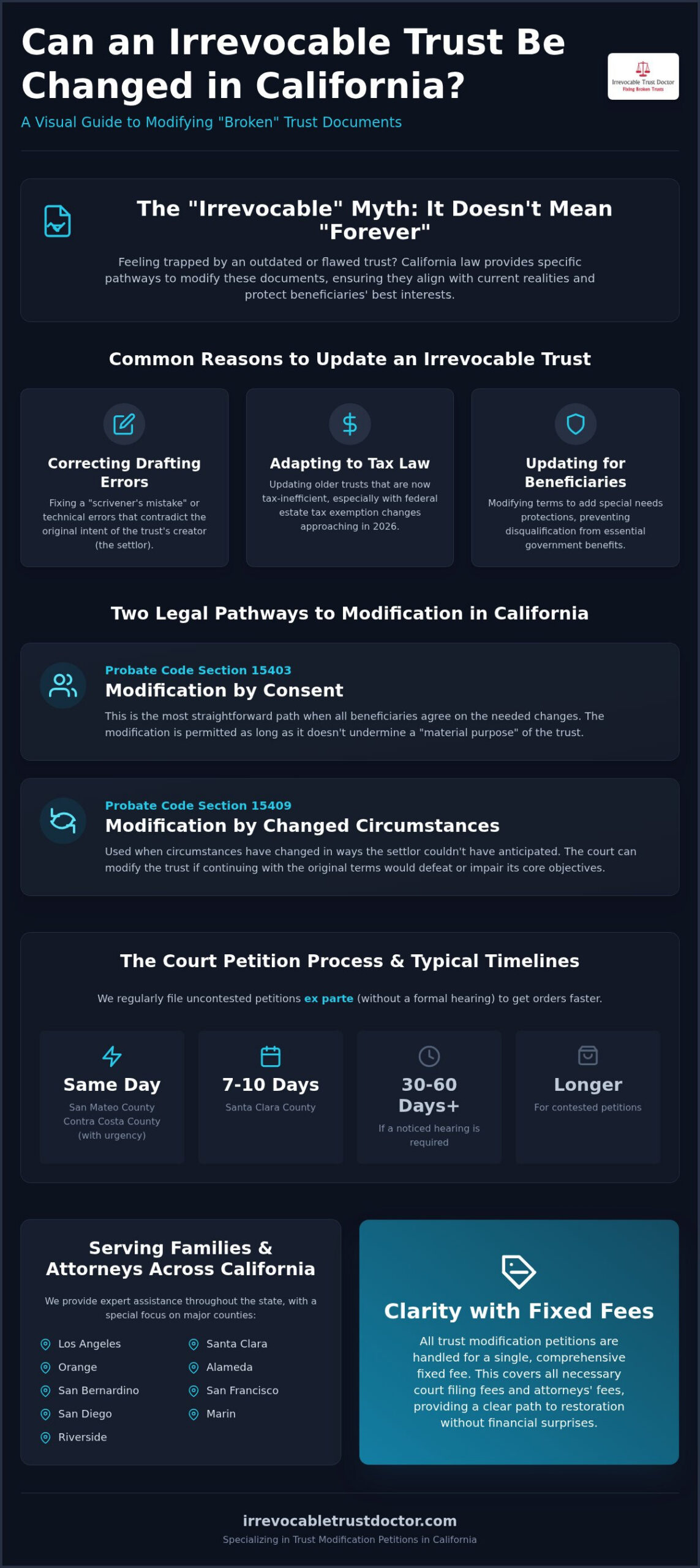
Trusts often break because the world moves faster than the paperwork. We frequently assist families and attorneys in Los Angeles, Orange, San Diego, San Bernardino, and Riverside Counties with petitions to fix specific issues. If a trust is no longer serving the beneficiaries, it’s usually due to one of these common scenarios:
- Correcting Drafting Errors: Sometimes a "scrivener’s mistake" or a technical error in the original language creates a result that contradicts the settlor’s intent.
- Adapting to Tax Law Shifts: With the 2026 federal estate tax exemption changes approaching, many older trusts are becoming tax-inefficient. If your trust was written when exemptions were lower, it might need an update to avoid unnecessary costs.
- Updating for Beneficiary Needs: If a beneficiary develops a disability, a standard distribution could disqualify them from vital government benefits. We help modify trust for special needs protections to include the language necessary to preserve eligibility for programs like Medi-Cal.
- **Providing Asset Protection for Inheritance: **Older trusts often do not provide for any asset protection for the inheritance received by heirs.
Whether you’re in Riverside, San Diego, or San Francisco, these fixes are handled through a specialized fixed-fee structure. This ensures your family has a clear path to restoration without the stress of unpredictable hourly billing or hidden costs.
Judicial Pathways: Probate Code Section 15403 and 15409
If you’re asking how can an irrevocable trust be changed when the settlor is no longer available or the document feels like a legal straitjacket, the California Probate Code provides the necessary tools. We focus on two primary statutes to help families and attorneys fix dysfunctional trusts. California Probate Code Section 15403 allows for modification if all beneficiaries provide their consent, provided the change doesn’t undermine a material purpose of the trust. This is often the most straightforward path when everyone is in agreement about the necessary update.
When circumstances change in ways the settlor never anticipated, Probate Code Section 15409 offers a different solution. This section allows the court to modify the trust if continuing under the original terms would defeat or substantially impair the trust’s objectives. We regularly assist clients in Los Angeles, Orange, and San Bernardino with these petitions using a comprehensive fixed-fee model. By filing on an uncontested basis, we can often streamline the California probate court trust petition process. In Santa Clara, San Mateo, and Contra Costa Counties, we frequently file ex parte to obtain orders even faster.
Comparing Consent vs. Changed Circumstances
Choosing between Section 15403 and Section 15409 depends on beneficiary alignment and the nature of the "broken" terms. If the change is administrative, consent is often sufficient. If the change is substantive, the court must apply the "material purpose" test to ensure the settlor’s core intent remains intact. A California court balances settlor intent with beneficiary needs by determining if the modification fixes a modern problem without destroying the trust’s original reason for existing. To explore your options, book a trust petition consultation today.
The Court Petition Process and What to Expect
Navigating the judicial system requires a clear procedural roadmap. If you’re wondering, can an irrevocable trust be changed, the answer lies in a well-drafted court petition. The process starts with a diagnostic review of the trust document to identify the specific failure, followed by drafting a petition under Probate Code Section 15409. Success depends on articulating how changed circumstances impair the trust’s original goals. We handle every step, from the initial filing to obtaining the judge’s signature. Our comprehensive fixed-fee model covers all filing costs and legal representation, offering a transparent solution for families in Los Angeles, Orange, and San Diego.
Local Court Timelines: From Days to Months
Efficiency often depends on your specific jurisdiction. In Santa Clara County, our petitions are typically granted in 7 to 10 days. If you’re filing in San Mateo or Contra Costa Counties, we can often secure a granted order the same day through an ex parte application, which is a request made without a formal, long-term hearing date. It’s important to understand that Contra Costa specifically requires a showing of urgency for this speed. When an ex parte filing isn’t appropriate, a noticed hearing is required, generally taking 30 to 60 days plus notice time. Contested matters, where beneficiaries or trustees disagree, move at a much slower pace. We serve clients throughout California, ensuring that your petition is handled with expertise. For a deeper look at how this process works across different counties, our guide on changing trust terms through court in California provides a comprehensive county-by-county breakdown.
Take Control of Your Irrevocable Trust Today
You don’t have to remain bound by a trust document that no longer serves your family’s needs or the current tax landscape. While the document may say it’s permanent, the question of can an irrevocable trust be changed is answered by the powerful remedial tools in the California Probate Code. Whether you’re correcting a drafting error or adapting to the 2026 tax shifts, a judicial petition provides a reliable path to restoration. Robert P. Bergman is a Certified Specialist who assists families and attorneys throughout California, from Los Angeles and Orange to San Diego. We simplify the court process using a transparent, fixed-fee model that covers both filing costs and legal representation. If you’re ready to fix a broken trust, Book a Trust Petition Consultation with The Irrevocable Trust Doctor. You can achieve the order and clarity your beneficiaries deserve.
Frequently Asked Questions
Can an irrevocable trust be changed after the settlor dies in California?
Yes, an irrevocable trust can be modified after the settlor’s death through a court order. If the document contains errors or circumstances shift, you can use Probate Code Section 15409 to petition for a change. We assist families throughout California in answering: can an irrevocable trust be changed? We ensure the trust remains functional even after the creator is gone.
Do all beneficiaries have to agree to change an irrevocable trust under Probate Code Section 15403?
Generally, Probate Code Section 15403 requires the consent of all beneficiaries to modify a trust. In working with our office, it is necessary that there be agreement in order to proceed ex parte.
What is the difference between trust reformation and trust modification?
Reformation fixes a drafting error to align the document with the settlor’s original intent, while modification updates the trust to handle new, unforeseen circumstances. Both methods address the core concern: can an irrevocable trust be changed? Whether you’re correcting a "scrivener’s mistake" or responding to the 2026 tax law changes, these judicial pathways provide a specialized remedy for broken trusts. Families navigating either approach will benefit from understanding the full scope of changing trust terms through court, including which statute applies to their specific situation.
How much does it cost to petition the court to change a trust in California?
We provide all trust modification services on a fixed-fee basis. This single, comprehensive price covers your attorney fees and the required court filing fees. Whether we’re filing an ex parte petition in San Mateo for same-day results or a petition in Santa Clara that takes 7 to 10 days, you’ll never face unpredictable hourly billing or hidden costs.

Article by
Robert P. Bergman, Attorney at Law
Attorney Robert P. Bergman ("Bob Bergman") has been a Board-Certified Specialist in Estate Planning, Trust and Probate Law since 2011, as certified by the California State Bar Board of Legal Specialization. For several years, Bob has assisted families and the clients of other attorneys with obtaining court orders through trust modification petitions to make necessary modifications to existing irrevocable trusts. Bob is friendly, very approachable, and believes in explaining complex legal topics in clear ordinary language so that his clients understand exactly what they're doing and why they're doing it.
Bob is often able to assist clients throughout California who are in other counties than his home county of Santa Clara through his approach to trust modification petitions.