
Disclaimer
This article is for informational purposes only. Nothing in this article is intended to replace legal advice from a competent attorney or be considered legal guidance for anybody's specific legal situation. Nobody should rely on information in this article in making legal decisions without such consultation.
What if the word “irrevocable” didn’t actually mean your family’s financial plans were set in stone? It’s common to feel stuck when you’re dealing with an unresponsive trustee or trust terms that create a heavy tax burden for the beneficiaries. You might believe there’s no way out, but the law provides clear pathways for those who need to know how to fix irrevocable trust structures that no longer serve their purpose. By using the right legal mechanisms, you can restore order and ensure the trust actually fulfills its intended goals.
In this article, How to Fix an Irrevocable Trust in California: A Step-by-Step Guide in California, you’ll learn about the specific court procedures used to modify outdated or broken trusts. We’ll explore how Probate Code Section 15403 and Probate Code Section 15409 allow for changes that reflect your family’s current reality. You’ll also see how our specialized approach uses ex parte petitions to get results in as little as 7 to 10 days in Santa Clara County, or even the same day in San Mateo County. With fixed fees that cover everything from filing to attorney costs, you can move forward with total financial predictability and confidence.
Key Takeaways
- Understand that “irrevocable” isn’t a dead end by identifying common scenarios, like tax law changes or unresponsive trustees, that justify a legal modification.
- Learn exactly how to fix irrevocable trust terms using specific legal pathways under Probate Code Section 15403 and Probate Code Section 15409.
- Discover how to bypass long court delays by filing petitions “ex parte,” which can lead to approvals in as little as 7 to 10 days in Santa Clara County or even the same day in San Mateo County.
- Gain financial predictability through a fixed-fee model that covers both the necessary court filing fees and the professional attorney fees for the entire process.
Diagnosing a “Broken” Irrevocable Trust in California
If you’re dealing with a trust that no longer aligns with your goals, it’s essential to understand that “irrevocable” isn’t a legal dead end. While the term implies the document is permanent, California law provides specific remedies when a trust becomes dysfunctional or obsolete. Learning what is an irrevocable trust is the first step toward realizing that these documents are built on a foundation of intent, and when that intent is blocked by unforeseen events, the court can intervene. Figuring out how to fix irrevocable trust arrangements starts with a precise diagnosis of why the current terms are failing your family.
A trust is often considered “broken” if it contains outdated instructions that lead to unnecessary conflict or financial loss. We assist attorneys and clients throughout California with trust modification petitions under Probate Code Section 15403 and Probate Code Section 15409. If the situation is uncontested, we focus on filing ex parte in Santa Clara, San Mateo, and Contra Costa Counties to bypass the usual delays of the court calendar. This specialized approach allows us to address “broken” trusts with surgical precision, restoring the document’s original purpose without a long, drawn-out battle.
When the Law or Your Family Changes in California
External changes often render a perfectly drafted trust ineffective. For instance, with the 2026 federal estate tax exemption confirmed at $15 million per individual, many older trusts contain tax-planning language that is now redundant or harmful. Beyond the law, family changes such as a beneficiary developing a disability or the death of a named trustee can create a situation where the trust can’t operate as intended. In these cases, we use the Probate Code to adjust the trust’s language so it works in the modern legal and personal landscape. Many families in this situation first ask can an irrevocable trust be changed under California law, and the answer is that specific judicial pathways exist to address exactly these kinds of shifts.
Correcting Clerical Mistakes and Drafting Errors in California
Sometimes the issue isn’t a change in circumstances, but a mistake made during the original drafting process. A “scrivener’s error” occurs when a typo or a poorly phrased clause fails to reflect what the creator actually wanted. To fix these errors, you must provide clear evidence of the original intent to the court. We handle these reformation petitions using fixed fees that cover both the court filing fees and the attorneys’ fees, giving you a clear path to correct the record and protect your assets. If your trust suffers from unclear or conflicting wording, reforming ambiguous trust language in California is a specialized legal remedy that can resolve these drafting issues before they escalate into a contested dispute.
Choosing the Right Legal Pathway Under the California Probate Code
Once you’ve identified that your trust is no longer functional, you must select the specific legal mechanism that will allow for a correction. In California, we don’t rely on generic strategies; we use precise sections of the law to achieve a resolution. If you’re researching how to fix irrevocable trust terms, your strategy will likely fall under one of two primary statutes. The choice depends on whether your family is in full agreement or if the trust itself contains restrictive language that complicates a simple update. This selection process is the bridge between identifying a problem and securing a court-ordered solution.
Modification by Beneficiary Consent Under Probate Code Section 15403
If every beneficiary named in the document agrees on the proposed changes, Probate Code Section 15403 provides a direct route. This section allows a court to modify or even terminate an irrevocable trust if all beneficiaries consent, provided the change doesn’t interfere with a “material purpose” of the trust. A common hurdle here is a “spendthrift clause,” which is a rule designed to protect assets from a beneficiary’s creditors by preventing them from signing away their inheritance. If such a clause exists, the court has the discretion to decide if the reasons for the modification are more important than the original protective intent.
Modification for Changed Circumstances Under Probate Code Section 15409
When unanimous consent isn’t possible, or if some beneficiaries cannot be located, we look to Probate Code Section 15409. This section allows for a modification if circumstances have changed in a way that the person who created the trust didn’t anticipate. As outlined in How to Fix an Irrevocable Trust in California: A Step-by-Step Guide in California, you must demonstrate that the current terms would defeat or substantially impair the trust’s original goals. This is a powerful tool for addressing issues like outdated administrative rules or sudden shifts in a beneficiary’s health or financial status that require immediate intervention. When the problem stems from unclear drafting rather than changed circumstances, a petition focused on reforming ambiguous trust language in California may be the more precise legal remedy to pursue.
Selecting the right path is essential for a fast resolution. For uncontested matters, we often file ex parte in Santa Clara, San Mateo, and Contra Costa Counties. This can lead to your petition being granted in as little as 7 to 10 days in Santa Clara, or even the same day in San Mateo and Contra Costa. We handle these cases with comprehensive fixed fees that cover both the attorney fees and the court filing fees. If you’re unsure which pathway fits your family’s situation, you can book a trust petition consultation to get a professional evaluation of your options.
Navigating the Court Petition Process for a Fixed Fee in California
Once you’ve identified the legal pathway, the actual mechanics of the court system come into play. Navigating the bureaucratic obstacles of a local courthouse can be daunting, but the process is surprisingly efficient when handled by a specialist. If you’re wondering how to fix irrevocable trust terms without spending months in legal limbo, the answer lies in the type of petition we file. We specialize in assisting both individual clients and their existing attorneys with trust modification petitions under Probate Code Section 15403 and Probate Code Section 15409 throughout the state. Families dealing with outdated provisions or changed circumstances may also benefit from a broader overview of amending irrevocable trust in California to understand all available legal remedies before selecting the right approach.
To provide total clarity, we handle these petitions with a fixed-fee model. This isn’t just an estimate; it’s a comprehensive price that covers both the necessary court filing fees and the attorneys’ fees. You won’t have to worry about billable hours or unexpected costs as the case progresses. Review our fixed fees and costs for trust modification petitions to see how we prioritize financial predictability for our clients. This transparency is a core part of our guide, How to Fix an Irrevocable Trust in California: A Step-by-Step Guide in California.
Local Court Timelines: Santa Clara, San Mateo, and Contra Costa
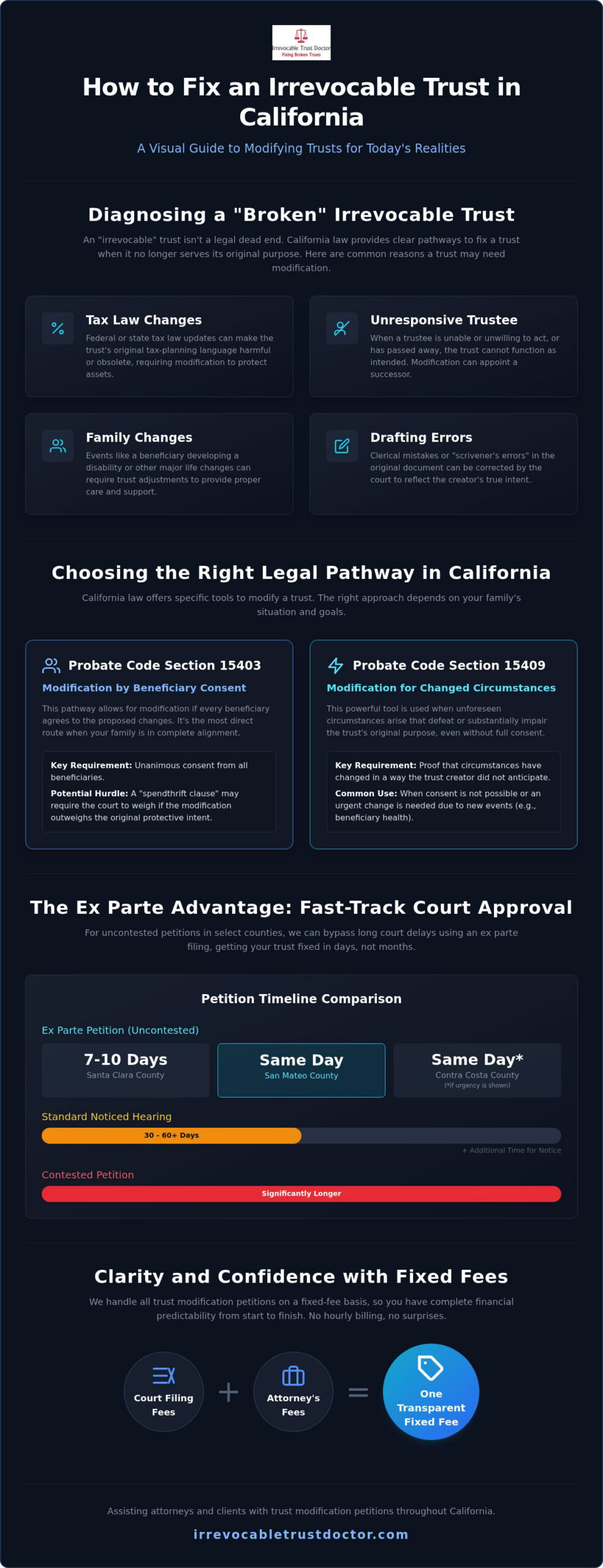
The speed of your “fix” often depends on your specific jurisdiction. We have a high-speed focus on certain counties where the courts are particularly efficient with uncontested matters. For a comprehensive overview of how these county-specific timelines and legal grounds work together, the California probate court trust petition process guide explains what to expect at each stage of filing under Probate Code Section 15403 and Section 15409:
- Santa Clara County: Petitions filed ex parte are typically granted in 7 to 10 days.
- San Mateo County: Petitions can often be filed, heard, and granted on the same day.
- Contra Costa County: Same-day grants are possible if we can demonstrate urgency to the Court.
The Difference Between Ex Parte and Noticed Hearings
The secret to these fast timelines is the “ex parte” petition. This is a legal request made to the court without a formal, scheduled hearing date. It’s the ideal fast-track for uncontested fixes where all parties agree on the solution. If a judge requires a noticed hearing, the timeline typically shifts to 30 or 60 days, plus the time required for legal notice. Contested petitions, where parties disagree, will take significantly longer. Knowing how to fix irrevocable trust documents efficiently requires choosing the right hearing type. You can contact us to see if your case qualifies for an ex parte petition and get your trust back on track quickly.
Take the Next Step Toward Restoring Your Trust
A trust that no longer serves its purpose isn’t just a paperwork problem; it’s a source of ongoing stress for your family. By understanding how to fix irrevocable trust documents through the California Probate Code, you’ve already taken the first step toward a resolution. Whether you’re dealing with an outdated tax provision or a shift in beneficiary needs, the law provides clear mechanisms like Probate Code Section 15403 and Probate Code Section 15409 to modernize your plan. Our approach focuses on speed and certainty, utilizing ex parte petitions to secure results in as little as 7 to 10 days in Santa Clara County, or even the same day in San Mateo and Contra Costa Counties.
As a Certified Specialist in Estate Planning, Trust, and Probate Law, I provide the expertise needed to navigate these court procedures efficiently. We handle every petition with a comprehensive fixed fee that covers all court costs and legal fees, ensuring you never face an unexpected bill. You don’t have to stay stuck with a dysfunctional document. Get a Professional Consultation to Fix Your Trust in California and let’s start the process of bringing your trust back into alignment with your family’s current reality. You deserve the peace of mind that comes with a trust that actually works.
Frequently Asked Questions
Can an irrevocable trust be changed in California if the creator has died?
Yes, you can modify a trust even after the person who created it has passed away. California law provides specific legal pathways under Probate Code Section 15403, which allows for changes if all beneficiaries agree, and Probate Code Section 15409, which addresses circumstances the creator didn’t foresee. These tools ensure the trust remains functional and continues to serve the family’s best interests as times change. For a comprehensive look at how these statutes apply in today’s legal environment, our guide on can an irrevocable trust be changed in California walks through the current rules and 2026 tax law considerations in detail.
How long does the court petition process take to fix a trust?
The timeline depends on the county and whether the petition is uncontested. If we file ex parte in San Mateo County, the petition is often granted the same day. In Santa Clara County, the process typically takes 7 to 10 days. However, if the judge requires a formal noticed hearing, it usually takes 30 to 60 days plus additional time for notice, while contested cases take significantly longer.
Do I need a lawyer to fix an irrevocable trust in California?
While you aren’t legally required to have an attorney, navigating how to fix irrevocable trust documents involves complex filings and strict court procedures. A specialist ensures your petition correctly references Probate Code Section 15403 or Probate Code Section 15409 to meet the court’s requirements. This expertise helps you avoid procedural errors that could lead to delays or a denial of your request.
What is the cost of a trust modification petition in California?
We handle these legal matters using a transparent, fixed-fee model to provide you with total cost certainty. This comprehensive fee is designed to cover both the necessary court filing fees and the professional attorneys’ fees for the entire petition process. By choosing a fixed fee, you don’t have to worry about the unpredictable costs of hourly billing while we work to resolve your trust’s issues.

Article by
Robert P. Bergman, Attorney at Law
Attorney Robert P. Bergman ("Bob Bergman") has been a Board-Certified Specialist in Estate Planning, Trust and Probate Law since 2011, as certified by the California State Bar Board of Legal Specialization. For several years, Bob has assisted families and the clients of other attorneys with obtaining court orders through trust modification petitions to make necessary modifications to existing irrevocable trusts. Bob is friendly, very approachable, and believes in explaining complex legal topics in clear ordinary language so that his clients understand exactly what they're doing and why they're doing it.
Bob is often able to assist clients throughout California who are in other counties than his home county of Santa Clara through his approach to trust modification petitions.