
Disclaimer
This article is for informational purposes only. Nothing in this article is intended to replace legal advice from a competent attorney or be considered legal guidance for anybody's specific legal situation. Nobody should rely on information in this article in making legal decisions without such consultation.
Most people believe that an "irrevocable" trust is set in stone, but the truth is that the law provides a clear path to unlock even the most rigid documents. If you’re dealing with outdated tax strategies, drafting errors, or terms that no longer make sense, you aren’t stuck. A judicial modification of trust in California allows you to petition the court to fix these issues and restore the trust’s original purpose. It’s a specialized remedy for what often feels like a frustrating, impossible situation.
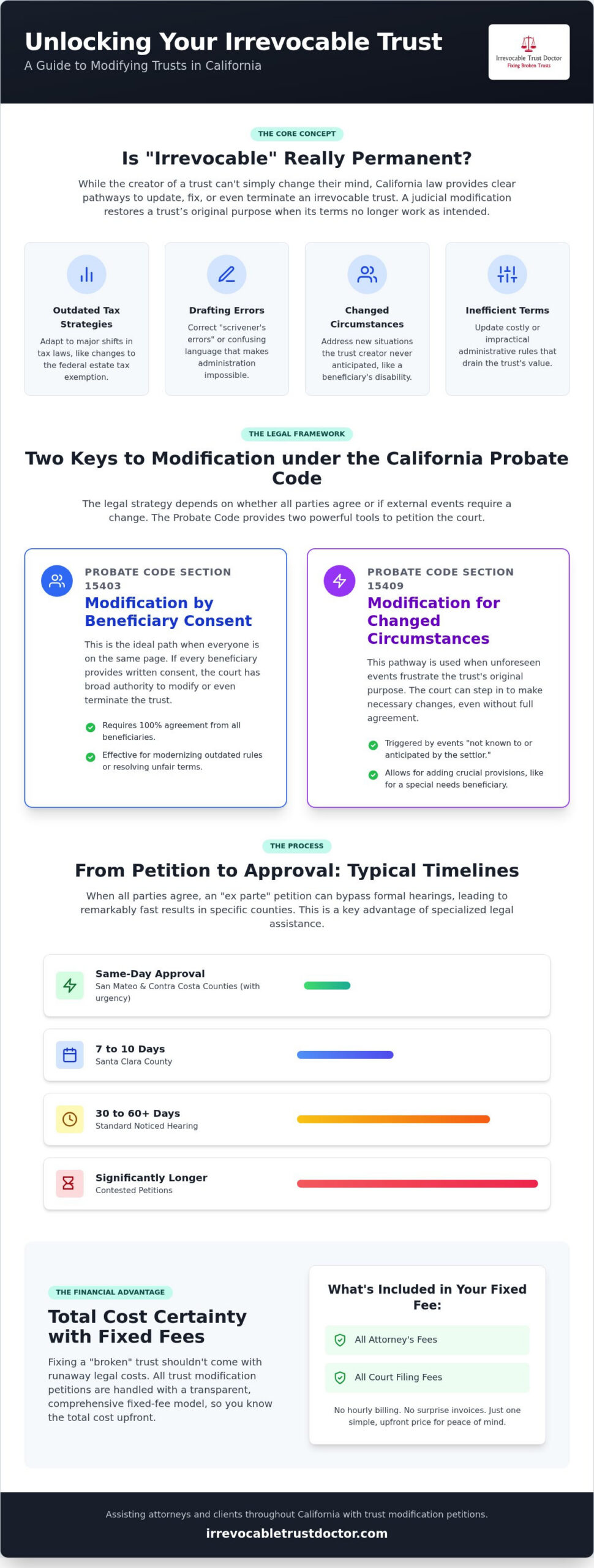
I assist attorneys and clients throughout the state with trust modification petitions under Probate Code Section 15403 and Probate Code Section 15409. If everyone agrees on the changes, we can often bypass long delays by filing "ex parte," which is a way to request a court order quickly without a formal hearing. In Santa Clara County, these are typically granted in 7 to 10 days. In San Mateo County, we often have them heard and granted the same day, and Contra Costa County offers same-day results if urgency is shown. This guide to Judicial Modification of Trust in California explains how we use the Probate Code to achieve results quickly using a transparent fixed-fee model that covers both the court filing fees and all attorney’s fees.
Key Takeaways
- Learn how to legally update outdated tax strategies or correct drafting errors in trusts that were previously considered permanent.
- Understand the specific legal pathways for change provided by Probate Code Section 15403 and Probate Code Section 15409.
- Discover how a judicial modification of trust in California can be granted in as little as one day in San Mateo and Contra Costa Counties through specialized court filings.
- Find out how to resolve trust issues with total cost certainty through a fixed-fee model that covers both attorneys’ fees and court filing costs.
- See how specialized legal assistance helps both individual clients and other attorneys navigate the court system to fix “broken” trusts throughout the state.
Understanding Judicial Modification of Trust in California: Is "Irrevocable" Really Permanent?
The word "irrevocable" often creates a sense of finality that’s legally inaccurate. While the person who created the trust can’t simply change their mind and take back the assets, California law provides several "keys" to unlock these documents when they’re no longer working. A judicial modification of trust California is a court-ordered remedy designed to adapt a trust to new realities or correct mistakes that happened during the drafting process. It helps to start by Understanding Trusts and the specific roles of everyone involved, as this foundation makes the legal process much easier to follow.
Common Reasons for a Court Petition to Amend an Irrevocable Trust in California
Most petitions arise because the trust has become "broken" or dysfunctional. Technical drafting mistakes, often called "scriveners errors," can lead to confusion that makes the trust impossible to manage. Large shifts in the law also play a major role. For instance, the federal estate tax exemption is $15 million per individual in 2026. If an older trust contains rigid tax formulas based on much lower limits, it could cost the family a fortune in unnecessary taxes. Other times, administrative rules become so expensive that they swallow the trust’s value. I assist attorneys and clients throughout the state in identifying these issues and filing petitions under Probate Code Section 15403 or Probate Code Section 15409 to set things right.
The Role of the California Probate Court in Modification
The court acts as a neutral problem-solver for trusts that no longer fulfill their purpose. Its primary goal is to ensure the original intent of the person who created the trust is preserved, even if the specific language must be updated. When a California Trust Law Attorney in California navigates this process, they present evidence showing that the requested changes actually support the trust’s long-term goals. This judicial modification of trust California offers a structured way to find order and clarity when a document feels like a dead end. We handle these matters with fixed fees in California, so you don’t have to worry about runaway legal costs while fixing a broken trust.
Legal Pathways Under the Probate Code: Sections 15403 and 15409
When you seek a judicial modification of trust California, the legal strategy depends on whether the parties are in agreement or if external events have forced your hand. California law provides two primary mechanisms for fixing an irrevocable trust. These aren’t just administrative shortcuts; they are powerful tools that allow trustees and beneficiaries to seek judicial relief when a document’s original language creates a barrier to proper administration. I assist attorneys and clients throughout California with trust modification petitions under both Probate Code Section 15403 and Probate Code Section 15409 to ensure that the core purpose of the trust remains protected.
Modification by Beneficiary Consent Under Probate Code Section 15403
If all beneficiaries agree that a change is necessary, the court has broad authority to act. Under Understanding California Probate Code 15403 in 2026, a trust can be modified or even ended if every beneficiary provides written consent. This path is often used when the person who created the trust has passed away and the heirs realize the existing rules are outdated or unfair. Even if the change goes against a "material purpose" of the trust, the court can still grant the petition if it finds that the reason for the change outweighs that original purpose. It is a highly effective way to modernize a trust when everyone is on the same page.
Modification for Changed Circumstances Under Probate Code Section 15409
Sometimes agreement isn’t possible, or the issue is caused by something the settlor never could have predicted. California Probate Code 15409 allows the court to modify a trust if "circumstances not known to or anticipated by the settlor" would frustrate the trust’s goals. This might involve a beneficiary developing a disability that requires a special needs provision or a specific asset becoming obsolete and draining the trust’s value. You can learn more about this in my guide on California Probate Code 15409: Modifying Irrevocable Trusts for Changed Circumstances. If you find yourself in a situation where the trust’s terms are causing harm, you might want to Book a Trust Petition Consultation to diagnose the best path forward. We handle these petitions with a fixed-fee model, which provides total cost certainty for both the legal work and the court filing fees.
The Court Process and Timelines for Trust Petitions in California
Understanding the mechanics of the court system is the final step in resolving a broken trust. When you file for a judicial modification of trust California, the procedural path you choose determines how quickly you can move forward. I assist attorneys and clients throughout the entire state with these filings, but the specific county where the petition is heard can significantly impact the schedule. For a comprehensive look at the statutes involved, you can review the California Probate Code for Trust Modification in California.
Ex Parte Petitions in Santa Clara, San Mateo, and Contra Costa Counties
If a petition is uncontested, meaning all parties agree on the changes, we can often file "ex parte." This allows us to bypass the standard 30 to 60 day waiting period for a noticed hearing. In Santa Clara County, these petitions are typically granted in 7 to 10 days. In San Mateo County, a petition can often be filed, heard, and granted on the same day. Similarly, in Contra Costa County, same-day grants are possible if we demonstrate "urgency" to the Court. These rapid timelines provide immediate relief for families facing time-sensitive tax or distribution issues.
What to Expect with Noticed Hearings and Contested Petitions
Not every situation qualifies for an ex parte filing. If the court requires a noticed hearing, it generally takes 30 to 60 days to get on the calendar, plus the additional time required to provide legal notice to all interested parties. Contested petitions, where beneficiaries or trustees disagree on the modification, naturally take longer and require a more extensive evidentiary process. Regardless of the complexity, I handle all trust modification petitions with a fixed-fee model. This single price covers both the attorney’s fees and the necessary court filing fees, which are $435 in 2026. You can find more details on my Fees and Costs in California page to ensure you have total financial transparency throughout the process.
Take the Next Step to Fix Your Irrevocable Trust
You don’t have to live with a "broken" trust that no longer serves your family’s needs. Whether you’re dealing with outdated tax math or a simple drafting error, a judicial modification of trust in California provides a legal pathway to fix the problem and move forward. By utilizing Probate Code Section 15403 for consent-based changes or Probate Code Section 15409 for changed circumstances, we can modernize your documents to reflect today’s legal and financial reality. My experience as a Certified Specialist in Estate Planning, Trust, and Probate Law ensures that your petition is handled with clinical accuracy.
For uncontested matters in Santa Clara, San Mateo, and Contra Costa Counties, we specialize in rapid results through ex parte petitions that can be granted in as little as one day. We handle every petition with a clear, fixed-fee structure that includes both the attorney’s fees and all court filing costs, providing you with total financial certainty. If you’re ready to restore the original purpose of your trust, Schedule a Consultation with The Irrevocable Trust Doctor today. It’s possible to find order and clarity again, and I’m here to guide you through the process.
Frequently Asked Questions
Can a trustee petition for judicial modification of a trust in California?
Yes, a trustee has the legal standing to request a judicial modification of trust California to ensure the trust remains functional. While beneficiaries often initiate these requests, trustees frequently petition the court under Probate Code Section 15409 when they realize the trust’s administrative terms are preventing them from fulfilling their fiduciary duties. If the trust’s language has become a barrier to effective management or is costing the estate unnecessary money, the trustee can act as a proactive problem-solver to seek a court order.
What happens if one beneficiary refuses to consent to a trust modification?
If a single beneficiary refuses to sign off on a change, you can still seek a judicial modification of trust California by proving "changed circumstances" to the court. While Probate Code Section 15403 requires the consent of all beneficiaries, Probate Code Section 15409 allows the court to modify the trust even without total agreement. If we can show the court that the person who created the trust didn’t anticipate current events, the judge has the authority to order the change to protect the trust’s underlying purpose.
How much does it cost to file a trust modification petition in California?
The standard court filing fee for a trust petition in California is $435 in 2026. However, the total cost of the process depends on the complexity of the filing and whether the petition is contested. I provide a fixed-fee solution for these petitions throughout the state, which is a comprehensive price that covers both the $435 filing fee and all attorney’s fees. This ensures that families and other attorneys have complete financial transparency without the worry of hidden costs or hourly billing surprises.
Is a court hearing always required to change an irrevocable trust?
No, a formal noticed hearing is not always required if the petition is uncontested and filed "ex parte," which is a faster way to get a court order. In San Mateo County, we can often have an uncontested petition filed, heard, and granted on the same day. In Santa Clara County, the process typically takes 7 to 10 days. If the situation is urgent in Contra Costa County, the court may also grant the order the same day the paperwork is submitted, allowing you to bypass the typical 30 to 60 day wait for a standard hearing.

Article by
Robert P. Bergman, Attorney at Law
Attorney Robert P. Bergman ("Bob Bergman") has been a Board-Certified Specialist in Estate Planning, Trust and Probate Law since 2011, as certified by the California State Bar Board of Legal Specialization. For several years, Bob has assisted families and the clients of other attorneys with obtaining court orders through trust modification petitions to make necessary modifications to existing irrevocable trusts. Bob is friendly, very approachable, and believes in explaining complex legal topics in clear ordinary language so that his clients understand exactly what they're doing and why they're doing it.
Bob is often able to assist clients throughout California who are in other counties than his home county of Santa Clara through his approach to trust modification petitions.