
Disclaimer
This article is for informational purposes only. Nothing in this article is intended to replace legal advice from a competent attorney or be considered legal guidance for anybody's specific legal situation. Nobody should rely on information in this article in making legal decisions without such consultation.
What if the "irrevocable" label on your trust wasn’t actually permanent? It’s common to feel trapped by an outdated document, especially when you’re worried about the tax implications of a "broken" trust. You might feel overwhelmed by the complex requirements of the legal system, but there is a specialized way to fix a trust that no longer works. California probate code 15404 acts as a master key, allowing you to modify or terminate a trust if the settlor and all beneficiaries provide mutual consent.
We assist both individual clients and their attorneys with an Irrevocable Trust Modification Petition in California, often utilizing Probate Code Section 15403 or Section 15409 to resolve these issues. In many cases, we file these petitions ex parte, meaning a formal hearing isn’t required. This allows for rapid results in counties like Santa Clara, San Mateo, and Contra Costa. This guide walks you through the court process and explains our fixed-fee structure, which covers both attorney fees and filing fees. You’ll discover how to move from a state of legal uncertainty toward a clear, actionable resolution with predictable costs.
Key Takeaways
- California probate code 15404 requires the active consent of the person who created the trust, which is a critical distinction from other trust modification methods.
- Petitions filed in San Mateo County can often be granted the same day, while those in Santa Clara County typically take between 7 and 10 days for court approval.
- A successful Trust Modification Petition in California often involves a strategic combination of Probate Code Sections 15403, 15404, and 15409 to achieve your specific goals.
- Our fixed-fee model includes both filing fees and attorney fees, providing you with predictable legal costs and peace of mind from the very beginning.
Understanding California Probate Code 15404 in California
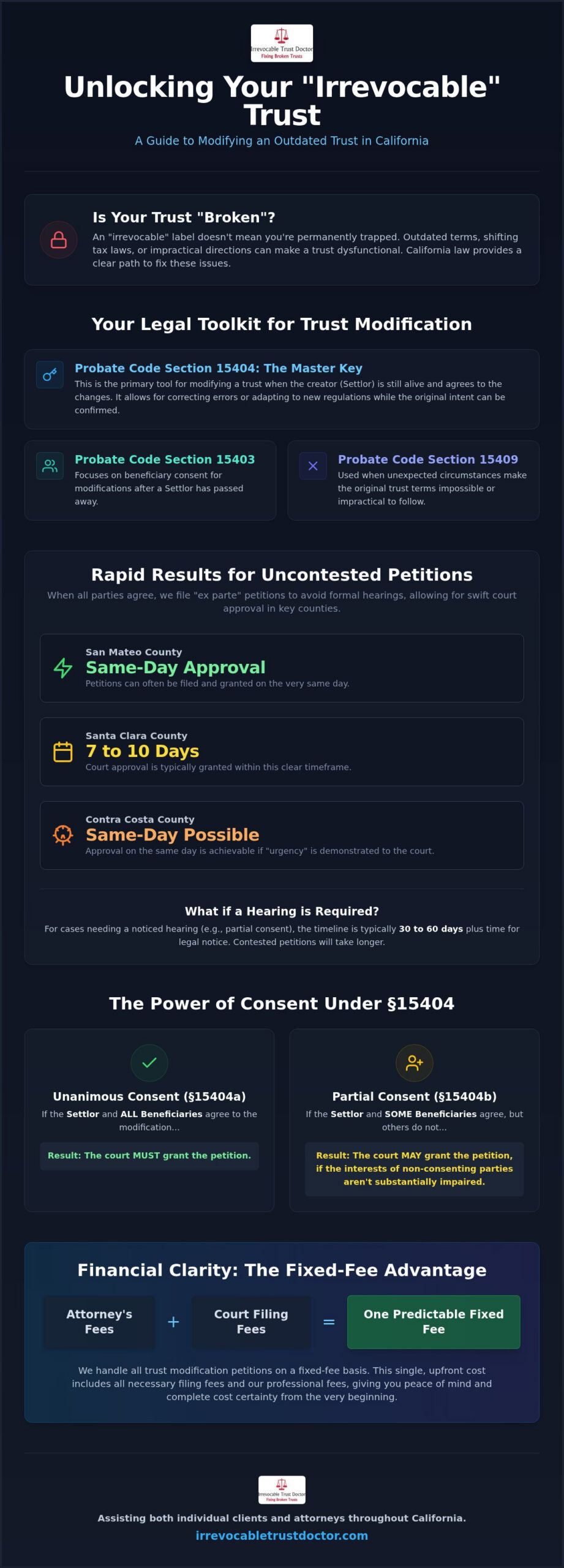
California Probate Code Section 15404 serves as a specialized remedy for trusts that have become dysfunctional or outdated. While the broader principles of United States trust law emphasize the permanence of irrevocable documents, this specific statute allows for active intervention when the settlor is still alive. Unlike Probate Code Section 15403, which focuses on beneficiary consent after a settlor has passed, Section 15404 requires the person who created the trust to be alive and in agreement with the changes. This makes it the primary tool for correcting drafting errors or updating a trust to reflect shifting tax regulations while the original intent can still be confirmed.
We often use this code alongside Probate Code Section 15409 when unexpected circumstances make the original trust terms impossible or impractical to follow. We assist both individual clients and fellow attorneys throughout the state with an Irrevocable Trust Modification Petition in California to ensure these "broken" trusts are restored to health. All our work is handled using a fixed-fee structure that includes both the necessary filing fees and our professional fees.
The Power of Unanimous Consent
Under subdivision (a) of California Probate Code 15404, if the settlor and every single beneficiary agree to the modification, the court must grant the petition. The legal theory is that the collective group effectively owns the trust’s intent and can choose to redirect it. We frequently file these as uncontested petitions ex parte in Santa Clara, San Mateo, and Contra Costa Counties to avoid a formal hearing. In San Mateo County, we can often file and receive a granted order the same day. In Santa Clara County, the process typically takes 7 to 10 days. If you need immediate assistance, you can contact us to evaluate your specific situation.
Modifying with Partial Consent
Subdivision (b) covers situations where the settlor and some beneficiaries agree, but others do not. In these cases, the court can still approve the modification if the interests of the non-consenting parties aren’t "substantially impaired." This means the change won’t financially or legally harm those who didn’t sign on. In Contra Costa County, same-day filing and granting are possible if we demonstrate "urgency" to the Court. If a noticed hearing is required, the timeline usually moves to 30 to 60 days plus additional time for notice. Contested petitions will naturally take longer to resolve.
The Process for a Trust Modification Petition in California
Correcting a trust requires a methodical approach that balances legal precision with procedural efficiency. We begin every case with a detailed review to determine if your situation meets the specific criteria of California Probate Code 15404. Once we confirm the settlor and beneficiaries are in agreement, we draft a formal petition. This document often references Probate Code Section 15403 or Section 15409 to ensure all legal bases are covered, providing the court with a clear roadmap for the requested changes.
After the drafting is complete, we handle the filing process. For many of our clients, this is where the speed of our specialized approach becomes most apparent. We manage the entire process through a fixed-fee structure, which eliminates the stress of unpredictable billing by covering both the court’s filing fees and our professional services. If you aren’t sure where to start, you can Book a Trust Petition Consultation to discuss your specific trust document.
Ex Parte Filings and Local County Timelines
In cases where all parties agree, we often file the petition "ex parte." This means we ask the court for an order without the need for a formal, scheduled hearing. Our deep roots in local jurisdictions allow us to navigate these bureaucratic paths quickly. For example, petitions in Santa Clara County are typically granted within 7 to 10 days. In San Mateo County, we are often able to file and receive a granted order on the same day. For those in Contra Costa County, same-day results are also possible if we can demonstrate "urgency" to the Court.
Noticed Hearings and Contested Petitions
If the court determines that a formal hearing is necessary, or if we are utilizing subdivision (b) of California Probate Code 15404 where not all beneficiaries have consented, the timeline shifts. A noticed hearing usually requires a window of 30 to 60 days, plus the additional time needed to serve legal notice to all interested parties. It’s important to understand that contested petitions, where parties actively disagree on the modification, will naturally take longer to resolve through the court system. We assist both individual clients and their existing attorneys in navigating these more complex procedural requirements to reach a successful conclusion.
Why Work with a Specialist for Your Trust Petition in California
Navigating the probate court requires a niche expertise that general practitioners often lack. We focus exclusively on trust modification petitions, which allows us to identify potential obstacles before they cause unnecessary delays. Whether you’re an individual client or an attorney looking for a "lawyer’s lawyer," our experience ensures that petitions citing California Probate Code 15404 are drafted with clinical accuracy. We provide this specialized support throughout the state, handling filings in every county from San Diego to Sacramento.
Our role as a "specialist fixer" means we understand the subtle differences in how local courts interpret the law. While the statutory language of California probate code 15404 remains constant, the procedural preferences in different jurisdictions can vary. By focusing on this specific area of law since 1980, we offer a level of order and clarity that helps you move past the stress of a dysfunctional trust. We assist with petitions involving Probate Code Section 15403 and Section 15409 to ensure every possible legal avenue is explored for your benefit.
The Fixed-Fee Advantage
Traditional hourly billing often leaves clients feeling uncertain about the final cost of their legal matter. We eliminate this stress by using a structured model where every petition is handled on a fixed-fee basis. This single, transparent price includes both our professional fees and the required court filing fees. If you prefer predictability over open-ended invoices, you can find more detail on our fees and costs page. This approach allows you to focus on the resolution of your trust rather than the ticking clock.
Next Steps for Your Irrevocable Trust
If your current trust document feels like a burden or no longer serves its original purpose, it’s time to explore your options. We can help you determine if your situation qualifies for a modification under the law. Taking action now can prevent future tax complications or family disputes. You’re invited to Contact the Irrevocable Trust Doctor for a specialized case evaluation to review your specific document and discuss a path forward.
Take Control of Your Trust Modification Today
You don’t have to remain stuck with a trust document that no longer fits your family’s needs or current tax laws. By utilizing California Probate Code 15404, you can successfully modify or terminate an irrevocable trust if the person who created it and all beneficiaries provide mutual consent. We assist both individual clients and their attorneys with an Irrevocable Trust Modification Petition in California, often utilizing Probate Code Section 15403 and Probate Code Section 15409 to ensure a successful outcome.
Our approach focuses on efficiency, particularly in Bay Area counties. We regularly file ex parte petitions in Santa Clara, San Mateo, and Contra Costa Counties, where results can be granted in as little as one day. Because we use a fixed-fee structure inclusive of all filing costs, you can move forward with total financial clarity. As a Certified Specialist, I provide the niche expertise needed to navigate these complex bureaucratic obstacles. It’s time to restore order to your legal affairs with a predictable, specialized remedy.
Schedule Your Trust Modification Consultation Today to begin reviewing your specific document. Achieving a resolution for your trust is a practical step toward long-term peace of mind.
Frequently Asked Questions
Can I use California Probate Code Section 15404 if the settlor has passed away?
No, you cannot use this specific statute once the settlor has died. California probate code 15404 requires the active consent of the person who created the trust to function. If the settlor is no longer living, we typically assist clients and their attorneys by filing a petition under Probate Code Section 15403 or Section 15409 instead. These sections provide alternative legal paths to modify an irrevocable trust when the original creator is unavailable to provide consent. For a broader overview of how courts can intervene to fix outdated or broken trust documents, our guide on judicial modification of trust in California explains the full range of options available.
What is the difference between Probate Code 15403 and 15404?
The main distinction is whether the settlor is involved in the modification process. California Probate Code Section 15404 is the primary tool used when the settlor is alive and agrees with the beneficiaries to change the trust terms. Section 15403 is generally reserved for situations where the beneficiaries want to modify the trust but the settlor is either deceased or not participating in the agreement. Both paths require a court petition, but 15404 is often the most direct route for cooperative families. When neither section fully addresses the problem, a judicial modification of trust in California under Probate Code Section 15409 may provide the additional flexibility needed to correct drafting errors or impossible trust terms.
Do I need to go to a court hearing to modify my trust in California?
A formal court hearing is often unnecessary for uncontested petitions. In Santa Clara, San Mateo, and Contra Costa Counties, we regularly file these petitions ex parte, which means the court can grant the order without a scheduled hearing. If the petition is contested or the court requires a noticed hearing, the timeline usually extends to 30 or 60 days. We handle all these procedural steps using a fixed-fee structure that includes both attorney fees and court filing fees, so you don’t have to worry about unexpected costs.
How long does it take to get a court order for trust modification in Santa Clara County?
In Santa Clara County, an uncontested petition is typically granted within 7 to 10 days. This is remarkably fast compared to other jurisdictions, though San Mateo County often allows for same-day filings and grants. If you are filing in Contra Costa County, we can also achieve same-day results if we demonstrate sufficient urgency to the court. Our role is to navigate these specific local timelines to ensure your trust modification is completed as efficiently as possible.

Article by
Robert P. Bergman, Attorney at Law
Attorney Robert P. Bergman ("Bob Bergman") has been a Board-Certified Specialist in Estate Planning, Trust and Probate Law since 2011, as certified by the California State Bar Board of Legal Specialization. For several years, Bob has assisted families and the clients of other attorneys with obtaining court orders through trust modification petitions to make necessary modifications to existing irrevocable trusts. Bob is friendly, very approachable, and believes in explaining complex legal topics in clear ordinary language so that his clients understand exactly what they're doing and why they're doing it.
Bob is often able to assist clients throughout California who are in other counties than his home county of Santa Clara through his approach to trust modification petitions.