
Disclaimer
This article is for informational purposes only. Nothing in this article is intended to replace legal advice from a competent attorney or be considered legal guidance for anybody's specific legal situation. Nobody should rely on information in this article in making legal decisions without such consultation.
Imagine discovering that a simple drafting error in your family’s irrevocable trust is causing confusion or, even worse, sparking a heated debate among siblings. You might feel that because the document is labeled "irrevocable," you’re trapped with wording that doesn’t actually reflect the settlor’s true intent. Reforming ambiguous trust language in California is not only possible; it’s a specialized legal remedy designed to fix these exact "broken" trust instruments before they lead to a long, contested court battle.
I understand the anxiety that comes with conflicting legal terms. It’s a common fear that a single unclear sentence will undo years of careful planning. In this guide, you’ll learn how to use California legal procedures to clarify intent and make your trust legally functional again. We’ll look at how filing a petition under Probate Code Section 15403 or Probate Code Section 15409 can resolve these issues. While reformation specifically corrects errors to match the settlor’s original intent, modification handles changed circumstances. Depending on your county, such as Santa Clara, Contra Costa, or San Mateo, we can often secure these corrections in as little as one to ten days through an ex parte process. I handle these petitions with a transparent, fixed-fee model that covers both filing and attorney fees, so you can focus on restoration rather than rising costs.
Key Takeaways
- Distinguish between trust reformation, which corrects retroactive drafting errors, and trust modification under Probate Code Section 15403 or Probate Code Section 15409 for future needs.
- Identify the specific “extrinsic evidence,” such as attorney notes or prior drafts, required for reforming ambiguous trust language in California to clarify the settlor’s true intent.
- Explore how to fast-track your petition ex parte in Santa Clara, San Mateo, or Contra Costa Counties to secure a court order in as little as one to ten days.
- Learn why a fixed-fee approach provides financial certainty by including both the attorney’s fees and the necessary court filing fees in one comprehensive price.
What is Trust Reformation in California?
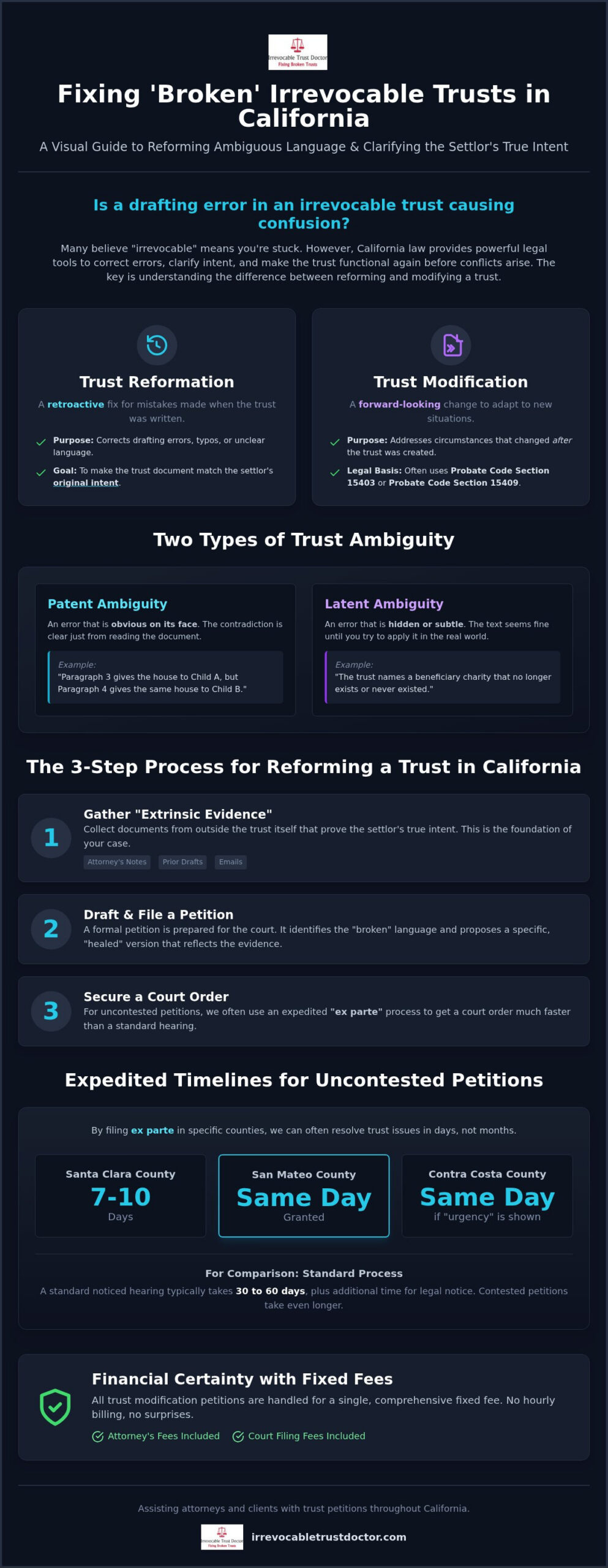
Trust reformation is essentially a legal "correction" of a document. While many believe an irrevocable trust is set in stone, California law provides specific pathways for reforming ambiguous trust language California courts can recognize as a drafting error. Under broader U.S. trust law, reformation is the process of rewriting a document to align with the settlor’s true intent. It acts as a retroactive fix for mistakes that occurred during the drafting stage.
It’s helpful to distinguish between reformation and modification. Reformation is retroactive; it fixes a mistake that existed the moment the pen hit the paper. Modification, often handled under Probate Code Section 15409, addresses circumstances that changed after the trust was created. If a provision is unclear, we use these tools to "heal" the document. I assist clients by ensuring these petitions are handled with fixed fees, which cover both the attorney’s fees and the necessary court filing fees.
Patent vs. Latent Ambiguity in California
Errors usually fall into two categories. A patent ambiguity is an error obvious on its face. For instance, if paragraph three says a house goes to "Child A" and paragraph four says it goes to "Child B," the conflict is clear. A latent ambiguity is more subtle. This happens when the text looks fine until you try to follow it, like naming a charity that no longer exists or never did. In both cases, the goal is to resolve the confusion before it turns into a family fight.
The Legal Basis: Probate Code Section 15403 and 15404
Probate Code Section 15403 allows for modification or termination if all beneficiaries consent. This often simplifies the process significantly. Throughout this work, the settlor’s intent remains the "North Star." The court isn’t looking to write a new trust; it wants to ensure the original vision is actually functional. When I file these petitions ex parte in counties like Santa Clara or San Mateo, I focus on presenting this intent clearly to the judge for a swift resolution.
How to Reform Ambiguous Trust Language in California
The process of reforming ambiguous trust language California judges will accept starts with a clear identification of the error. We begin by gathering what the law calls "extrinsic evidence." These are documents outside the trust itself, such as the original drafting attorney’s intake notes, previous versions of the estate plan, or even emails from the settlor. This evidence is vital under California Probate Code § 15404 because it proves that the written words don’t match the settlor’s actual intent.
Once we have the evidence, we draft a formal petition that identifies the "broken" language and proposes a specific "healed" version. For petitions involving reforming ambiguous trust language in California courts often look for a solution that preserves the trust’s original purpose while correcting the technical defect. If the petition is uncontested, we often file it ex parte in Santa Clara, San Mateo, or Contra Costa Counties. This allows us to move much faster than a standard noticed hearing, which typically takes 30 to 60 days. In Santa Clara County, we often see these granted in 7 to 10 days, while San Mateo and Contra Costa can sometimes be handled the same day. I handle these matters using fixed fees that cover both the attorney’s time and court costs.
Correcting Drafting Errors in California
A common ground for reformation is a scrivener’s error, which is a fancy way of saying a lawyer made a typo or a technical mistake. If a trust says "50 percent" but the lawyer’s notes clearly show "5 percent," we can ask the court to fix it. To prove this, we present a clear trail of evidence that shows the mistake was purely clerical and didn’t reflect the settlor’s wishes. This proactive approach prevents future litigation among beneficiaries and ensures the trust remains functional. If your trust also contains outdated provisions or circumstances have changed since it was created, you may want to explore amending an irrevocable trust in California as a complementary legal remedy. Families managing a trust written decades ago that no longer reflects current tax law or family circumstances may also benefit from reviewing a checklist for how to update an outdated irrevocable trust in California to ensure every necessary step is addressed.
The Role of the Specialist Attorney
Navigating these petitions requires a deep understanding of local court rules and the specific preferences of probate judges. As a California trust law attorney, I don’t just help families; I also assist other lawyers who realize their original drafts contain errors that need fixing. If you’re dealing with a trust that doesn’t say what it should, you can schedule a trust petition consultation to review your options and begin the restoration process.
Fast-Tracking Your Petition and Managing Costs in California
Many families delay reforming ambiguous trust language California lawyers might have drafted poorly because they fear a multi-month court battle. While a standard noticed hearing typically takes 30 to 60 days plus additional time for notice, we can often bypass this wait entirely. If a petition is uncontested, we utilize the ex parte process, which allows us to seek a court order without a formal hearing. This is a specialized "fixer" strategy that saves you from the stress of long-term litigation and potential family infighting.
The speed of your resolution often depends on the specific county where we file. In Santa Clara County, petitions filed ex parte are typically granted in 7 to 10 days. If you’re in San Mateo County, we can often file, have the petition heard, and see it granted the same day. Similarly, in Contra Costa County, the court may grant the petition the same day if we demonstrate "urgency" to the judge. These timelines represent a significant advantage over the standard probate schedule, which can stretch into many months or even years if a contest arises.
Fixed Fees for Trust Reformation in California
I believe that legal fees shouldn’t be a mystery or a source of additional stress. That’s why all trust modification petitions are handled with fixed fees. This comprehensive price includes both the mandatory court filing fees and the attorneys’ fees, so you aren’t surprised by hidden costs or hourly billing spikes later. You can view a detailed breakdown of our fees and costs to see how we maintain total transparency for the families we serve.
Statewide Service with Local Expertise
While I have a specific focus on the Bay Area, I assist attorneys and clients throughout California with petitions under Probate Code Section 15403 and Probate Code Section 15409. Whether you are in San Diego or Sacramento, the procedural requirements for Fixing a Broken Irrevocable Trust in California remain consistent. Working with a Certified Specialist ensures that your petition is drafted correctly the first time, avoiding the technical pitfalls that often stall these cases in the probate system. Families across the state, from Los Angeles to the Bay Area, have also found success by pursuing amending an irrevocable trust in California under Probate Code Section 15403 and 15409 when their trust documents no longer reflect current circumstances.
Protect Your Legacy by Clarifying Your Trust Today
You don’t have to live with a "broken" trust document that creates confusion or family tension. Reforming ambiguous trust language California is a methodical process that restores the settlor’s true intent without the need for a long, contested battle. Whether you’re dealing with a simple typo or a complex conflict in terms, California law provides the tools to heal these documents retroactively. Taking this step now ensures your family’s future remains secure and clear.
As a Certified Specialist in Estate Planning, Trust, and Probate Law, I help families and other attorneys navigate the specific requirements of Probate Code Section 15403 and Probate Code Section 15409. By using the ex parte process, we can often secure a court order in just 7 to 10 days in Santa Clara County, or even the same day in San Mateo and Contra Costa Counties. All of our work is handled with transparent, fixed fees that cover both the attorney’s fees and the mandatory court filing fees. If you’re ready to resolve these drafting errors for good, you can Schedule a Consultation to Fix Your Trust to start the process. I’m here to provide the clinical accuracy and specialized assistance you need to restore order to your estate plan.
Frequently Asked Questions
What is the difference between trust reformation and trust modification in California?
Trust reformation is a retroactive correction used to fix a mistake that existed the moment the trust was signed. It effectively rewrites the document to match the settlor’s original intent. Trust modification, often handled under Probate Code Section 15409, is used to change terms based on circumstances that shifted after the trust was created. Reformation heals an original error, while modification adapts the trust to new realities.
Can an irrevocable trust be changed if all beneficiaries agree to fix a mistake?
Yes, you can change an irrevocable trust under Probate Code Section 15403 if all beneficiaries provide their consent. This is a powerful tool for reforming ambiguous trust language California families often face when a drafting error makes the trust’s instructions unclear. If everyone agrees on the correction, the court can approve the petition to ensure the trust functions as the settlor intended.
How long does it take to reform a trust in Santa Clara County?
If we file an uncontested petition ex parte in Santa Clara County, the court typically grants it in 7 to 10 days. This is much faster than a standard noticed hearing, which usually takes 30 to 60 days plus additional time for notice. By using these expedited procedures, we can resolve drafting errors and clarify intent without the long wait times associated with traditional probate court schedules.
What is a scrivener’s error in California trust law?
A scrivener’s error is a technical or clerical mistake made by the person who drafted the document, usually a lawyer or a paralegal. Common examples include typos in beneficiary names, incorrect asset percentages, or conflicting paragraphs. Since these errors don’t reflect the settlor’s true wishes, the court can reform the trust language to "heal" the document and make it legally functional again.
Do I have to go to a court hearing to fix ambiguous trust language?
Not necessarily, as many uncontested petitions can be handled without a formal hearing. In San Mateo County, petitions can be filed and granted the same day. In Contra Costa County, the court can also grant the petition the same day if we demonstrate "urgency." This streamlined approach is a highly effective way of reforming ambiguous trust language California residents use to avoid stressful and expensive court battles.
Does reforming a trust in California cost a lot of money?
I handle all trust modification petitions using a fixed-fee model to provide families with total price transparency. These fees are comprehensive, covering both the required court filing fees and the attorneys’ fees. This approach eliminates the fear of unpredictable hourly billing and ensures you know the total cost of fixing your trust before the process even begins.

Article by
Robert P. Bergman, Attorney at Law
Attorney Robert P. Bergman ("Bob Bergman") has been a Board-Certified Specialist in Estate Planning, Trust and Probate Law since 2011, as certified by the California State Bar Board of Legal Specialization. For several years, Bob has assisted families and the clients of other attorneys with obtaining court orders through trust modification petitions to make necessary modifications to existing irrevocable trusts. Bob is friendly, very approachable, and believes in explaining complex legal topics in clear ordinary language so that his clients understand exactly what they're doing and why they're doing it.
Bob is often able to assist clients throughout California who are in other counties than his home county of Santa Clara through his approach to trust modification petitions.