
Disclaimer
This article is for informational purposes only. Nothing in this article is intended to replace legal advice from a competent attorney or be considered legal guidance for anybody's specific legal situation. Nobody should rely on information in this article in making legal decisions without such consultation.
What if the word “irrevocable” wasn’t actually the final word on your family’s future? It’s common to feel trapped by a trust document that no longer makes sense, especially when outdated provisions lead to high tax liabilities or confusion over complex legal requirements. If your circumstances have changed or the original document contains errors, then you can pursue a legal remedy for amending irrevocable trust in California through the court system to restore functionality to a “broken” trust.
This guide provides a clear roadmap for modifying a trust under Probate Code Section 15403 and Probate Code Section 15409. We’ll explain the legal grounds for these petitions and how we assist families and attorneys throughout the state, including Los Angeles, Orange, Riverside, and San Diego. You’ll also learn about the expedited timelines for ex parte petitions in Santa Clara, San Mateo, and Contra Costa Counties, where court orders can be obtained in as little as one to ten days. By working with a specialist who offers comprehensive fixed fees, you can move from uncertainty toward a methodical, legally sound resolution.
Key Takeaways
- Realize that “irrevocable” doesn’t mean unchangeable; California law provides specific pathways to fix trusts that no longer serve their purpose due to tax changes or family shifts.
- Gain clarity on the legal grounds for amending irrevocable trust in California using Probate Code Section 15403 for beneficiary consent or Section 15409 for changed circumstances.
- Learn how to expedite the process through ex parte petitions in Bay Area counties like Santa Clara and San Mateo, potentially resolving your case in just a few days.
- Discover how to navigate the petition process with financial certainty through fixed fees that cover all filing costs and attorney’s fees throughout the state.
- Understand the difference between a noticed hearing and an ex parte petition to set realistic expectations for your legal timeline and procedural requirements.
Why You Might Need to Amend an Irrevocable Trust in California
If you believe an irrevocable trust is set in stone, you aren’t alone. Most people assume that once a trust becomes irrevocable, its terms are frozen forever. However, under California law, the term “irrevocable” describes the initial status of the document, not its finality. There are many instances where amending irrevocable trust in California is not only possible but necessary to protect the interests of the beneficiaries. According to a U.S. Trust Law Overview, trusts are designed to fulfill the settlor’s intent. When the document can no longer do that, the legal system provides a remedy through a court petition.
Common Reasons for Modifying Trust Terms
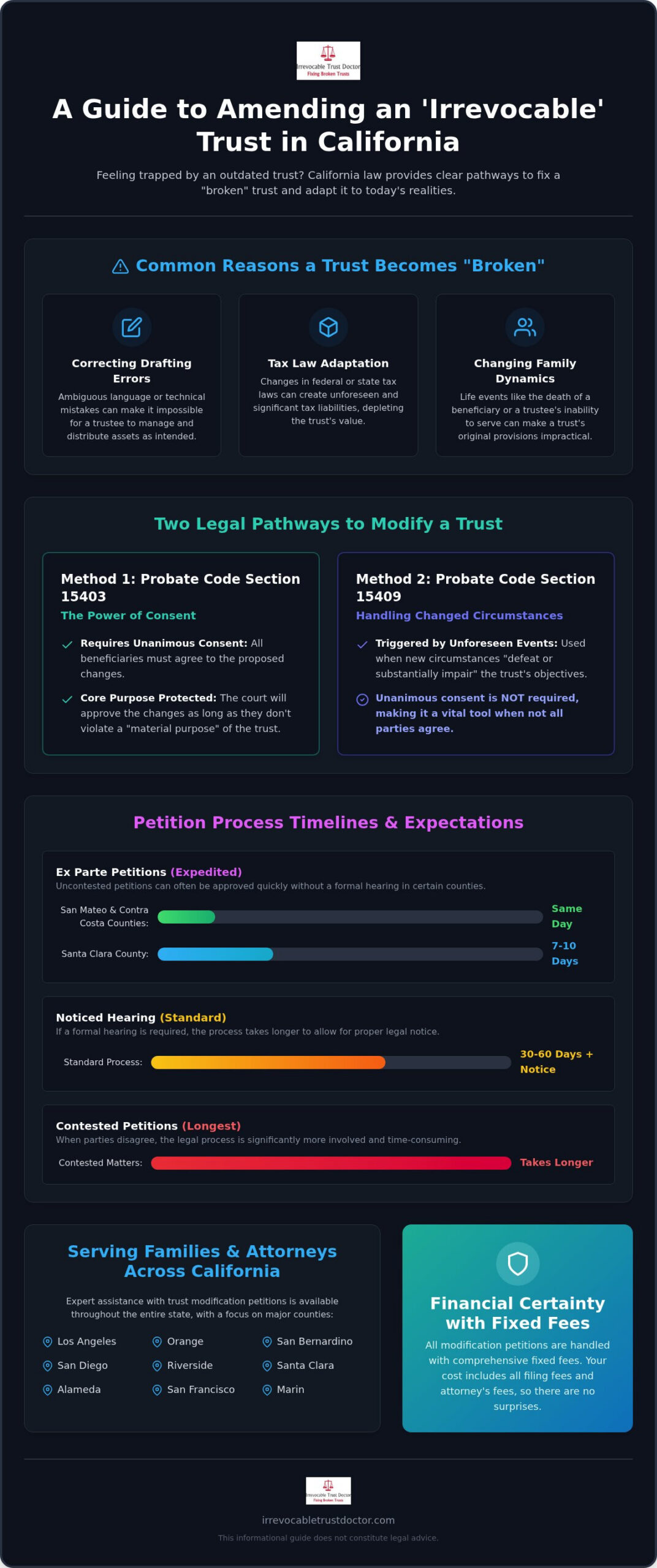
There are several practical triggers that necessitate a change to a trust’s terms. These usually involve external factors that the original creator could not have predicted. Common reasons include:
- Correcting Drafting Errors: Ambiguous language or technical mistakes can cause administrative gridlock, making it impossible for a trustee to distribute assets.
- Tax Law Adaptation: If federal or state tax regulations change, an old trust might suddenly face high tax liabilities that deplete the estate’s value.
- Family Dynamics: Significant life events, such as the death of a beneficiary or a change in a trustee’s ability to serve, often require updated provisions to keep the trust functional. Issues like fixing trustee succession errors in California trust documents are among the most common reasons families seek court intervention.
When an Irrevocable Trust Becomes “Broken”
We often describe a trust as “broken” when it becomes impractical, inefficient, or excessively expensive to manage. This occurs when the administrative costs outweigh the benefits or when the trust’s purpose is “defeated or substantially impaired” by unforeseen circumstances. In these cases, reforming ambiguous trust language in California can resolve the friction between the document’s text and current financial realities.
If your trust is no longer working, then a court petition is your primary tool for correction. Whether you are located in Los Angeles, Orange, Riverside, or San Diego, we provide specialized assistance to families and attorneys throughout the state. All our modification petitions are handled with fixed fees, ensuring that you know the total cost, including filing fees, before the process begins. If you’re working with a document written years ago that no longer reflects current tax law or family circumstances, our checklist for how to update an outdated irrevocable trust in California can help you identify the right procedural steps to take.
Legal Grounds for Amending Irrevocable Trust in California
If you’re facing a trust that no longer serves its purpose, then knowing the specific legal grounds for amending irrevocable trust in California is essential. The law doesn’t leave you stranded with a broken document; it offers specific statutory remedies that act as diagnostic tools to repair a dysfunctional trust. Whether you’re an individual beneficiary or an attorney representing a client, these petitions are available throughout the state, from Los Angeles and Orange County to San Diego and Riverside.
Probate Code Section 15403: The Power of Consent
When every beneficiary is in agreement, Probate Code Section 15403 provides a direct route to modification. The court generally respects the unanimous consent of beneficiaries, provided the proposed change doesn’t violate a “material purpose” of the trust. A material purpose is the core reason the trust was created, such as protecting a beneficiary with poor spending habits or ensuring funds are used strictly for education. If we can demonstrate that the need for modification outweighs this original purpose, the court has the authority to grant the petition. Unanimous consent is a powerful tool that often simplifies the path to a resolution.
Probate Code Section 15409: Handling Changed Circumstances
Life often moves faster than a trust document can anticipate. Under Probate Code Section 15409, the court can modify or terminate a trust if unforeseen circumstances would “defeat or substantially impair” its objectives. This typically involves a radical shift in asset value or a major change in tax law that the settlor didn’t expect. Unlike the consent-based route, this section allows for a modification even without unanimous agreement from all beneficiaries, as long as the change furthers the settlor’s original intent. It’s a vital safety net for trusts that have become economically impractical to maintain. Situations where all named successor trustees have died or become unable to serve — requiring fixing trustee succession errors in a California irrevocable trust — are a prime example of the unforeseen circumstances this statute is designed to address. For a structured overview of the statutory tools available, including judicial modification and decanting, see our detailed guide to updating an outdated irrevocable trust in California.
We regularly assist families and attorneys in San Bernardino, Santa Clara, Alameda, San Francisco, and Marin with these complex filings. If you’re unsure which statute applies to your specific situation, you can schedule a trust petition consultation to review your options. Every petition we handle is managed with a comprehensive fixed fee that covers all filing and attorney costs, providing you with financial clarity from the start.
The Court Petition Process: Timelines and Expectations
Once you’ve identified the legal grounds, the next step is filing a formal petition with the local Probate Court. We provide this specialized service for families and other attorneys throughout the state, including Los Angeles, Orange, San Bernardino, San Diego, Riverside, Alameda, San Francisco, and Marin. If you are managing a trust that is no longer functional, then understanding the difference between an “ex parte” petition, which is handled without a formal hearing, and a noticed hearing is vital for setting expectations. We focus on uncontested petitions, allowing us to navigate the court system with precision and speed while amending irrevocable trust in California.
County-Specific Timelines for Trust Petitions
The location where you file significantly impacts how quickly the court grants your request. While every court has its own rhythm, we’ve established a methodical approach in specific jurisdictions to ensure the fastest possible resolution. Consider these typical timelines for uncontested petitions:
- Santa Clara County: Petitions are typically granted in 7 to 10 days.
- San Mateo and Contra Costa Counties: Same-day grants are often possible, though Contra Costa requires a specific showing of “urgency.”
- General Noticed Hearings: If a hearing is required, the timeline is typically 30 to 60 days plus the necessary notice time.
Fixed Fees and Specialist Assistance
Transparency is a cornerstone of our practice. All trust modification petitions are handled using a single, comprehensive fixed fee. These fees and costs cover both the necessary filing fees and the attorneys’ fees, so you won’t encounter unexpected bills. We also act as a resource for other legal professionals who need a specialist to handle the technical nuances of a petition for their clients. Following a step-by-step guide to fixing a trust ensures every procedural requirement is met, allowing us to resolve your matter efficiently.
If you’re an attorney whose client needs a trust modification, then partnering with a specialist can save you significant time and administrative effort. We handle the bureaucratic obstacles so you can focus on your client’s broader needs. By choosing a seasoned practitioner, you ensure that the process of amending irrevocable trust in California is handled with the clinical accuracy the legal system requires.
Take Control of Your Trust’s Future
Dealing with a trust that’s no longer functional can be stressful, but you have the power to fix it. California’s Probate Code provides the specific tools needed for amending irrevocable trust in California, whether you’re dealing with outdated tax provisions or a significant change in family circumstances. By utilizing Probate Code Section 15403 or Probate Code Section 15409, you can ensure the trust once again aligns with its original intent and operates efficiently for all beneficiaries involved.
We specialize in navigating these complex petitions for families and legal professionals throughout the entire state, including Los Angeles, Orange, San Diego, and the Bay Area. As a Certified Specialist in Estate Planning, Trust, and Probate Law, Robert P. Bergman offers a methodical approach that prioritizes speed and financial transparency. All our modification petitions are handled with a single fixed fee that covers every filing and attorney cost. If you’re ready to move toward a clear resolution, you can request a trust petition consultation today. Don’t let a “broken” document dictate your family’s future when a specialized remedy is within reach.
Frequently Asked Questions
Can an irrevocable trust be changed after the settlor dies?
Yes, an irrevocable trust can be modified after the settlor’s death through a formal court petition. Under Probate Code Section 15403, if all beneficiaries agree, they can ask the court to update the terms to reflect current needs. If consent isn’t unanimous, Probate Code Section 15409 allows for changes due to unforeseen circumstances. We regularly assist families in Los Angeles and San Francisco with these post-death modifications to ensure the trust remains functional.
Do I need a court order to amend an irrevocable trust in California?
Most modifications to an existing irrevocable trust require a formal court order to be legally binding and effective. While California law offers some private alternatives, a court-approved petition provides the most reliable protection for trustees and beneficiaries alike. We file these petitions throughout the state, including Riverside and San Bernardino. In the Bay Area, we often use ex parte procedures to secure these orders quickly for our clients.
What happens if one beneficiary does not consent to the trust modification?
If a beneficiary refuses to consent, you can still petition the court under Probate Code Section 15409. This specific section doesn’t require unanimous agreement if you can prove that changed circumstances have substantially impaired the trust’s purpose. The court will weigh the interests of all parties to determine if the modification is appropriate. This is a common path when amending irrevocable trust in California when family dynamics are complicated.
How much does it cost to petition the court for a trust amendment?
We provide all trust modification services on a fixed-fee basis to ensure total transparency for our clients. This comprehensive fee covers every aspect of the case, including the initial court filing fees and all professional attorney’s fees. Whether your case is in Orange County or Santa Clara, you’ll know the exact cost upfront. This model eliminates the anxiety of hourly billing while we work to resolve your “broken” trust issues.

Article by
Robert P. Bergman, Attorney at Law
Attorney Robert P. Bergman ("Bob Bergman") has been a Board-Certified Specialist in Estate Planning, Trust and Probate Law since 2011, as certified by the California State Bar Board of Legal Specialization. For several years, Bob has assisted families and the clients of other attorneys with obtaining court orders through trust modification petitions to make necessary modifications to existing irrevocable trusts. Bob is friendly, very approachable, and believes in explaining complex legal topics in clear ordinary language so that his clients understand exactly what they're doing and why they're doing it.
Bob is often able to assist clients throughout California who are in other counties than his home county of Santa Clara through his approach to trust modification petitions.