
Disclaimer
This article is for informational purposes only. Nothing in this article is intended to replace legal advice from a competent attorney or be considered legal guidance for anybody's specific legal situation. Nobody should rely on information in this article in making legal decisions without such consultation.
The word "irrevocable" isn’t the final word on your family’s legacy. You might feel stuck with an outdated document, but the California probate court trust petition process offers a specialized remedy for trusts that no longer serve their purpose. Whether you’re in Los Angeles, Orange, San Diego County, or elsewhere in California, the law provides clear pathways to modify a trust that has become dysfunctional.
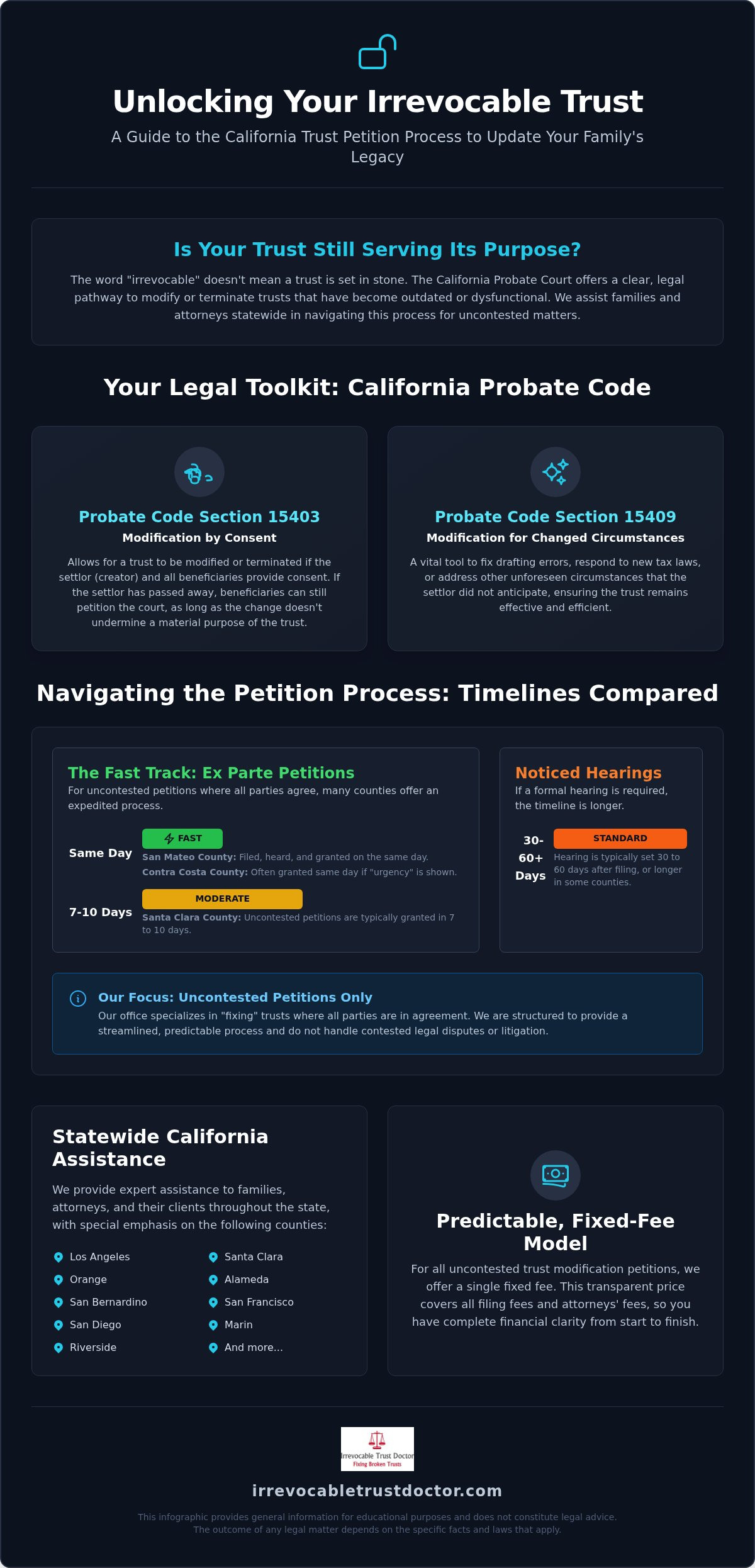
We’ll explain how to use Probate Code Section 15403 and Probate Code Section 15409 to update your plan. We assist families and attorneys statewide, including those in Riverside and San Bernardino. While noticed hearings are typically set 30 to 60 days or more after filing or later, ex parte petitions in Santa Clara County are typically granted in 7 to 10 days. San Mateo petitions can be filed, heard, and granted the same day. In Contra Costa County, they’re often granted the same day if urgency is demonstrated. We don’t handle contested matters, offering fixed fees for a clear conclusion.
Key Takeaways
- Learn how the California probate court trust petition process provides a legal mechanism to update or terminate irrevocable trusts that are no longer functional or effective.
- Identify the specific statutory grounds for modification under Probate Code Section 15403 and Probate Code Section 15409 to ensure your trust reflects current family needs.
- Discover how to navigate varying court timelines, from same-day grants in San Mateo and Contra Costa Counties to 7 to 10-day turnarounds for ex parte petitions in Santa Clara County.
- Understand the benefits of a fixed-fee model for uncontested petitions available to families and attorneys statewide, though please note our office does not handle contested legal disputes.
Understanding the California Probate Court Trust Petition Process
When a trust document becomes unworkable, the California probate court trust petition process provides a reliable path forward. At its core, a trust is a legal relationship where property is managed for a beneficiary’s benefit. If the terms of that relationship are no longer clear or effective, a petition allows the Superior Court to intervene. While many people fear that "irrevocable" means "unchangeable," the Probate Code offers specific mechanisms to modify or even terminate trusts that have outlived their original purpose.
The court’s role is to oversee trust administration and interpret the settlor’s intent during changing times. We assist families and attorneys in Los Angeles, Orange, San Diego, and Riverside with these filings to ensure the trust remains a functional tool. It’s vital to clarify that our office doesn’t handle contested petitions. We specialize as "fixers" for uncontested matters where all parties agree on the necessary resolution.
The Purpose of Filing a Petition for Trust Instructions in California
Trustees often encounter ambiguous language that creates administrative gridlock. A petition for instructions provides judicial approval for actions not explicitly authorized in the original document, establishing a legal record that protects the trustee from future liability. Actionable tip: Collect all correspondence from financial institutions that refuse to honor the trust’s current language to help demonstrate the need for court intervention. In Northern California, this process is often expedited. Ex parte petitions in Santa Clara County are typically granted in 7 to 10 days. In San Mateo County, petitions can be filed, heard, and granted the same day. Similarly, petitions in Contra Costa County can often be filed and granted the same day if urgency is demonstrated to the Court’s satisfaction.
Legal Grounds for Filing a Trust Petition in California
The California probate court trust petition process relies on proving that the current trust document no longer aligns with reality. To succeed, you must present clear evidence of either the settlor’s original intent or significant unforeseen changes. Professional drafting is essential; the court requires a precise roadmap of the proposed changes to ensure they don’t violate the trust’s material purpose. This is particularly important in busy jurisdictions like Los Angeles and Orange County, where judges expect high standards of procedural accuracy. We strictly handle uncontested matters and do not represent clients in contested litigation.
Modification Under Probate Code Section 15403 and Probate Code Section 15409
Under Probate Code Section 15403, a trust can be modified or terminated if the settlor and all beneficiaries consent. If the settlor has passed, the beneficiaries can still petition the court, provided the change doesn’t undermine a material purpose of the trust. Conversely, Probate Code Section 15409 addresses "changed circumstances." This is a vital tool for families and attorneys to fix drafting errors or respond to new tax laws that the settlor didn’t anticipate. For instance, a trust drafted decades ago might not account for current capital gains tax strategies. In such cases, the court can modify the document so the family doesn’t lose significant assets to unnecessary taxes.
Our office assists clients throughout the state, including San Diego and Riverside, in preparing these specialized filings. If you’re unsure which statute applies to your situation, you can book a trust petition consultation to evaluate your case. We focus exclusively on uncontested matters, ensuring that the process remains streamlined and predictable. By using a diagnostic approach, we identify the exact legal grounds needed to restore a dysfunctional trust to full health. Families dealing with outdated terms or drafting errors may also benefit from reviewing the detailed steps involved in filing a court petition for trust amendment to understand the full procedural roadmap before moving forward.
Timelines and Procedures for California Trust Petitions
The California probate court trust petition process moves at different speeds depending on local rules and the nature of the request. We offer statewide support for families and attorneys in Los Angeles, Orange, San Bernardino, San Diego, and Riverside, as well as Northern California hubs like Santa Clara, Alameda, San Francisco, and Marin. Our model relies on fixed fees that cover both filing fees and attorneys’ fees, providing predictable costs for our clients. Please be aware that our office focuses solely on uncontested matters; we don’t handle contested petitions.
Ex Parte vs. Noticed Hearings: What to Expect
The procedural path you take significantly impacts your timeline. Uncontested petitions filed ex parte in Santa Clara County are typically granted in 7 to 10 days. In San Mateo County, ex parte petitions can be filed, heard, and granted the same day. If you’re filing in Contra Costa County, petitions can often be filed and granted the same day if "urgency" is demonstrated to the Court’s satisfaction.
If an ex parte filing isn’t available, a noticed hearing is required. These are typically set 30 to 60 days after the petition is filed, though some counties may schedule them several months later. You must also allow time for mandatory notice to all interested parties. To find the most efficient route for your trust, Book a Trust Petition Consultation with our specialist team. We ensure your paperwork is precise from the start to minimize court-related delays. For a comprehensive overview of how the amendment process works from start to finish, our guide on how to file a court petition for trust amendment in California walks through each procedural step in detail.
Restoring Order to Your Family Legacy
An outdated trust document shouldn’t stand in the way of your family’s financial security. The California probate court trust petition process provides the legal tools necessary to modify or terminate irrevocable trusts that no longer align with your current needs. By using specific pathways like Probate Code Section 15403 or Probate Code Section 15409, you can effectively correct drafting errors or respond to unforeseen changes in tax law. Whether you’re seeking a same-day resolution in San Mateo or a noticed hearing in Riverside, the right procedural strategy makes all the difference.
For families who need comprehensive support with probate administration or long-term asset protection alongside their trust modifications, probateestate-planning.com offers the specialized legal expertise required to secure a legacy.
Beyond trust modifications, if your family is navigating the aftermath of a property foreclosure, you can learn more about Surplus Funds CA to explore options for recovering equity from the sale.
Our office brings over 40 years of experience to every case, providing a transparent, fixed-fee structure for uncontested matters throughout the state. As a Certified Specialist in Estate Planning, Trust, and Probate Law, we help you navigate complex requirements with clinical accuracy. Book Your Trust Petition Consultation with a Certified Specialist to start your journey toward a functional trust. You don’t have to feel stuck; a resolution is within reach.
Frequently Asked Questions
How long does the California probate court trust petition process take?
The California probate court trust petition process duration depends on the county and the filing type. Ex parte petitions in Santa Clara County are typically granted in 7 to 10 days, while San Mateo and Contra Costa can grant them the same day. Standard noticed hearings usually take 30 to 60 days, though some counties require several months for a court date.
Can an irrevocable trust be changed if all beneficiaries agree?
Yes, an irrevocable trust can be modified if all beneficiaries consent under Probate Code Section 15403. Even if the settlor is deceased, the court may approve changes as long as they don’t interfere with a material purpose of the trust. This is a vital tool for families in Orange and San Diego Counties who need to resolve administrative issues.
What is the difference between an ex parte and a noticed hearing in probate court?
An ex parte hearing is an expedited process for urgent or uncontested matters that bypasses long notice periods. A noticed hearing is the standard procedure where a court date is set weeks or months in advance. We use the ex parte California probate court trust petition process in specific counties to help clients achieve their goals in a fraction of the usual time.
Does the Irrevocable Trust Doctor handle contested trust petitions?
No, our office does not handle contested petitions or trust litigation. We specialize exclusively in uncontested trust modification and termination petitions where all parties are in agreement. By focusing on non-adversarial matters, we provide a reliable, fixed-fee structure for families and attorneys across the state, from Los Angeles to Marin County, ensuring predictable costs and outcomes.

Article by
Robert P. Bergman, Attorney at Law
Attorney Robert P. Bergman ("Bob Bergman") has been a Board-Certified Specialist in Estate Planning, Trust and Probate Law since 2011, as certified by the California State Bar Board of Legal Specialization. For several years, Bob has assisted families and the clients of other attorneys with obtaining court orders through trust modification petitions to make necessary modifications to existing irrevocable trusts. Bob is friendly, very approachable, and believes in explaining complex legal topics in clear ordinary language so that his clients understand exactly what they're doing and why they're doing it.
Bob is often able to assist clients throughout California who are in other counties than his home county of Santa Clara through his approach to trust modification petitions.