
Disclaimer
This article is for informational purposes only. Nothing in this article is intended to replace legal advice from a competent attorney or be considered legal guidance for anybody's specific legal situation. Nobody should rely on information in this article in making legal decisions without such consultation.
The term "irrevocable" is often misunderstood as a legal dead end, but in the state of California, it’s actually a door that can be unlocked with the right procedural key. You likely feel stuck with a document written decades ago that no longer reflects the 2026 federal estate tax exemption of $15 million or your family’s current reality. It’s frustrating to watch a rigid trust structure potentially harm a beneficiary with special needs or leave an unfit trustee in power simply because the original language didn’t anticipate these specific changes.
This checklist provides the legal steps and California Probate Code requirements you need to update an outdated irrevocable trust and protect your family’s future. We’ll explore how modern statutory tools like judicial modification and decanting offer a clear, predictable path to restoration. You’ll discover how to navigate the court filing process to ensure your legacy remains a benefit rather than a burden.
Key Takeaways
- Recognize the specific legal triggers, such as shifts in federal tax exemptions or a beneficiary’s special needs, that necessitate a formal diagnostic review of your trust documents.
- Gain clarity on using California Probate Code Sections 15404 and 15409 to secure modifications through beneficiary consent or demonstrated changed circumstances.
- Master the procedural checklist required to update an outdated irrevocable trust, transforming a rigid document into a modern, functional asset protection tool.
- Evaluate the differences between noticed hearings and ex parte applications to determine the most efficient path through the California court system for your specific county.
Signs Your Irrevocable Trust is Outdated and Needs a "Legal Diagnostic"
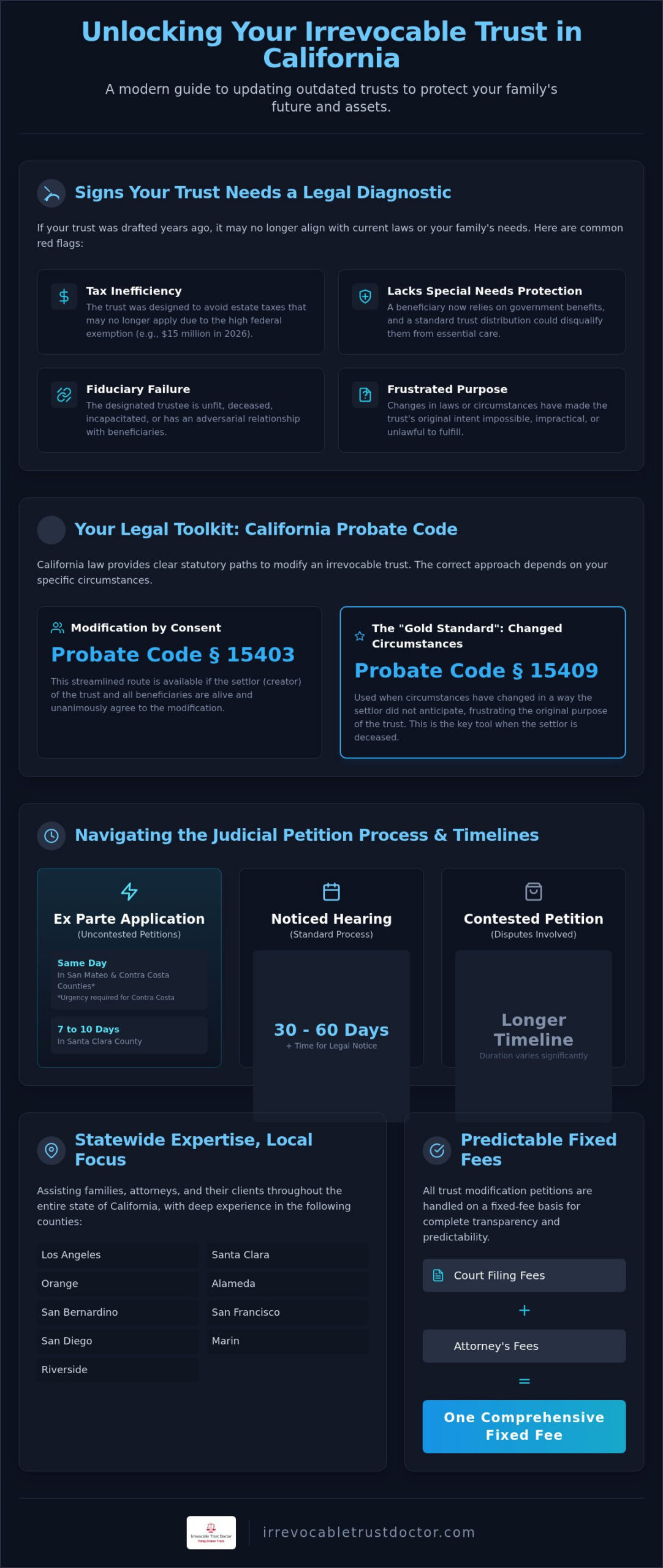
Many families discover that their legal documents haven’t kept pace with reality. If your trust was drafted before the federal estate tax exemption reached $15 million in 2026, the administrative burden may now outweigh the tax benefits. Understanding What is an Irrevocable Trust? is the first step in identifying why a document designed for stability might now be obsolete.
Common indicators that you need to update outdated irrevocable trust documents include:
- Tax Inefficiency: The trust focuses on avoiding estate taxes that no longer apply to your specific asset level.
- Special Needs Protection: A beneficiary now requires government assistance. Given the 2026 Medi-Cal asset limit of $130,000 for individuals, a standard distribution could disqualify them from essential care.
- Fiduciary Failure: The designated trustee is deceased, incapacitated, or the relationship with beneficiaries has turned adversarial. Families facing this situation should understand the process of fixing trustee succession errors in California trust documents to prevent trust assets from becoming completely frozen.
- Frustrated Purpose: The original intent of the trust has become impossible or unlawful due to external changes.
Identifying "Broken" Trust Language in California
Administrative gridlock often stems from "broken" language. This occurs when a document lacks modern decanting provisions or a Power of Appointment, leaving the trustee without the tools to adapt to new laws. If the text contains conflicting instructions or vague definitions, you should investigate reforming ambiguous trust language in California to restore functionality. Recognizing these flaws early allows for a targeted judicial fix when you must update outdated irrevocable trust provisions to protect your legacy.
The Legal Checklist for Updating an Irrevocable Trust in California
To successfully update outdated irrevocable trust structures, you must first determine which statutory path fits your situation. If the settlor and all beneficiaries are alive and in agreement, California Probate Code § 15403 provides a streamlined route for modification. If the settlor is deceased, the process becomes more complex, requiring a diagnostic look at the trust’s original purpose and current effectiveness.
Before initiating a court filing, gather your evidence. You’ll need the original trust instrument, all valid amendments, and current contact details for every beneficiary. These documents form the clinical basis of your petition. Missing records or outdated addresses often cause significant delays in the California probate system, so thorough preparation is essential.
Qualifying Under Probate Code Section 15409
Probate Code Section 15409 is the "gold standard" for families needing to update outdated irrevocable trust provisions when the settlor’s original intent is frustrated by unforeseen shifts in law or family health. The court may modify the trust if "changed circumstances" exist that were not anticipated at the time of drafting. This procedural tool is widely utilized by practitioners in Los Angeles, Orange, and San Diego counties to fix trusts that no longer serve their intended function.
Navigating these statutory requirements requires the technical expertise of a Certified Specialist. If you’re ready to move from uncertainty to a structured legal solution, you can book a trust petition consultation to evaluate your specific case criteria and determine the most efficient path forward.
Navigating the Judicial Petition Process and Timelines
Some practitioners describe court intervention as a "hassle" to be avoided. However, when you must update outdated irrevocable trust provisions, a judicial order is the most secure method to ensure financial institutions and the IRS recognize your modifications. It provides a level of legal finality that informal decanting often lacks. The process begins with a formal petition, where we determine whether your case requires a standard noticed hearing or an ex parte application.
A noticed hearing typically requires a 30 to 60 day window to allow for proper service to all interested parties. Certain Northern California counties offer significantly faster results. In Santa Clara, Contra Costa, or San Mateo, our specialized experience allows us to navigate the probate departments with greater efficiency. We believe in transparency, which is why we utilize a fixed-fee model for these services. You can review our Fees and Costs page to see how we manage filing and attorney fees with total predictability.
What to Expect: From Filing to Court Order
Your timeline varies by county and the chosen procedural path. In Santa Clara County, petitions are often granted in as little as 7 to 10 days. San Mateo can sometimes grant orders on the same day through ex parte filings. These expedited results are a hallmark of a focused legal diagnostician. To understand the mechanics of this process further, read about amending an irrevocable trust in California. This judicial route ensures your legacy is protected by a valid, modernized court order. Cases involving successor trustee vacancies benefit from the same expedited approach; learn more about fixing trustee succession errors in California trust documents through an Irrevocable Trust Modification Petition.
Securing Your Family’s Future Through Modernization
We’ve established that "irrevocable" isn’t a permanent legal barrier. By identifying "broken" trust language and leveraging California Probate Code Sections 15403 and 15409, you can restore a document’s original purpose. Whether you’re navigating expedited timelines in Santa Clara or standard hearings elsewhere, the judicial process offers a secure, predictable resolution for your family.
When you’re ready to update outdated irrevocable trust provisions, Robert P. Bergman provides the clinical accuracy your legacy requires. As a Certified Specialist in Estate Planning, Trust, and Probate Law, he offers fixed-fee pricing and statewide service across California. This structured approach removes the uncertainty of hourly billing while ensuring your modification meets strict legal standards. Book a Trust Petition Consultation with Robert P. Bergman to begin your review. Taking this step brings order to a dysfunctional situation and ensures your beneficiaries remain protected.
Frequently Asked Questions
Can you change an irrevocable trust without going to court in California?
You can update outdated irrevocable trust provisions without court intervention through trust decanting or a Non-Judicial Settlement Agreement if the document grants the trustee specific powers. However, many older trusts lack these modern provisions. If your document doesn’t explicitly allow these methods; a judicial petition remains the only secure way to ensure banks and the IRS recognize the modifications.
What is the difference between Probate Code Section 15403 and 15409?
Section 15403 allows for modification with the consent of all beneficiaries, provided the change doesn’t interfere with a material purpose of the trust. Section 15409 is the "changed circumstances" statute. It permits a judge to modify a trust if unforeseen events frustrate the settlor’s original intent. We select the specific code based on whether your situation involves consensus or external shifts in law.
How much does it cost to update an outdated irrevocable trust?
The total cost includes the standard California probate court filing fee, which is currently $435 in most counties as of 2026. Beyond court costs, our firm utilizes a fixed-fee model for every Irrevocable Trust Modification Petition. This approach provides you with a predictable legal expense from the start, avoiding the uncertainty and escalating costs associated with traditional hourly billing structures.
How long does the trust modification process take in Los Angeles vs. Santa Clara County?
Timelines vary significantly by jurisdiction. A standard petition in Los Angeles County often takes 12 to 18 months due to heavy court backlogs. In contrast, we can often secure a court order in Santa Clara County within 7 to 10 days using an ex parte application. If your case qualifies for expedited processing, we target these faster Northern California venues to resolve your matter quickly.

Article by
Robert P. Bergman, Attorney at Law
Attorney Robert P. Bergman ("Bob Bergman") has been a Board-Certified Specialist in Estate Planning, Trust and Probate Law since 2011, as certified by the California State Bar Board of Legal Specialization. For several years, Bob has assisted families and the clients of other attorneys with obtaining court orders through trust modification petitions to make necessary modifications to existing irrevocable trusts. Bob is friendly, very approachable, and believes in explaining complex legal topics in clear ordinary language so that his clients understand exactly what they're doing and why they're doing it.
Bob is often able to assist clients throughout California who are in other counties than his home county of Santa Clara through his approach to trust modification petitions.