
Disclaimer
This article is for informational purposes only. Nothing in this article is intended to replace legal advice from a competent attorney or be considered legal guidance for anybody's specific legal situation. Nobody should rely on information in this article in making legal decisions without such consultation.
Understanding the Petition to Modify an Irrevocable Trust in California
While the word "irrevocable" suggests permanence, California law provides powerful tools for correcting trusts that have become outdated, inefficient, or no longer serve their original purpose. Many beneficiaries and trustees in Los Angeles, San Diego, and across the State of California search for how to "terminate" or "end" an irrevocable trust. Legally, this is most often achieved through a Petition to Modify an Irrevocable Trust—a formal request filed with the California Probate Court to change the trust’s terms. This modification can range from a minor administrative update to a complete, structured dissolution of the trust.
It is crucial to distinguish between a private agreement and a court-ordered modification. While some changes can be made with the consent of all parties, a formal court order is the "gold standard." It provides the trustee with absolute protection from future claims or lawsuits from beneficiaries, ensuring the changes are legally binding and final. This judicial approval is what gives everyone involved—and the financial institutions holding the assets—complete peace of mind.
Non-Judicial Modification vs. Court Petitions
California Probate Code Section 15404 allows for the modification of a trust with the consent of the settlor (the creator) and all beneficiaries. However, this will not work at all if you are trying to modify an irrevocable trust that became irrevocable because one of the settlors died. This is because the written consent of the deceased settlor would be required, which of course is impossible if they’ve already died. Even if permitted under the law, this non-judicial approach often lacks the finality required by third parties. Financial institutions, title companies, and brokerage firms frequently refuse to act on a private agreement, demanding the security of a judge’s signature on a formal court order. A court petition solidifies the changes, making them enforceable and protecting the trustee from liability for implementing them.
Common Reasons for Modification
A petition to modify a trust is typically filed when the trust is considered "broken" or no longer practical. Common justifications for seeking a court-ordered change include:
- The trust’s purpose has been fulfilled: The original goals of the trust have been met, and its continued existence is unnecessary.
- The trust’s purpose has become impossible or illegal to achieve: Changes in law or circumstances prevent the trust from operating as intended.
- The trust assets are too small: The value of the trust property is so low that the cost of administration outweighs the benefits to the beneficiaries, making its continuation economically unfeasible.
- Outdated administrative or tax provisions: The trust contains language that creates negative tax consequences or administrative burdens that the settlor never anticipated. For more details on this, see our guide to Judicial Modification of Trust in California: A Guide to Fixing "Broken" Irrevocable Trusts.
Legal Grounds for Modification: Probate Code 15403 and 15409
Two key sections of the California Probate Code form the legal basis for most uncontested trust modifications. Understanding which one applies to your situation is the first step in crafting a successful petition. These statutes provide a clear pathway for fixing "broken" trusts, whether due to outdated tax laws, a beneficiary’s special needs, or other unforeseen issues.
The primary difference lies in consent versus changed circumstances. Probate Code Section 15403 is the pathway for modification when all beneficiaries agree to the proposed changes. In contrast, Probate Code Section 15409 allows the court to approve a modification when circumstances have changed in a way that defeats or substantially impairs the trust’s original purpose, even without unanimous consent.
However, the court must always consider the "Material Purpose" of the trust. A judge may deny a petition, even if everyone agrees, if the proposed change would undermine a core objective the settlor intended to achieve.
Probate Code 15403: The Power of Consent
This section empowers beneficiaries to modify or terminate a trust if they all provide written consent. For a petition under this code to proceed smoothly as an uncontested matter, obtaining signatures from every single beneficiary is essential. If the settlor is deceased, the process can move forward with just the beneficiaries’ consent. A specialist attorney can ensure all necessary parties are identified and their consent is properly documented, paving the way for a swift court approval. For an in-depth look, please read Understanding California Probate Code 15403 in 2026: Modifying Irrevocable Trusts by Beneficiary Consent.
Probate Code 15409: Solving the "Unexpected"
When obtaining unanimous consent isn’t possible or when the issue stems from unforeseen events, Probate Code Section 15409 is the solution. This statute allows a trustee or beneficiary to petition the court to modify a trust’s terms because of "changed circumstances" not known to or anticipated by the settlor. Under this code, the court effectively "steps into the shoes" of the settlor, authorizing a modification that aligns with what the settlor would have likely wanted had they known about the new situation. This is particularly useful for trusts that no longer make financial or practical sense due to shifts in tax law, family dynamics, or economic conditions.
Fast-Tracking Your Petition: Ex Parte Procedures and Timelines
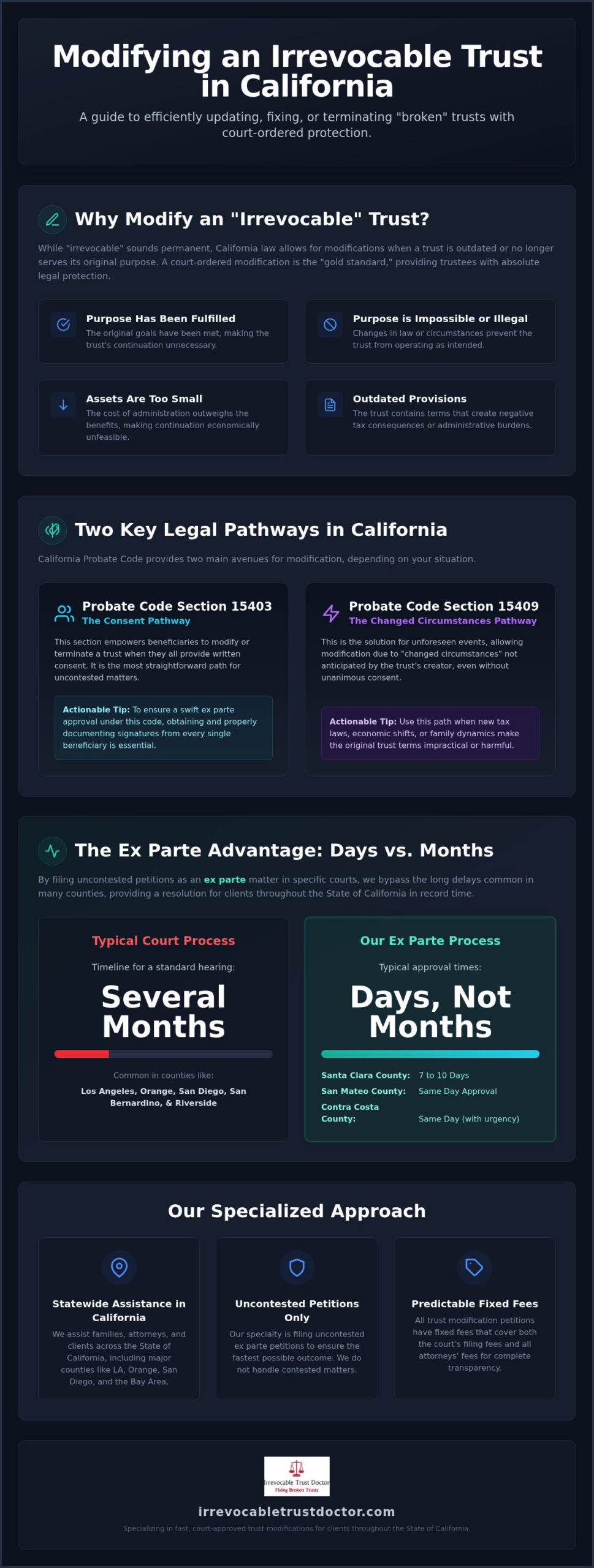
One of the biggest concerns for families and attorneys in counties like Los Angeles, Orange, and San Bernardino is the slow pace of the court system, where a simple petition can take months to be heard. However, a specialist who understands county-specific procedures can bypass these delays. By filing an uncontested petition as an ex parte matter, it is possible to get a judge’s order in a matter of days, not months.
The ex parte advantage allows a petitioner to present their case to a judge for immediate consideration without a formally scheduled hearing. This is reserved for uncontested matters where all parties are in agreement and proper notice has been given. Our office specializes in this approach, leveraging the efficiency of specific Bay Area courts to serve clients throughout the State of California.
- Santa Clara County: Petitions filed ex parte are typically reviewed and granted in just 7 to 10 days.
- San Mateo County: With proper preparation, petitions can often be filed, heard, and granted on the very same day.
- Contra Costa County: Same-day results are also achievable, especially when "urgency" can be demonstrated to the court’s satisfaction.
The Standard Noticed Hearing Timeline
Without the ex parte strategy, a standard petition requires setting a hearing date 30 to 60 days in the future. All interested parties must receive formal notice of this hearing, and the process moves at the court’s regular, often congested, pace. This is the timeline that our specialized practice is designed to avoid for our clients, whether they reside in Riverside, Ventura, or Marin County.
Criteria for an Uncontested Ex Parte Petition
The key to achieving these rapid results is a perfectly prepared petition. A specialist attorney ensures the documentation anticipates and answers every potential question a judge might have, demonstrating that the modification is legally justified and all procedural requirements have been met. The single most important element is having signed consents from all beneficiaries. This transforms the petition from a potential dispute into a simple administrative approval, making it eligible for the fastest possible judicial review.
The Fixed-Fee Advantage and Statewide Support
Legal processes are often associated with unpredictable, open-ended hourly billing, which creates significant anxiety for clients. We eliminate this uncertainty. All uncontested trust modification petitions are handled on a fixed-fee basis. This transparent pricing model covers all court filing fees and attorney fees from start to finish, so you know the exact cost before the process even begins.
This approach provides predictability and peace of mind. We also frequently act as a "specialist fixer" for general practice attorneys across California who need expert assistance with a complex trust modification for their clients. By partnering with us, they can deliver a fast, efficient solution without becoming experts in this niche area of probate law.
Statewide Assistance from a Certified Specialist
Our office, based in San Jose, files all petitions in the highly efficient Santa Clara County Probate Court. This allows us to provide expert assistance to families, individuals, and their legal counsel throughout the State of California, from San Diego to Sacramento, without requiring them to travel. By leveraging our deep knowledge of local court procedures, we can secure court orders in days, avoiding the multi-month delays common in other county courts like those in Alameda and San Francisco.
This specialized expertise in uncontested trust petitions significantly reduces the risk of court rejection and ensures the fastest, most cost-effective path to modifying your "broken" trust. For more information on our pricing, you can review our transparent fees and costs.
Next Steps: Your Trust Diagnostic Consultation
If you are a trustee, beneficiary, or attorney dealing with a problematic irrevocable trust, the first step is to determine the best path forward. A Trust Diagnostic Consultation can assess the feasibility of a modification. To prepare, you should gather your trust documents and a clear understanding of the changes you wish to make. During the consultation, we can determine the fastest legal path to modify your specific irrevocable trust and achieve your goals.
Book your Trust Petition Consultation today to get started.
Frequently Asked Questions (FAQs)
**Can an irrevocable trust be modified without going to court in California?
**
While a private agreement (non-judicial modification) is sometimes possible with the consent of the settlor and all beneficiaries, it often lacks the legal finality that financial institutions require. A court-ordered modification provides the trustee with complete liability protection and is universally accepted.
**How long does it take to get a petition to modify a trust granted in San Mateo County?
**
For a properly prepared and uncontested ex parte petition, it is often possible to have it filed, heard, and granted on the same day in San Mateo County.
**What is the difference between Probate Code 15403 and 15409 for trust modification?
**
Probate Code Section 15403 is used for modifications when all beneficiaries consent to the change. Probate Code Section 15409 is used when there are "changed circumstances" that frustrate the trust’s purpose, which allows a court to approve modifications even without unanimous beneficiary consent.
**Does a petition to modify an irrevocable trust require a formal hearing?
**
Not always. If the petition is uncontested and filed ex parte in a court familiar with these procedures (like Santa Clara or San Mateo County), a judge can often sign the order without a formal hearing, significantly speeding up the process.
**How much are the fixed fees for a trust modification petition in California?
**
Our office handles all uncontested trust modification petitions on a fixed-fee basis. This single fee includes all court filing costs and attorney fees, providing complete cost certainty from the beginning.
**Can a trustee be held liable for modifying a trust with a court order?
**
No. Obtaining a court order is the primary way a trustee protects themselves from future liability. Once the court approves the modification, the trustee is legally authorized and protected when acting in accordance with the judge’s order.

Article by
Robert P. Bergman, Attorney at Law
Attorney Robert P. Bergman ("Bob Bergman") has been a Board-Certified Specialist in Estate Planning, Trust and Probate Law since 2011, as certified by the California State Bar Board of Legal Specialization. For several years, Bob has assisted families and the clients of other attorneys with obtaining court orders through trust modification petitions to make necessary modifications to existing irrevocable trusts. Bob is friendly, very approachable, and believes in explaining complex legal topics in clear ordinary language so that his clients understand exactly what they're doing and why they're doing it.
Bob is often able to assist clients throughout California who are in other counties than his home county of Santa Clara through his approach to trust modification petitions.