
Disclaimer
This article is for informational purposes only. Nothing in this article is intended to replace legal advice from a competent attorney or be considered legal guidance for anybody's specific legal situation. Nobody should rely on information in this article in making legal decisions without such consultation.
Most people believe that once a trust is labeled "irrevocable," its terms are carved in stone forever, but that’s simply not true under California law. If you feel stuck because a trust no longer serves its intended purpose, then you’re likely facing the common anxiety of high hourly fees and confusion over the California Probate Code. Working with an irrevocable trust modification specialist allows you to fix a "broken" trust by using specific legal petitions to update its terms. I assist both individuals and fellow attorneys throughout California by filing petitions under Probate Code Section 15403 and Probate Code Section 15409 to ensure your legal documents reflect current needs.
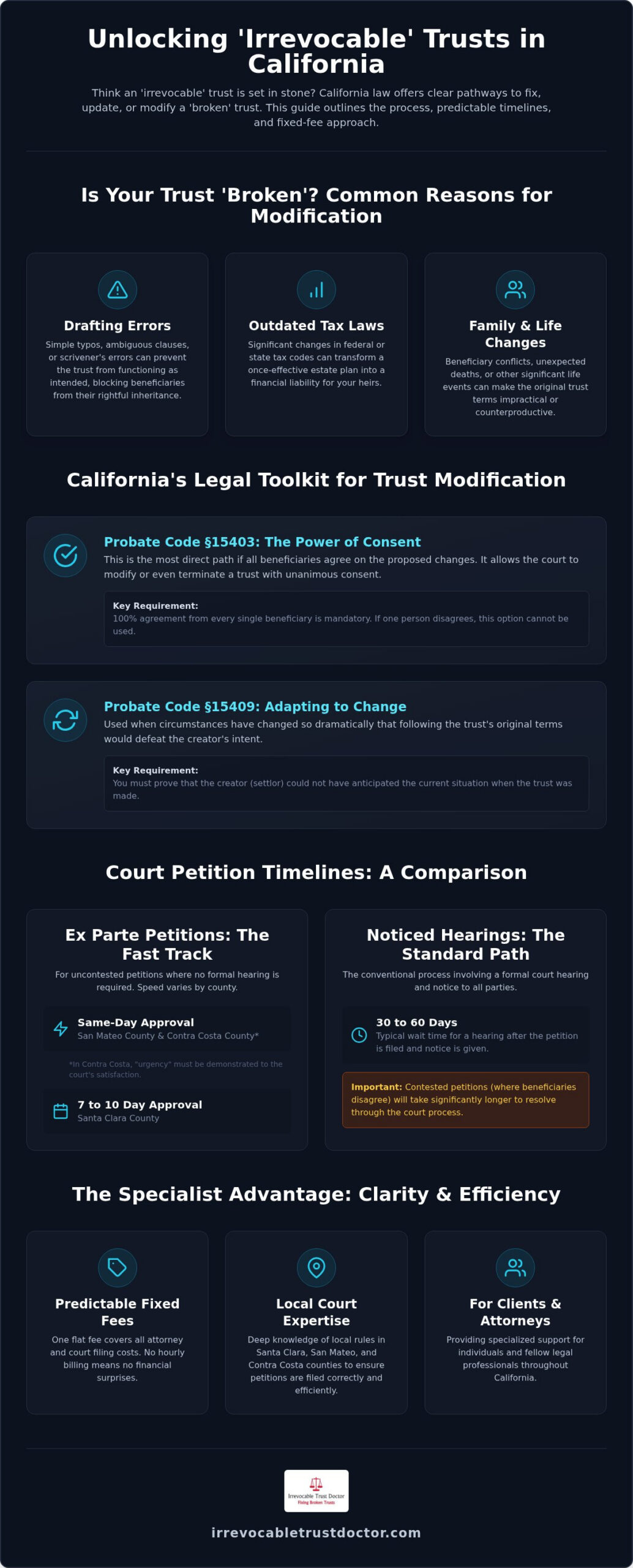
My practice focuses on filing "ex parte" petitions, which is a way to get a court order quickly without a formal hearing. In Santa Clara County, these are typically granted in 7 to 10 days, while in San Mateo and Contra Costa Counties, they can often be granted the same day if urgency is demonstrated to the court. Because I use a fixed-fee model that covers both filing and attorney fees, you’ll know exactly what to expect from the start. This guide explains how we use these specific California statutes and expedited court procedures to provide a predictable, fast resolution for your trust issues.
Key Takeaways
- Learn how an irrevocable trust modification specialist applies specific California statutes to fix errors or outdated terms in documents previously thought to be permanent.
- Find out how to potentially secure a court order in as little as 1 to 10 days using expedited filing procedures in Santa Clara, San Mateo, or Contra Costa Counties.
- Gain financial clarity through a fixed-fee billing structure that eliminates the uncertainty of hourly rates and covers all necessary court filing costs.
- Determine if your trust qualifies for a modification through the consent of all beneficiaries or by demonstrating circumstances the original creator didn’t anticipate.
Why You Need an Irrevocable Trust Modification Specialist in California
Many people assume an irrevocable trust is a permanent, unchangeable document. While that is the general rule, life doesn’t always go as planned. An irrevocable trust modification specialist acts as a legal "fixer" for trusts that have become dysfunctional due to drafting errors, changes in tax law, or beneficiary conflicts. This condition, often called "Broken Trust" syndrome, occurs when the trust’s original instructions no longer align with current reality or the settlor’s intent.
If you have spoken to a general estate planner about changing a trust, you might have been told it’s impossible. Most planners focus on drafting new documents; they often avoid court petitions because the procedural requirements are highly technical and carry a high risk of rejection if not handled perfectly. This is where a California Irrevocable Trust Modification Attorney steps in. These specialists possess the niche expertise required to navigate the Probate Court system and successfully petition a judge to reform or terminate a trust document that is no longer working.
Certified Specialist vs. General Practitioner
The California State Bar offers a specific certification in Estate Planning, Trust, and Probate Law. To earn this title, an attorney must pass a rigorous exam, demonstrate extensive experience, and receive favorable evaluations from peers and judges. When you work with a specialist, you’re hiring someone who understands the granular local rules in counties like Santa Clara or Contra Costa. These local nuances often determine whether a petition is granted in a matter of days or dragged out for months through unnecessary hearings.
Common Reasons to Seek a Modification
Trusts often need a "tune-up" or a complete overhaul for several practical reasons:
- Correcting Drafting Mistakes: A simple typo or a poorly worded clause can prevent beneficiaries from receiving their inheritance as the creator intended.
- Tax Efficiency: Significant changes in federal or state tax codes can turn a once-smart estate plan into a financial burden for heirs.
- Probate Code Updates: California law evolves constantly. A trust written twenty years ago might not take advantage of modern statutory protections that exist today.
- **Asset Protection for Heirs and Beneficiaries: **Older trusts do not have asset protection for heirs and beneficiaries or special planning for special needs heirs and beneficiaries.
Navigating California Probate Code Sections 15403 and 15409
California law provides specific legal pathways to update or terminate a trust that was meant to be unchangeable. These aren’t loopholes; they are established statutes designed to ensure that a trust continues to serve the best interests of its beneficiaries or the original intent of the person who created it. As an irrevocable trust modification specialist, I focus on two primary sections of the California Probate Code to petition the court for these necessary changes. The first step in any case is a trust petition consultation to determine which of these statutes provides the strongest legal ground for your specific situation.
Probate Code 15403: The Power of Beneficiary Consent
If every beneficiary named in the trust agrees to a change, Probate Code Section 15403 allows the court to modify or even end the trust. This is often the most straightforward path, but it requires total agreement. If even one beneficiary refuses or is unable to consent, this section cannot be used. Additionally, the court may still deny the request if the modification would defeat a "material purpose" of the trust. A material purpose is the core reason the trust was created, such as protecting a beneficiary from their own financial mismanagement. If the proposed change undermines that core goal, the judge has the authority to block it.
Probate Code 15409: Handling Unforeseen Circumstances
Life changes in ways that the settlor, the person who created the trust, could never have predicted. Probate Code Section 15409 allows for modification when circumstances have changed so significantly that following the original trust language would frustrate the settlor’s intent. Common examples include massive shifts in federal tax laws, the unexpected death of a key family member, or extreme family estrangement. In these cases, I petition the court by demonstrating that the current trust terms have become a hindrance rather than a help. If you’re unsure if your situation qualifies, you can schedule a diagnostic review of your trust to explore your legal options.
The Court Petition Process: Timelines for California Residents
Many people hesitate to fix a broken trust because they assume the court system is a slow, expensive labyrinth. While traditional litigation can certainly drag on, an irrevocable trust modification specialist uses specific procedural tools to move your case through the system with surgical precision. The typical journey follows a structured five-step path: it begins with a trust petition consultation to evaluate your case, followed by drafting the legal documents, filing with the Superior Court, judicial review, and finally, the issuance of the court order.
Expedited Results: The Ex Parte Advantage
The fastest way to modify a trust is through an "ex parte" petition. This is a request for a court order without the standard, lengthy notice periods required for a formal hearing. My practice frequently utilizes this method for uncontested modifications in specific Bay Area counties. If your case is filed in Santa Clara County, the petition is typically granted in 7 to 10 days without you ever needing to step into a courtroom. In San Mateo County, the process is even faster; petitions can often be filed, heard, and granted on the very same day. For those in Contra Costa County, same-day results are also possible if we can demonstrate "urgency" to the Court’s satisfaction. If you’re ready to see if your case qualifies for these timelines, you can schedule your consultation here.
Noticed Hearings and Contested Petitions
If an ex parte filing isn’t appropriate for your situation, we move to a noticed hearing. This is the standard procedure where we provide formal notice to all interested parties. You should expect a timeline of 30 to 60 days after filing for the court to hear the matter, with additional time needed to ensure everyone is properly notified. It’s also important to understand that contested petitions, where beneficiaries disagree on the changes, will take significantly longer. However, by working with a specialist who understands these local court rules, you can avoid the procedural errors that often stall cases for months.
Fixed Fees and Next Steps for Trust Modification
Anxiety over unpredictable legal bills often prevents people from seeking the help they need to fix a dysfunctional trust. I address this concern directly by using a fixed-fee model for every trust modification petition I handle. This approach ensures total transparency; the flat fee you’re quoted is all-inclusive, covering both my professional time and the required court filing costs. You won’t have to worry about mounting hourly invoices or surprise expenses while we work toward a resolution.
Assisting Clients and Legal Counsel Statewide
While my practice has a deep focus on the specific local rules of Northern California, I assist clients and fellow attorneys throughout the entire state. I often act as a specialized "lawyer for lawyers" when an estate planning firm encounters a complex modification that requires a deep dive into Probate Code Sections 15403 or 15409. Whether you’re a beneficiary in San Diego or an attorney in Sacramento, I provide the niche expertise needed to navigate these technical court petitions successfully. If you’re ready to move forward, you can book a trust petition consultation to discuss your case details.
Preparing for Your Consultation
To make our initial meeting as productive as possible, it helps to have your records organized. This preparation allows me to quickly diagnose the "Broken Trust" syndrome and determine which statutory path offers the highest chance of success. Please have the following items ready:
- The original signed trust document.
- Copies of any and all previous amendments.
- A brief summary of the specific changes you wish to make or the problems you need to solve.
Working with an irrevocable trust modification specialist transforms a seemingly permanent problem into a manageable legal task. By using a methodical, fixed-fee approach, I provide the clarity and order necessary to fix your documents correctly. Schedule your consultation with the Irrevocable Trust Doctor today to take the first step toward a functional estate plan.
Take Control of Your "Broken" Trust Today
Resolving the technical complexities of California’s Probate Code doesn’t have to be a source of constant anxiety. You’ve seen how specific statutes allow us to modify documents that once seemed permanent. Whether you’re a beneficiary seeking a change or an attorney needing local expertise, an irrevocable trust modification specialist can streamline the process. I provide the technical precision needed to secure court orders quickly. This includes the possibility of same-day grants in counties like San Mateo and Contra Costa when urgency is demonstrated to the court.
As a Certified Specialist in Estate Planning, Trust, and Probate Law, I prioritize financial transparency through a fixed-fee model that covers all your legal and filing costs. You don’t have to settle for a trust document that no longer reflects your family’s needs or current tax laws. It’s time to move from uncertainty toward a practical, court-approved resolution. I look forward to helping you restore order to your estate plan.
Book Your California Trust Petition Consultation
Frequently Asked Questions
Can an irrevocable trust really be changed in California?
Yes, you can modify an irrevocable trust in California by filing a specific petition under Probate Code Section 15403 or 15409. These statutes provide a legal pathway to update documents when all beneficiaries agree or when life circumstances change in ways the original creator didn’t expect. An irrevocable trust modification specialist knows how to present these facts to the court to ensure the trust continues to serve its intended purpose.
What is the difference between a noticed hearing and an ex parte petition?
A noticed hearing is the standard court process where a judge schedules a formal date 30 to 60 days after filing. This allows time for all interested parties to receive legal notice and voice any objections. In contrast, an ex parte petition is an expedited request handled without a formal hearing. This method is much faster, often resulting in an order within days if the modification is uncontested and drafted correctly.
How much does it cost to modify an irrevocable trust in California?
I use a fixed-fee model for every trust modification petition I handle in California. This means you pay one flat price that covers both the professional attorney time and the required court filing fees. Unlike traditional firms that bill by the hour, this structure provides total transparency and eliminates the fear of unexpected costs as we navigate the court system together.
How long does the court petition process take in Santa Clara County?
The timeline in Santa Clara County depends on the type of petition filed. If we file ex parte, the court typically grants the petition in 7 to 10 days without requiring a hearing. If a noticed hearing is required, you should expect a timeline of 30 to 60 days plus additional time for notice. Contested cases where parties disagree will naturally take longer, making the specialist’s role in securing consent vital for speed.
Do I need to hire a local attorney if my trust was drafted in another county?
You don’t need to hire an attorney from the county where the trust was originally written. However, it’s highly beneficial to work with a practitioner who has a deep understanding of the local rules in the county where the petition will be filed. I assist clients and other attorneys throughout California, using my specialized experience in Santa Clara, San Mateo, and Contra Costa Counties to achieve faster results through their specific procedural requirements.

Article by
Robert P. Bergman, Attorney at Law
Attorney Robert P. Bergman ("Bob Bergman") has been a Board-Certified Specialist in Estate Planning, Trust and Probate Law since 2011, as certified by the California State Bar Board of Legal Specialization. For several years, Bob has assisted families and the clients of other attorneys with obtaining court orders through trust modification petitions to make necessary modifications to existing irrevocable trusts. Bob is friendly, very approachable, and believes in explaining complex legal topics in clear ordinary language so that his clients understand exactly what they're doing and why they're doing it.
Bob is often able to assist clients throughout California who are in other counties than his home county of Santa Clara through his approach to trust modification petitions.