
Disclaimer
This article is for informational purposes only. Nothing in this article is intended to replace legal advice from a competent attorney or be considered legal guidance for anybody's specific legal situation. Nobody should rely on information in this article in making legal decisions without such consultation.
What if the “irrevocable” trust you’re managing has become a financial burden instead of a benefit? Many trustees and beneficiaries believe they’re stuck with outdated terms, but simply following the rules isn’t enough when those rules lead to unexpected tax liabilities or administrative costs that outweigh the trust’s value. It’s a common struggle, yet California law provides a specific “escape hatch” for these situations. By understanding the legal grounds for trust modification California courts recognize, you can transition from struggling with a stagnant document to implementing a solution that actually works for your family today.
In this guide, I’ll show you how to distinguish between standard trust administration and the formal petition process required to fix a broken trust. We’ll look at how Probate Code Section 15403 and Probate Code Section 15409 allow for changes when circumstances shift or all beneficiaries agree. If you’re dealing with an urgent matter, you’ll see how I regularly help clients and fellow attorneys secure fast-track results through ex parte petitions. In Santa Clara County, these are often granted in 7 to 10 days, while San Mateo and Contra Costa can sometimes be resolved the same day. I handle these petitions with a straightforward fixed fee that covers everything from filing costs to legal work, providing the clarity you need to move forward.
Key Takeaways
- Learn to identify when a trust is “broken” and why standard administration must give way to a formal modification petition to protect your interests.
- Explore the specific grounds for trust modification California recognizes, including beneficiary consent under Probate Code 15403 and changed circumstances under Section 15409.
- Discover how to navigate the court system efficiently using ex parte petitions that can resolve uncontested matters in as little as 7 to 10 days.
- Understand the roadmap for noticed hearings and why a fixed-fee structure provides the most predictable path for both clients and collaborating attorneys.
Trust Modification vs. Administration: Understanding the Baseline
A trust is a legal relationship where a trustee manages assets for the benefit of others. Trust administration is the act of driving that vehicle. You follow the map provided by the person who created the trust, paying bills and distributing assets exactly as they were written. Trust modification, however, is a diagnostic process used when that map is fundamentally broken. If the road is gone or the destination no longer exists, you don’t just keep driving; you petition the court to redraw the route.
When tax laws shift or family dynamics change, standard administration often fails. Simply following the rules might lead to a dead end where the trust’s original purpose is defeated. This is why understanding the specific grounds for trust modification California law provides is essential. It moves you from simply following orders to actively protecting the trust’s integrity. Whether you’re a trustee or a beneficiary, identifying these “broken” terms early can save years of frustration and thousands of dollars in wasted assets.
The Legal Risks of “Self-Help” Administration
It’s tempting for a trustee to simply ignore an outdated term, but “self-help” administration is a dangerous path. If you fail to follow the trust document without a court order, you open yourself up to claims of breach of fiduciary duty. This is a legal claim that you failed in your responsibility to manage the trust correctly. Beneficiaries can sue if they feel your “creative” administration harmed their interests. To avoid this, I help clients use Probate Code Section 15403 or Section 15409 to obtain formal court approval. This protects the trustee and ensures the changes are legally binding for everyone involved.
Signs Your Irrevocable Trust Needs a Diagnostic Fix
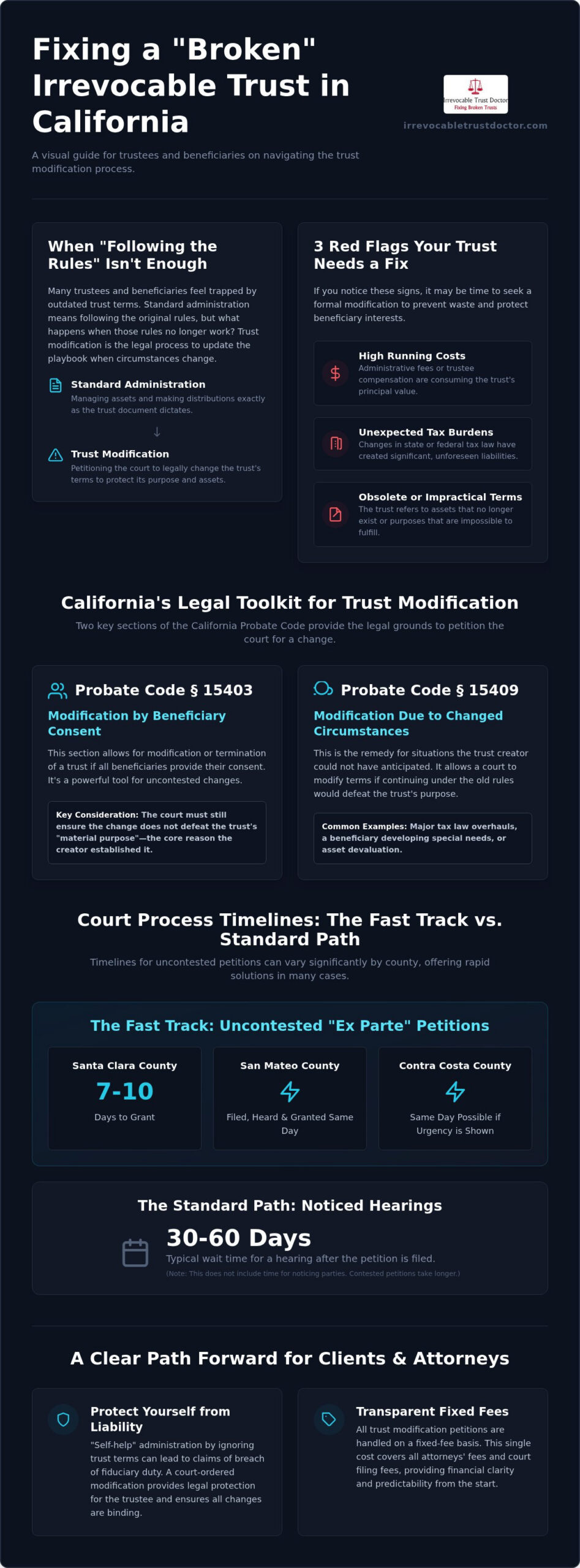
How do you know if a trust is “broken”? Look for these specific red flags:
- Administrative costs, such as accounting fees or trustee compensation, are eating up the trust principal.
- Tax liabilities have increased significantly because of changes in state or federal law since the trust was written.
- The trust terms are obsolete, such as a requirement to fund a business that no longer exists or to care for a pet that has passed away.
If any of these apply, you likely have the necessary grounds for trust modification California courts look for to grant relief. Whether you need an ex parte petition in Santa Clara County for a 7 to 10-day resolution or a standard 30 to 60-day noticed hearing, I provide a clear path forward with fixed fees that cover all costs.
Grounds for Trust Modification: California Probate Code 15403 and 15409
When a trust document becomes dysfunctional, we turn to two specific statutes. These provide the primary grounds for trust modification California courts require to approve changes to an irrevocable document. While these codes are technical, they serve as the diagnostic tools I use to restore a trust to health. I assist both attorneys and individual clients throughout the state in navigating these petitions to ensure the legal framework matches current realities.
Modifying with Beneficiary Consent (PC 15403)
If every beneficiary agrees that the trust terms need an update, California Probate Code 15403 offers a clear path. This section allows for modification or even termination if all beneficiaries consent. However, the court must still consider the “material purpose” of the trust. A material purpose is the core reason the settlor created the trust; for instance, ensuring a child reaches a certain age before receiving a full inheritance or protecting assets from creditors. If the proposed change honors that intent while fixing administrative flaws, the court is likely to grant the petition.
Changed Circumstances and Judicial Discretion (PC 15409)
Probate Code 15409 is the primary legal remedy for trusts rendered obsolete by events the settlor never saw coming. This “Changed Circumstances” doctrine allows the court to modify a trust if staying the course would defeat or substantially impair the trust’s goals. Common examples include massive overhauls in tax law, a beneficiary developing special needs, or asset devaluation that makes the trust too expensive to run. Identifying these shifts provides the necessary grounds for trust modification California judges look for when exercising their discretion.
In these cases, the court has the power to reform the trust to meet modern needs. Whether you’re looking for a specialized partner for your law firm or you’re a trustee trying to fix a broken plan, you can schedule a consultation to review your options. I handle these petitions with a transparent fixed-fee structure that covers both filing fees and attorneys’ fees, providing financial predictability throughout the entire process.
The California Court Process: Timelines and County Variations
Once we establish the legal grounds for trust modification California law demands, the focus shifts to the court’s procedural mechanics. Navigating the probate system requires a deep understanding of how different counties handle petitions. While some courts are heavily backlogged, others offer efficient “fast track” options through ex parte petitions. An ex parte petition is a request made to the court without a formal, long-term hearing date, allowing for a rapid resolution of uncontested matters where delay would cause harm.
I assist both attorneys and clients across the state in determining which procedural path fits their specific needs. Whether you’re dealing with a simple administrative fix or a complex change in trust purpose, the venue matters. Each county has its own local rules and judicial preferences that can significantly impact how quickly your petition is granted.
Fast-Track Timelines in the Bay Area
My regular practice involves filing uncontested petitions in specific Bay Area counties where I can achieve accelerated results. If your trust matter is in Santa Clara County, ex parte petitions are typically granted within 7 to 10 days. In San Mateo County, the process is even more streamlined; petitions can often be filed, heard, and granted on the same day. Similarly, in Contra Costa County, we can frequently secure same-day orders if we demonstrate “urgency” to the Court’s satisfaction under California Probate Code 15409.
What to Expect in a Standard Noticed Petition
Not every situation qualifies for an ex parte hearing. Most standard petitions follow a “noticed” roadmap, which typically takes 30 to 60 days after the initial filing. This window is necessary to provide proper legal notice to all interested parties, such as beneficiaries or creditors, giving them time to review the proposed changes. If a petition becomes contested, the timeline will extend as the court requires more evidence. Regardless of the schedule, I manage these petitions for a fixed fee that covers all filing and attorney costs. If you’re ready to move forward, book a trust petition consultation today to review the specific timeline for your county.
How The Irrevocable Trust Doctor Fixes Broken Trusts
Most estate planning firms focus on the initial creation of documents, but my practice is built around the diagnostic repair of trusts that have already failed. I don’t handle general civil litigation or family law; instead, I serve as a “specialist fixer” for irrevocable trusts that are no longer functional. By focusing exclusively on court petitions, I can navigate the specific grounds for trust modification California judges require with a level of precision that general practitioners may not possess.
Whether you’re a trustee struggling with an obsolete distribution schedule or a beneficiary facing unexpected tax consequences, my goal is to restore the trust’s original purpose. I take a methodical, hands-on approach to every petition, ensuring that the legal framework is corrected so the trust assets can be managed effectively again.
Fixed Fees for Predictable Legal Costs
One of the biggest hurdles in trust modification is the fear of open-ended hourly billing. Court processes can feel unpredictable, but your legal costs shouldn’t be. I eliminate this anxiety by offering a transparent, fixed-fee structure for all trust modification petitions. This single price covers everything from the initial drafting of the petition to the final court order, including all filing fees. You can find detailed fee information on my website to help you plan your budget with confidence.
Assisting Attorneys and Clients Statewide
My work isn’t limited to individual clients; I frequently act as a collaborative partner for other attorneys throughout California. Many estate lawyers are excellent at planning but prefer to avoid the specific procedural quirks of filing petitions under Probate Code Sections 15403 and 15409. I step in to provide that specialized expertise, representing clients from San Diego to Sacramento while keeping their existing legal team informed.
If you’re ready to address a broken trust, the first step is a diagnostic review of the document and the current circumstances. Schedule your Trust Petition Consultation today to discuss the grounds for trust modification California law provides for your specific situation. We’ll build a roadmap together to fix the problem and secure the court order you need.
Take Control of Your Trust’s Future
Managing an irrevocable trust that no longer serves its purpose is a heavy burden, but you don’t have to carry it indefinitely. You’ve seen how identifying the specific grounds for trust modification California courts recognize allows you to fix outdated terms through Probate Code Sections 15403 or 15409. Whether you need an urgent same-day ex parte filing in San Mateo or Contra Costa Counties or a standard 30 to 60-day noticed hearing, there is a clear roadmap to a functional resolution.
As a Certified Specialist in Estate Planning, Trust, and Probate Law, Robert P. Bergman provides the technical precision needed to navigate these complex petitions. I handle the entire process for a predictable fixed fee that includes all court filing fees, ensuring you have total transparency from start to finish. If you’re ready to move from administrative frustration to a practical solution, Book a Trust Petition Consultation with the Irrevocable Trust Doctor. You have the power to protect the trust’s original intent while adapting to today’s realities; let’s start fixing what’s broken today.
Common Questions About California Trust Modification
Can an irrevocable trust be changed if the settlor is already deceased?
Yes, you can modify a trust even after the person who created it has passed away. In fact, most petitions regarding the grounds for trust modification California law allows involve trusts that became irrevocable precisely because of the settlor’s death. We use Probate Code sections to address issues that the original creator couldn’t have predicted, such as new tax regulations or a beneficiary’s changed financial needs. This allows the trust to remain a functional tool for the family.
What is the difference between trust modification and trust reformation in California?
The primary difference lies in the timing and the goal of the change. Trust modification adjusts the terms of the document from this point forward to accommodate new realities or beneficiary agreement. Reformation is a “look-back” tool used to correct a specific drafting mistake or fraud so the document reflects what the settlor actually intended from the start. Both require a formal petition but serve different diagnostic purposes for a broken trust.
How long does it take to modify a trust in Santa Clara County?
The timeline depends on whether the petition is contested and how it’s filed. For uncontested matters in Santa Clara County, an ex parte petition is typically granted within 7 to 10 days. If the matter requires a standard noticed hearing, you should expect a timeline of 30 to 60 days to allow for the mandatory notice period for all interested parties. Contested matters will naturally take longer depending on the court’s calendar.
Do I need to fire my current estate lawyer to file a modification petition with you?
No, you don’t need to end your relationship with your existing attorney. I frequently act as a “specialist fixer” who collaborates with your current estate lawyer to handle the technical court petition phase. This partnership allows you to keep your trusted advisor while benefiting from specialized expertise in navigating the grounds for trust modification California probate courts require. I represent clients and assist fellow attorneys across the entire state.
Are there fixed fees for filing a trust modification petition in California?
Yes, I handle all trust modification petitions using a transparent fixed-fee model. This single price covers both the court filing fees and all attorneys’ fees, eliminating the financial uncertainty of hourly billing. Whether we’re filing a same-day petition in San Mateo or a noticed hearing in Southern California, you’ll know the exact cost before we begin the process. This predictability is vital for trustees who must manage trust assets responsibly.

Article by
Robert P. Bergman, Attorney at Law
Attorney Robert P. Bergman ("Bob Bergman") has been a Board-Certified Specialist in Estate Planning, Trust and Probate Law since 2011, as certified by the California State Bar Board of Legal Specialization. For several years, Bob has assisted families and the clients of other attorneys with obtaining court orders through trust modification petitions to make necessary modifications to existing irrevocable trusts. Bob is friendly, very approachable, and believes in explaining complex legal topics in clear ordinary language so that his clients understand exactly what they're doing and why they're doing it.
Bob is often able to assist clients throughout California who are in other counties than his home county of Santa Clara through his approach to trust modification petitions.