
Disclaimer
This article is for informational purposes only. Nothing in this article is intended to replace legal advice from a competent attorney or be considered legal guidance for anybody's specific legal situation. Nobody should rely on information in this article in making legal decisions without such consultation.
This article is for informational purposes only. Nothing
in this article is intended to replace legal advice from a competent attorney
or be considered legal guidance for anybody’s specific legal situation. Nobody
should rely on information in this article in making legal decisions without
such consultation.
What if the "permanent" trust that’s currently draining your family’s wealth or causing endless arguments isn’t actually permanent at all? It’s common to feel trapped by rigid trust terms that no longer serve their purpose, especially when they lead to high taxes or beneficiary disputes that seem impossible to resolve. You might believe that "irrevocable" means "unchangeable," but under California law, that is simply not the case. This Complete guide to The Irrevocable Trust Doctor reveals how specialized legal petitions can fix, update, or terminate trusts that have become dysfunctional.
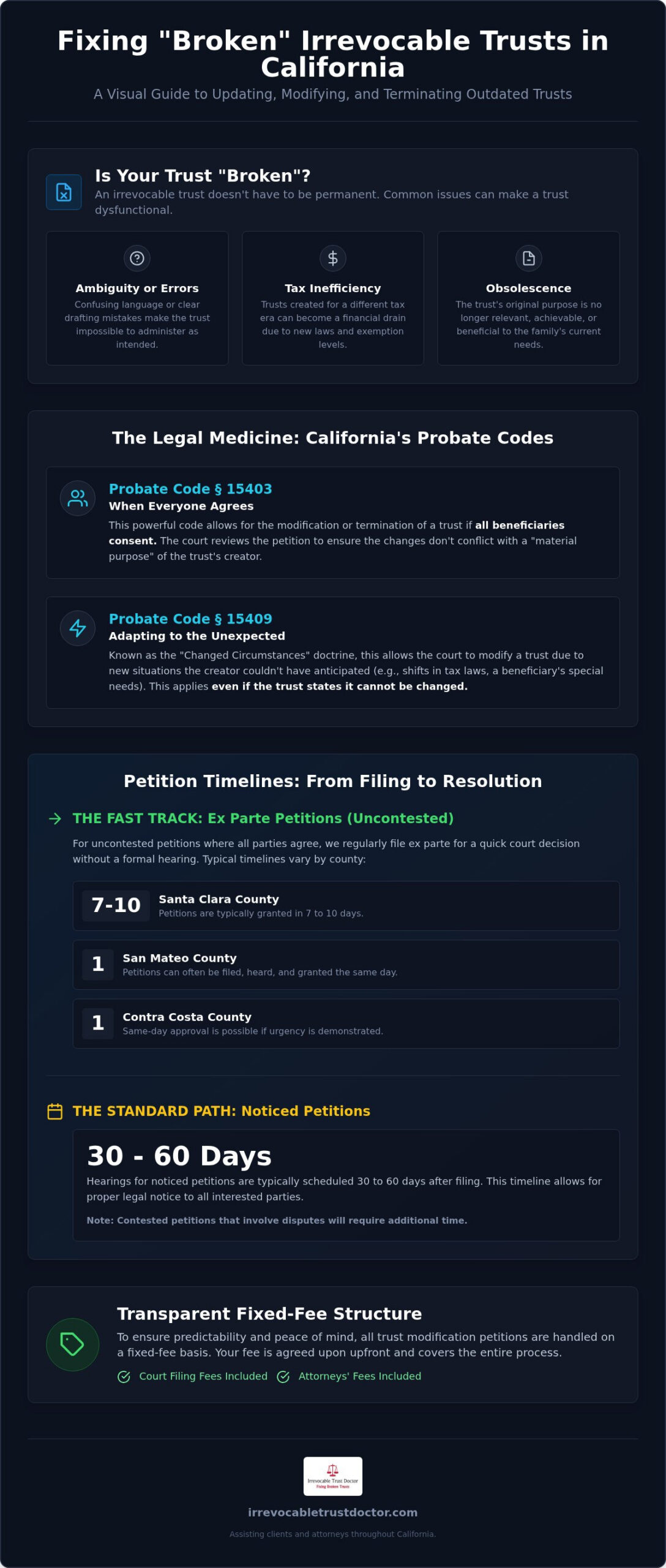
We’ll look at how Probate Code Section 15403 and Section 15409 allow us to petition the court for necessary changes. For many clients and attorneys throughout California, this process is much faster than expected. We’ll explain how ex parte filings, which are requests made to the court for a quick decision, can be granted in as little as 7 to 10 days in Santa Clara County. In San Mateo or Contra Costa Counties, these petitions can often be heard and granted the same day if we can demonstrate urgency to the court’s satisfaction. This guide outlines the roadmap to a fast resolution with predictable fixed fees, helping you move from legal gridlock to a clear, updated plan.
Key Takeaways
- Identify common triggers that “break” a trust, such as outdated tax structures or drafting errors, and learn how to restore the document’s original intent.
- This Complete guide to The Irrevocable Trust Doctor explains how to utilize California Probate Code Sections 15403 and 15409 to legally modify or terminate even the most rigid trust agreements.
- Discover how ex parte filings can bypass lengthy formal hearings, securing court orders in as little as one day in San Mateo and Contra Costa Counties or 7 to 10 days in Santa Clara County.
- Understand the financial benefit of a transparent fixed-fee structure that covers both court filing fees and attorney fees for the entire modification petition process.
- Learn how both individual clients and their existing attorneys throughout California can leverage specialized expertise to navigate complex probate court procedures efficiently.
**What is The Irrevocable Trust Doctor? Fixing
"Broken" Trusts in California**
Many people view an irrevocable trust like a locked vault.
While that’s the general idea behind this type of trust, life rarely stays
static. Laws change, families evolve, and drafting mistakes happen. The
Irrevocable Trust Doctor is a specialized legal service designed specifically
to modify or terminate trusts that are no longer functional. Led by Robert P.
Bergman, a Certified Specialist with over 40 years of experience, we act as
"legal diagnosticians" for documents once thought to be set in stone.
We don’t just serve the Bay Area; we assist clients and
fellow attorneys throughout California, from San Diego to Sacramento and the
Oregon border, throughout the Central Valley and beyond. This **Complete
guide to The Irrevocable Trust Doctor **explores how we use surgical legal
precision to update trusts that have become a financial or emotional burden. If
a trust is "broken," it simply means the document’s current terms
conflict with the current tax environment or the beneficiaries’ actual needs.
Signs Your Irrevocable Trust Needs a "Doctor"
You might feel stuck, but there’s usually a way out. Common
triggers for a trust modification include:
- **Ambiguity:
**The trust language is confusing or contains clear drafting mistakes
that make administration impossible. - **Tax
Inefficiency for Joint Trusts: **Federal estate tax exemptions are set
at $15 million per person for 2026. If your trust was built for a
different tax era, it might be costing you more than it saves. This may involve removing the
requirement that trust assets be split at the death of the first spouse creating
a bypass trust, or else including a general power of appointment in favor
of the surviving spouse where a bypass trust has already been created. Both options will permit all the assets
of the trust to receive an income tax “step up” in cost basis at the death of
the surviving spouse First - **Obsolescence:
**The original purpose of the trust is no longer achievable or even
relevant to the family’s current situation. - **Providing
Asset Protection for Heirs: **Modifying
a trust to include asset protected trusts (what we call “Castle Trust”)
for the inheritance to be received by the heirs modifying the trust to
include asset protection for the inheritance to be received by the heirs - **Obsolescence:
**The original purpose of the trust is no longer achievable or even
relevant to the family’s current situation. - **Special
Needs Beneficiaries: **Modifying
the distribution to an heir so there is not an outright distribution but
instead in a Supplemental Needs Trust in order to avoid the special needs
beneficiary losing benefits.
The Collaborative Model: Assisting Other Attorneys
We often partner with general estate lawyers who don’t
specialize in the specific mechanics of probate court petitions, especially those
in counties that take several months for a resolution. We provide the
"litigation-lite" expertise needed to navigate the court system
without the hostility of a full-blown lawsuit. By focusing exclusively on trust
modification petitions, we help other firms deliver fast results for their
clients. If you’re an attorney or a trustee facing a rigid document, you
can reach
out for a consultation to see how we can help fix the problem.
The Legal Medicine: California Probate Code 15403 and
15404
While some states make it nearly impossible to open a
"locked vault" trust, California provides specific statutory keys.
These laws act as the "medicine" we use to heal a trust that’s become
a burden. In this part of our Complete guide to The Irrevocable Trust Doctor,
we’ll look at the specific codes that allow for these surgical repairs. Just as a patient might seek the specialized expertise of Dr. Rodrigo Ávila Cervantes · Spine Neurosurgeon for complex physical procedures, a trust requires a specialist when its "health" is at stake.
Understanding these statutes is the first step toward regaining control over an
outdated estate plan.
Probate Code 15403: When Everyone Agrees
If all the beneficiaries agree that a change is necessary, California Probate Code 15403 is often the most
direct path. This statute allows the court to modify or even end a trust if
every person receiving assets from it consents. It isn’t always a "rubber
stamp" process, however. The court must still decide if the proposed
change interferes with a "material purpose" of the trust. For
example, if the person who created the trust specifically wanted to prevent a
beneficiary from spending everything at once, the court might be hesitant to
remove those protections unless the reason is compelling.
Probate Code 15409: Adapting to the Unexpected
Sometimes life throws a curveball that the original document
couldn’t have predicted. This is where Probate Code Section 15409, known as the
"Changed Circumstances" doctrine, comes into play. It allows the
court to modify a trust if new situations arise that weren’t known or
anticipated by the person who created the trust. Common examples include a
beneficiary developing special needs that require a different trust structure
or a massive shift in tax laws that makes the current plan counterproductive.
Even if the trust document itself says the trust cannot be modified, the court
still has the legal power to intervene under this section if the current terms
would defeat the trust’s original goals.
When the person who created the trust (the Settlor) is still
living, Probate Code Section 15404 provides even more flexibility. Their
consent combined with the beneficiaries’ can often override almost any
restriction. Before you start the court process, here’s a quick actionable tip:
review your trust for a "Trust Protector" clause. Some modern trusts
name an independent person who has the power to make these changes without ever
stepping foot in a courtroom. This Complete guide to The Irrevocable
Trust Doctor aims to help you navigate these choices. If you aren’t
sure which path applies to your situation, you can book
a trust petition consultation to review your options.
The Judicial Petition Process: Timelines and Expectations
One of the most common questions we hear is how long the
legal process actually takes. While the probate court is often viewed as a slow
moving machine, trust modification can be surprisingly fast when handled
correctly. This **Complete guide to The Irrevocable Trust Doctor **highlights
how we use specific procedural advantages to bypass the typical months of
waiting. We regularly file uncontested petitions ex parte, which is a
legal term for a request made to the court without a formal, scheduled hearing.
This approach allows us to get a judge’s signature much faster than the
standard court calendar allows.
The timeline for your petition depends heavily on which
California county has jurisdiction. In Santa Clara County, our ex parte
petitions are typically granted within 7 to 10 days. If your case is in San
Mateo County, we can often file, have the matter heard, and receive a granted
order on the same day. For Contra Costa County, same day results are also
possible if we can demonstrate "urgency" to the court’s satisfaction.
These expedited timelines are a core part of our practice for both individual
clients and the attorneys we assist throughout the state.
Ex Parte vs. Noticed Petitions
If an ex parte filing isn’t appropriate, a noticed
hearing will be necessary. Our office does not handle such matters, because it
typically means that there is or will be one or more parties who will likely object
to such a petition. In such a case, an
attorney who handles trust litigation may be a more appropriate choice. This is the standard path to ensure all interested
parties have legally sufficient time to review the changes. A noticed hearing
under California Probate Code § 15403 typically takes 30
to 60 days after filing. Contested petitions, where someone disagrees with the
modification, will naturally take longer to resolve.
What Happens After the Court Order?
Once the judge signs the ex parte order, the
"permanent" trust is officially modified. You’ll then need to update
trust records and notify financial institutions of the legal change. This
ensures the trust finally achieves its new objectives, whether that’s reducing
taxes or resolving a long standing dispute. If you’re ready to move forward,
you can book a trust petition consultation to determine
which timeline applies to your specific case.
Why Expertise and Fixed Fees Matter in Trust Modification
Navigating the California Probate Code requires more than
just a general understanding of estate law. It demands a practitioner who knows
how the local courts in Santa Clara, San Mateo, or Contra Costa counties actually
operate. While many attorneys can draft a trust template, very few specialize
in the "litigation-lite" work of fixing them after they are signed.
This Complete guide to The Irrevocable Trust Doctor emphasizes that
you need a legal diagnostician who understands court procedures as well as they
understand the statutes. Robert P. Bergman is a Certified Specialist in Estate
Planning, Trust, and Probate Law, which means he has met rigorous standards of experience
and education that general practitioners haven’t.
A "fixer" approach is vital because modifying an
irrevocable trust is a procedural challenge. It’s about moving a petition
through the court system efficiently rather than just moving text around a
page. By focusing exclusively on these types of petitions, we can offer a level
of predictability that traditional litigation firms can’t match. This expertise
allows us to evaluate the feasibility of your modification quickly and
accurately.
Transparency in Legal Costs
One of the biggest hurdles for families seeking a trust
modification is the fear of open-ended hourly billing. Trust litigation often
falls into an "hourly trap" where costs spiral out of control before
a resolution is reached. We handle our trust modification petitions
differently. We provide a fixed fee guarantee that covers both the mandatory
court filing fees and all attorneys’ fees in one transparent price. This
approach ensures you know exactly what the financial commitment will be from
the start. You can visit our Fees
and Costs page for a clear understanding of how we structure our
services to provide predictability and peace of mind.
Start Your Modification Journey Today
If you feel trapped by a trust that is no longer working,
the first step is a professional evaluation of your current document. Gathering
your existing trust agreement and any amendments is essential for an expert
review. This allows us to determine if your situation fits the criteria for a
petition under Probate Code Section 15403 or 15409. As this **Complete guide
to The Irrevocable Trust Doctor **has shown, "irrevocable" does not
have to mean permanent. When you are ready to explore your options, please contact
us to begin the diagnostic process and find the right remedy for your
trust.
Take the Next Step Toward Fixing Your Irrevocable Trust
You’ve seen that an "irrevocable" trust doesn’t
have to be a permanent burden. By using California Probate Code Sections 15403
and 15409, we can surgically repair documents that are no longer functional.
This Complete guide to The Irrevocable Trust Doctor has
outlined how we secure fast results through ex parte filings in counties
like Santa Clara, San Mateo, and Contra Costa. Whether you’re an individual or
an attorney, you can access specialized expertise with the certainty of fixed
fees that cover all filing and legal costs.
As a Certified Specialist in Estate Planning, Trust, and
Probate Law, Robert P. Bergman provides statewide coverage to help you navigate
the probate court with confidence. You don’t have to stay stuck with a trust
that no longer serves your family’s needs or reflects current tax laws. It’s
time to move from legal gridlock to a clear, actionable resolution.
Request
a Trust Modification Consultation with a Certified Specialist
Frequently Asked Questions
Can an irrevocable trust be changed in California if the
settlor has passed away?
Yes, you can modify or even terminate an irrevocable trust
after the settlor’s death. California law provides specific pathways like
Probate Code Section 15403 and Section 15409 to fix trusts that have become
dysfunctional or obsolete. This **Complete guide to The Irrevocable Trust
Doctor **explains that while the settlor’s intent is important, the court has
the power to update the document to meet current needs.
How long does it take to modify a trust in Santa Clara
County?
In Santa Clara County, an uncontested ex parte petition is
typically granted within 7 to 10 days.
Do all beneficiaries have to agree to an irrevocable
trust modification?
Not always. While Probate Code Section 15403 generally
requires consent from all beneficiaries, Probate Code Section 15409 allows the
court to modify a trust based on "changed circumstances" even if some
parties disagree. The court focuses on whether the modification helps the trust
achieve its original purpose despite new, unforeseen challenges that have
arisen since the document was first created.
What is the difference between Probate Code 15403 and
15409?
Probate Code Section 15403 is the primary tool used when all
beneficiaries agree to a change and the modification doesn’t interfere with the
trust’s material purpose. This **Complete guide to The Irrevocable Trust
Doctor **identifies Section 15409 as the "Changed Circumstances"
rule, which is used when unexpected events make the current terms impractical
or impossible to carry out, regardless of total beneficiary agreement.
Can I terminate an irrevocable trust entirely if the
assets are too small to manage?
Yes, California law allows for the termination of a trust if
the value of the assets has become too low to justify the ongoing costs of
administration. This is a practical solution for "uneconomic" trusts
that are being drained by bank fees or tax preparation costs. We handle these
termination petitions with a clear fixed fee that covers both the court filing
fees and all attorneys’ fees.
Article by
Robert P. Bergman, Attorney at Law
Attorney Robert P. Bergman ("Bob Bergman") has
been a Board-Certified Specialist in Estate Planning, Trust and Probate Law
since 2011, as certified by the California State Bar Board of Legal
Specialization. For several years, Bob has assisted families and the clients of
other attorneys with obtaining court orders through trust modification
petitions to make necessary modifications to existing irrevocable trusts. Bob
is friendly, very approachable, and believes in explaining complex legal topics
in clear ordinary language so that his clients understand exactly what they’re
doing and why they’re doing it.
Bob is often able to assist clients throughout California
who are in other counties than his home county of Santa Clara through his
approach to trust modification petitions.

Article by
Robert P. Bergman, Attorney at Law
Attorney Robert P. Bergman ("Bob Bergman") has been a Board-Certified Specialist in Estate Planning, Trust and Probate Law since 2011, as certified by the California State Bar Board of Legal Specialization. For several years, Bob has assisted families and the clients of other attorneys with obtaining court orders through trust modification petitions to make necessary modifications to existing irrevocable trusts. Bob is friendly, very approachable, and believes in explaining complex legal topics in clear ordinary language so that his clients understand exactly what they're doing and why they're doing it.
Bob is often able to assist clients throughout California who are in other counties than his home county of Santa Clara through his approach to trust modification petitions.