
Disclaimer
This article is for informational purposes only. Nothing in this article is intended to replace legal advice from a competent attorney or be considered legal guidance for anybody's specific legal situation. Nobody should rely on information in this article in making legal decisions without such consultation.
Most people believe that once a trust is labeled “irrevocable,” its terms are set in stone for eternity, regardless of how much the tax laws or your family circumstances change. This common misconception often leaves beneficiaries feeling trapped by outdated language that no longer serves its purpose. If you’re currently struggling with a document that triggers high taxes or administrative friction, a specialized trust petition consultation is the first step toward finding a resolution. It’s natural to feel anxious about the complexity of the California Probate Court, but “irrevocable” doesn’t have to mean “unfixable” when you have the right legal diagnostic tools.
In this article, I’ll show you exactly how a specialist evaluates a “broken” trust to determine the most effective path to a court-approved modification. You’ll discover how we can utilize California Probate Code sections 15403 or 15409 to fix specific dysfunctions and restore order to your estate plan. I’ll also explain how recent legislative updates, such as the 2026 virtual representation rules under AB 565, can streamline the court process and provide the clear judicial order you need to move forward with confidence.
Key Takeaways
- Learn how a trust petition consultation serves as a legal diagnostic to identify whether your irrevocable trust is “broken” or requires a specific statutory remedy.
- Understand the critical differences between California Probate Code sections 15403 and 15409 to determine if your situation qualifies for modification based on beneficiary consent or changed circumstances.
- Discover the specific defects or obsolete provisions that specialists look for when reviewing a trust instrument to ensure it meets the court’s strict criteria.
- Gain clarity on how a specialist demonstrates the settlor’s “probable intent” to overcome the high burden of proof required by the California Probate Court.
- Find out how a specialist fixer provides a clear roadmap for the entire court process, assisting both individual clients and their existing legal counsel.
What is a Trust Petition Consultation?
A trust petition consultation is much more than a simple legal interview. It’s a comprehensive forensic analysis of your existing estate plan to determine if the document can be legally altered to meet your current needs. In the context of trust law, an irrevocable trust is often perceived as a permanent structure, but California law provides specific mechanisms to repair documents that have become dysfunctional. This consultation serves as the essential first step in the California Probate Court process, where we move beyond the “what” of your situation to the “how” of a legal remedy.
We must distinguish between a “disputed” trust and a “broken” one. A disputed trust typically involves litigation between beneficiaries or trustees who are at odds over management or distributions. Conversely, a “broken” trust is one where the language of the document itself creates an obstacle. If the trust contains outdated tax provisions or terms that have become impossible to fulfill due to changed circumstances, the document is structurally unsound. My role as a Certified Specialist is to diagnose these specific drafting errors or obsolete provisions and map out a path for judicial correction.
In many instances, these “changed circumstances” involve financial pressures on trust-held assets, particularly for family businesses navigating international trade; to see if your company can reclaim overpaid duties, you can learn more about Trump Tariff Relief.
The Diagnostic Nature of the Consultation
During this review, I evaluate the original intent of the settlor against the current reality of the trust’s administration. We look for “scrivener’s errors,” which are technical mistakes made during the drafting process, or significant shifts in tax law that now penalize the beneficiaries. If the trust language is simply being misinterpreted, it might only require better administration. However, if the language itself is the primary problem, judicial intervention is the only way to restore the trust’s original purpose. This diagnostic phase identifies whether the trust is truly broken or if it simply needs a change in management strategy.
Initial Feasibility Assessment
Not every trust requires a full day in court. In some instances, we may explore non-judicial settlement options if all parties are in total agreement and the modification doesn’t violate a material purpose of the trust. However, because California courts are protective of a settlor’s original intent, most irrevocable modifications require a formal trust petition consultation followed by a court order. This ensures the trustee is fully protected from future liability. During our assessment, we’ll discuss realistic timelines for the California Probate Court and determine whether the evidence of “probable intent” is strong enough to secure a successful outcome.
Grounds for Modification: What the Specialist Looks For
Identifying the correct statutory framework is the most critical part of a trust petition consultation. In California, the “irrevocable” nature of a trust doesn’t mean it’s immune to correction. Instead, we view the California Probate Code as a toolkit containing specific instruments designed to repair documents that no longer function. When I evaluate your case, I’m looking for a precise match between your trust’s dysfunction and one of three primary statutes. These laws provide the court with the authority to intervene while still respecting the underlying principles of equity.
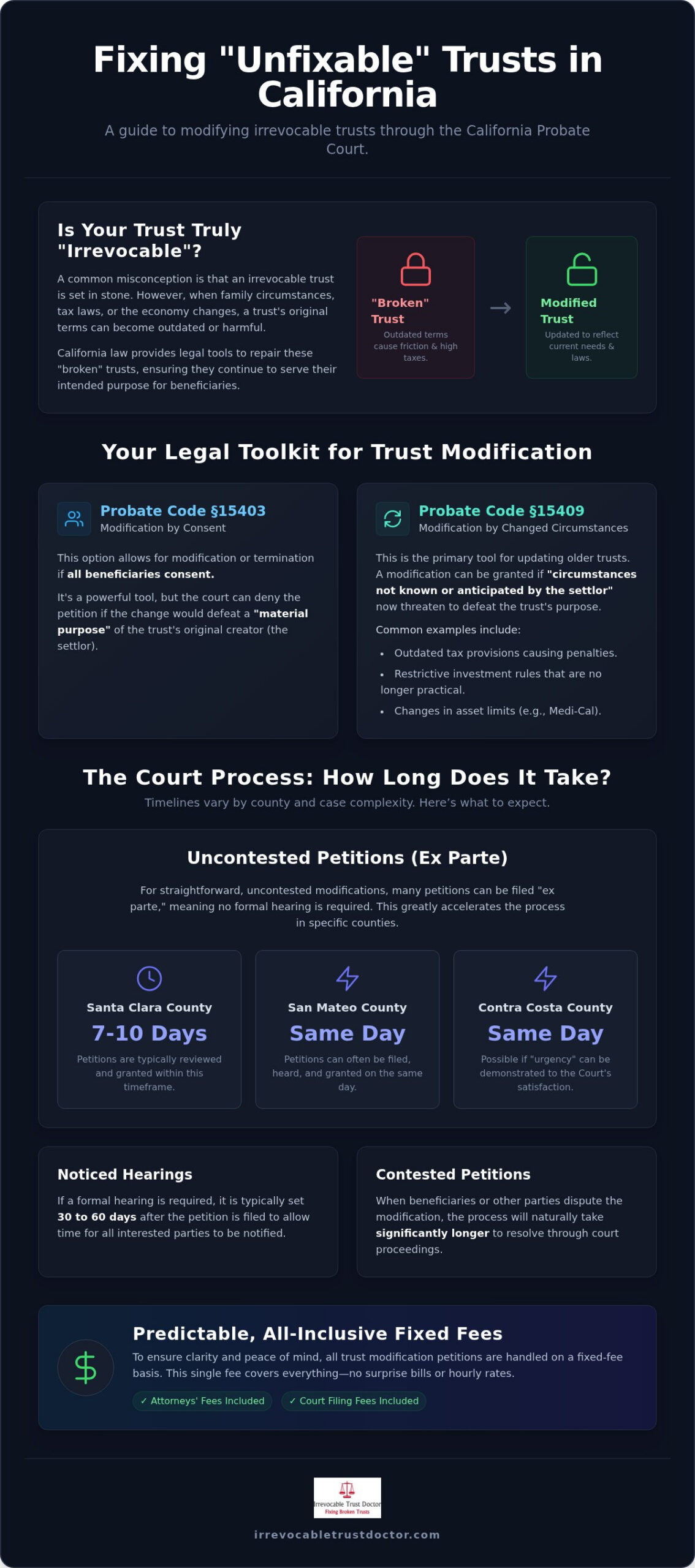
Under California Probate Code §15403, the court may modify or terminate an irrevocable trust if all beneficiaries consent. This is a powerful tool, but it carries a significant caveat: the court can deny the request if the modification would defeat a “material purpose” of the trust. If the settlor is still living and joins the beneficiaries in the request, we look to Section 15404. This section is even broader, allowing for modifications even if they contradict the trust’s original purpose. Most cases I handle, however, involve deceased settlors and require a more diagnostic approach using Section 15409.
Probate Code 15409: The “Changed Circumstances” Doctrine
This statute allows the court to modify a trust if “circumstances not known or anticipated by the settlor” threaten to defeat the trust’s purpose. If the trust was drafted decades ago, it might contain restrictive language that makes no sense in today’s economy. For example, a trust might mandate investments in low-yield bonds or fail to account for current Medi-Cal asset limits, which stand at $130,000 for an individual as of 2026. Section 15409 serves as the primary legal mechanism for updating a trust when unforeseen events threaten to undermine the settlor’s original financial goals. If you’re unsure which statute applies to your situation, a specialized review can clarify your legal standing.
Beneficiary Consent and Potential Conflicts
What happens if one beneficiary refuses to sign on? While Section 15403 generally requires unanimous consent, the court can sometimes proceed if the interests of the dissenting party aren’t substantially impaired. The introduction of Assembly Bill 565 in 2026 has streamlined this by allowing “virtual representation,” where one adult beneficiary can bind minor or unborn beneficiaries with similar interests. This reduces the need for expensive court-appointed guardians. Ultimately, the court must balance the beneficiaries’ current needs against the settlor’s original intent, ensuring the modification provides a remedy without causing fresh conflict. For a detailed procedural walkthrough of how to apply these statutes in practice, the California how-to guide on filing a court petition to amend an irrevocable trust provides step-by-step guidance for 2026.
The Anatomy of a Trust Petition Consultation
The process of a trust petition consultation is a high level forensic assessment. We don’t just skim the pages of your document; we dissect the language to find the specific friction point between the trust’s current terms and your desired outcome. This meeting is where the abstract legal grounds we discussed previously become a concrete procedural roadmap. It’s the moment we move from identifying that a trust is “broken” to drafting the specific “theory of the case” that we will present to the California Probate Court.
A successful consultation typically follows a structured sequence of diagnostic steps:
- Forensic Review: A line-by-line examination of the Trust Instrument and all subsequent amendments to identify obsolete provisions.
- Defect Identification: Pinpointing the exact “scrivener’s error” or the specific tax law change that makes the trust dysfunctional.
- Beneficiary Profiling: Evaluating the current list of beneficiaries to determine who must receive notice and who is likely to provide consent.
- Theory Development: Crafting the legal argument that explains why the modification is necessary to fulfill the settlor’s original intent.
- Procedural Planning: Outlining the specific steps for filing in your local jurisdiction, from the initial petition to the final judicial order.
Document Review: What to Bring
To make the most of our time, you should arrive prepared with the complete history of the trust. I need the original, signed trust document and every amendment ever executed. If there have been prior court orders regarding the trust, those are equally vital. To demonstrate the need for change, we often require financial statements or tax returns that show how the current trust language is causing financial harm. If we’re moving forward under the “changed circumstances” doctrine, bring death certificates or medical records that document the unforeseen events that have occurred since the trust was first drafted.
Strategic Mapping and Risk Assessment
We must also look ahead at potential obstacles. This includes identifying anyone who might object to the modification, such as a disgruntled beneficiary or even the IRS in cases involving significant tax shifts. While the California Courts Self-Help Center provides general information on probate, a specialist review focuses on the specific surcharges and notice requirements of your local county. For example, as of January 2026, the standard filing fee for a trust petition is approximately $435, though counties like Riverside or San Francisco may apply additional surcharges. We also account for the mandatory 30-day notice period required by California law. If you don’t provide proper notice to every required party, the court won’t hear your case, which is why we map out every deadline well in advance of the filing date.
Evaluating Feasibility: Will the Court Grant Your Petition?
Success in the California Probate Court isn’t about aggressive litigation; it’s about clinical precision. During a trust petition consultation, we determine if your proposed changes meet the high burden of proof required to override an irrevocable document. The court’s primary duty is to protect the settlor’s original vision. To succeed, we must present clear evidence of the settlor’s “probable intent,” essentially proving that if the settlor were alive today, they would agree that the current trust language is a barrier to their goals. If the evidence is purely based on beneficiary convenience rather than the settlor’s intent, the petition will likely fail.
The “Material Purpose” Hurdle
A common reason petitions fail is the “material purpose” test. If a modification contradicts a core reason the trust was created, such as a spendthrift clause meant to protect a beneficiary from their own creditors, the judge will likely reject it. Under California law, the material purpose test prohibits any modification that would significantly undermine a primary objective the settlor intended to achieve through the trust’s specific structure. We overcome this by framing the modification as a tool to better fulfill that intent. For example, if a trust’s administrative costs are consuming the principal, we argue that modifying the trust is the only way to ensure the beneficiaries actually receive the support the settlor intended.
Navigating Local Court Rules
Feasibility also depends on the specific county where you file. Local rules in Santa Clara County, for instance, differ significantly from those in Los Angeles or San Francisco. Every petition is reviewed by a probate examiner before it ever reaches the judge’s desk. These examiners look for technical perfection. If your proposed Decree and Order are messy or fail to address local surcharges, your petition will be “continued,” leading to months of delays. My focus as a specialist fixer is to ensure your filing is technically flawless the first time, addressing every potential examiner “note” before it’s even written.
Common pitfalls include failing to provide the mandatory 30-day notice or neglecting to account for the interests of minor and unborn beneficiaries. While the 2026 update to Probate Code § 15804 now allows for virtual representation in many cases, some judges still require a Guardian ad Litem to ensure no future interest is harmed. Avoiding these procedural traps is why the diagnostic phase is so vital. If you are ready to determine if your trust modification is legally viable, you can schedule a trust petition consultation to review your specific case details and develop a winning strategy.
The Irrevocable Trust Doctor: Your Modification Specialist
Robert P. Bergman is a Certified Specialist in Estate Planning, Trust, and Probate Law who has spent over four decades mastering the nuances of the California Probate Court. Since 1980, he has focused on the complex intersections of fiduciary duty and statutory modification. This extensive experience allows our firm to act as a “specialist fixer” for trusts that other practitioners might consider unchangeable. We treat every case with the clinical accuracy of a legal diagnostician, identifying the precise statutory remedy for your specific document dysfunction. Whether you are a beneficiary dealing with an obsolete document or an attorney seeking niche expertise for a client’s case, our firm provides the technical precision required for a successful outcome in a trust petition consultation.
Statewide Consultation Services
Although our home base is in San Jose, we represent clients throughout California. If you reside outside of the Bay Area, we offer virtual consultation options that allow for a thorough review of your case without the need for travel. We frequently collaborate with existing family attorneys who may not specialize in the specific procedural requirements of an Irrevocable Trust Modification Petition. This collaborative approach ensures that your local representation remains involved while we provide the specialized knowledge required to navigate the bureaucratic obstacles of the probate system. We take a methodical approach to every jurisdiction, ensuring that local court rules and examiner preferences are addressed before the first document is filed. This statewide reach allows us to bring a consistent, expert level of service to trustees and beneficiaries regardless of their location.
Next Steps: Booking Your Trust Review
Booking your Trust Petition Consultation is the first step toward restoring order to a dysfunctional estate plan. Our structured onboarding process ensures that no detail is overlooked, from the initial conflict check to the forensic review of your trust instrument and all related amendments. We provide a clear roadmap for the entire court process, offering a sense of calm reliability in a field that often feels overwhelming. If you find yourself burdened by an “irrevocable” document that no longer reflects the settlor’s intent or current tax realities, remember that “irrevocable” does not have to mean unchangeable. We are here to provide the specialized remedy required to fix your “broken” trust and secure your family’s financial future. Our goal is to move you from a state of uncertainty toward a clear, actionable conclusion that protects both the trust assets and your peace of mind.
Restoring Function to Your Irrevocable Trust
Navigating the California Probate Court requires more than just filling out forms; it demands a strategic alignment of your trust’s dysfunction with the specific statutory remedies provided by the Probate Code. By identifying obsolete provisions and framing modifications as a fulfillment of the settlor’s probable intent, you can overcome the high burden of proof required to fix a “broken” document. Whether you’re addressing unforeseen tax law changes or outdated administrative terms, the legal path to a successful modification begins with a precise diagnostic review. A professional trust petition consultation provides the clarity and roadmap you need to move from uncertainty toward a court-approved resolution. To understand the full procedural requirements involved, reviewing a comprehensive guide on the court petition to amend an irrevocable trust in California can help you prepare for each stage of the process.
In addition to seeking professional help for trust modifications, it is equally important to ensure that your initial estate planning documents are drafted with the utmost care; to explore your options for document preparation, you can discover Aiker Wills and Trusts for expert assistance.
Robert P. Bergman is a Certified Specialist in Estate Planning, Trust, and Probate Law who has been practicing since 1980. With an exclusive focus on modification petitions, he provides statewide service to trustees and beneficiaries who need a seasoned practitioner to handle complex court processes. You don’t have to remain trapped by a document that no longer serves its original purpose. Take the first step toward a functional estate plan by choosing a specialist who knows how to navigate the bureaucratic obstacles of the legal system.
Schedule Your Trust Petition Consultation with Robert P. Bergman
Frequently Asked Questions
Can an irrevocable trust be changed in California without going to court?
Yes, it’s possible to change a trust through a non-judicial settlement agreement if all beneficiaries and the trustee are in total agreement. However, these agreements are limited because they cannot violate a material purpose of the trust. Most trustees still insist on a formal court order to ensure they have full judicial protection from future liability or claims of breach of fiduciary duty.
How much does a trust petition consultation cost?
The cost of a trust petition consultation depends on the complexity of the trust instrument and the number of amendments that require forensic review. This initial meeting is a specialized diagnostic service where we evaluate the legal viability of your case. Because every trust dysfunction is unique, we determine the fee based on the specific time required to perform a comprehensive document analysis.
What are the most common reasons to petition the court for a trust modification?
The most frequent reasons include fixing outdated tax language that causes high liabilities or updating administrative terms that have become impossible to follow. We also see many petitions to add special needs provisions to protect a beneficiary’s eligibility for government benefits. If the trust was drafted decades ago, it often contains restrictive investment clauses that don’t make sense in today’s economic environment.
How long does the court process take once the petition is filed?
You should generally expect the process to take between four and six months from the initial filing date. California law requires a strict 30-day notice period for all interested parties, and the court’s calendar depends on the specific county’s backlog. If the probate examiner finds technical errors in your petition, it can lead to continuances that extend the timeline by several months.
Do all beneficiaries have to agree to a trust modification in California?
Not necessarily. While having unanimous consent under Probate Code section 15403 is the smoothest path, section 15409 allows the court to modify a trust due to changed circumstances even without total agreement. Recent 2026 updates to the law regarding virtual representation also allow certain adult beneficiaries to represent the interests of minor or unborn beneficiaries, which can streamline the consent process.
What is the difference between trust reformation and trust modification?
Trust reformation is used to correct a mistake that existed at the moment the trust was signed, such as a “scrivener’s error” or a typo. Trust modification is used to change the actual terms of the trust to adapt to new events that the settlor didn’t anticipate. Both strategies require a trust petition consultation to determine which legal theory provides the highest probability of success in court.
Can a trust petition be used to remove a trustee?
Yes, a petition regarding the internal affairs of a trust can include a request to remove a trustee. If the trustee’s actions or the trust’s restrictive language prevents the document from functioning correctly, the court can remove the trustee and appoint a successor. This is often a necessary step when the current trustee refuses to cooperate with a needed modification that benefits the beneficiaries.
What happens if the settlor of the trust is already deceased?
Modification is still entirely possible after the settlor’s death. We focus on the “changed circumstances” doctrine and present evidence to the court regarding the settlor’s “probable intent.” The goal is to prove that if the settlor had known about the current situation, they would have drafted the trust differently to ensure their primary objectives were still met for the family.

Article by
Robert P. Bergman, Attorney at Law
Attorney Robert P. Bergman ("Bob Bergman") has been a Board-Certified Specialist in Estate Planning, Trust and Probate Law since 2011, as certified by the California State Bar Board of Legal Specialization. For several years, Bob has assisted families and the clients of other attorneys with obtaining court orders through trust modification petitions to make necessary modifications to existing irrevocable trusts. Bob is friendly, very approachable, and believes in explaining complex legal topics in clear ordinary language so that his clients understand exactly what they're doing and why they're doing it.
Bob is often able to assist clients throughout California who are in other counties than his home county of Santa Clara through his approach to trust modification petitions.