
Disclaimer
This article is for informational purposes only. Nothing in this article is intended to replace legal advice from a competent attorney or be considered legal guidance for anybody's specific legal situation. Nobody should rely on information in this article in making legal decisions without such consultation.
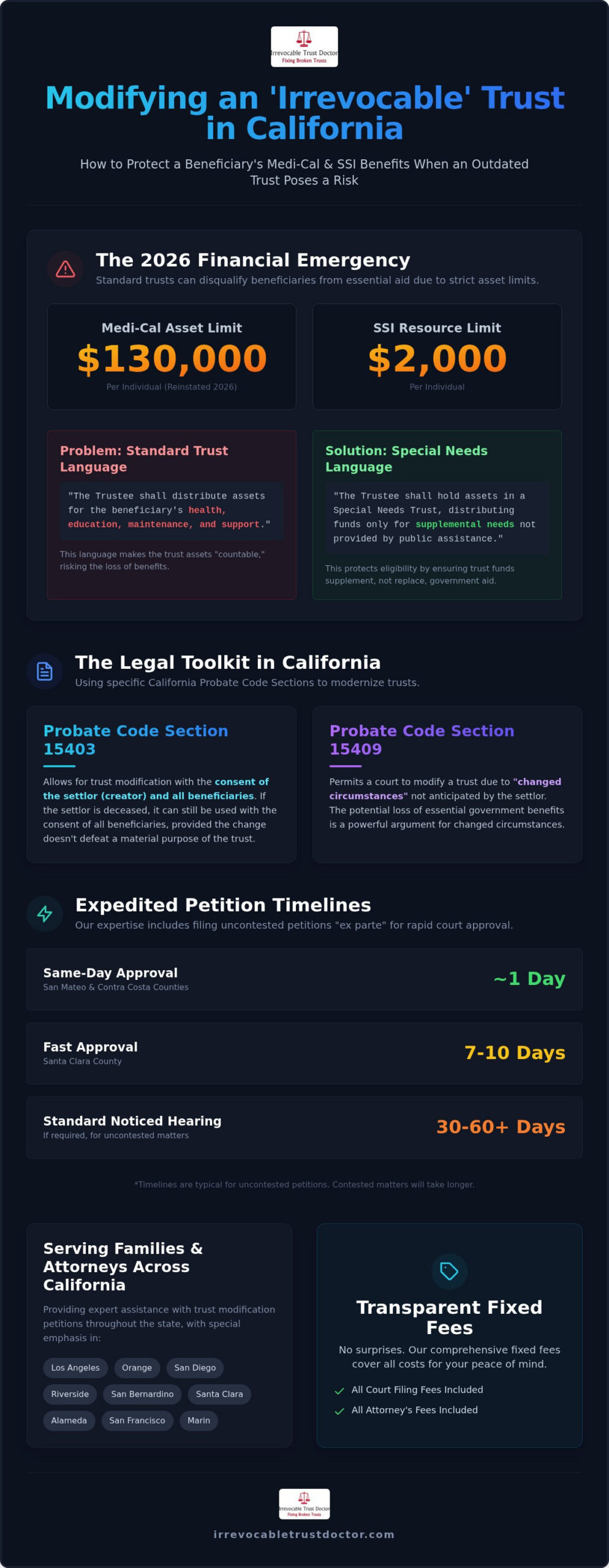
What if the "irrevocable" trust meant to protect your child is the very thing disqualifying them from Medi-Cal? You likely feel that signed documents are set in stone, even if they threaten a beneficiary’s health coverage. With California reinstating 2026 Medi-Cal asset limits at $130,000, an outdated trust is a financial emergency. I’ll show you how to modify trust for special needs provisions using the California Probate Code to safeguard those essential benefits. If your document lacks modern language, then a court petition is the necessary remedy to restore eligibility.
I assist families and attorneys in counties throughout the state of California, including Los Angeles, Orange, San Diego, Riverside, San Bernardino, Santa Clara, Alameda, San Francisco, San Mateo, Contra Costa, and Marin. We use Probate Code Section 15403 and Probate Code Section 15409 to secure court orders, often in 7 to 10 days in Santa Clara County or same-day in San Mateo, using comprehensive fixed fees. This guide reveals the exact steps to modernize your documents and protect your beneficiary.
Key Takeaways
- Learn how to prevent a loss of benefits crisis by identifying when standard inheritance language triggers disqualification for SSI or Medi-Cal.
- Discover the legal strategies used to modify trust for special needs by applying Probate Code Section 15403 or Probate Code Section 15409 for changed circumstances.
- Understand the expedited timelines for uncontested petitions, which can be granted in as little as one day in San Mateo or 7 to 10 days in Santa Clara.
- Benefit from a transparent, fixed-fee model that covers all filing and attorney costs for trust modification petitions filed anywhere in California.
Why You May Need to Modify a Trust for Special Needs in California
Many families create a standard living trust without realizing it can disqualify a child with a disability from essential government aid. If a beneficiary receives an inheritance through a standard trust, those assets count toward the strict resource limits reinstated in 2026. For a single individual, the SSI resource limit is just $2,000, while Medi-Cal asset limits are now $130,000. An inheritance that exceeds these amounts causes a "loss of benefits" crisis, potentially stripping a vulnerable person of their health coverage and monthly income; similarly, those receiving personal injury settlements in Texas may look to jefftoddlaw.com to help navigate the legal complexities of protecting their financial future.
California law provides a specific path to resolve this through Probate Code Section 15409. This statute allows a court to modify a trust if "changed circumstances" exist that the original creator did not anticipate. Often, a parent didn’t realize that standard "support" language would trigger a benefit cutoff. When you modify trust for special needs provisions, we demonstrate that the trust’s original purpose is being defeated by the loss of public assistance. This allows us to modernize outdated language that fails to meet current Social Security Administration (SSA) requirements.
Protecting Eligibility for Medicaid and SSI in California
SSI and Medi-Cal are means-tested programs, which means they’re only available to those with very limited financial resources. A standard support trust usually requires the trustee to pay for "health, education, and support," which the SSA views as a resource that counts against the beneficiary. By contrast, a supplemental needs trust specifies that assets should only be used for items government benefits don’t cover. If your document is outdated, you can learn more about how an irrevocable trust can be changed in California to meet modern standards. We assist families from Los Angeles to Marin and everywhere in between, including Orange, San Bernardino, San Diego, and Riverside, ensuring their trusts are legally sound and benefit-compliant.
Case Study: Converting a Standard Trust into a Special Needs Trust
Consider the Millers, a family in Orange County who established a standard living trust decades ago. When the parents passed away, their son David inherited a significant sum. Because David relies on SSI and Medi-Cal, this standard inheritance created an immediate crisis. The trust was now irrevocable, and its "support" language threatened to disqualify David from his medical coverage. To modify trust for special needs requirements, we utilized Probate Code Section 15403 with the consent of all heirs.
The transformation involves a critical shift in legal language:
- Standard Language (The Problem): "The Trustee shall distribute assets for the beneficiary’s health, education, maintenance, and support."
- Modified Language (The Solution): "The Trustee shall hold assets in a Special Needs Trust, distributing funds only for supplemental needs not provided by public assistance."
Applying Probate Code Section 15403 and Section 15409
These sections are essential tools for families in Los Angeles, San Diego, and Riverside, even when the original trust creator is deceased. The primary challenge is the "Material Purpose" hurdle. A court may refuse a change if it contradicts the original reason the trust was created. A specialist overcomes this by arguing that the parents’ primary intent was the child’s long-term care, which is now jeopardized by the loss of government aid. Beyond benefit eligibility, families should also be aware that outdated trust language can create significant tax exposure for heirs; a trust modification for tax law changes may be equally necessary to address capital gains consequences under IRS Revenue Ruling 2023-2. If your family is facing a similar document conflict, you can schedule a consultation to review your trust language. We handle these petitions with comprehensive fixed fees to provide your family with total cost transparency.
The Process for a Trust Modification Petition in California
The procedure to modify trust for special needs eligibility begins with a thorough diagnostic review of your current document. Once I identify the specific language that triggers a benefit disqualification, I draft a formal petition for the Superior Court. We handle these cases throughout California, including San Bernardino, Marin, and Riverside. To maintain transparency, all our trust modification petitions are handled with fixed fees. These are comprehensive, covering both the court’s filing fees and my professional fees. You can review our fixed fees and costs to understand the total investment before we begin.
For uncontested petitions, we frequently file "ex parte," which translates to "without a formal hearing." This is a specialized procedural tool that allows a judge to review and sign the order based on the written evidence alone. It’s a highly efficient way to update a trust when all parties are in agreement, saving families from the anxiety of a long wait for a court date. If the petition is uncontested and drafted correctly, the court can often grant the request without requiring your physical presence in the courtroom. Families who want a broader understanding of how courts evaluate these requests can also review our guide on modifying irrevocable trust language California courts accept under Probate Code Sections 15403 and 15409. Families with significant appreciated assets held in trust may also benefit from reviewing our California trust modification guide for 2026 tax law changes, which addresses how to secure a step-up in income-tax basis for your heirs.
Expected Timelines in Santa Clara, San Mateo, and Contra Costa
The speed of your resolution depends heavily on the specific county of filing. In Santa Clara County, we typically see petitions granted in 7 to 10 days. If your case is in San Mateo or Contra Costa Counties, same-day results are often possible, though Contra Costa requires a specific showing of urgency. By contrast, courts in Alameda or San Francisco usually require a noticed hearing. This typically results in a 30 to 60-day timeline plus notice time. While we serve clients from San Diego to Marin, understanding these local variations helps us set realistic expectations for your case.
Secure Your Beneficiary’s Financial Future Today
An irrevocable trust doesn’t have to be a barrier to your loved one’s essential government benefits. By using the specific procedures found in Probate Code Section 15403 and Section 15409, you can modify trust for special needs requirements and ensure long-term stability. Whether your case is in Los Angeles, Santa Clara, or any of the 58 counties across California, I provide the specialized expertise needed to navigate these complex court petitions. I handle every case with fixed-fee transparency that includes all your filing costs. This methodical approach removes the stress of "unfixable" documents and provides a clear roadmap to restoring eligibility for Medi-Cal and SSI. Don’t let an outdated document jeopardize a beneficiary’s health coverage; for Southern California families also dealing with personal injury matters, the Law Offices of Michael D. Payne offers expert legal support to protect your rights and recovery.
Book a Trust Petition Consultation with a Certified Specialist to begin the process of modernizing your trust. You have the power to protect your family’s legacy.
Frequently Asked Questions
Can an irrevocable trust be modified if the person who created it has passed away?
Yes. Even after the settlor’s death, we can modify trust for special needs eligibility using Probate Code Section 15403 or Probate Code Section 15409. If all beneficiaries consent, or if changed circumstances like new Medi-Cal asset limits threaten the trust’s purpose, the court has the authority to approve the modification to protect the beneficiary’s government benefits.
Will I have to go to a court hearing to modify a trust for special needs?
Not necessarily. In many cases, I file the petition ex parte, which means the judge reviews the documents without a formal hearing. This is common for uncontested petitions in Santa Clara, San Mateo, and Contra Costa Counties. If a noticed hearing is required in counties like Alameda or San Francisco, I usually handle the appearance so you don’t have to attend.
What are the costs involved in filing a trust modification petition in California?
I handle these petitions using a transparent fixed-fee structure. This single fee is comprehensive, meaning it covers both the required court filing fees and my professional attorney’s fees. You won’t face unpredictable hourly billing or hidden costs. This approach ensures families throughout California, from Los Angeles to Marin, have budget certainty while seeking a specialized remedy for their trust.
How long does it take to change trust terms through the court system?
The timeline depends on the county where we file. In Santa Clara, petitions are typically granted in 7 to 10 days. Same-day results are often possible in San Mateo and Contra Costa, though Contra Costa requires a showing of urgency. If your case requires a noticed hearing in Riverside or San Diego, expect a timeline of 30 to 60 days plus notice time.

Article by
Robert P. Bergman, Attorney at Law
Attorney Robert P. Bergman ("Bob Bergman") has been a Board-Certified Specialist in Estate Planning, Trust and Probate Law since 2011, as certified by the California State Bar Board of Legal Specialization. For several years, Bob has assisted families and the clients of other attorneys with obtaining court orders through trust modification petitions to make necessary modifications to existing irrevocable trusts. Bob is friendly, very approachable, and believes in explaining complex legal topics in clear ordinary language so that his clients understand exactly what they're doing and why they're doing it.
Bob is often able to assist clients throughout California who are in other counties than his home county of Santa Clara through his approach to trust modification petitions.