
Disclaimer
This article is for informational purposes only. Nothing in this article is intended to replace legal advice from a competent attorney or be considered legal guidance for anybody's specific legal situation. Nobody should rely on information in this article in making legal decisions without such consultation.
The word "irrevocable" is often treated as a legal dead end, but in the eyes of the California Probate Code, it’s actually a starting point for necessary surgical adjustments. You might feel stuck with restrictive distribution language or outdated tax provisions that don’t account for the $15 million estate tax exemption of 2026. It’s frustrating to watch a trust become a burden simply because the original drafter didn’t anticipate today’s specific financial realities.
If you need to modify trust language California courts will accept, this guide provides the clarity you require. You’ll discover the specific legal pathways under Probate Code Sections 15403 and 15409 used to correct drafting errors and modernize trust terms. We’ll also preview the court timeline for these petitions and explain how recent 2026 legislative updates, such as Assembly Bill 565, have simplified the process of obtaining beneficiary consent for a successful modification.
Key Takeaways
- Identify the critical distinctions between a standard trust amendment and the formal court petition required to modify trust language California law governs.
- Navigate the specific legal criteria of Probate Code Sections 15403 and 15409 to resolve restrictive distribution terms or outdated tax clauses.
- Streamline the correction of drafting errors through uncontested petitions that utilize 2026 virtual representation laws to simplify beneficiary consent.
- Gain financial predictability for your legal matter by utilizing a fixed-fee model that encompasses all professional attorney costs and court filing fees.
Understanding Why You Need to Modify Trust Language in California
While a revocable living trust allows for simple amendments, an irrevocable trust requires a more formal legal intervention known as reformation. If you find yourself restricted by a document that no longer reflects current reality, you must modify trust language California courts recognize as legally binding. This isn’t a simple update; it is a precise judicial process to repair "broken" language that often stems from drafting errors or outdated tax provisions.
A foundational grasp of Understanding Trust Law reveals that trusts are designed to be enduring, yet they aren’t meant to be dysfunctional. For instance, many trusts drafted years ago didn’t anticipate the 2026 federal estate tax exemption of $15,000,000. When a trust’s formula clauses cause unintended financial loss under these new limits, a specialist fixer acts as a legal diagnostician to restore the settlor’s original intent through the probate court system. Families facing these outdated provisions should explore a trust modification for tax law changes to understand how the 2026 federal estate tax landscape directly affects their irrevocable trust documents.
Common Scenarios Requiring Language Reformation in California
If a trust contains technical drafting errors that contradict the settlor’s clear wishes, then a petition for modification is essential. We frequently encounter situations where administrative provisions are too rigid for modern asset management or where distribution language fails to protect a beneficiary with special needs. Correcting these errors ensures the trust remains a helpful tool rather than a source of litigation. To learn more about navigating complex estate issues, Massingill Attorneys & Counselors at Law offers insights into what many lawyers might overlook. These modifications often focus on:
- Updating administrative powers to allow for more efficient, modern trust management.
- Restructuring distributions to preserve eligibility for government assistance programs.
- Clarifying ambiguous terms that prevent the trustee from making necessary asset distributions.
Legal Grounds for Changing Provisions under the Probate Code
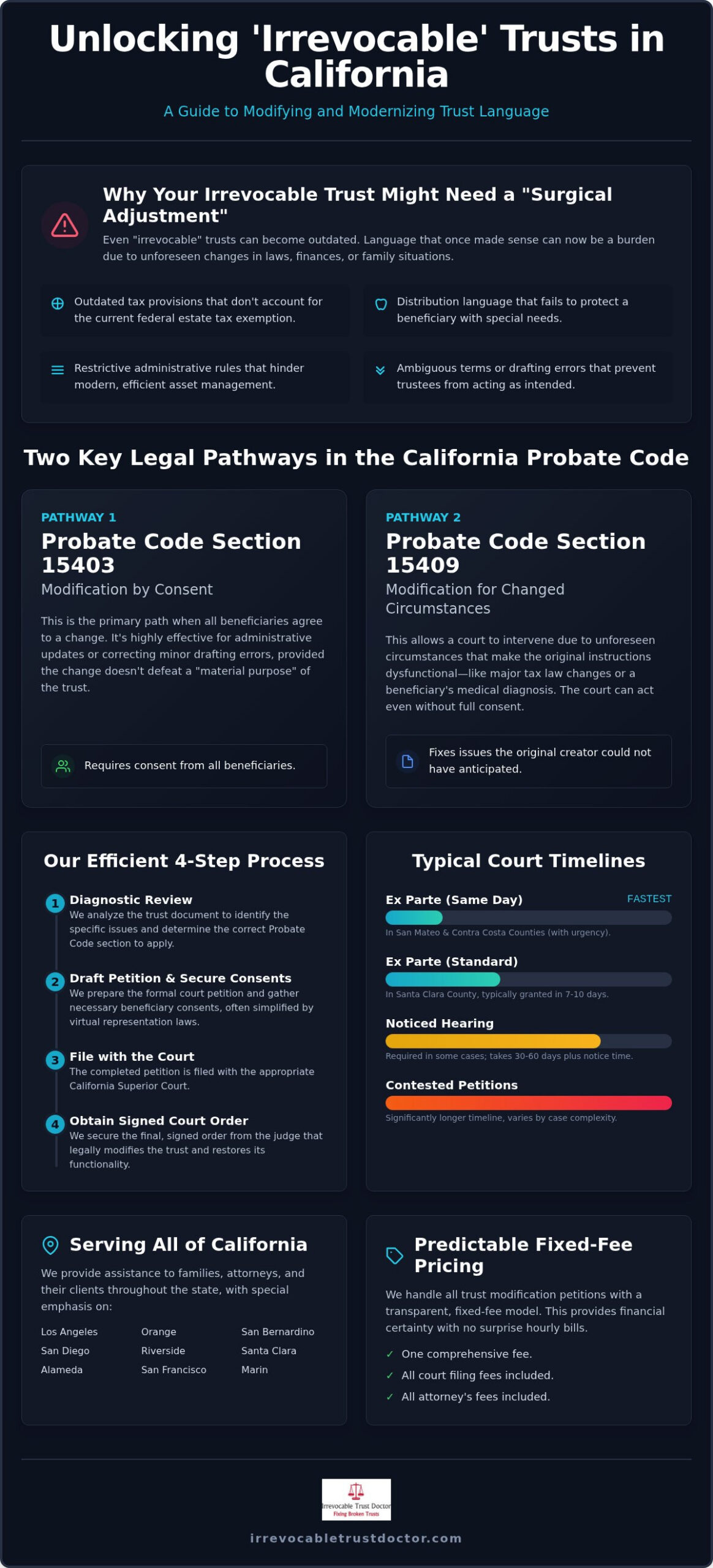
To successfully modify trust language California courts require a specific statutory hook. Probate Code Section 15403 is the primary path when all beneficiaries consent. If every party is in agreement, the court can reform the trust provided the change doesn’t defeat a "material purpose" of the trust. This section is highly effective for administrative updates or correcting minor drafting errors. These laws apply uniformly across the state; whether your matter is filed in Los Angeles, Orange, or San Diego County, the legal standards remain the same.
Applying Probate Code Section 15409 for Changed Circumstances
Sometimes, consent isn’t enough, or not all beneficiaries are available to sign off. In these cases, California Probate Code § 15409 allows a court to intervene based on circumstances the settlor didn’t see coming. A "changed circumstance" is essentially a surprise that makes the trust’s original instructions dysfunctional. It’s a shift in reality, such as the 2026 tax law changes or a beneficiary’s sudden medical diagnosis, that renders the existing language obsolete.
The judge evaluates if the proposed modification will further the trust’s overall purpose rather than undermining it. If the current wording creates a financial or administrative outcome the settlor would have wanted to avoid, the court has the power to intervene. Probate Code Section 15409 is the primary tool for fixing outdated trust language. For a detailed analysis of how shifting federal exemption amounts and IRS Revenue Ruling 2023-2 create the grounds for court intervention, our California Trust Modification: 2026 Tax Law Guide explains the step-up in basis implications and the statutory roadmap available to trustees and beneficiaries. If you’re unsure which section fits your case, you can schedule a trust petition consultation to review your specific document.
Navigating the Court Petition Process for Trust Language Modification
To modify trust language California courts require a formal petition, even when the request is uncontested. The process follows a logical progression. First, we perform a diagnostic review of the trust document to identify the applicable Probate Code sections. Next, we draft the formal petition and secure all necessary beneficiary consents, often utilizing the simplified virtual representation rules under Assembly Bill 565. Finally, we file the matter with the court to obtain a signed order that restores the trust’s functionality.
Procedural Timelines in Santa Clara, San Mateo, and Contra Costa Counties
The speed of your modification depends on local court rules. In Santa Clara County, we typically see uncontested petitions granted within 7 to 10 days. If your situation involves extreme urgency, there is potential for "same day" results in San Mateo and Contra Costa Counties, though this requires meeting specific criteria for ex parte relief. If a matter cannot be handled ex parte, it moves to a noticed hearing.
These hearings typically take 30 to 60 days plus the required notice time. When we modify trust language California courts often require specific notice periods for all interested parties. By utilizing specialized uncontested ex parte procedures, we aim to avoid these longer backlogs whenever possible. You can review our pricing on our fees and costs page to understand the total investment required for your petition.
Restoring Functionality to Your Irrevocable Trust
The belief that an irrevocable trust is set in stone often prevents families from correcting critical errors or updating outdated provisions. As we have discussed, the California Probate Code provides specific surgical tools through Sections 15403 and 15409 to repair dysfunctional documents. Whether you’re dealing with restrictive distribution language or tax clauses that no longer align with 2026 regulations, you have a clear legal path forward. When you need to modify trust language California judges require a precise and methodical approach to ensure the settlor’s intent is actually preserved.
We specialize in these complex petitions, offering fixed-fee pricing that includes all filing and attorney costs for clients from San Diego to Sacramento. If your trust is no longer serving its purpose, Book a Trust Petition Consultation to review your case. You don’t have to navigate these bureaucratic obstacles alone; expert assistance is available to bring order and clarity back to your estate plan.
Frequently Asked Questions
Can you change the language of an irrevocable trust without going to court in California?
No, you generally cannot change the language of an irrevocable trust without a court order in California. While some documents include provisions for a trust protector, most modifications require a formal petition under the Probate Code. If you need to modify trust language California law requires judicial oversight to ensure the settlor’s intent and the beneficiaries’ rights remain protected.
What is the difference between Probate Code Section 15403 and Section 15409?
Section 15403 allows for modification when all beneficiaries consent, provided the change doesn’t defeat a material purpose of the trust. In contrast, Section 15409 is used when changed circumstances occur that the settlor didn’t anticipate. If you have a situation where the trust’s original language has become dysfunctional due to new tax laws or medical needs, Section 15409 provides the necessary remedy.
How long does it take to modify trust language in Santa Clara County?
In Santa Clara County, an uncontested petition to modify trust language California courts oversee is typically granted within 7 to 10 days. This rapid timeline is possible when we file the matter ex parte with all required beneficiary consents in place. If the matter requires a noticed hearing, the timeline extends to 30 or 60 days, depending on the current court backlog.
Does the Irrevocable Trust Doctor work with other attorneys to fix their clients’ trusts?
Yes, we frequently collaborate with estate planning and probate attorneys who don’t specialize in these specific court petitions. If you are an attorney whose client needs a surgical modification to an irrevocable trust, we can handle the entire petition process on a fixed-fee basis. This partnership allows you to provide a specialized solution for your clients without navigating the technical nuances yourself.
What are the fixed fees for a trust modification petition in California?
We utilize a fixed-fee model for all trust modification petitions, which provides our clients with total financial predictability. This single fee covers the initial consultation, the drafting of the petition, all attorney costs, and the required court filing fees. If you choose our service, you won’t encounter the unexpected expenses or the fluctuating costs often associated with traditional hourly legal billing.

Article by
Robert P. Bergman, Attorney at Law
Attorney Robert P. Bergman ("Bob Bergman") has been a Board-Certified Specialist in Estate Planning, Trust and Probate Law since 2011, as certified by the California State Bar Board of Legal Specialization. For several years, Bob has assisted families and the clients of other attorneys with obtaining court orders through trust modification petitions to make necessary modifications to existing irrevocable trusts. Bob is friendly, very approachable, and believes in explaining complex legal topics in clear ordinary language so that his clients understand exactly what they're doing and why they're doing it.
Bob is often able to assist clients throughout California who are in other counties than his home county of Santa Clara through his approach to trust modification petitions.