
Disclaimer
This article is for informational purposes only. Nothing in this article is intended to replace legal advice from a competent attorney or be considered legal guidance for anybody's specific legal situation. Nobody should rely on information in this article in making legal decisions without such consultation.
Most families believe that once a trust is labeled "irrevocable," its terms are set in stone regardless of how the tax landscape shifts. You’re likely concerned that outdated language will lead to massive capital gains taxes for your beneficiaries, especially following IRS Revenue Ruling 2023-2, that held assets in an irrevocable grantor trust that are not included in the grantor’s gross estate do not receive a step-up in cost basis under Internal Revenue Code Section 1014.
It’s stressful to feel trapped by a plan that no longer serves your family’s needs, especially with changes in the federal estate tax exclusion amounts. However, a trust modification for tax law changes can legally restore efficiency to your estate plan. You’ll discover how to secure a step-up in income-tax basis and protect your heirs under the 2026 tax reality. We’ll explore how Probate Code Section 15403 and Probate Code Section 15409 provide a roadmap for these corrections. If you are a seeking a Trust Modification anywhere in California, these specialized petitions are available to families and attorneys statewide for a comprehensive fixed fee.
Key Takeaways
- Learn how to regain a “stepped-up” basis for your heirs by addressing the impacts of IRS Revenue Ruling 2023-2 on your current irrevocable trust.
- Discover how Probate Code Section 15403 and Probate Code Section 15409 allow you to legally amend “unchangeable” documents when tax laws shift.
- Secure a trust modification for tax law changes efficiently by utilizing expedited court procedures available in counties like Santa Clara, San Mateo, and Contra Costa.
- Navigate the legal process with confidence using a comprehensive fixed-fee structure that includes all filing and attorney costs for families throughout California.
Why Recent Tax Law Changes Make Irrevocable Trust Modification Essential
A trust modification for tax law changes is a specialized legal procedure designed to repair irrevocable documents that no longer align with the current tax environment. While the legal concept of a trust usually implies permanence, California law recognizes that significant tax shifts can render an estate plan dysfunctional or even harmful to beneficiaries. We specialize in updating these instruments to ensure they remain efficient and protective.
With the federal estate tax exemption now permanently set at $15 million per individual as of 2026, the primary threat to most California families has shifted from estate taxes to capital gains taxes. Many older trusts were designed to keep assets out of a person’s estate to save on estate taxes they will likely never owe. This strategy backfires when it prevents assets from receiving a "stepped-up" basis, potentially costing heirs hundreds of thousands of dollars in avoidable taxes.
The Impact of IRS Revenue Ruling 2023-2 on California Trusts
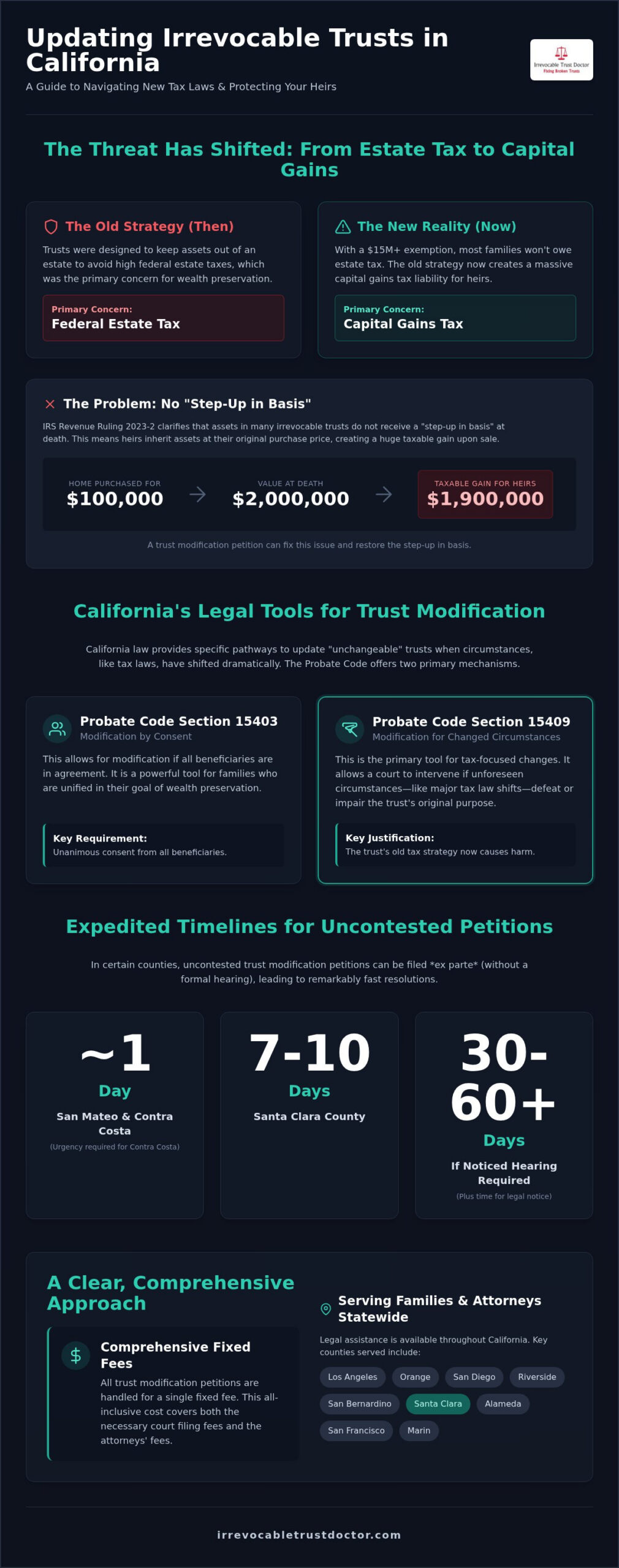
IRS Revenue Ruling 2023-2 fundamentally changed the landscape for many irrevocable grantor trusts by clarifying that assets in these trusts do not receive a basis step-up at the grantor’s death. This means your beneficiaries may inherit property at the original purchase price rather than the current fair market value. For a family home or business in Santa Clara County, Los Angeles County or Orange County that has appreciated significantly, this creates a massive tax liability upon sale.
Specific trust types most at risk include older Bypass Trusts, which were often funded to avoid estate taxes that the vast majority of families no longer face. If your trust was drafted decades ago, it likely lacks the modern provisions needed to navigate today’s IRS rulings. We handle these petitions for a comprehensive fixed fee that covers both filing costs and attorney’s fees.
A court petition can fix this basis issue by strategically adding or removing powers of appointment to ensure assets are included in the estate for a basis step-up.
To manage these assets effectively after the modification, families often benefit from the expertise of firms like timothyrobertsllc.com, which provide specialized wealth management and tax preparation services to ensure long-term financial health.
Legal Grounds for Modifying a Trust in California Under the Probate Code
California law provides specific pathways to update irrevocable trusts that have become outdated or inefficient. While many people believe these documents are permanent, the Probate Code offers two primary mechanisms for adjustment. Under Probate Code Section 15403, a trust can be modified if all beneficiaries provide consent, provided the change doesn’t conflict with a "material purpose" of the trust. This is a powerful tool for families who are unified in their goal of wealth preservation.
For more complex situations, Probate Code Section 15409 serves as the primary tool for a trust modification for tax law changes. This section allows the court to intervene if existing terms "defeat or substantially impair" the trust’s purpose due to circumstances the settlor didn’t foresee. For a deeper look at these rules, read our pillar article on Can an Irrevocable Trust Be Changed in California? Your 2026 Legal Guide.
Navigating Probate Code Section 15409 for Changed Tax Circumstances
In the context of modern estate planning, "changed circumstances" often refers to drastic shifts in federal estate and income tax law. Under California Probate Code § 15409, the court balances the settlor’s original intent with the current need for tax efficiency. If an old tax strategy now creates a massive capital gains burden, the court has the authority to authorize a trust modification for tax law changes to protect the beneficiaries.
We regularly file these petitions ex parte in Northern California counties like Santa Clara, San Mateo, and Contra Costa. This allows for a much faster resolution; petitions in Santa Clara are typically granted in 7 to 10 days, while San Mateo and Contra Costa often grant them the same day (with urgency required for Contra Costa). All petitions are handled with comprehensive fixed fees, and we assist families and attorneys throughout Los Angeles, Orange, San Diego, and Riverside. To fix a "broken" trust, you can book a trust petition consultation to discuss your options.
The Court Petition Process for Tax-Focused Trust Amendments
Initiating a trust modification for tax law changes requires a precise procedural approach within the California court system. We manage the entire lifecycle of the case, from drafting the formal petition to filing it in the appropriate local Probate Court. Our specialized assistance is available to families, attorneys, and their clients throughout the state, including Los Angeles, Orange, San Diego, Riverside, San Bernardino, Alameda, San Francisco, and Marin. By handling the technical filings, we allow you to focus on the long-term protection of your family’s wealth.
While we focus on the legal framework, many families also seek to enhance their financial literacy; platforms like Don Kilam offer insights into financial emancipation and wealth-building strategies that complement a robust estate plan.
Financial transparency is essential when resolving complex legal issues. We operate exclusively with fixed fees that are fully comprehensive. These fees cover both the mandatory court filing costs and all attorneys’ fees, ensuring you won’t encounter unexpected billing during the process. Whether you’re an individual trustee or an attorney seeking specialized support for a client, this structure provides the certainty needed to move forward confidently.
Procedural Timelines in Santa Clara, San Mateo, and Contra Costa Counties
The speed of a trust modification for tax law changes often depends on the specific county’s local rules. We regularly file uncontested petitions ex parte, which means they’re handled without a formal hearing. In Santa Clara County, these petitions are typically granted in just 7 to 10 days. If the matter is handled in San Mateo or Contra Costa Counties, it’s often possible to receive a same-day grant, though Contra Costa requires a specific showing of "urgency."
If your situation is more complex or contested, a noticed hearing may be required. These typically follow a timeline of 30 to 60 days plus the required notice time. While contested petitions take longer, our methodical approach ensures that every statutory requirement is met to avoid unnecessary delays.
Secure Your Family’s Legacy Under Current Tax Law
The legal landscape for irrevocable trusts has shifted, making traditional estate plans potentially costly for your heirs. By pursuing a trust modification for tax law changes, you can address the impacts of Revenue Ruling 2023-2 and regain a stepped-up basis for your beneficiaries. Our team utilizes Probate Code Section 15403 and Probate Code Section 15409 to correct these documents through the California court system. Whether you’re in Los Angeles, Orange, or Santa Clara County, we provide statewide assistance with a transparent fixed-fee structure covering all legal and filing costs. As a Certified Specialist in Estate Planning, Trust, and Probate Law, Attorney Robert P. Bergman offers the niche expertise required to navigate these petitions efficiently. Don’t let an outdated document drain your wealth. Book a Trust Petition Consultation with a Certified Specialist today to begin the restoration process. You have the power to protect your family’s future.
Frequently Asked Questions
Can an irrevocable trust be modified specifically for tax efficiency in California?
Yes, an irrevocable trust can be modified to restore tax efficiency under the California Probate Code. If changes in federal law, such as IRS Revenue Ruling 2023-2, create a tax burden for beneficiaries, you can petition the court for a trust modification for tax law changes. This process allows for the addition of powers of appointment to secure a stepped-up basis for inherited assets.
What is the role of Probate Code Section 15409 in changing trust terms?
Probate Code Section 15409 serves as the primary legal mechanism for modifying a trust due to unforeseen circumstances. If recent shifts in tax legislation defeat the original purpose of the trust, the court can authorize amendments to preserve the estate. This statute is essential for families in Los Angeles and Orange County seeking to modernize documents that no longer align with current IRS regulations.
How long does the trust modification petition process take in Santa Clara County?
Petitions filed in Santa Clara County are typically granted within 7 to 10 days. We regularly file these uncontested matters ex parte to avoid the delays of a formal hearing. If your case is located in San Mateo or Contra Costa Counties, it’s often possible to receive a grant on the same day. These expedited timelines help families quickly resolve urgent tax issues throughout California.
Are trust modification petitions handled on a fixed fee basis?
Yes, we handle all trust modification petitions on a comprehensive fixed-fee basis. This single fee covers both the necessary court filing costs and all attorneys’ fees, ensuring total financial transparency for our clients. Whether you’re a family member or an attorney seeking specialized assistance in San Diego or Riverside, you’ll know the exact cost of the petition process before we begin.

Article by
Robert P. Bergman, Attorney at Law
Attorney Robert P. Bergman ("Bob Bergman") has been a Board-Certified Specialist in Estate Planning, Trust and Probate Law since 2011, as certified by the California State Bar Board of Legal Specialization. For several years, Bob has assisted families and the clients of other attorneys with obtaining court orders through trust modification petitions to make necessary modifications to existing irrevocable trusts. Bob is friendly, very approachable, and believes in explaining complex legal topics in clear ordinary language so that his clients understand exactly what they're doing and why they're doing it.
Bob is often able to assist clients throughout California who are in other counties than his home county of Santa Clara through his approach to trust modification petitions.