
Disclaimer
This article is for informational purposes only. Nothing in this article is intended to replace legal advice from a competent attorney or be considered legal guidance for anybody's specific legal situation. Nobody should rely on information in this article in making legal decisions without such consultation.
You might believe that an "irrevocable" trust is set in stone, but the California legal system provides several powerful tools to rewrite the rules when circumstances change. It’s incredibly frustrating to feel trapped by outdated trust language that no longer serves your family or reflects current tax laws. You’re likely looking for a way to fix these issues without falling into a spiral of high legal fees or endless litigation. Changing trust terms through court is a specialized process that can correct drafting errors or add a power of appointment through judicial reformation. This guide explains how to successfully petition for a Trust Modification in California under Probate Code Section 15403 and Probate Code Section 15409. We’ll explore how families from Los Angeles to Santa Clara navigate this path, including how we often secure court orders in as little as seven days using a simple, fixed-fee structure.
Key Takeaways
- Discover why “irrevocable” doesn’t mean permanent and how the California Probate Code provides specific pathways to fix outdated or broken trust language.
- Learn the streamlined judicial process for changing trust terms through court in California to ensure your legal documents reflect current tax laws and your family’s actual needs.
- Find out how specialized petitions in counties like Santa Clara, San Mateo, and Contra Costa can often be granted in as little as one to ten days.
- Understand how a comprehensive fixed-fee model eliminates the uncertainty of hourly billing by covering both attorney fees and court filing costs for your petition.
Grounds for Changing Trust Terms Through Court in California
Judicial modification is a formal legal request where a judge is asked to rewrite or "reform" the language of a trust. While the label "irrevocable" suggests a permanent arrangement, California law understands that life and laws change. When a trust’s purpose is frustrated, the document is considered "broken." This often happens because of drafting errors or outdated tax provisions that no longer benefit the heirs. Based on foundational U.S. trust law principles, the court’s role is to ensure the creator’s true intent is actually carried out.
This specialized process is accessible to families and attorneys throughout the state. We assist clients in Los Angeles, Orange, San Diego, and Riverside, as well as those in the Bay Area counties of Santa Clara, San Mateo, Contra Costa, San Francisco, and Marin. Changing trust terms through court allows for a surgical correction of specific clauses that have become unworkable over time.
Key Statutes: Probate Code Section 15403 and 15409
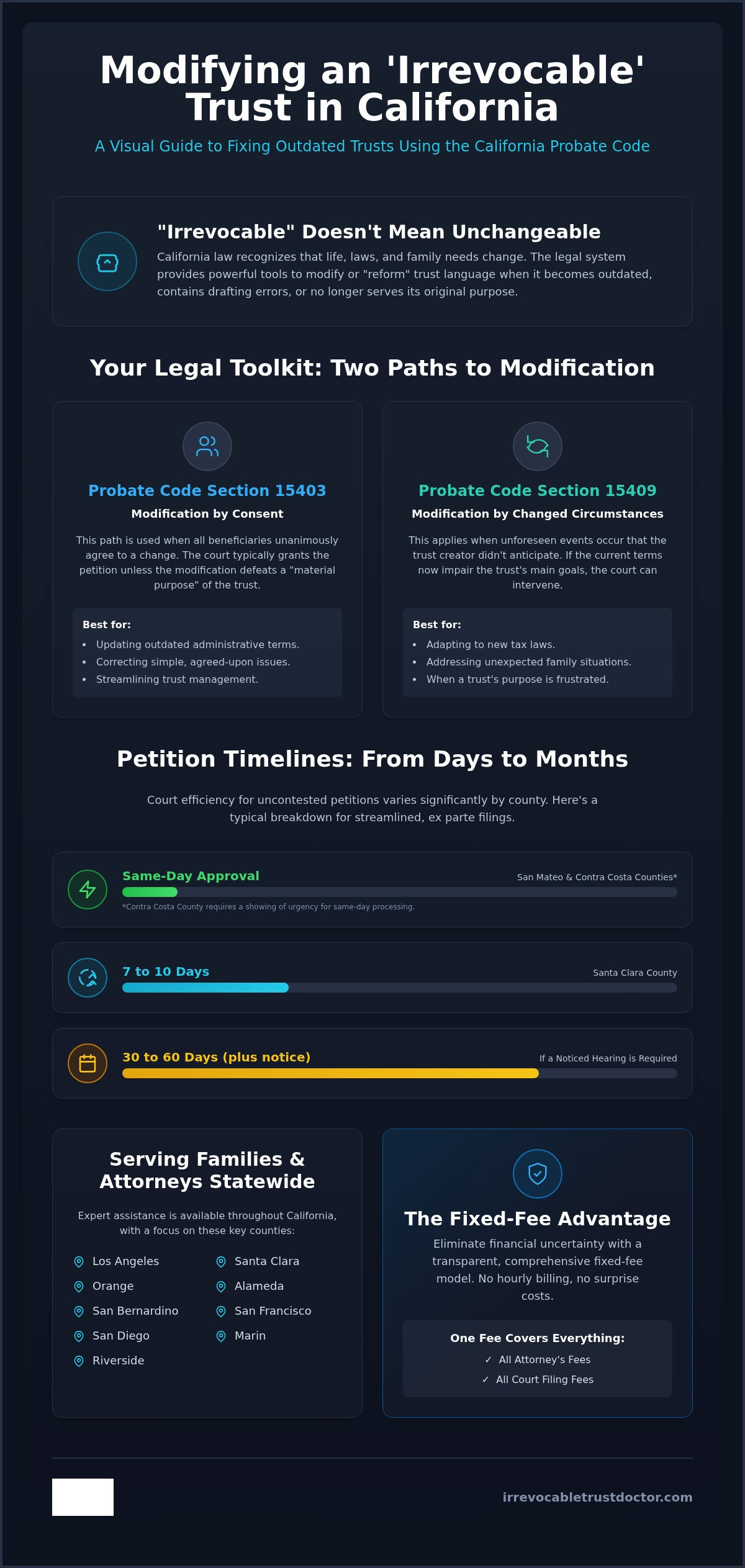
Probate Code Section 15403 allows for modification when all beneficiaries agree to the change. If you have unanimous consent, the court will generally grant the petition unless the modification would defeat a "material purpose" of the trust. Changing trust terms through court under this section is a common path for updating administrative terms that have become cumbersome.
Probate Code Section 15409 focuses on "changed circumstances." This statute applies when events occur that the original settlor didn’t anticipate. If the existing terms now impair the trust’s primary goals, the court has the authority to intervene. Understanding how to fix an irrevocable trust in California often involves identifying which of these two sections provides the strongest legal footing for your specific situation. This is especially critical when you need to modify trust for special needs provisions to protect a beneficiary’s eligibility for essential government benefits like Medi-Cal.
The Judicial Process: Filing a Petition in California Probate Courts
Preparing a formal Petition for Modification or Reformation is a technical task that requires high precision. This document must clearly explain why the change is necessary under statutes like California Probate Code § 15403. Most specialized fixes we handle are uncontested, where all beneficiaries agree to the update. While contested petitions involve complex litigation and longer delays, uncontested petitions allow for a more streamlined resolution. Using clear, precise language is vital when you plan on changing trust terms through court to ensure the judge understands exactly how the modification repairs the trust.
We act as a specialized resource for families and their existing counsel in Los Angeles, Orange County, and throughout California. If your current attorney doesn’t specialize in these specific petitions, we coordinate with them to provide the expertise required for a successful outcome. This partnership allows families from San Diego to Marin to fix "broken" trusts efficiently. If you need to assess your trust’s specific issues, you can book a trust petition consultation to determine the best path forward.
County-Specific Timelines: From 24 Hours to 60 Days
Court efficiency varies significantly across the state. In Santa Clara County, petitions are typically granted in 7 to 10 days. In San Mateo and Contra Costa Counties, orders can often be granted the same day, though Contra Costa requires a showing of urgency. If the court determines that a noticed hearing is necessary, the timeline typically shifts to 30 to 60 days plus notice time. We manage these variations by utilizing a fixed-fee model that includes both the necessary filing fees and the attorney fees, ensuring you aren’t surprised by unexpected costs during the process.
Navigating Costs and Professional Assistance in California
Selecting a Certified Specialist in Estate Planning, Trust, and Probate Law ensures that your petition meets the exact requirements of the California court system. Changing trust terms through court is a niche area where procedural mistakes lead to costly delays. We offer a transparent fixed-fee model that covers both attorney fees and the required court filing fees. This approach provides financial certainty for families dealing with the stress of an outdated or dysfunctional trust. You should review our Fees and Costs page to see how we provide transparency in a field often known for unpredictable billing.
Many families already have a trusted general attorney who handles their ongoing needs. We often act as a "specialist fixer" for these professionals, taking over the technical drafting of the petition while the primary attorney manages the client relationship. Whether the goal is a correction of a drafting error or a modification due to changed circumstances, our focused expertise helps avoid the pitfalls of general civil litigation. Families who need to modify trust for special needs beneficiaries face particular urgency, as outdated trust language can directly threaten a loved one’s Medi-Cal eligibility and access to critical care. We assist families and their lawyers throughout the state, including in Los Angeles, Orange, and San Bernardino Counties.
Why Statewide Expertise Matters for Trust Petitions
Filing a petition in San Diego or Riverside requires a different understanding of local preferences than filing in Alameda. Local rules in San Francisco or Marin are particularly nuanced. Missing a small procedural detail can set your timeline back by weeks. Our experience across these diverse jurisdictions allows us to anticipate these requirements before they become obstacles. Changing trust terms through court should be a methodical, predictable process regardless of where the trust was originally drafted. If you’re ready to fix a broken trust, Book a Trust Petition Consultation to evaluate your specific case.
Take the First Step Toward Fixing Your Irrevocable Trust
You don’t have to remain stuck with a "broken" trust that no longer serves its purpose. Whether you’re dealing with outdated tax provisions or drafting errors, changing trust terms through court is a proven method to restore order to your estate plan. We offer a fixed-fee guarantee that covers all filing and attorney fees, providing the financial clarity you need. With over 40 years of experience as a Certified Specialist, we’ve secured orders in as little as one day in select counties like San Mateo or Contra Costa. Our team assists families and attorneys throughout the entire state, including Los Angeles, Orange, and Santa Clara. You can resolve these complex legal hurdles efficiently and move forward with confidence.
Book Your Trust Petition Consultation with a California Specialist today to evaluate your options and protect your family’s future.
Frequently Asked Questions
Can an irrevocable trust be changed in California after the settlor dies?
Yes, you can modify an irrevocable trust after the settlor passes away. California law provides specific pathways under the Probate Code to address "broken" trusts. If all beneficiaries agree, Probate Code Section 15403 is often the most effective route. If circumstances have changed in ways the settlor didn’t anticipate, Probate Code Section 15409 allows the court to intervene and fix the document’s terms.
How long does the court process take for a trust modification petition?
The timeline depends on the county where the petition is filed. In Santa Clara County, orders are typically granted in 7 to 10 days. San Mateo and Contra Costa Counties often grant petitions the same day. We handle these petitions using a fixed-fee model that covers all filing and attorney fees, regardless of whether the process takes 24 hours or 60 days.
What is the difference between trust reformation and trust modification?
Changing trust terms through court involves two distinct legal remedies. Reformation is a surgical fix used to correct a drafting error to reflect the settlor’s original intent. Modification changes the actual terms of the trust because the current language is no longer functional or tax-efficient. Both require a formal petition but solve different problems within a "broken" trust document. If you need a comprehensive overview of the legal pathways available, our guide to modifying irrevocable trusts in California explains how courts evaluate requests to modify trust language California families bring forward under Probate Code Sections 15403 and 15409.
Do I need to go to a formal court hearing to change trust terms?
A formal hearing isn’t always required. In counties like Santa Clara, San Mateo, and Contra Costa, we frequently file ex parte petitions that a judge grants without a hearing. This streamlined approach is a major advantage of changing trust terms through court when all beneficiaries agree. It avoids the stress and delay of a public courtroom appearance while fixing the trust’s broken terms.

Article by
Robert P. Bergman, Attorney at Law
Attorney Robert P. Bergman ("Bob Bergman") has been a Board-Certified Specialist in Estate Planning, Trust and Probate Law since 2011, as certified by the California State Bar Board of Legal Specialization. For several years, Bob has assisted families and the clients of other attorneys with obtaining court orders through trust modification petitions to make necessary modifications to existing irrevocable trusts. Bob is friendly, very approachable, and believes in explaining complex legal topics in clear ordinary language so that his clients understand exactly what they're doing and why they're doing it.
Bob is often able to assist clients throughout California who are in other counties than his home county of Santa Clara through his approach to trust modification petitions.