
Disclaimer
This article is for informational purposes only. Nothing in this article is intended to replace legal advice from a competent attorney or be considered legal guidance for anybody's specific legal situation. Nobody should rely on information in this article in making legal decisions without such consultation.
What if the "irrevocable" label on your trust isn’t actually the final word? Most people feel trapped when a trust document no longer fits their family’s needs, whether it’s due to shifting tax laws or administrative burdens that didn’t exist years ago. You might assume the California Probate Court is a black hole of delays, but for many, a court petition to amend irrevocable trust is a straightforward path to relief. I’ve spent years acting as a specialist fixer for both families and fellow attorneys, proving that these "permanent" documents are often quite flexible when you apply the right legal pressure.
I understand the anxiety that comes with rigid trust terms; it feels like you’re managing a ghost’s outdated wishes rather than a living financial tool. This guide will show you exactly how to leverage California Probate Code sections 15403 and 15409 to modify your trust legally. We’ll explore why certain counties like Contra Costa, San Mateo or Santa Clara offer remarkably fast results, sometimes granting petitions on the same day they’re filed, and how our fixed-fee structure keeps your legal costs predictable. From navigating the 2026 filing fee requirements to mastering ex parte procedures, you’re about to discover how to turn a dysfunctional trust into a working solution.
Key Takeaways
- Learn how a court petition to amend irrevocable trust leverages California Probate Code Sections 15403 and 15409 to update rigid or outdated documents.
- Discover how to bypass standard court delays by utilizing ex parte filings in Santa Clara, San Mateo, and Contra Costa Counties.
- Compare the timelines for standard 30 to 60 day noticed hearings against expedited options that can be granted in as little as 24 hours.
- Understand how fixed-fee pricing provides total cost predictability by covering both court filing fees and professional legal representation.
- Explore how a specialist fixer assists both individual clients and their current attorneys in navigating complex trust modifications across California.
Determining Your Legal Grounds to Petition for a Trust Amendment
A court petition to amend irrevocable trust is a formal legal request submitted to a judge to alter terms that have become problematic or obsolete. While the legal definition of a trust suggests a permanent and unchangeable arrangement, California law provides specific pathways to fix documents that no longer serve their intended purpose. Your success depends on identifying the correct statutory grounds before you file your paperwork. If you’re unsure which path applies to your family’s situation, a trust petition consultation can help you evaluate your specific legal standing and requirements.
Modification with Beneficiary Consent (Probate Code 15403)
Under Section 15403, a trust can often be modified if the creator and all beneficiaries are in total agreement. The court’s primary role is to verify that the proposed change doesn’t defeat a "material purpose" of the trust. This might include specific instructions meant to protect assets from a beneficiary’s creditors or ensuring long-term financial support. Gathering written consent from all parties before you file is a critical step to streamline the entire process. When everyone is on the same page, the court is much more likely to grant the modification without a lengthy or expensive dispute.
Modification for Changed Circumstances (Probate Code 15409)
Section 15409 is the primary tool used when circumstances arise that the trust creator didn’t anticipate. This often happens when tax laws change significantly, a beneficiary develops special needs, or the trust becomes too small to justify its own administrative costs. It’s the "broken trust" remedy. Probate Code 15409 serves as the ultimate safety valve for trusts that have become outdated or dysfunctional due to unforeseen life events, allowing a judge to step in and correct the document to meet today’s realities. Working with an irrevocable trust modification specialist ensures you select the correct statutory pathway and build the strongest possible case for the court.
Filing the Court Petition: A Step-by-Step Action Plan
Moving from a "broken" document to a functional one requires a methodical approach. The process starts with drafting the formal court petition to amend irrevocable trust. This document must clearly state the specific changes you’re requesting and the legal grounds under the Probate Code. In California, it’s not enough to just file the paperwork; the petitioner must sign a verification under penalty of perjury. This procedural step is mandatory and ensures the court has accurate information from the start. You must file this petition in the Superior Court of the county where the trust is currently administered. Because even a small clerical error can lead to a rejection, working with a California irrevocable trust modification attorney is the most reliable way to ensure your paperwork is bulletproof from day one.
Preparing the Filing and Notifying Interested Parties
Once the petition is filed, you must notify all "interested parties." This list includes every person currently receiving distributions and those who might receive them in the future, known as contingent beneficiaries. For a standard noticed hearing, California law typically requires a 30 to 60 day window after filing. This time allows parties to review the request and respond. While an irrevocable trust is designed to be permanent, these notice periods provide the necessary legal transparency for the court to authorize a change.
The Role of the Judge in Trust Reformation
During the hearing, the judge reviews the evidence to ensure the modification aligns with the law. If no one objects, the process is usually smooth and predictable. However, if the petition is contested, the judge may require additional testimony or documentation, which naturally extends the timeline. The ultimate goal is the "Order." This is the formal document the judge signs that officially strikes out the old language and inserts the new, amended terms. To see if your situation qualifies for this streamlined approach, you can schedule a consultation to review your trust. We handle these petitions with a fixed-fee structure, so you don’t have to worry about escalating hourly costs or hidden filing fees.
California Timelines: How Fast Can a Trust Be Amended?
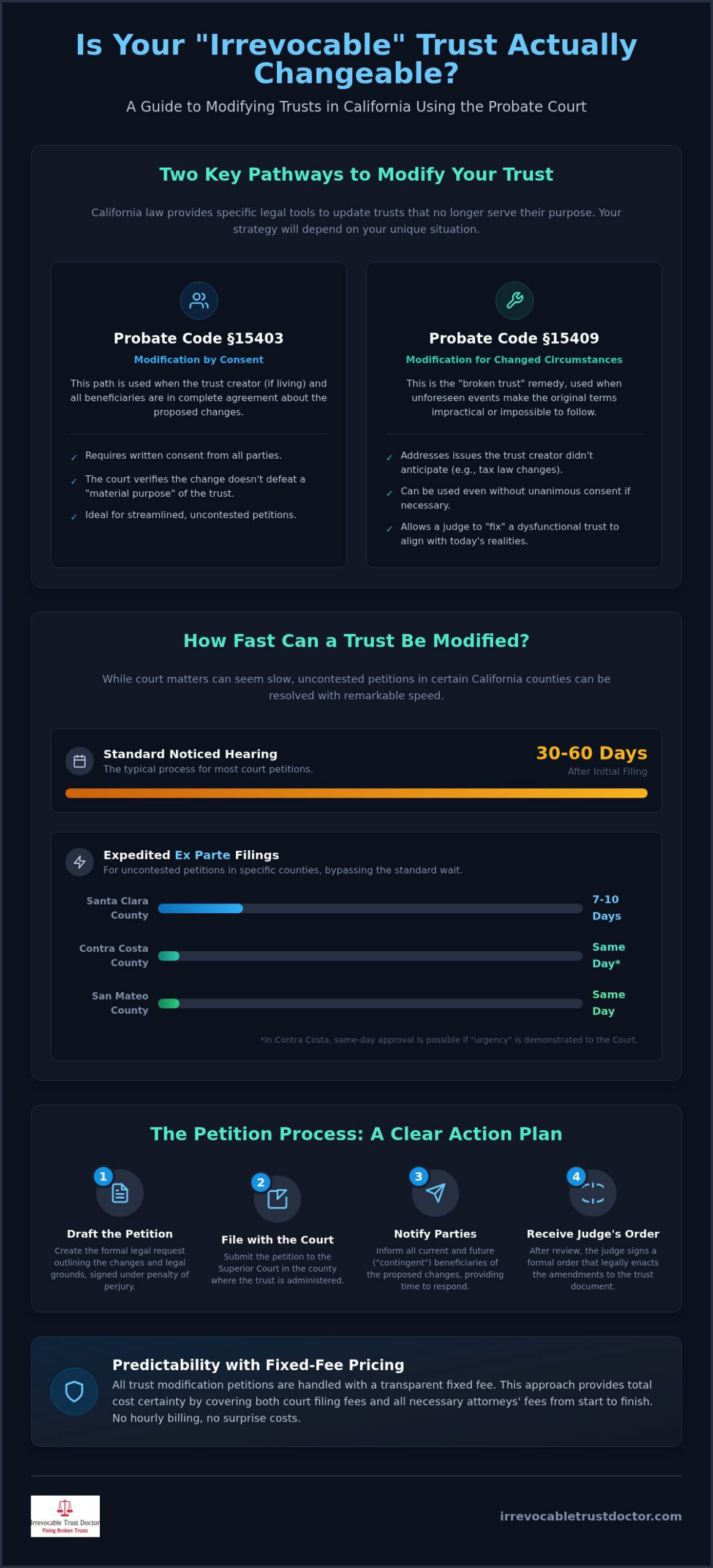
The speed of your legal resolution depends heavily on which county courthouse you’re entering. Most people assume the legal system is a black hole of delays, but a court petition to amend irrevocable trust doesn’t have to take months. While a standard noticed hearing usually requires a 30-to-60 day wait, we often utilize "ex parte" filings. This process allows the petition to be handled without a formal hearing, which bypasses the standard calendar entirely. If your case is uncontested and you can demonstrate a specific need for speed, you may qualify for this expedited treatment.
Fast-Track Counties: Santa Clara, San Mateo, and Contra Costa
Our regular practice in specific Bay Area counties has revealed remarkably efficient pathways for families in need. In Santa Clara County, ex parte petitions are typically granted within 7 to 10 days of filing. San Mateo County offers even more impressive results; we often file the petition, have it heard by a judge, and receive the signed order on the very same day. In Contra Costa County, the court frequently grants same-day petitions if we can demonstrate "urgency" to the judge’s satisfaction. These timelines allow for rapid corrections to trusts that are causing immediate financial or tax burdens. An experienced irrevocable trust modification specialist who regularly practices in these counties will know exactly how to frame your petition to meet each court’s specific urgency standards.
Standard vs. Contested Petitions
It’s important to understand that these fast-track options rely on the petition being "uncontested," meaning no one is fighting the change. If a beneficiary or interested party objects, the judge will move the case to the standard trial calendar, which takes much longer. Even a standard noticed hearing requires an additional buffer of time to ensure all parties are legally served with notice. We handle these complex petitions across California with a fixed-fee structure that covers both the court filing fees and our professional services. To find out if your trust modification qualifies for an expedited timeline, book a trust petition consultation today.
Why a Specialized ‘Trust Doctor’ Is Essential for Your Petition
Most general estate planners focus on the initial creation of a trust, not the complex task of fixing one when it fails. Filing a court petition to amend irrevocable trust requires a niche understanding of the Probate Code that goes far beyond standard drafting. I act as a "specialist fixer" for both individual families and fellow attorneys who find themselves stuck with a dysfunctional or outdated document. With over 40 years of experience as a Certified Specialist in San Jose and across the state, I’ve developed the clinical precision needed to diagnose exactly why a trust is broken and prescribe the precise legal remedy to restore its utility.
The Benefit of Fixed-Fee Representation
Traditional legal work often creates "billable hour" anxiety, where every phone call or email adds to an unpredictable total. We’ve eliminated that stress by using a fixed-fee model for our trust modification petitions. This single price is all-inclusive, covering both the court’s mandatory filing fees and our professional legal services. If you’re looking for total transparency, you can view our fees and costs page for specific details. This project-based approach ensures that our focus remains entirely on getting your petition granted as efficiently as possible.
Statewide Assistance for California Residents
While my practice is rooted in the San Francisco Bay Area, I handle petitions for clients throughout Northern and Southern California. Whether you’re dealing with a rigid trust in San Diego or an outdated document in Sacramento, the same rules under Probate Code 15403 and 15409 apply. We leverage our deep experience with ex parte procedures in counties like Santa Clara, where petitions are typically granted in 7 to 10 days, and San Mateo, where they can often be granted the same day. If you’re an attorney needing specialized help for a client or a beneficiary feeling trapped by rigid terms, we provide the methodical, hands-on guidance necessary to navigate the California Probate Court system with confidence.
Take the Next Step Toward a Functional Trust
You don’t have to remain stuck with a trust document that no longer reflects your family’s needs or today’s tax realities. By filing a court petition to amend irrevocable trust, you can leverage California’s specific legal pathways to correct administrative errors or adapt to changed circumstances. Whether you’re utilizing the rapid ex parte processes in San Mateo or Santa Clara or navigating a standard noticed hearing, the goal is always a precise legal remedy that restores order to your estate.
Beyond legal updates, ensuring your estate is truly prepared involves comprehensive organization; a family readiness assessment from IronClad Family can help you secure and manage your most important documents and digital assets.
As a Certified Specialist in Estate Planning, Trust, and Probate Law with over 40 years of experience, I’ve dedicated my practice to being a specialist fixer for these exact situations. My firm provides total cost transparency through fixed-fee pricing that covers both your court filing fees and our expert representation. You don’t have to navigate the complexities of the Probate Court alone. I assist both individual clients and fellow attorneys throughout California to ensure every petition is handled with clinical accuracy.
Request a Trust Modification Consultation with The Irrevocable Trust Doctor today to begin the process of fixing your broken trust. Your document can be restored; it just requires the right legal approach.
Frequently Asked Questions
Can I amend an irrevocable trust without going to court in California?
In most cases, you cannot formally amend an irrevocable trust without judicial intervention. While some documents allow for a "Trust Protector" to make minor adjustments, a formal court order is the only way to guarantee the modification is legally bulletproof and recognized by all financial institutions. Utilizing the court system under Probate Code 15403 or 15409 protects the trustee from future liability by ensuring a judge has approved the changes.
What is the difference between a noticed hearing and an ex parte petition for trust modification?
A noticed hearing is the standard procedure where all beneficiaries receive 30 to 60 days’ notice before a judge hears the case in open court. An ex parte petition is a "fast-track" option filed without a formal hearing, which we frequently use in counties like San Mateo and Santa Clara. In San Mateo, these can often be granted the same day; in Santa Clara, the process typically takes 7 to 10 days.
How much does it cost to file a court petition to amend a trust in California?
As of January 1, 2026, the mandatory filing fee for a petition concerning the internal affairs of a trust is $435. We handle these matters using a fixed-fee structure that covers this court filing fee along with all professional attorney fees. This approach provides you with total cost predictability and eliminates the anxiety of unpredictable billable hours during the legal process.
What happens if a beneficiary refuses to consent to the trust amendment?
If a beneficiary objects, the case becomes a contested court petition to amend irrevocable trust and moves to the standard trial calendar. While Probate Code 15403 usually requires the consent of all beneficiaries, you can still seek a modification under Probate Code 15409. This path allows a judge to approve changes if you can prove that circumstances have changed in a way that the trust’s creator didn’t anticipate.
Can I change an irrevocable trust after the settlor has passed away?
Yes, you can modify a trust even after the person who created it has died. This is often necessary when tax laws change or a beneficiary’s life situation shifts, such as the development of special needs. By using the "changed circumstances" pathway in the Probate Code, we can ask the court to reform the document to meet today’s realities while still respecting the creator’s overall intent.

Article by
Robert P. Bergman, Attorney at Law
Attorney Robert P. Bergman ("Bob Bergman") has been a Board-Certified Specialist in Estate Planning, Trust and Probate Law since 2011, as certified by the California State Bar Board of Legal Specialization. For several years, Bob has assisted families and the clients of other attorneys with obtaining court orders through trust modification petitions to make necessary modifications to existing irrevocable trusts. Bob is friendly, very approachable, and believes in explaining complex legal topics in clear ordinary language so that his clients understand exactly what they're doing and why they're doing it.
Bob is often able to assist clients throughout California who are in other counties than his home county of Santa Clara through his approach to trust modification petitions.