
Disclaimer
This article is for informational purposes only. Nothing in this article is intended to replace legal advice from a competent attorney or be considered legal guidance for anybody's specific legal situation. Nobody should rely on information in this article in making legal decisions without such consultation.
The word "irrevocable" often feels like a legal dead end, but it doesn’t mean your family’s future is stuck with an unfit or unresponsive trustee. If you need to modify trust to change trustee provisions California law offers clear, accessible pathways to restore order through the court system. Whether your current successor plan is impossible to fulfill or you need to update trustee powers to reflect modern needs, you aren’t trapped by outdated language.
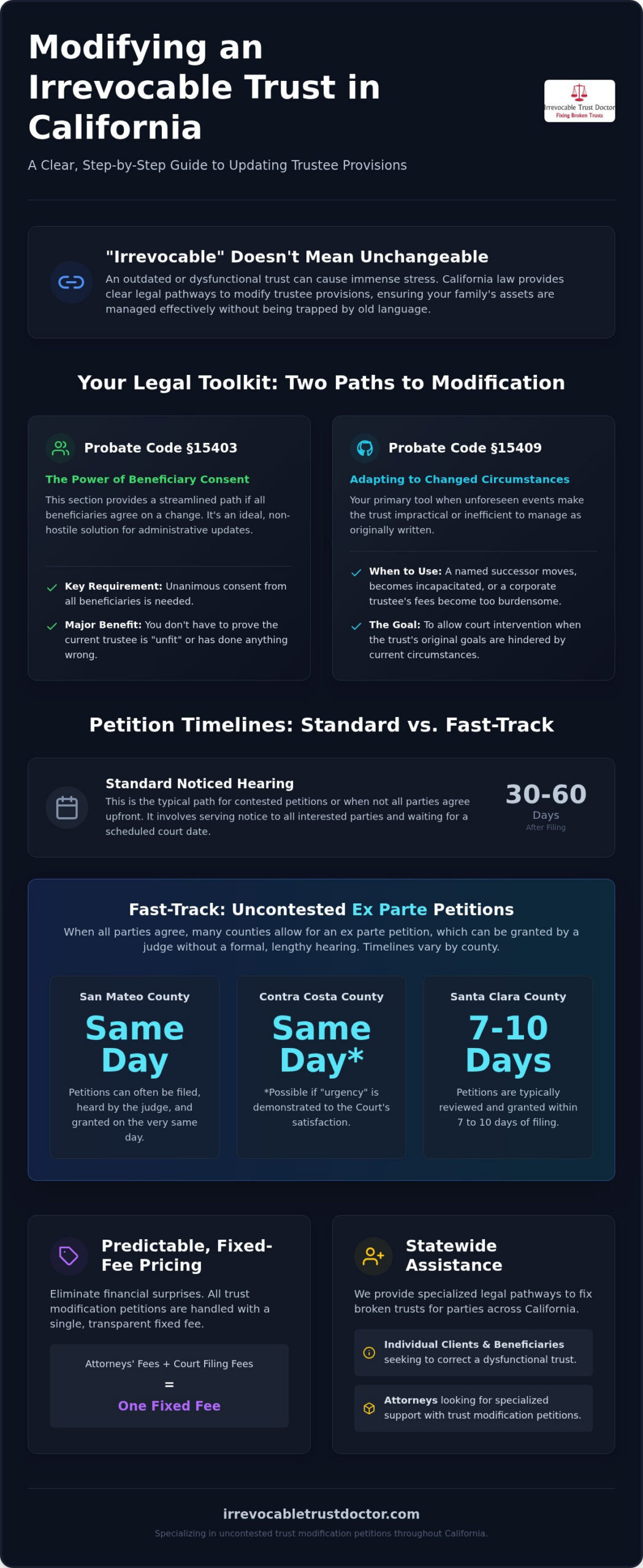
I’ve seen how a dysfunctional trust causes immense stress, yet many beneficiaries don’t realize that Probate Code Section 15403 and Probate Code Section 15409 exist specifically to fix these documents. This guide reveals how to secure a clear legal path to update your trustee language. We’ll explore how ex parte petitions, which are requests granted by a judge without a formal hearing, can resolve issues in as little as one day in San Mateo County. In Contra Costa County, same-day results are possible with demonstrated urgency, while Santa Clara County petitions are typically granted in 7 to 10 days. I assist attorneys and clients statewide using a fixed-fee model that covers both filing and legal fees. While contested petitions take longer, most cases offer a predictable, streamlined way to ensure your trust is functional again.
Key Takeaways
- Understand how Probate Code Sections 15403 and 15409 allow you to update an irrevocable trust if the current trustee is unfit or the succession rules are no longer practical.
- Discover the specific steps to modify trust to change trustee provisions California using an ex parte petition to bypass long wait times for a formal hearing.
- Learn how to secure court approval in as little as one day in San Mateo County or Contra Costa County, or within 10 days in Santa Clara County.
- Eliminate financial surprises by choosing a fixed-fee service that covers everything from the initial drafting to the final court filing fees.
- Find out how both individual clients and their existing attorneys can use these specialized legal pathways to fix broken trusts anywhere in the state.
Legal Grounds to Modify Trustee Provisions in California
Trustee provisions act as the operational manual for a trust. They define who is in charge, how a successor is appointed, and exactly what authority they have over the assets. When these provisions become outdated or impossible to follow, the entire administration can grind to a halt. While many people assume an irrevocable trust is "unfixable," California law offers specific remedies. Choosing to modify trust to change trustee provisions California families rely on is often a superior alternative to filing a hostile removal petition. Rather than engaging in a long, expensive battle to prove a trustee is "unfit," we focus on correcting the document’s structure to ensure it works for everyone involved.
Using Probate Code 15403: The Power of Beneficiary Consent
If all beneficiaries of an irrevocable trust agree on a change, then Probate Code Section 15403 provides a streamlined path. The major benefit here is that you don’t have to prove the current trustee committed a "wrong" or failed in their duties. Unanimous consent allows the court to bypass the need for evidence of misconduct. The only hurdle is the "material purpose" test. The court must ensure the modification doesn’t violate the core reason the trust was established. Since most trustee updates are administrative, they typically pass this test easily. This approach relies on foundational trust law principles to modernize the document without the drama of litigation.
Probate Code 15409: Adapting to Unforeseen Circumstances
When circumstances change in ways the original creator didn’t anticipate, Probate Code Section 15409 becomes your primary tool. This section applies when the current trustee structure has become impractical or inefficient. Common examples include a named successor moving out of the country, becoming incapacitated, or a corporate trustee’s requirements becoming too burdensome for the trust’s size. If these events make it harder to fulfill the trust’s goals—such as effectively managing or selling real estate through Integrity Estates Realty—then the court can intervene to modify trust to change trustee provisions California courts oversee. I assist both individual clients and their existing attorneys throughout the state to navigate these petitions using a transparent, fixed-fee model that covers both legal work and filing fees.
The Petition Process: Updating Trustee Succession and Powers
The official journey to fix a dysfunctional trust begins with a formal document known as a "Petition for Modification." This isn’t a generic form you can download; it’s a precise legal argument drafted by a California irrevocable trust modification attorney. To successfully modify trust to change trustee provisions California courts require you to cite specific statutory grounds, such as Probate Code 15403 or 15409. You must also detail the exact language you want to remove and the specific wording that will replace it. Strategic petitions focus on administrative clarity rather than personal grievances. This approach minimizes the risk of a judge denying the request because it frames the change as a necessary fix for the trust’s survival.
Drafting the Petition for Maximum Efficiency
A judge’s time is limited. If your petition uses vague or confusing language, the court will likely delay the request for clarification. I focus on drafting revisions that leave no room for misinterpretation. One practical tip is to include a "proposed court order" with the initial filing. This allows the judge to see exactly what the final resolution looks like, making it much easier for them to sign off on the change. When the court sees a clear, well-structured order ready for signature, it significantly reduces the administrative friction that often slows down probate cases.
Noticed Hearings vs. Uncontested Resolutions
Standard probate procedures often require a "noticed hearing." This means you must serve a copy of the petition to every person with an interest in the trust, including all named beneficiaries and successor trustees. You then wait for a scheduled court date, which typically falls 30 to 60 days after the filing date. However, if every beneficiary and the current trustee agree to the changes, the petition becomes uncontested. Judges view these unanimous requests much more favorably because they don’t involve family disputes or litigation. If you’re dealing with an urgent situation where a trustee is failing to act, you might discuss your specific timeline during a consultation to see if a faster route is available. While contested petitions can take much longer, a unified front usually leads to a predictable and calm resolution.
Fast-Track Options: Ex Parte Petitions and County Timelines
Standard probate timelines often feel agonizingly slow when a trust is in crisis. If you need to modify trust to change trustee provisions California law allows for "ex parte" petitions. This is a specialized request for immediate court intervention that bypasses the standard 30 to 60 day notice period required for typical hearings. As a specialist fixer for broken trusts, I focus on these expedited pathways to ensure your family’s assets aren’t left in legal limbo while waiting for a distant court date. To succeed with this approach, your petition must demonstrate a level of urgency that satisfies the local judge’s requirements.
Santa Clara, San Mateo, and Contra Costa Speed Data
The speed of your resolution often depends on which county has jurisdiction over the trust. Through my regular practice in the Bay Area, I’ve observed consistent patterns in how local courts handle these urgent requests:
- Santa Clara County: Petitions filed ex parte here are typically reviewed and granted within 7 to 10 days of filing.
- San Mateo County: This jurisdiction is exceptionally efficient; petitions can often be filed, heard, and granted on the same day.
- Contra Costa County: Same-day grants are also possible here, provided the level of urgency is clearly demonstrated to the Court’s satisfaction.
When is a Trustee Issue Considered ‘Urgent’?
Courts don’t grant ex parte requests for mere convenience. in some counties, you must show that waiting for a standard hearing would cause actual harm to the trust or its beneficiaries. Common examples include a pending real estate sale that requires a trustee’s signature by a hard deadline or a "leaderless" trust where no one has the authority to pay essential bills or taxes. Urgency is the key that unlocks the ex parte door in California probate courts. If your situation requires immediate intervention to modify trust to change trustee provisions California families can schedule a consultation to discuss an expedited petition. These timelines are critical for protecting assets that are in immediate financial jeopardy.
Predictable Costs: Fixed Fees for Trust Modification
Traditional legal billing often leaves families in a state of financial anxiety. Most firms charge by the hour, which means every phone call or court delay adds to your bill. This structure can lead to excessive costs that eat away at the very assets the trust was meant to protect. I’ve chosen a different path. By using a fixed-fee model for all petitions to modify trust to change trustee provisions California families need, I ensure that the cost is transparent from the start. This approach aligns our goals; we both want a swift, successful resolution without unnecessary billing cycles.
What’s Included in a Fixed-Fee Petition?
When we agree on a price, it covers the entire procedural lifecycle of your case. These fixed fees include the initial drafting of the petition, all required court filing fees, and the work necessary to secure the final court order. Whether your case is heard ex parte in 7 to 10 days in Santa Clara or requires a standard 30 to 60 day noticed hearing elsewhere, your cost remains the same. This pricing structure provides peace of mind to beneficiaries who worry about depleting their inheritance on open-ended legal bills. It allows you to focus on the outcome rather than the clock.
Taking the First Step: The Trust Petition Consultation
Every trust is unique, and a specialized consultation is the first step toward a fix. During this session, we’ll determine if your specific situation qualifies for modification under Probate Code Section 15403 or 15409. I assist clients and their existing attorneys throughout California, from San Diego to Sacramento, providing the niche expertise needed to navigate these complex filings. If you’re ready to restore functionality to a broken trust, Book Your Trust Petition Consultation Today. Whether we’re seeking a same-day grant in San Mateo or managing a more complex statewide filing, we’ll move forward with a clear plan and a predictable price.
Restore Order to Your Family Trust
Living with a trust document that no longer functions is a choice, not a legal requirement. As we’ve discussed, California law provides specific statutory pathways to modernize your succession plan and trustee powers. Whether you are dealing with an unresponsive trustee or an outdated list of successors, you can modify trust to change trustee provisions California courts recognize to ensure your assets are managed correctly. By utilizing ex parte petitions in counties like San Mateo or Santa Clara, you can secure a court order in a fraction of the time required for standard hearings.
I offer a fixed-fee approach that eliminates the financial guesswork often associated with probate litigation. My 40 years of experience as a Certified Specialist in Estate Planning, Trust, and Probate Law allows me to navigate these bureaucratic hurdles with clinical precision. I assist clients and their existing attorneys throughout the state to find specialized remedies for dysfunctional trusts. If you’re ready to fix your broken trust and move forward with a predictable, transparent plan, it’s time to take the next step. Book a Trust Petition Consultation with a Certified Specialist today. You have the power to restore clarity and protection to your family’s legacy.
Frequently Asked Questions
Can you change the trustee of an irrevocable trust without going to court?
Changing a trustee without a court order is generally only possible if the trust document itself contains a specific "power of appointment" or names a "trust protector" with the authority to make the switch. For most irrevocable trusts, you’ll need to file a petition to modify trust to change trustee provisions California courts must approve. This formal process ensures the new trustee has clear legal authority to manage assets and protects them from future liability claims by beneficiaries.
How much does it cost to modify trustee provisions in California?
I handle these petitions using a fixed-fee model that covers both my legal services and the court’s filing fees. This approach is different from most firms that bill by the hour, which can lead to unpredictable and excessive costs. By providing a single transparent price, you can resolve the issue without worrying that legal bills will deplete the inheritance you’re trying to protect.
What is the fastest way to change a trustee in Santa Clara County?
The quickest route in Santa Clara County is filing an uncontested ex parte petition, which is a request for a judge to act without a formal hearing. While a standard noticed hearing usually takes 30 to 60 days, an ex parte petition in Santa Clara is typically granted in 7 to 10 days. I regularly use this expedited path for both clients and their existing attorneys to fix broken trusts quickly.
Do all beneficiaries have to agree to change a trustee in an irrevocable trust?
Unanimous agreement is required if you’re using Probate Code Section 15403 to modify trust to change trustee provisions California families find unworkable. If you don’t have everyone’s consent, you can still petition the court under Probate Code Section 15409. In that case, you’ll need to prove that "changed circumstances" have made the current trustee structure impractical or detrimental to the trust’s original purpose.
What qualifies as ‘changed circumstances’ for a trust modification in California?
Changed circumstances are unforeseen events that make the original trust instructions difficult or impossible to carry out. This includes situations where a named successor has moved out of state, a corporate trustee has significantly increased its fees, or a designated individual has become incapacitated. If these new realities hinder the trust’s success, the court can intervene under Section 15409 to update the trustee language and restore functionality.

Article by
Robert P. Bergman, Attorney at Law
Attorney Robert P. Bergman ("Bob Bergman") has been a Board-Certified Specialist in Estate Planning, Trust and Probate Law since 2011, as certified by the California State Bar Board of Legal Specialization. For several years, Bob has assisted families and the clients of other attorneys with obtaining court orders through trust modification petitions to make necessary modifications to existing irrevocable trusts. Bob is friendly, very approachable, and believes in explaining complex legal topics in clear ordinary language so that his clients understand exactly what they're doing and why they're doing it.
Bob is often able to assist clients throughout California who are in other counties than his home county of Santa Clara through his approach to trust modification petitions.