
Disclaimer
This article is for informational purposes only. Nothing in this article is intended to replace legal advice from a competent attorney or be considered legal guidance for anybody's specific legal situation. Nobody should rely on information in this article in making legal decisions without such consultation.
What if the word “irrevocable” didn’t actually mean “unchangeable” in the eyes of the law? Most people assume that once a trust is finalized, the terms are set in stone, leaving beneficiaries stuck with high taxes or outdated language that no longer serves their needs. If you feel trapped by a document that’s causing family disputes or financial drain, you’re not alone. Working with an irrevocable trust modification attorney California families and legal professionals rely on can turn a “broken” trust into a functional tool again.
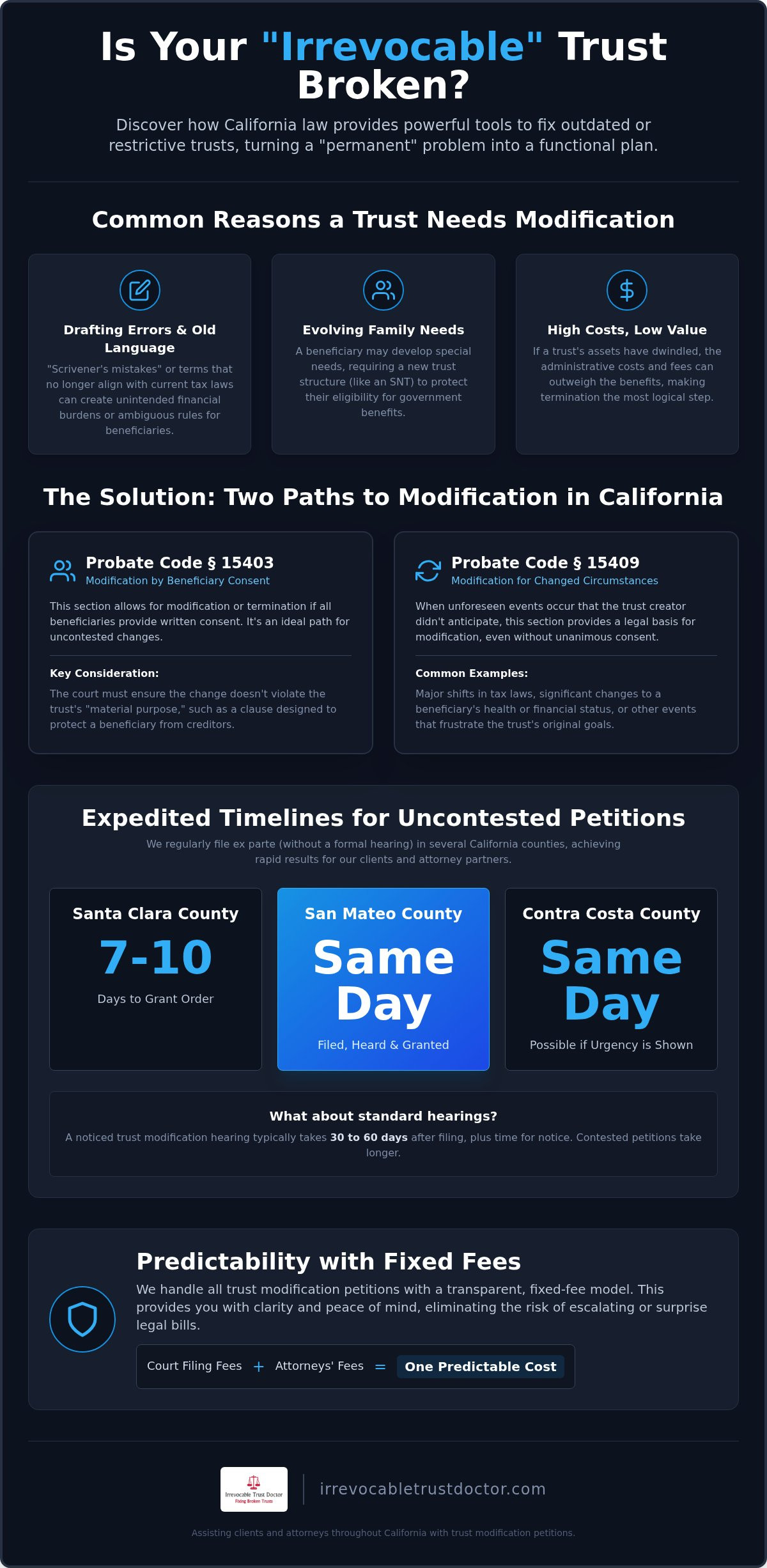
I assist both clients and fellow attorneys statewide in navigating the California Probate Code to update or terminate restrictive trusts. By utilizing Probate Code Section 15403 for beneficiary consent or Section 15409 for changed circumstances, we can often bypass lengthy delays. For example, in Santa Clara County, I regularly obtain court orders via ex parte petitions in just 7 to 10 days. In San Mateo or Contra Costa, we can often get a petition granted the same day if urgency is shown to the court. This article explains how our fixed-fee model covers everything from filing to attorney fees, ensuring you have a clear, predictable path to fixing your trust in 2026.
Key Takeaways
- Learn how Probate Code Sections 15403 and 15409 provide the legal authority to update or terminate trusts that no longer serve their intended purpose.
- Discover how ex parte petitions can bypass long court delays, with some California counties granting orders in as little as 7 to 10 days or even on the same day.
- See why working with a specialized irrevocable trust modification attorney California trusts can help you navigate the unique procedural requirements of different local courts.
- Understand how a fixed-fee approach simplifies the process by covering both court filing fees and legal representation in one predictable cost.
- Identify the specific criteria for “changed circumstances” that allow you to fix drafting errors or address high taxes caused by outdated trust language.
Why Your Irrevocable Trust Might Be Broken and How to Fix It
A “broken” trust isn’t necessarily one that was poorly written from the start. Often, a trust breaks because the world around it changes while the document remains static. In legal terms, a trust is considered broken when it no longer achieves its “material purpose” due to shifts in tax law, family dynamics, or financial circumstances. While Understanding Trust Law helps clarify the foundational roles of the settlor, trustee, and beneficiary, it’s essential to realize that “irrevocable” is merely a starting point under California law. It is not a permanent dead end.
I assist both individual families and other law firms as an irrevocable trust modification attorney California practitioners rely on to navigate these complex petitions. If you discover that the settlor’s original intent is now at odds with your current reality, don’t lose hope. Life outpaces even the best estate plans. A quick tip: you should review your trust every five years. This ensures it still aligns with current California tax codes and your family’s evolving needs.
Common Scenarios Requiring a Trust Modification
Several specific situations often require a court-ordered fix. These include:
- Fixing “scrivener mistakes” or drafting errors that lead to unintended tax consequences or ambiguous distribution rules.
- Updating terms because a beneficiary has developed special needs, requiring a Special Needs Trust (SNT) structure to preserve government benefits.
- Terminating a trust if the assets have dwindled to the point where administrative costs exceed the value of the trust itself.
- Addressing international complexities, such as US-Italy cross-border business operations or immigration-related asset shifts that might require the expertise of Tosolini, Toniutti & Partners to ensure the trust remains functional.
The Role of the Probate Court in Trust Reformation
Many people fear that going to court means a hostile trial. In reality, judicial modification is usually a procedural tool for restoration. The court acts as a facilitator to ensure the trust remains a viable and helpful instrument. I guide clients through this process using Probate Code Section 15403 and Probate Code Section 15409 to achieve the desired results. If you’re worried about the expense, keep in mind that I handle these petitions with fixed fees that cover both the filing fees and attorney’s fees. This provides the clarity you need to move forward without financial surprises.
Understanding California Probate Code Sections 15403 and 15409
When people hear “irrevocable,” they often assume the document is a final, unchangeable decree. However, as an irrevocable trust modification attorney California families trust, I use specific sections of the law to reopen these documents. The two most powerful tools at our disposal are Probate Code Sections 15403 and 15409. These statutes allow us to petition the court for changes that reflect today’s reality rather than yesterday’s assumptions. One helpful tip: if you’re pursuing a 15403 petition, gather written consent from all beneficiaries as early as possible to streamline the process.
Section 15403: When All Beneficiaries Agree
Under California Probate Code Section 15403, if the person who created the trust has passed away and all beneficiaries agree to a change, the court can grant a modification. The main hurdle here is the “material purpose” test. This means a judge will check if the requested change defeats the core reason the trust was created. For example, if a trust has a “spendthrift clause,” which is a specific rule meant to protect assets from a beneficiary’s creditors or poor spending habits, a judge might deny a request to end the trust early because doing so would violate that original protective purpose.
Section 15409: Navigating Unforeseen Changes
Section 15409 is the solution when life takes an unexpected turn that the creator never saw coming. This could include major shifts in tax law or a change in a beneficiary’s health. You don’t always need unanimous consent here if we can prove the trust is failing its goals. In counties like Santa Clara, I can often get these petitions granted in 7 to 10 days. In San Mateo or Contra Costa, we can sometimes achieve this on the same day if we show urgency to the court’s satisfaction. While a noticed hearing usually takes 30 to 60 days, my fixed-fee model ensures you won’t face escalating costs regardless of the timeline. To see if your situation qualifies, you can schedule a trust petition consultation to review your options.
The Court Petition Process: Timelines and Local County Rules
Once we identify that your trust needs a fix, the next step is moving through the California court system. The process begins with drafting and filing a formal petition. While this might sound intimidating, an irrevocable trust modification attorney California families rely on can often streamline this using an “ex parte” petition. This is essentially a request for the court to act without a formal, scheduled hearing, which is the secret to fast-tracking your results. According to the California Probate Code on Trust Modification, the court has the authority to grant these requests quickly if the proper procedural steps are followed.
Fast-Track Modification: Santa Clara, San Mateo, and Contra Costa
The timeline for your petition depends heavily on where it is filed. Each county has its own local rules that dictate speed. Here is what you can typically expect in my primary practice areas:
- Santa Clara County: Ex parte petitions here are usually granted in 7 to 10 days.
- San Mateo County: I can often file, have the petition heard, and get it granted on the very same day.
- Contra Costa County: Same-day results are possible here as well, provided we can demonstrate “urgency” to the court’s satisfaction.
A helpful tip: if you need a quick resolution, focus on clearly documenting the immediate financial or legal harm that will occur if the trust isn’t modified right away. Demonstrating this urgency is often the key to moving to the front of the line.
Noticed Hearings vs. Ex Parte Filings
If an ex parte filing isn’t appropriate, we move to a noticed hearing. This requires formally notifying all interested parties, which typically adds 30 to 60 days to the timeline. If the petition is contested, meaning someone disagrees with the change, the process will naturally take longer and require more evidence. Regardless of the path, I handle these matters using fixed fees that include all filing and attorney costs. If you’re ready to start the process, you should book a trust petition consultation to discuss your specific county’s requirements.
Working with an Irrevocable Trust Specialist Attorney
Modifying a trust isn’t a standard part of estate planning; it’s a specific legal intervention that requires a diagnostic approach. While many attorneys create trusts, few specialize in the procedural “surgery” required to fix them once they’re broken. As an irrevocable trust modification attorney California families and law firms rely on, I focus exclusively on these complex court petitions. This niche expertise is why many general probate practitioners hire me as a “specialist fixer” to handle their most technical cases. If you’re an attorney seeking support for a client’s difficult petition, I provide the precision needed to navigate local rules and Probate Code requirements successfully.
Because I regularly file petitions ex parte in Santa Clara, San Mateo, and Contra Costa counties, I understand the subtle differences in what each judge expects. That specialized knowledge is what allows me to obtain orders in 7 to 10 days in Santa Clara, or even on the same day in San Mateo. If you’re dealing with a trust that no longer serves its purpose, working with a specialist ensures the petition is drafted correctly the first time, avoiding the delays of a noticed hearing that can take 30 to 60 days.
Fixed Fees and Transparent Costs
Most legal services feel like a blank check because of hourly billing. I’ve chosen a different path to provide families and trustees with complete predictability. You can view our fixed fees and costs to see exactly what to expect before we begin. This fixed fee is comprehensive; it covers both the mandatory court filing fees and my professional time to handle the petition from start to finish. If you’re worried about legal expenses draining the trust’s assets, this model offers the financial clarity you need to move forward with confidence.
Taking the Next Step for Your Trust
You don’t have to live with a trust that’s causing tax problems or family disputes. To prepare for our talk, bring the original trust document and any amendments. It’s also helpful to have a clear list of what isn’t working. For example, if a beneficiary now has special needs or if the trust’s administrative costs are too high, those are key details. When you’re ready to fix the document, you can schedule your trust petition consultation. The law provides the tools to restore your trust; you just need the right expert to apply them.
Restore Your Peace of Mind and Your Legacy
You don’t have to stay stuck with a trust that no longer fits your family’s needs. California law provides specific pathways through Probate Code Sections 15403 and 15409 to update, amend, or terminate even the most restrictive documents. Whether you’re a beneficiary facing high taxes or an attorney seeking a specialist fixer for a complex petition, the right legal strategy can resolve these issues quickly. In many cases, we can even bypass the long wait times of a formal hearing by using ex parte filings in counties like Santa Clara, San Mateo, or Contra Costa.
I am a Certified Specialist in Estate Planning, Trust, and Probate Law, and I provide statewide service for both clients and legal professionals. My practice is built on a transparent, fixed-fee model that covers all filing and attorney fees, ensuring you never face unexpected costs. If you’re ready to fix a broken trust and move forward with clarity, it’s time to take the first step. You can Contact The Irrevocable Trust Doctor for a Consultation today. Working with an irrevocable trust modification attorney California families rely on is the surest way to ensure your legacy remains protected and functional.
Frequently Asked Questions
Can an irrevocable trust be changed in California without going to court?
Generally, a court order is required to modify or terminate an irrevocable trust once the person who created it has passed away. While some documents include provisions for a “trust protector” who can make minor administrative tweaks, most substantive changes to beneficiary distributions or trust management require a formal petition. Working with an irrevocable trust modification attorney California families trust ensures that your petition meets the specific requirements of the Probate Code to secure a valid court order.
What is the difference between Probate Code 15403 and 15409?
The primary difference lies in whether you have the consent of all beneficiaries. Section 15403 is used when every beneficiary agrees to the modification, provided the change doesn’t defeat a core purpose of the trust. Section 15409 is the tool we use when consent isn’t possible but “changed circumstances” have made the trust’s original goals impossible to achieve. If you can demonstrate that the creator of the trust didn’t foresee these shifts, the court can intervene to fix the document.
How long does it take to modify a trust in Santa Clara County?
In Santa Clara County, I typically obtain court orders for uncontested ex parte petitions in 7 to 10 days. This is a much faster alternative to a noticed hearing, which generally takes 30 to 60 days. If your petition is contested by another party, the timeline will naturally extend as the court requires more evidence and formal hearings. For most “broken” trusts, the ex parte process is the most efficient path to a resolution.
Does the Settlor need to be alive to modify an irrevocable trust?
No, the person who created the trust does not need to be alive for a modification to occur. Many of the cases I handle involve trusts that became irrevocable upon the creator’s death. California law allows beneficiaries to petition the court to update or end these trusts if the terms are no longer economically viable or if the original intent is being frustrated by current laws. You don’t have to stay stuck with an outdated document just because the settlor is gone.
Are there fixed fees for filing a trust modification petition in California?
Yes, I handle all trust modification petitions with a fixed-fee model that provides complete price transparency. This single fee covers both the mandatory court filing fees and my professional legal fees for the entire process. Unlike traditional hourly billing, which can make legal costs unpredictable, my fixed-fee approach ensures you know the total cost before we file. This applies to petitions filed throughout California, including those handled on an expedited basis in San Mateo or Contra Costa counties.

Article by
Robert P. Bergman, Attorney at Law
Attorney Robert P. Bergman ("Bob Bergman") has been a Board-Certified Specialist in Estate Planning, Trust and Probate Law since 2011, as certified by the California State Bar Board of Legal Specialization. For several years, Bob has assisted families and the clients of other attorneys with obtaining court orders through trust modification petitions to make necessary modifications to existing irrevocable trusts. Bob is friendly, very approachable, and believes in explaining complex legal topics in clear ordinary language so that his clients understand exactly what they're doing and why they're doing it.
Bob is often able to assist clients throughout California who are in other counties than his home county of Santa Clara through his approach to trust modification petitions.