
Disclaimer
This article is for informational purposes only. Nothing in this article is intended to replace legal advice from a competent attorney or be considered legal guidance for anybody's specific legal situation. Nobody should rely on information in this article in making legal decisions without such consultation.
Imagine discovering that your family’s trust assets are completely frozen because every named successor trustee has passed away or is unable to serve. It’s an overwhelming realization that leaves many families feeling trapped by an outdated document. You likely want a resolution that doesn’t involve a multi-year court battle. You can restore your trust’s functionality by fixing trustee succession errors in California trust through an Irrevocable Trust Modification Petition. This guide explains how we assist families and attorneys throughout the state, including Los Angeles, Orange, San Bernardino, and Riverside.
We’ll explore using Probate Code Section 15403 and Probate Code Section 15409 to secure a valid court order. You’ll learn about our specialized process in Santa Clara County, where petitions are typically granted in 7 to 10 days. Our approach uses a predictable, fixed-fee model covering all filing and attorney fees to ensure your trust is restored and protected for the future.
Key Takeaways
- Identify the specific signs of a “broken” trust clause and learn how a court order can unfreeze assets when no named successor is available to act.
- Discover the legal process for fixing trustee succession errors in California trust by utilizing Probate Code Section 15403 or Probate Code Section 15409.
- Leverage fast-track procedural options like ex-parte filings in Santa Clara, San Mateo, and Contra Costa Counties to secure a new trustee in as little as one to ten days.
- Understand the benefits of a comprehensive fixed-fee model that covers all filing costs and attorney fees for clients throughout Los Angeles, Orange, and San Diego Counties.
Recognizing Trustee Succession Errors and ‘Broken’ Trust Clauses
A "broken" succession clause occurs when your trust document lacks a viable path to appoint a new leader. This structural failure freezes the legal concept of a trust, making it impossible to manage assets or fulfill the grantor’s intent. Without an authorized person to sign deeds, pay taxes, or distribute funds, the trust becomes stagnant. If you’re facing a situation where every named person is gone or refuses to act, you’re effectively fixing trustee succession errors in California trust by seeking court intervention. Drafting mistakes, like failing to give beneficiaries a "power to appoint" a successor, often leave families with no choice but to petition the court for a remedy.
Common Scenarios Where Trustee Succession Fails
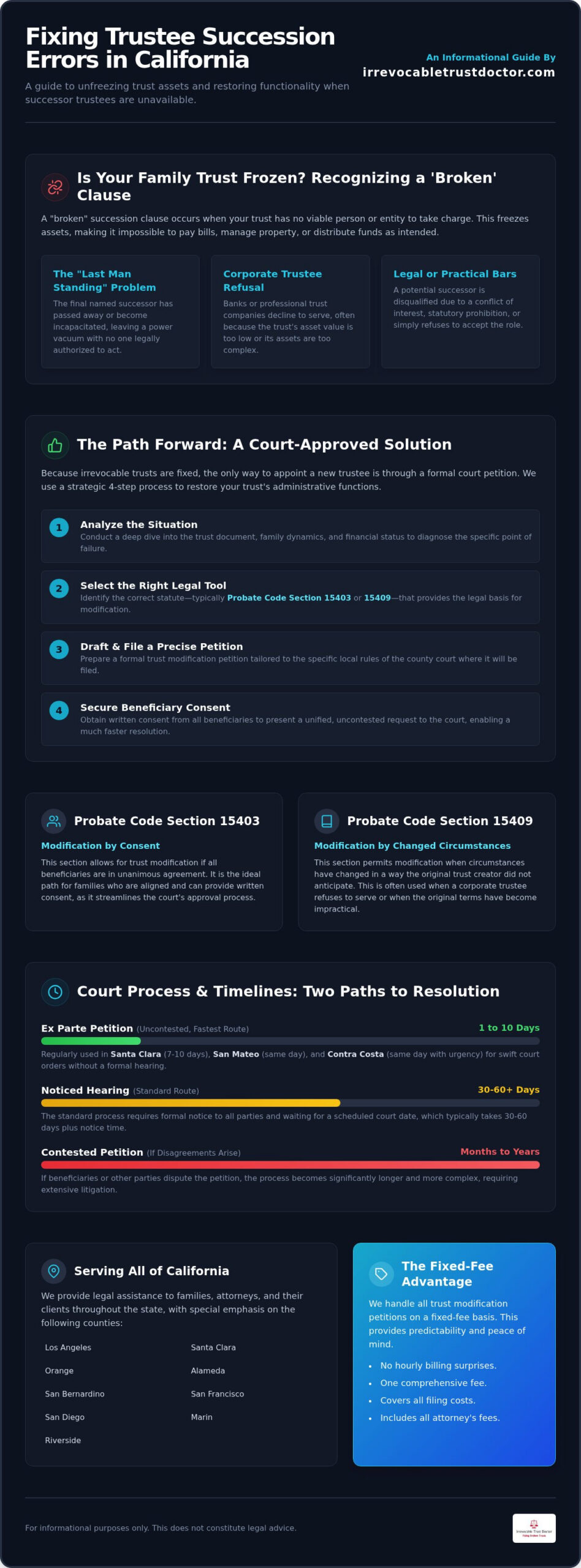
Succession often breaks down due to three specific events that the original drafter didn’t anticipate:
- The "Last Man Standing" Problem: This happens when the final named successor passes away unexpectedly or becomes incapacitated, leaving no one with legal authority to act on behalf of the beneficiaries.
- Corporate Trustee Refusal: Banks or trust companies frequently decline to serve if the trust’s asset value doesn’t meet their current minimum requirements or if the assets are too complex to manage.
- Legal Bars: A named successor might be legally barred from serving due to a conflict of interest or specific statutory prohibitions found in the Probate Code.
You can’t fix these issues with a simple amendment because the trust is irrevocable. The document is fixed in time, and its terms are rigid. When the succession language fails, the only path forward is through the California Probate Court to modify the trust and appoint a new fiduciary. This legal diagnostic process is essential for families in Los Angeles, Orange, and San Diego who need to restore authority to their trust structure.
How to Fix Trustee Succession Errors in California
Resolving a broken succession clause requires more than just a new name; it demands a surgical legal correction. When fixing trustee succession errors in California trust, your first step is a clinical review of the original document. You need to determine if any residual power exists to appoint a successor or if the document is entirely silent. Once you’ve diagnosed the specific failure, you must identify the correct statutory pathway to restore the trust’s administrative functions.
- Step 1: Conduct a deep dive into the trust’s current family dynamics and financial status.
- Step 2: Select the appropriate statute, such as California Probate Code Section 15660, which provides the mechanism for filling a trustee vacancy when the document fails.
- Step 3: Draft a formal modification petition tailored to your county’s specific local rules.
- Step 4: Secure written consent from all beneficiaries to bypass lengthy, contested court dates.
Petitioning Under Probate Code Section 15403 and 15409
We specialize in utilizing specific statutes to bypass administrative gridlock. Probate Code Section 15403 allows for modification if all beneficiaries agree, provided the change doesn’t defeat a material purpose of the trust. If consent isn’t possible, Probate Code Section 15409 permits modification due to "changed circumstances" that the original settlor never anticipated, such as a bank’s refusal to serve. Whether you are in Los Angeles, Orange, or San Diego, these tools allow us to rewrite the succession rules permanently. If you’re unsure which path fits your situation, you can schedule a trust petition consultation to review your options.
Navigating the California Probate Court Process and Timelines
Navigating the procedural landscape of the court system is often the most stressful part for families. When you’re fixing trustee succession errors in California trust, you generally face two paths. A noticed hearing is the standard route; it requires serving notice to all interested parties and waiting for a scheduled court date. Conversely, an ex parte petition allows for an expedited decision without a formal hearing, provided the matter is uncontested and meets specific local requirements. While you can find California probate court forms online, the success of these filings depends on precise drafting and a deep understanding of local judicial preferences.
We believe legal solutions should be accessible and predictable. This is why we utilize a fixed-fee model for all modification petitions. You won’t have to worry about hourly billing or unexpected costs; our comprehensive fees cover both the necessary court filing fees and all attorney labor. You can learn more about our transparent fees and costs to see how we provide clarity in a process that often feels opaque.
What to Expect: Turnaround Times by County
The speed of your resolution often depends on where the petition is filed. In Santa Clara County, we typically see petitions granted within 7 to 10 days. If your matter is in San Mateo or Contra Costa Counties, same-day grants are frequently possible, though Contra Costa requires a showing of specific urgency. For other jurisdictions like Alameda, San Francisco, or Marin, a noticed hearing is often mandatory, resulting in a timeline of 30 to 60 days plus notice time. By working with a specialist who understands these regional nuances when fixing trustee succession errors in California trust, you can avoid the multi-year delays common in contested litigation.
Restoring Your Trust’s Leadership and Functionality
A failed succession clause can feel like a dead end, but the law provides a clear path to resolution. You’ve seen that identifying a "broken" clause is the first step toward fixing trustee succession errors in California trust. By petitioning the court, you can secure a new trustee and update your trust’s terms to reflect current family needs. Whether you’re in Los Angeles, Orange, or the Bay Area, our statewide service offers the expertise of a Certified Specialist in Estate Planning, Trust, and Probate Law. We handle these petitions with a transparent, fixed-fee model that covers all filing and attorney costs. You don’t have to stay stuck with frozen assets or outdated instructions. Book a Trust Petition Consultation to Fix Your Broken Trust today and regain control of your family’s legacy.
Frequently Asked Questions
Can an irrevocable trust be changed if the trustee dies in California?
Yes, an irrevocable trust can be modified through the court if the succession clause fails. We use Probate Code Section 15403 or Probate Code Section 15409 to appoint a new trustee. This process is essential for fixing trustee succession errors in California trust when the original document is outdated or silent on future vacancies.
What is the cost of filing a trust modification petition in California?
We provide all trust modification services on a fixed-fee basis to ensure complete transparency. This comprehensive fee covers both the necessary court filing fees and all professional attorney fees. Families in Los Angeles, Orange, and San Diego won’t face hourly billing or unexpected expenses while we work to restore the trust’s legal authority.
Do I need a court hearing to fix a trustee succession error?
You don’t always need a formal hearing if the petition is uncontested. We frequently file ex parte petitions for fixing trustee succession errors in California trust in Santa Clara, San Mateo, and Contra Costa Counties. While Santa Clara typically takes 7 to 10 days, San Mateo and Contra Costa can often grant the order the same day.
What happens if beneficiaries do not agree on a new successor trustee?
If beneficiaries cannot agree, the court will intervene to appoint a successor based on the trust’s intent and the Probate Code. While contested matters take longer than the typical 30 to 60 day noticed hearing window, we represent clients statewide to ensure a legally valid appointment. This helps families in Marin and Alameda move past administrative gridlock.

Article by
Robert P. Bergman, Attorney at Law
Attorney Robert P. Bergman ("Bob Bergman") has been a Board-Certified Specialist in Estate Planning, Trust and Probate Law since 2011, as certified by the California State Bar Board of Legal Specialization. For several years, Bob has assisted families and the clients of other attorneys with obtaining court orders through trust modification petitions to make necessary modifications to existing irrevocable trusts. Bob is friendly, very approachable, and believes in explaining complex legal topics in clear ordinary language so that his clients understand exactly what they're doing and why they're doing it.
Bob is often able to assist clients throughout California who are in other counties than his home county of Santa Clara through his approach to trust modification petitions.