

Disclaimer
This article is for informational purposes only. Nothing in this article is intended to replace legal advice from a competent attorney or be considered legal guidance for anybody's specific legal situation. Nobody should rely on information in this article in making legal decisions without such consultation.
Reforming a trust to qualify for disability benefits may be possible in California if changing its terms can limit a beneficiary’s access to trust assets and better align distributions with benefit rules. A trust’s own modification provisions may help identify a path, while discretionary distributions, decanting, or a court petition may also be considered. A change alone does not guarantee eligibility.
It is reasonable to ask whether trust rules allow changes, especially when the trust was not designed with disability benefits in mind. The key questions are how the trust gives the beneficiary access to money and what the trustee may pay on the beneficiary’s behalf.
This article explains how discretionary distributions can affect benefits, when decanting may be considered, and why the trust’s modification language matters. It also describes how a California court petition may fit into the analysis, helping clarify which issues need careful review before a trust is changed.
Key Takeaways
Review whether the trust gives the beneficiary a right to demand income or principal; discretionary distributions may change how access to assets is assessed.
Decanting may move assets into a new trust, but whether it helps depends on the trust terms and the proposed arrangement.
Read the trust’s modification provisions closely to identify whether they provide a route to change terms that affect benefit eligibility.
Learn how an uncontested ex parte petition may be filed in Santa Clara County for a trust located elsewhere in California, and what timelines may apply in other counties.
Table of Contents
How can replacing mandatory income rights with discretionary distributions affect disability benefits?
Reforming a trust to qualify for disability benefits may involve replacing a beneficiary’s automatic right to income with trustee discretion. That change may affect how Supplemental Security Income (SSI) treats trust resources, but it does not establish eligibility on its own. The trust’s terms and actual distributions still matter.
How can trust terms affect SSI benefits?
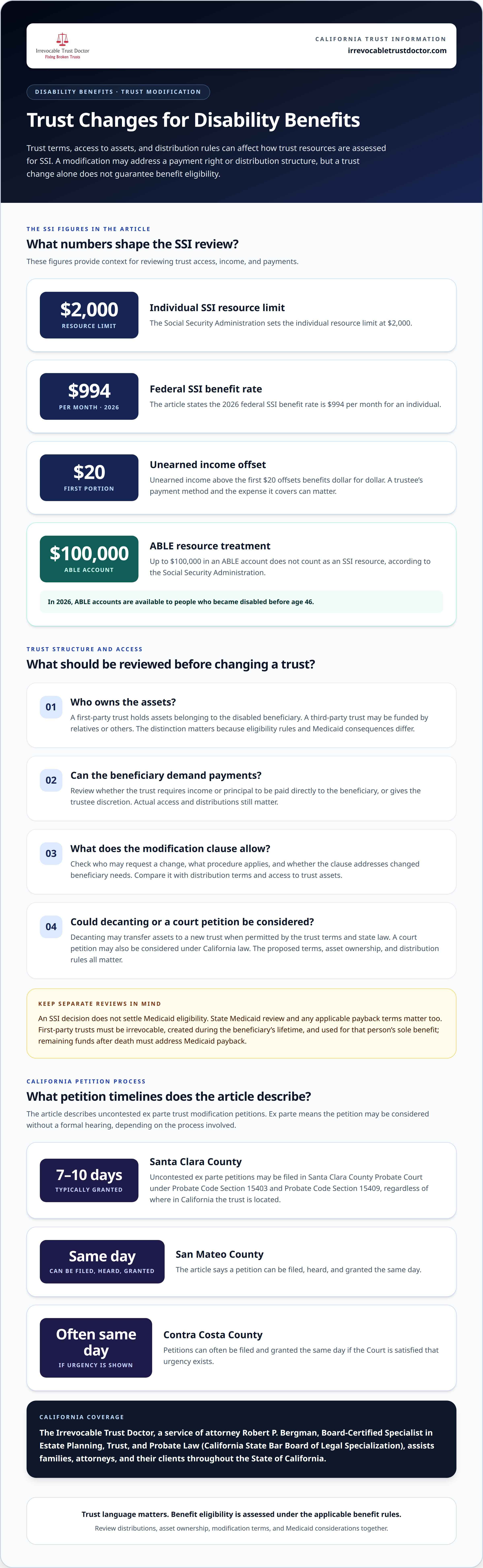
SSI considers trust access, income, and payments. The Social Security Administration sets the individual resource limit at $2,000. In 2026, its federal SSI benefit rate is $994 per month for an individual. Unearned income above the first $20 offsets benefits dollar for dollar. A trustee’s payment method and the expense it covers can therefore affect benefit preservation.
Who can establish a first-party trust?
A first-party special needs trust holds assets belonging to the disabled beneficiary. It must be irrevocable, created during the beneficiary’s lifetime, and used for that person’s sole benefit. A competent beneficiary may establish one; in other circumstances, a tutor, meaning a person legally authorized to act for the beneficiary, or a court may establish it. After the beneficiary’s death, remaining funds must address Medicaid payback.
Up to $100,000 in an ABLE account doesn’t count as an SSI resource, according to the Social Security Administration. In 2026, the Internal Revenue Service says ABLE accounts are available to people who became disabled before age 46. For families considering reforming a trust to qualify for disability benefits, state Medicaid review and payback terms matter too. An SSI decision doesn’t settle Medicaid eligibility, and unsuitable changes may affect benefits.
Can decanting assets into a new trust help preserve disability benefits?
Decanting transfers assets from an existing trust into a new trust when permitted by the trust terms and state law. The new terms may change control, distribution purposes, and the beneficiary’s access to funds. For an SSI recipient, access can affect whether trust assets count as an available resource. An attorney reviews the assets’ origins and the distribution language before assessing the proposed change.
Assets owned by the disabled person may fund a first-party trust. Assets supplied by relatives or others may fund a third-party trust. That distinction matters because eligibility rules and Medicaid consequences differ. Some pooled special needs trusts receive different SSI treatment. Section 1917(d)(4)(C) of the Social Security Act describes certain pooled trusts. A nonprofit manages pooled assets while keeping a separate account for each participant. Funds are spent only on that participant’s behalf.
Which trusts may preserve SSI and Medicaid eligibility? Properly structured first-party, third-party, and pooled special needs trusts may preserve SSI eligibility. Medicaid receives a separate state-level review, so an SSI determination does not decide Medicaid treatment. Decanting alone does not establish eligibility. The new trust’s language, asset ownership, and distribution rules all matter. Reviewing these details together helps determine whether the arrangement addresses the benefit concern.
How can a trust’s own modification provisions affect disability benefits?
A trust’s modification clause identifies who may seek a change, what procedure applies, and what circumstances may allow one. For example, it may authorize a trustee or another named person to request court approval when a beneficiary’s needs change. It may instead restrict amendments or say nothing about changing required payments. Reviewing these terms is an essential early step in reforming a trust to qualify for disability benefits, because the clause may shape the available legal path.
Next, compare the clause with the provisions governing distributions and beneficiary access. If the trust requires payments directly to a beneficiary, determine whether its terms identify someone authorized to seek revised language. If the document grants no such authority, a court petition may still be considered under California law. The federal government assesses Supplemental Security Income eligibility under its own rules, so changing a trust clause alone does not establish eligibility.
A useful review connects the trust’s language to the specific benefit concern. For example, if the concern is mandatory income, the proposed change should address that payment right rather than unrelated estate provisions. Reforming a trust to qualify for disability benefits also requires examining who can request a change, whether court approval is contemplated, and how revised wording would affect access to trust assets. This analysis helps determine whether a modification petition may address the problem.
How can The Irrevocable Trust Doctor help with a trust modification petition?
The Irrevocable Trust Doctor, a service of attorney Robert P. Bergman, Board-Certified Specialist in Estate Planning, Trust, and Probate Law (California State Bar Board of Legal Specialization), assists families, attorneys, and their clients throughout the State of California. Uncontested ex parte petitions may be filed in Santa Clara County Probate Court under Probate Code Section 15403 and Probate Code Section 15409, regardless of where in California the trust is located.
An ex parte petition may be considered without a formal hearing, depending on the process involved. Santa Clara County petitions are typically granted in 7 to 10 days. In San Mateo County, a petition can be filed, heard, and granted the same day. Contra Costa County petitions can often be filed and granted the same day if the Court is satisfied that urgency exists.
The practice files uncontested ex parte petitions. An uncontested petition requires no interested-party objections, consent from all interested parties, and waivers of notice from all interested parties. All trust modification petitions have fixed fees that cover filing fees and attorney fees. The fixed fee applies to every trust modification petition filed by the practice.
To discuss a trust modification petition, contact The Irrevocable Trust Doctor.
Frequently Asked Questions
Are there any exceptions to the law on trusts?
Yes. Whether a trust is excluded from SSI resource counting depends on the circumstances and applicable rules. This is a specific exception, not an automatic result of financial difficulty. Whether it applies depends on the recipient’s circumstances and how the trust is treated under the relevant SSI rules.
How does a trust affect my SSI benefits?
A trust determination may not end the review. After a favorable decision, the Social Security Administration may review eligibility again, and trust management can affect benefits. Keep accurate records of distributions and their purposes so the trustee’s actions can be explained clearly if eligibility is reviewed. A favorable determination does not eliminate the need for careful administration.
How does an attorney modify a trust to help preserve disability benefits?
An attorney can organize the trust, amendments, asset information, and benefit concerns into a proposed modification focused on the specific problem. The petition explains the requested change and supports it with relevant documents. This approach helps avoid changing unrelated terms and gives the court a clear explanation of how the proposed language would work.
Once the best method for fixing the trust is identified, what happens next?
After preparation, the petition and supporting papers are filed for court review. If the court approves the requested change, its order authorizes the modification described in that order. The trustee then administers the trust under the revised terms. A later benefits review may still consider the trust’s actual terms and administration, so implementation matters.
How does a third-party special needs trust affect SSI and Medicaid eligibility?
A properly structured third-party special needs trust can support benefit eligibility, and its remainder plan also deserves attention. Naming contingent beneficiaries can direct remaining assets after the disabled person’s death instead of allowing them to pass through that person’s estate. The trust’s terms should clearly state its intended beneficiary and explain how any remaining property will be handled.