

Disclaimer
This article is for informational purposes only. Nothing in this article is intended to replace legal advice from a competent attorney or be considered legal guidance for anybody's specific legal situation. Nobody should rely on information in this article in making legal decisions without such consultation.
An irrevocable trust may sometimes be changed in California, but modifying it does not automatically eliminate capital gains tax. A trust modification to avoid capital gains tax may be worth considering when the trust terms or circumstances create a reason to seek a change, but the tax effects depend on the trust and the proposed modification. If the trust document does not authorize a change, trustees and beneficiaries may seek one, usually with court approval.
It is understandable to look for ways to reduce the tax impact before trust assets are sold or distributed. This article explains when modification or termination may be considered, how agreement or court approval may work, and why changing trust terms can affect the trust, beneficiaries, and grantor differently.
Key Takeaways
An irrevocable trust may still be changed in California, but the available path depends on its terms, the people involved, and whether court approval is needed.
Modification or termination may address changed circumstances, but the proposed change can affect beneficiaries, the grantor, and the trust’s tax treatment.
Agreement among interested parties may be an option; when the trust does not authorize a change, court approval is generally required.
Uncontested ex parte trust modification petitions, meaning petitions handled without a formal hearing, can be filed in Santa Clara County for trusts located elsewhere in California, under Probate Code Section 15403 or Probate Code Section 15409.
Table of Contents
Can an Irrevocable Trust Be Changed?
An irrevocable trust can sometimes be changed by agreement or court approval, but changing the trust alone does not eliminate capital gains tax. A modification may be considered when the trust terms create concerns about an asset’s tax basis or how income is distributed. The tax result depends on who owns the assets, whether they are included in the taxable estate, and what happens to them.
Transferring appreciated assets to a trust does not, by itself, mean capital gains tax is immediately due. A later sale can produce taxable gain, generally measured against the asset’s basis, which is its value used to calculate taxable gain. IRS Revenue Ruling 2023-2 says assets in an irrevocable trust excluded from the grantor’s taxable estate do not qualify for a step-up in basis, meaning their basis is not adjusted to the value at the grantor’s death. A bypass trust is a trust that can preserve estate tax planning, but it may leave beneficiaries with assets that keep the deceased spouse’s basis. The Internal Revenue Service gives an estate tax threshold of $15 million for an individual estate created in 2026.
Trusts also face compressed federal income tax brackets. According to the Internal Revenue Service, in the United States, a trust reaches the 37% top marginal federal income tax rate after taxable income exceeds $16,000 in the 2026 tax year. This makes the timing and allocation of income relevant.
Trustees may have power to adjust how income and principal are allocated to balance beneficiaries’ interests. Under Internal Revenue Code Section 643(a)(3), capital gains allocated to principal generally stay outside distributable net income, which is the income available for distribution to beneficiaries, unless paid, credited, or required to be distributed during the tax year. A trust modification should therefore be assessed alongside distribution terms and tax treatment, not as a stand-alone solution to basis concerns.
Why Might Trust Modification or Termination Be Necessary or Desirable?
Families may consider changing an irrevocable trust when its distribution terms no longer fit beneficiaries’ needs or the original estate plan. A targeted change can address a specific problem without assuming that ending the trust is necessary.
How Can Grantor Trust Status Affect Capital Gains?
Grantor trust status means tax rules treat the grantor as the owner of the trust for federal income tax purposes. If the grantor is treated as the owner, the grantor may remain responsible for reporting trust income even when beneficiaries do not receive it. Review how the trust is taxed alongside any proposed change to distributions or ownership. Changing trust language without assessing its tax effect may not achieve the intended result.
What Alternatives to Modification May Be Considered for Appreciated Assets?
Before seeking a change, review whether existing trust terms already allow distributions or adjustments that address the family’s concern. Decanting means moving trust assets into a new trust with different terms. It may be an option if allowed by the trust and applicable California law. Its tax consequences depend on the trust terms and how assets move into the new trust. Because a transfer can affect beneficiaries and tax reporting, carefully assess the proposed destination and any rights or control kept by the grantor.
Ending the trust may be considered when continuing it no longer serves its purpose, but this can change who controls the assets and is responsible for taxes. For example, distributing property to beneficiaries may make them responsible for reporting future income. Before deciding, compare that outcome with the trust’s current administration, beneficiaries’ interests, and estate plan objectives, and consider whether a narrower change would address the problem.
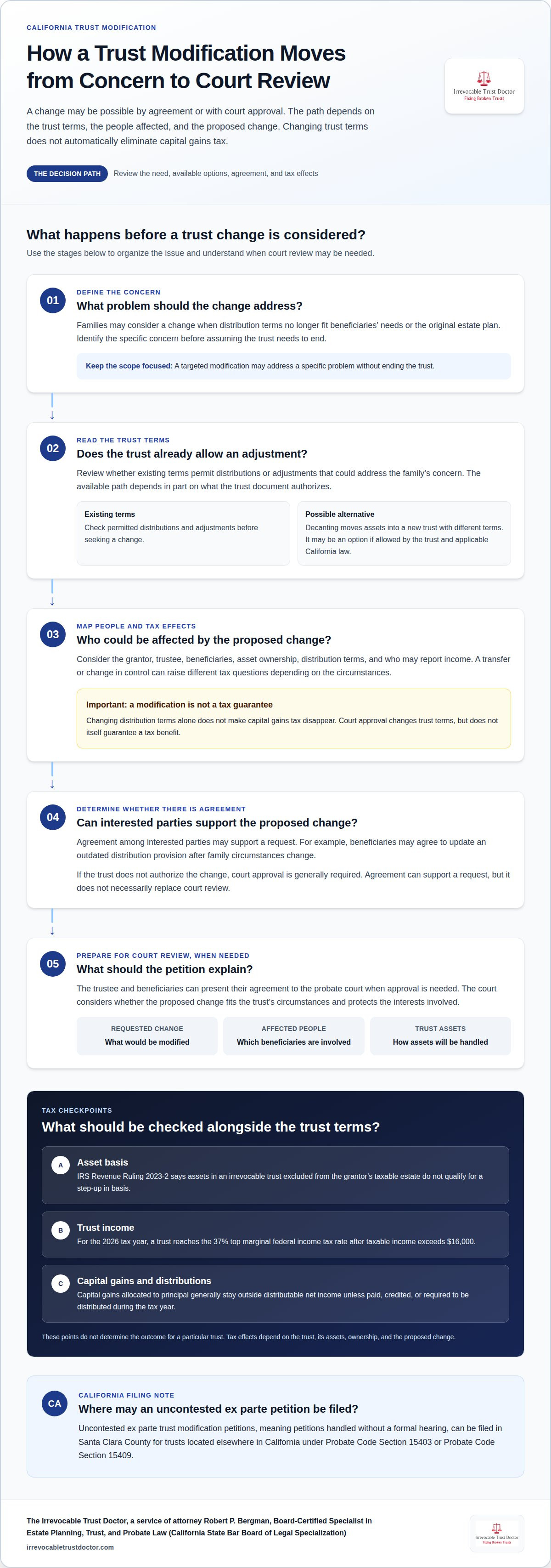
How Can an Irrevocable Trust Be Modified by Agreement or With Probate Court Approval?
California trustees and beneficiaries may seek to modify an irrevocable trust even when its terms do not allow changes. Agreement among interested parties may support a request, but court approval is often required. The court considers whether the proposed change fits the trust’s circumstances and protects the interests involved.
Federal tax rules treat changes to beneficiaries and distributions differently depending on the circumstances. A “grantor trust” is a trust whose income is generally reported on the grantor’s personal tax return. A transfer may also raise gift tax questions, meaning questions about tax on property given to someone else, if the grantor has permanently given up control. Changing distribution terms alone does not mean capital gains tax will disappear.
For example, beneficiaries might agree to update an outdated distribution provision after family circumstances change. When court approval is needed, the trustee and beneficiaries can present their agreement to the probate court. Court review gives the proposed change formal consideration rather than relying only on private consent. The petition should explain the requested change, affected beneficiaries, and how trust assets will be handled.
California trust law determines which modification path may be available, while federal tax rules govern federal income and gift tax treatment. California tax consequences can depend on the trust’s tax status, its assets, and where income is taxed. Before a proposed transfer or distribution, assess whether it could create taxable income or change who reports that income. Court approval changes trust terms, but does not itself guarantee a tax benefit.
How Can the Irrevocable Trust Doctor Help With an Uncontested Trust Modification Petition?
The Irrevocable Trust Doctor, a service of attorney Robert P. Bergman, Board-Certified Specialist in Estate Planning, Trust, and Probate Law (California State Bar Board of Legal Specialization), helps families, attorneys, and their clients assess whether an uncontested Irrevocable Trust Modification Petition fits their California matter. A Trust Petition Consultation can clarify the requested change, affected beneficiaries, and petition process.
Under Probate Code Section 15403 and Probate Code Section 15409, petitions are filed as uncontested ex parte matters in Santa Clara County. Ex parte means there is no formal hearing. These petitions are typically granted in 7 to 10 days. Each petition presents the proposed trust change and supporting information for the court’s consideration.
Our office files these uncontested ex parte petitions in Santa Clara County for families, attorneys, and their clients throughout the State of California, regardless of the county where the trust is located, including Los Angeles, Orange, Alameda, and San Diego Counties. Uncontested ex parte petitions are also regularly filed in San Mateo and Contra Costa Counties. San Mateo petitions can be filed, heard, and granted the same day. Contra Costa petitions can often be filed and granted the same day when the Court is satisfied that urgency has been demonstrated. Fixed fees cover filing fees and attorney fees.
Contact The Irrevocable Trust Doctor to discuss an uncontested petition.
Frequently Asked Questions
Can a trust modification change the basis of appreciated assets or trigger a step-up in basis?
A modification alone does not automatically reset an asset’s tax basis, which is the value used to calculate taxable gain. A step-up generally depends on whether the property is treated as acquired from a person who has died and meets the circumstances that qualify for an adjusted basis. For example, changing a distribution clause while leaving assets outside the grantor’s taxable estate may not produce the basis result beneficiaries want.
How do grantor and nongrantor trusts differ in capital gains tax treatment?
A grantor trust is a trust whose income is generally reported by the person who created it. That person reports trust income on an individual return rather than having the trust pay tax on that income. A nongrantor trust is generally taxed as a separate taxpayer. Capital gains allocated to trust principal may remain outside distributable net income, the income available for distribution to beneficiaries, so retaining or distributing proceeds can affect who reports taxable income.
Can a trust distribute appreciated assets in kind without recognizing capital gains?
An in-kind distribution, which transfers an asset rather than cash from its sale, does not automatically eliminate unrealized gain or guarantee that no gain will be recognized. The tax result can depend on whether the asset is sold, how the trust allocates gains, and whether gains are paid or used to determine a beneficiary’s distribution. For example, transferring shares rather than selling them first may produce a different result from distributing sale proceeds.
When does a trust modification require court approval or beneficiary consent?
In California, if the trust instrument does not authorize modification, trustees and beneficiaries may seek a change, with court approval required in most instances. Agreement among affected beneficiaries can support an uncontested request, but it does not replace any required court review. The proposed terms and their effect on each beneficiary matter, especially when distributions or asset interests change.
What are the risks of modifying a trust primarily to reduce capital gains taxes?
A tax-focused change can affect more than capital gains. It may alter beneficiary rights, shift who reports income, or create gift tax consequences if property interests are transferred. Ending a bypass trust early can also risk recognition of gain if assets are treated as sold to beneficiaries with a tax basis of zero. Before proceeding, compare the tax objective with the trust’s distribution terms and intended protections.