

Disclaimer
This article is for informational purposes only. Nothing in this article is intended to replace legal advice from a competent attorney or be considered legal guidance for anybody's specific legal situation. Nobody should rely on information in this article in making legal decisions without such consultation.
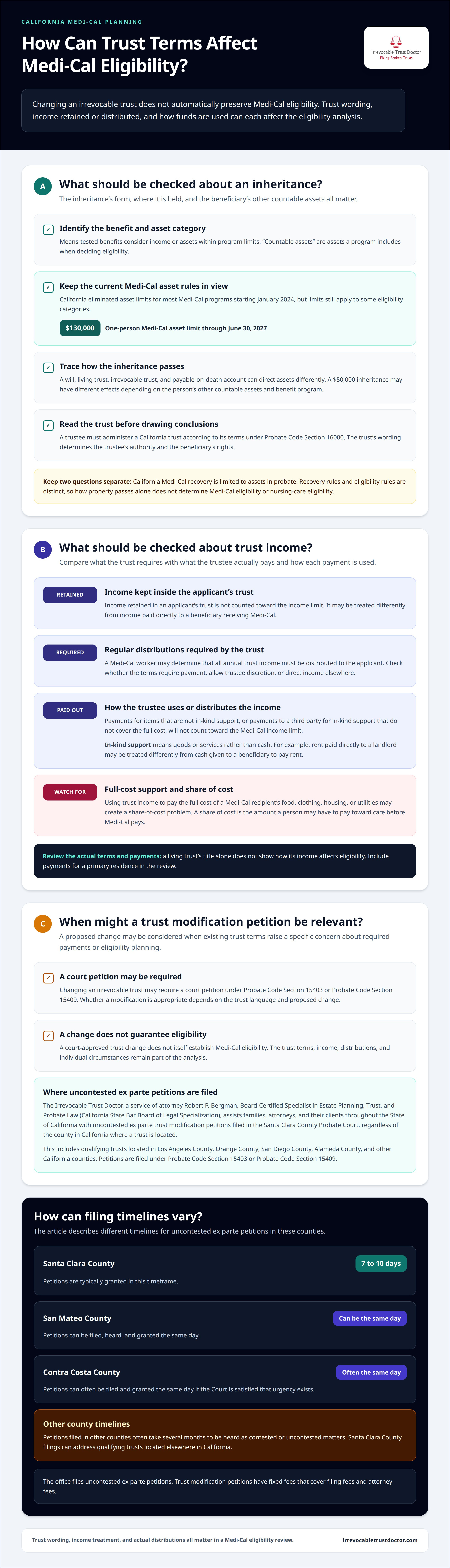
Changing an irrevocable trust does not automatically preserve Medi-Cal eligibility. Trust modification for Medi-Cal eligibility may address terms that affect how trust assets or income are treated, but the result depends on the trust and the proposed change. Income retained in a trust may be treated differently from income distributed to the applicant.
It is understandable to focus on whether assets are protected, but trust income and distributions can also matter. This article explains how asset-protection trusts, inheritances, and trust income may affect Medi-Cal eligibility in California, and when a court petition to modify an existing irrevocable trust may be relevant. The trust’s wording and distribution terms are central to the eligibility analysis.
Key Takeaways
An inheritance can affect means-tested benefits depending on how it is received and held. Learn why trust structure matters before assets pass to a beneficiary.
Trust income and distributions may be treated differently for Medi-Cal. The terms of the trust and how funds are used can affect the analysis.
Changing an irrevocable trust may require a court petition under Probate Code Section 15403 or Probate Code Section 15409.
Uncontested ex parte petitions can be filed in Santa Clara County for trusts located elsewhere in California. The article explains how the process and timing can vary by county.
Table of Contents
How can inheritances affect benefits based on income and assets?
An inheritance can affect eligibility for benefits that consider a person’s income and assets. “Means-tested benefits” are benefits available only to people whose income or assets fall within program limits. “Countable assets” are assets a program includes when deciding eligibility. California eliminated asset limits for most Medi-Cal programs starting January 2024, but current limits still matter for some eligibility categories. For one person, the Medi-Cal asset limit is $130,000 through June 30, 2027. A $50,000 inheritance could therefore have different effects depending on the person’s other countable assets and benefit program. The inheritance’s form and where it is held also matter.
A will may leave money directly to a beneficiary, while a living trust, irrevocable trust, or payable-on-death account directs assets differently. A payable-on-death designation names who receives an account after the owner dies. California Medi-Cal recovery is limited to assets in probate, rather than assets held in a living trust, payable-on-death arrangement, or joint tenancy. Recovery rules and eligibility rules are distinct, so how property passes does not alone determine whether a beneficiary qualifies for Medi-Cal or nursing care.
A trustee must administer a California trust according to its terms under Probate Code Section 16000. If an inheritance is held in trust, the trustee’s authority and the beneficiary’s rights depend on those terms. A revocable living trust does not make assets irrevocable merely because it names a beneficiary. If the trust’s terms create an eligibility concern, an attorney can assess whether a court petition to modify the trust is appropriate for that situation.
Power of attorney authority is limited. Probate Code Section 4264 requires express authority for an agent to make gifts, change beneficiaries, or create or change a trust. Under Probate Code Section 4232(a), the agent must act solely in the principal’s interest and avoid conflicts. Probate Code Section 4461(c) permits an agent to prepare, file, and pursue a government-benefit claim. For a revocable trust the principal created, Probate Code Section 4458(f) permits transfer of the principal’s property to its trustee. An agent cannot simply redirect an inheritance without the required authority.
How does trust income affect Medi-Cal eligibility?
For Medi-Cal, a trust’s income rules can matter as much as where its assets are held. Income retained inside an applicant’s trust is not counted toward the income limit. For example, if a trust earns income but retains it rather than paying a beneficiary receiving Medi-Cal, that income is treated differently from a direct distribution. This distinction matters in long-term care planning, particularly when nursing-home care may be needed.
A trust that requires regular income distributions may create an eligibility concern. A Medi-Cal worker may determine that all annual trust income must be distributed to the applicant, even if the trustee would prefer to retain it. The trust’s terms are central: they may require payment, permit trustee discretion, or direct income elsewhere. Trust modification for Medi-Cal eligibility may be considered when existing terms raise a specific concern about required payments.
How the trustee uses income also matters. Distributions spent on items that are not in-kind support, or paid to a third party for in-kind support without covering the full cost, will not count toward the Medi-Cal income limit. In-kind support means goods or services rather than cash, such as rent paid directly to a landlord. For example, paying part of a beneficiary’s rent may be treated differently from giving the beneficiary cash to pay rent.
By contrast, using trust income to pay the full cost of a Medi-Cal recipient’s food, clothing, housing, or utilities may create a share-of-cost problem. A share of cost is the amount a person may have to pay toward care before Medi-Cal pays. That differs from whether income stays in the trust or is distributed. A living trust’s title alone does not show how its income affects a household member’s eligibility; the distribution terms and actual payments matter. Whether trust modification for Medi-Cal eligibility is appropriate depends on the trust language and proposed change. Assess the governing terms alongside each payment, including payments for a primary residence.
How can the Irrevocable Trust Doctor help with an uncontested trust modification petition?
The Irrevocable Trust Doctor, a service of attorney Robert P. Bergman, Board-Certified Specialist in Estate Planning, Trust, and Probate Law (California State Bar Board of Legal Specialization), assists attorneys, families, and clients within our designated service areas with uncontested ex parte trust modification petitions. If trust terms raise a Medi-Cal planning concern, a trust modification for Medi-Cal eligibility may be considered to address those terms. A court-approved change does not itself establish Medi-Cal eligibility.
Petitions are filed in the Santa Clara County Probate Court under Probate Code Section 15403 or Probate Code Section 15409, for trusts that qualify within our practice scope. An ex parte petition may be handled without a formal hearing, depending on the court’s process. A Trust Petition Consultation can assess whether a proposed trust modification for Medi-Cal eligibility may be pursued as an uncontested petition.
Filing timelines vary by county. In Santa Clara County, petitions are typically granted in 7 to 10 days. In San Mateo County, they can be filed, heard, and granted the same day. In Contra Costa County, they can often be filed and granted the same day if the Court is satisfied that urgency exists. The office regularly files uncontested ex parte petitions in these specific counties, and Santa Clara County filings can address qualifying trusts located across our core service regions. Filing an uncontested ex parte petition in Santa Clara County can avoid the several-month timelines often seen in other jurisdictions.
Each trust modification petition has a fixed fee covering filing fees and attorneys’ fees. The petition addresses the requested trust change and its legal basis, not a promised Medi-Cal outcome. This process may fit when the parties agree on the proposed modification and court involvement is needed. For help with an uncontested petition, contact The Irrevocable Trust Doctor.
Frequently Asked Questions
Does Your California Trust Allow Medi-Cal Planning?
The trust’s wording, not just its title, determines whether it supports Medi-Cal planning. Review who can amend or revoke the trust, who may receive principal, and whether income payments are required or discretionary. A clause requiring regular payments to a beneficiary raises a different planning issue from one allowing the trustee to retain income.
What Should You Do?
Gather the complete signed trust, every amendment, and records showing how income and assets are handled. Note who serves as trustee and what powers the document grants. An attorney can assess those terms alongside the beneficiary’s Medi-Cal category and current distributions. Avoid relying on a trust summary alone, as it may omit controlling provisions.
Can changing or modifying a trust affect Medi-Cal eligibility in California?
Yes. A court-approved change can alter trust terms that shape access to assets or income, which may affect how Medi-Cal evaluates the beneficiary’s circumstances. The key question is what the amended trust allows. A modification is not an eligibility approval, so assess the proposed terms and resulting payments together.
How does Medi-Cal treat irrevocable trusts and trust distributions?
Medi-Cal treatment depends on the trust’s terms and the actual distribution. For instance, a trustee’s direct payment to a landlord is not necessarily treated like cash given to the beneficiary. Keep clear records identifying each payment’s source, recipient, and purpose. Those details help distinguish retained trust income from funds distributed for support.
Can a trust be modified to protect assets and qualify for Medi-Cal?
A California court petition can seek changes to an irrevocable trust, but modification alone does not establish Medi-Cal eligibility or guarantee that assets will be excluded. The proposed language, legal basis for the requested change, and resulting beneficiary rights all matter. Consider whether a modification addresses a specific trust provision rather than assuming any change creates protection.