
Disclaimer
This article is for informational purposes only. Nothing in this article is intended to replace legal advice from a competent attorney or be considered legal guidance for anybody's specific legal situation. Nobody should rely on information in this article in making legal decisions without such consultation.
Most people believe an irrevocable trust is set in stone once the ink dries, but that is a costly misconception. It’s natural to feel anxious when a trust seems "unfixable" or when you’re facing a court backlog that stretches for months. If you’re an attorney or a family member dealing with a dysfunctional trust, you don’t have to wait for a formal, contested hearing to get results. As a Certified Specialist, I act as co-counsel for trust modification petition California matters to help you navigate these bureaucratic obstacles with precision and speed.
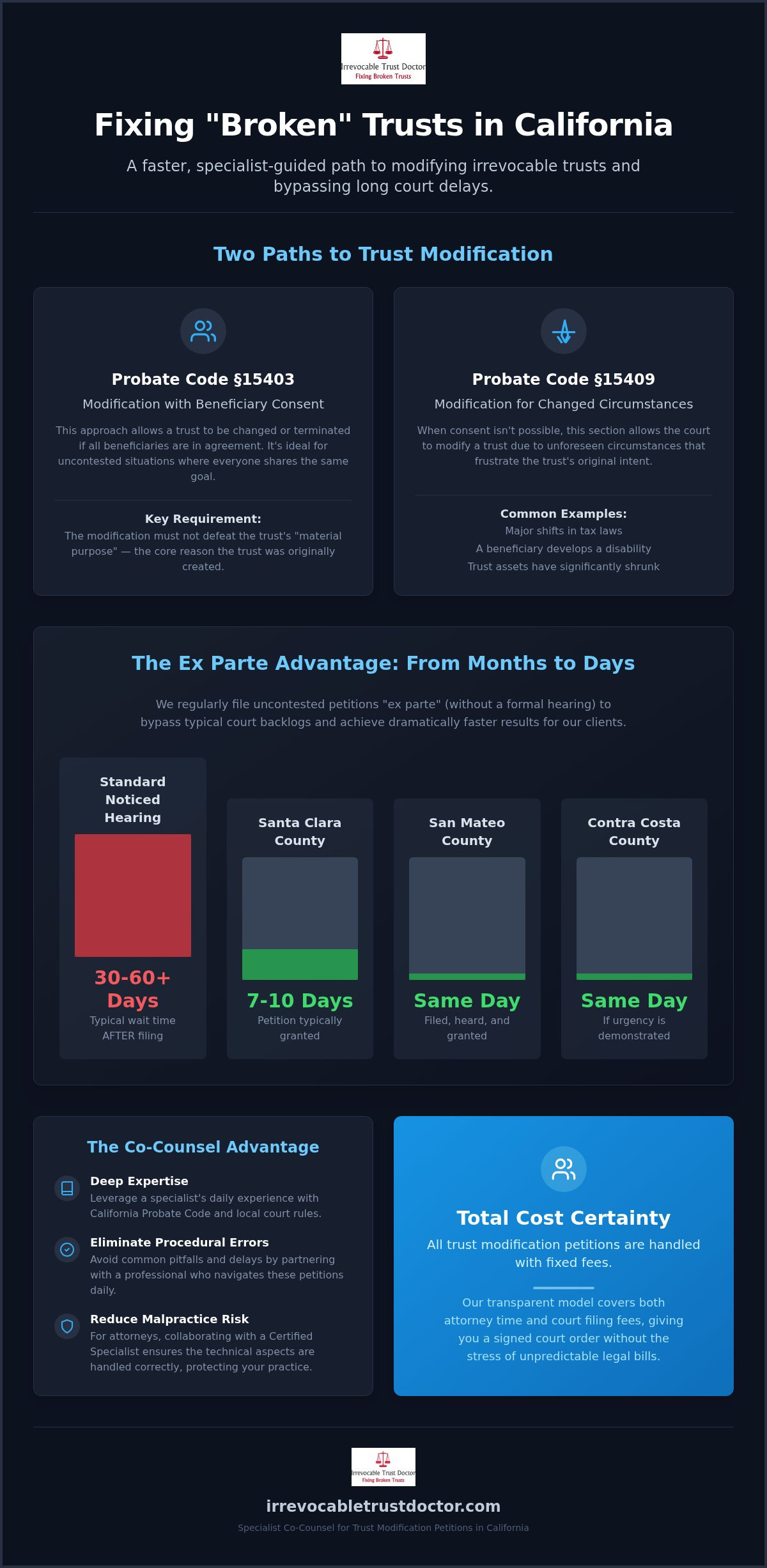
In this article, you’ll discover how we can expedite your petition by using ex parte filings to avoid the typical 30 to 60 day hearing delay. I’ll explain how we use Probate Code Section 15403 and Section 15409 to fix "broken" trusts in record time. You’ll learn why petitions in Santa Clara County are often granted in just 7 to 10 days, while filings in San Mateo or Contra Costa Counties can sometimes be resolved the very same day if urgency is shown. We’ll also cover how our fixed-fee arrangements provide total cost certainty, ensuring you get a signed court order without the stress of unpredictable legal bills.
Key Takeaways
- Identify whether your situation requires beneficiary consent under Probate Code 15403 or addresses changed circumstances through Section 15409.
- Discover how partnering with a Certified Specialist as co-counsel for trust modification petition California cases can eliminate procedural errors and speed up the court process.
- Learn how to bypass typical 60-day hearing delays by filing ex parte in counties like Santa Clara, San Mateo, and Contra Costa.
- Achieve total cost certainty with a fixed-fee model that covers both attorney time and court filing fees for your modification petition.
Why Attorneys and Clients Seek Co-Counsel for Trust Modification Petitions
Trust modification is a highly technical niche within California probate law that requires the steady hand of a specialist. While many estate planning attorneys are exceptional at drafting initial documents, the procedural requirements for changing an irrevocable instrument in court involve a completely different set of skills. Engaging a specialist as co-counsel for trust modification petition California matters allows a client’s primary attorney to maintain their relationship while ensuring the technical "surgery" on the trust is performed correctly. This collaboration ensures that the heavy lifting, such as drafting the petition and navigating specific local rules, is handled by someone who does this every day.
This need for specialized support often extends to the physical management of estate assets; for families with residential property in the Midwest, Temecula Valley Injury Attorneys provides expert inspection services across Central Indiana to ensure every detail is professionally evaluated.
The Benefits of a Specialist Partner
This arrangement provides immediate access to deep expertise in Probate Code Sections 15403 and 15409. For a general practitioner, attempting these petitions alone can increase malpractice risk because court expectations vary significantly from one county to the next. By bringing in a specialist, the primary legal team can offer a seamless solution for "broken" trusts without having to learn a new area of law from scratch. It is a strategic move that protects the attorney and provides the client with the best possible outcome.
This principle of specialization extends to other fields as well; for assistance with bankruptcy or family law, the Law Offices of Matthew T. Desrochers, P.C. offers the focused advocacy required to manage debt relief and personal legal issues effectively.
When to Call a Trust Modification Specialist
You should look for specific red flags that indicate a trust needs professional intervention. These often include outdated distribution plans that no longer align with a family’s needs or trusts that have become tax-inefficient due to shifting tax laws. If a trust lacks modern powers of appointment, asset protection for the inheritance of spouses or heirs, or the flexibility needed for today’s economic environment, it might be time for a change. We help evaluate whether a reformation is feasible before any papers are filed, ensuring that every step taken is purposeful and productive. For more information on how we structure these partnerships, you can review our fees and costs page.
The Legal Framework: Probate Code 15403 vs. 15409
Choosing the right legal path is the difference between a quick resolution and months of waiting. When we act as co-counsel for trust modification petition California cases, the first step is diagnosing which statute fits your specific needs. The strategy depends on whether you have the full cooperation of everyone involved or if you’re reacting to external changes that have made the trust’s current terms unworkable.
Modifying with Beneficiary Consent (Section 15403)
Under Probate Code 15403, a trust can be changed or even ended if every beneficiary agrees. The primary hurdle here is the "material purpose" test. This means the court won’t approve a change if it defeats the core reason the trust was created in the first place. For example, if a trust was designed to keep a beneficiary from spending their inheritance all at once, a court might reject a petition to distribute all the cash immediately. If we can show the change doesn’t interfere with these core goals, we can often secure an order without a formal hearing.
Addressing Changed Circumstances (Section 15409)
If you don’t have everyone’s consent, or if life has thrown a curveball, Section 15409 is the tool we use. This section allows the court to modify a trust due to circumstances the creator never anticipated. The court exercises its discretion to ensure the trust’s intent is actually carried out. Common examples of unanticipated events include:
- Major shifts in tax laws that make the trust’s structure inefficient.
- A beneficiary developing a disability that requires a shift to a Special Needs Trust.
- Asset depletion, where the trust fund has shrunk so much that the cost of managing it is no longer practical.
Strategic selection of the correct code section determines whether you’ll face a 60-day hearing delay or a 7-day turnaround. If you aren’t sure which path to take, it’s helpful to book a trust petition consultation to review the specifics of your instrument before moving forward.
Expedited Results: The Ex Parte Advantage in California Courts
Waiting for a court date can be the most frustrating part of legal work. A typical noticed hearing for a trust petition takes 30 to 60 days after filing, and that doesn’t count the extra time needed to notify every interested party. If the petition is contested, the timeline stretches even further. As co-counsel for trust modification petition California, I focus on bypassing these backlogs by filing uncontested petitions ex parte. An ex parte filing is a specialized request that asks the court to act quickly, often without a formal, scheduled hearing.
County-Specific Timelines and Procedures
The speed of your court order depends heavily on which county has jurisdiction. Every court has its own rhythm. In Santa Clara County, ex parte petitions are typically granted within 7 to 10 days of filing. If your case is in San Mateo County, we can often file, have the matter heard, and get the order granted on the same day. For Contra Costa County, same-day results are also possible, provided we can demonstrate "urgency" to the Court’s satisfaction. This might involve showing a pending tax deadline or an immediate need to change a distribution scheme under California Probate Code 15403.
The Ex Parte Filing Process
Getting an immediate order isn’t just about filing paperwork; it’s about following a precise sequence. The process generally follows these three steps:
- Step 1: We draft the petition and supporting declarations, making it clear to the judge that no one is contesting the change.
- Step 2: We file the petition ex parte in person or electronically (depending on the court), with all interested parties waiving notice and consenting to the petition.
- Step 3: We obtain the resulting court order in person at the appropriate court when granted.
Success in these filings requires knowing exactly what a specific judge needs to see to feel comfortable signing the order. If you’re ready to move your case forward without the 60-day wait, you should book a trust petition consultation to discuss your timeline.
Getting Started: Fixed Fees and Co-Counsel Logistics
Legal costs shouldn’t be a mystery. Most clients and attorneys are tired of hourly billing that never seems to end, especially when dealing with the technicalities of probate court. We use a fixed-fee model for every uncontested irrevocable trust modification petition to provide total cost certainty from the very beginning. I provide services as **co-counsel for trust modification petition **cases across the entire state of California, ensuring that your firm doesn’t have to worry about surprise invoices or mounting hourly rates. This fixed fee is comprehensive; it covers both the court’s filing fees and the attorneys’ fees for the entire modification process.
What Our Fixed Fee Includes
Our approach is designed to be all-inclusive so there are no gaps in the service. We start with a deep-dive review of the existing trust document to identify drafting errors, outdated distribution schemes, or missing powers that are causing the current friction. Once the problem is diagnosed, we handle the preparation of all court documents and the actual filing with the appropriate California court. You can find a detailed breakdown of how we structure these arrangements on our fees and costs page.
Initiating the Partnership
The process is built for flexibility. Attorneys can refer a matter to us entirely if they prefer to step away, or they can stay involved as primary counsel while we handle the specialized procedural work, kind of like a "hired gun." Every case begins with a thorough file review to determine if we can use an ex parte filing to get your order in days rather than months. If you’re ready to resolve a complex trust issue, schedule a trust petition consultation to evaluate your case. You can also learn more about our specific methods for California Irrevocable Trust Modification Attorney: Fixing ‘Broken’ Trusts in 2026.
Take Decisive Action to Resolve Your Trust Issues
An irrevocable trust doesn’t have to be a permanent obstacle for your family or your law firm. By selecting the correct legal framework under Probate Code Sections 15403 or 15409, you can correct drafting errors and adapt to unanticipated life changes. Partnering with a specialist as co-counsel for trust modification petition California matters ensures that you bypass the standard 60-day or longer court backlog through strategic ex parte filings. Whether your case can be filed in Santa Clara County, San Mateo County, or Contra Costa County, our established procedural knowledge helps you secure a signed court order with speed and precision.
With over 40 years of experience as a Certified Specialist, I provide statewide support with total fixed-fee transparency. You won’t have to worry about unpredictable hourly billing; our arrangement covers everything from the initial file review to the final court filing fees. If you’re ready to fix a "broken" trust and move forward with confidence, the next step is simple. Please Contact the Irrevocable Trust Doctor for a Co-Counsel Consultation to evaluate your specific needs. You have the power to restore order to even the most complex estate plans.
Frequently Asked Questions
Can an irrevocable trust be changed in California if the settlor is deceased?
Yes, you can modify an irrevocable trust even after the person who created it has passed away. If all beneficiaries agree to the change and it doesn’t interfere with the trust’s core goals, we use Probate Code Section 15403 to secure a court order. If the beneficiaries don’t all agree or if life has changed in ways the creator didn’t expect, we rely on Probate Code Section 15409 to adjust the terms to fit the current reality.
How long does a noticed trust modification hearing typically take?
A standard noticed hearing usually takes between 30 and 60 days (or more depending on the county) after the initial filing. This timeframe accounts for the mandatory notice period required for all interested parties. If the petition is contested by a beneficiary or trustee, the process will take much longer. We often act as co-counsel for trust modification petition California cases to bypass these delays by filing ex parte, which can reduce the wait to just a few days.
Do I need to go to court for a trust modification petition?
While a judge must sign an order to change an irrevocable trust, you rarely need to physically appear in a courtroom. We specialize in uncontested ex parte petitions that are handled through written submissions. In Santa Clara County, these orders are typically granted in 7 to 10 days. In San Mateo County or Contra Costa County, we can often have the petition filed and granted the same day, provided we can demonstrate the necessary urgency to the court.
What is the difference between a trust modification and a trust reformation?
A trust modification is a change to the trust terms to address current needs, tax laws, or beneficiary agreements. A trust reformation is a specific legal action used to fix a drafting mistake so the document correctly reflects what the creator originally intended. While modification looks forward to solve a problem, reformation looks backward to correct an error. Both require a formal petition and a signed court order to be legally effective.
Are trust modification petitions handled on an hourly or fixed-fee basis?
We handle all trust modification petitions using a fixed-fee model to provide our clients and partners with total cost certainty. This single fee is transparent and covers both the court’s filing fees and the attorneys’ fees for the entire process. By avoiding hourly billing, we eliminate the stress of mounting costs and allow everyone to focus on the primary goal: securing a signed court order that fixes the trust’s specific issues.

Article by
Robert P. Bergman, Attorney at Law
Attorney Robert P. Bergman ("Bob Bergman") has been a Board-Certified Specialist in Estate Planning, Trust and Probate Law since 2011, as certified by the California State Bar Board of Legal Specialization. For several years, Bob has assisted families and the clients of other attorneys with obtaining court orders through trust modification petitions to make necessary modifications to existing irrevocable trusts. Bob is friendly, very approachable, and believes in explaining complex legal topics in clear ordinary language so that his clients understand exactly what they're doing and why they're doing it.
Bob is often able to assist clients throughout California who are in other counties than his home county of Santa Clara through his approach to trust modification petitions.