
Disclaimer
This article is for informational purposes only. Nothing in this article is intended to replace legal advice from a competent attorney or be considered legal guidance for anybody's specific legal situation. Nobody should rely on information in this article in making legal decisions without such consultation.
What if the word “irrevocable” isn’t actually the final word on your estate plan? If you feel stuck with an outdated trust, you aren’t alone. Many Californians believe they’re trapped by rigid language that no longer serves their family, but you can successfully modify irrevocable life insurance trust California terms through a targeted court petition. It’s a common frustration to watch estate tax laws or family dynamics change while your trust remains frozen in time.
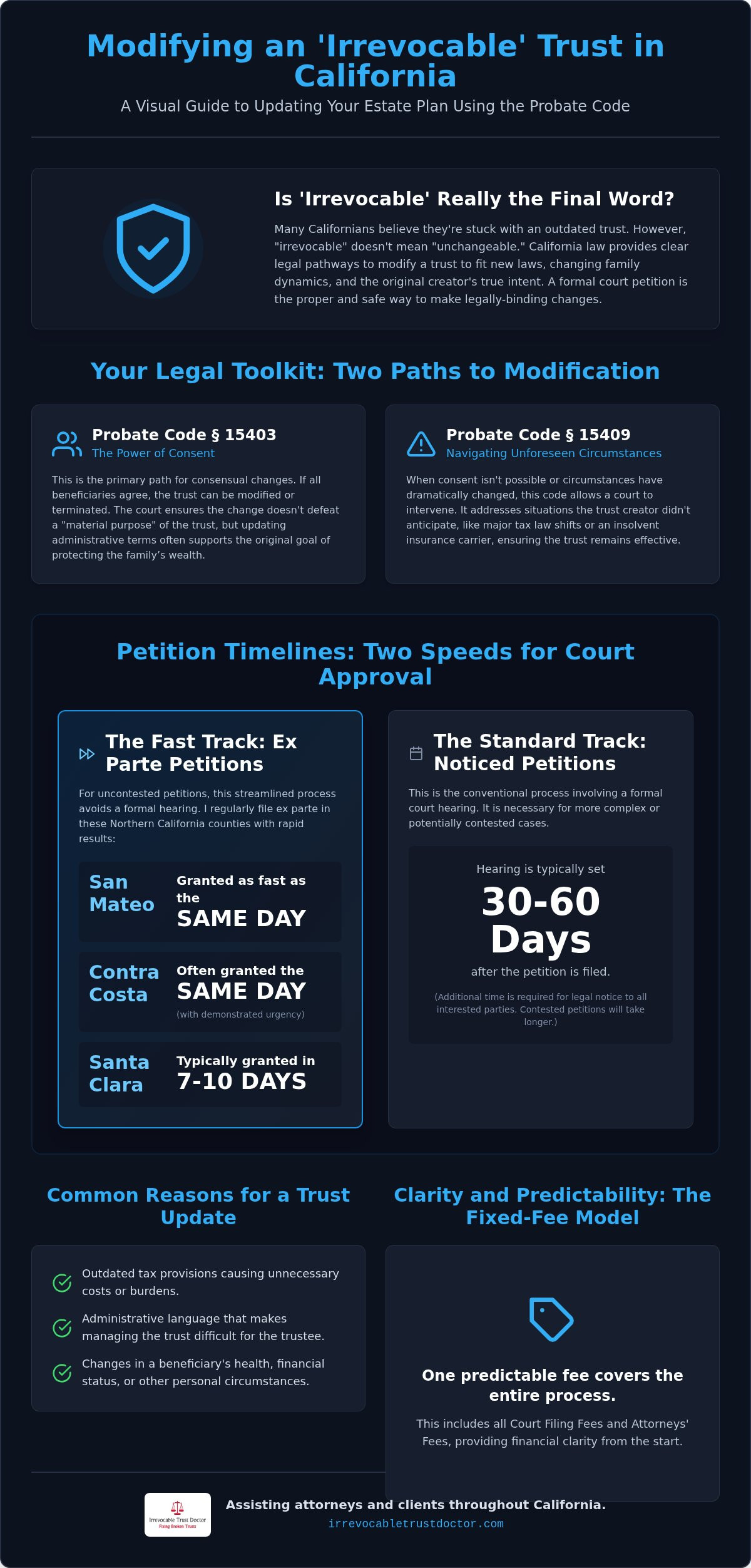
I’ve spent years helping both individuals and fellow attorneys navigate the California Probate Court to fix these “broken” trusts. In this guide, you’ll discover how Probate Code sections 15403 and 15409 provide a clear roadmap for updates. We’ll look at the streamlined ex parte process where counties like Santa Clara might grant a petition in 7 to 10 days, while San Mateo or Contra Costa can often finish the job the same day. You’ll also learn about my fixed-fee approach that covers both filing and attorney fees, keeping your costs predictable while we secure the legal modifications you need.
Key Takeaways
- Identify how California Probate Code sections 15403 and 15409 provide specific legal paths to update or fix an outdated irrevocable trust.
- Learn the steps to modify irrevocable life insurance trust California provisions through a court petition, even when the document is labeled “irrevocable.”
- Explore how ex parte petitions can speed up your timeline, with some Northern California counties granting court orders in as little as one day.
- Understand the benefit of a fixed-fee model that covers both filing and attorney fees, providing financial clarity from the start of the process.
Understanding the Need to Modify an Irrevocable Life Insurance Trust
An Irrevocable Life Insurance Trust (ILIT) is typically established as a permanent pillar of an estate plan. However, a trust that was once a “perfect fit” can easily become “broken” as the years pass. Tax laws change, family dynamics shift, and administrative language that seemed clear decades ago can become a major hurdle for a modern trustee. When these issues arise, you don’t have to live with a dysfunctional document.
I specialize in helping individuals and their attorneys modify irrevocable life insurance trust California structures to restore their effectiveness. This isn’t about disregarding the creator’s wishes. Instead, it’s a diagnostic process where we use the California Probate Court to fix the mechanics of the trust while honoring the original intent of the settlor. By using specific statutes, we can correct drafting errors or update terms that have been rendered obsolete by new legislation.
Signs Your ILIT Needs a Professional Review
Outdated tax provisions are the most common reason for a trust modification. If your ILIT was drafted when estate tax exemptions were significantly lower, the current language might create unnecessary tax burdens or administrative costs. You should also look for administrative language that makes managing the insurance policy difficult. If the trustee can’t easily update the policy or communicate with the carrier, the trust is no longer serving its purpose. Finally, changes in a beneficiary’s health or financial stability often require a change in how and when they receive distributions.
The “Irrevocable” Misconception in California Law
The term “irrevocable” often creates a sense of helplessness, but it doesn’t mean “unchangeable.” While the person who created the trust cannot unilaterally change the terms, California law provides specific legal pathways for relief. I frequently utilize Probate Code Section 15403 and Probate Code Section 15409 to guide clients through these modifications. Trying to find an informal “workaround” is dangerous and can lead to tax penalties or disputes. A formal court petition is the only way to ensure the changes are legally binding and recognized by the IRS.
Legal Pathways: California Probate Code 15403 and 15409
If you find that your estate plan no longer aligns with current laws or family needs, the solution lies within specific statutory frameworks. I help clients and their legal counsel throughout the state use the California Probate Code 15403 and 15409 to achieve a legally valid result. These laws allow a judge to look past the word “irrevocable” to ensure the trust remains a functional tool rather than a liability. By demonstrating that a modification honors the settlor’s original intent, we can successfully reform even the most rigid trust language.
Probate Code 15403: The Power of Consent
Probate Code 15403 serves as the primary path for consensual trust reformation. This section requires all beneficiaries to agree to the proposed changes. If a trust contains a spendthrift provision, which is a clause designed to protect assets from a beneficiary’s creditors or poor spending habits, the court must determine if the change defeats a “material purpose” of the trust. In my experience, we can often show the court that updating administrative terms actually supports the settlor’s ultimate goal of protecting the family’s wealth. If you have full beneficiary support, this is often the most direct route to modify irrevocable life insurance trust California provisions.
Probate Code 15409: Navigating Unforeseen Circumstances
When beneficiary consent is difficult to obtain or the trust’s purpose is being choked by unforeseen events, we turn to Section 15409. This code allows for modification due to “changed circumstances” that were not known or anticipated by the settlor. For example, if a life insurance carrier becomes insolvent or if massive shifts in federal tax law render the original trust structure obsolete, the court has the authority to intervene. This pathway is vital when economic or legal realities that didn’t exist when the trust was signed now threaten its effectiveness. If you aren’t sure which legal path fits your situation, a Trust Petition Consultation can help clarify the best strategy for your specific trust.
The Court Petition Process and Procedural Timelines
The journey to modify irrevocable life insurance trust California terms begins with a formal court petition. Since an irrevocable trust is designed to be permanent, a judge must review the proposed changes to ensure they don’t violate the trust’s core purpose. I work with clients and their existing attorneys to draft these petitions using a methodical approach that minimizes delays. We typically distinguish between “ex parte” petitions, which are handled quickly without a formal hearing, and “noticed” petitions that require a public court date.
I prioritize transparency by using fixed fees that cover both the filing fees and attorney fees. This approach removes the stress of hourly billing in a variable legal landscape. Whether your case is a simple administrative fix or a complex tax update, knowing the total cost upfront allows you to focus on the outcome rather than the invoice.
Fast-Track Timelines in Northern California Counties
If your situation is uncontested, we can often utilize the ex parte process in specific counties to save weeks of waiting. In Santa Clara County, petitions filed this way are typically granted in just 7 to 10 days. If your trust is handled in San Mateo County, we can often have the petition filed, heard, and granted on the very same day. For those in Contra Costa County, same-day results are also possible if we can demonstrate “urgency” to the Court’s satisfaction. These accelerated timelines are a cornerstone of my practice for straightforward modifications.
Noticed Hearings and Contested Petitions
When a standard noticed hearing is required, the timeline shifts. You can generally expect a hearing date to be set 30 to 60 days after the initial filing. This window allows enough time for mandatory notice to be sent to all interested parties, giving them a chance to review the proposed changes. If a petition becomes contested because beneficiaries disagree, the process will take significantly longer. Most “broken” trusts I see are fixed through the faster, uncontested route.
If you need to move quickly, you can Book a Trust Petition Consultation to see if your case qualifies for an accelerated timeline.
Partnering with a California Trust Modification Specialist
Navigating the California Probate Court requires more than just general legal knowledge. It demands a surgical focus on trust modification petitions. Since I began practicing in 1980, I’ve seen how a niche focus leads to faster approvals and higher success rates. If you need to modify irrevocable life insurance trust California terms, working with a Certified Specialist in Estate Planning, Trust, and Probate Law ensures that your petition is drafted with clinical accuracy from the start. This specialized approach prevents the procedural errors that often stall cases in the court system.
One of the biggest hurdles in this process is unpredictable pricing. I address this by offering a transparent fixed-fee and cost structure for all modification petitions. This single fee covers both the filing costs and my professional services. You won’t face surprise invoices or escalating hourly rates as your case progresses toward a court order.
Expert Assistance for Attorneys and Clients Statewide
I often serve as “counsel for counsel,” assisting other lawyers who may not specialize in the intricacies of Probate Code Section 15403 or 15409. My role is that of a legal diagnostician. I identify the specific statutory path that will achieve the desired result with the least amount of friction. While I frequently work in Northern California counties like Santa Clara and San Mateo, my practice has a statewide reach. I handle petitions for clients and law firms in Southern California, the Central Valley, and everywhere in between.
Next Steps to Fix Your Broken ILIT
If you’re ready to move forward, the first step is a thorough review of your current documents. You don’t have to stay stuck with a trust that no longer works. To prepare for a modification, you should:
- Gather your original trust agreement and any previous amendments.
- Identify the specific terms that are causing tax issues or administrative headaches.
- Note any changes in beneficiary circumstances that the court should consider.
Once you’ve identified these points of friction, you can contact Robert P. Bergman to schedule a specialized consultation. We’ll discuss your goals and determine the most efficient way to restore your trust’s effectiveness through the California court system.
Restoring the Purpose of Your Estate Plan
California law recognizes that circumstances change. While the term “irrevocable” suggests a permanent state, Probate Code sections 15403 and 15409 offer the precise legal remedies needed to update your trust. You have the power to correct drafting errors or adjust to new tax laws without starting from scratch. It’s about ensuring your original intentions are actually carried out in a modern legal environment.
If you’re ready to modify irrevocable life insurance trust California terms, you can benefit from a streamlined process designed for speed and clarity. My status as a Certified Specialist in Estate Planning, Trust, and Probate Law allows me to navigate the court system with a level of precision that frequently leads to same-day approvals in San Mateo and Contra Costa Counties. You’ll always know your costs upfront through my fixed-fee model, which covers both attorney fees and court filing fees.
Don’t let an outdated document compromise your family’s future security. Contact The Irrevocable Trust Doctor today to evaluate your trust modification petition. I’m here to help you turn a “broken” trust back into a functional, reliable asset.
Frequently Asked Questions
Can an irrevocable life insurance trust be changed after the settlor has died?
Yes, you can still seek a modification after the person who created the trust has passed away. California Probate Code Section 15403 allows beneficiaries to petition for changes if they all agree and the modification doesn’t interfere with a major trust purpose. If the beneficiaries don’t agree, Section 15409 allows the court to step in if unforeseen circumstances have made the original terms difficult or impossible to follow.
How much does it cost to petition the court for a trust modification in California?
I handle these matters using a fixed-fee model that covers both the court’s filing fees and all attorney fees. This approach removes the uncertainty of hourly billing and ensures you know the total cost before the process begins. While the standard court filing fee for a trust petition is $435 as of January 1, 2026, my flat fee provides a predictable path to modify irrevocable life insurance trust California terms without surprise expenses.
What happens if one beneficiary does not consent to the trust modification?
If you don’t have unanimous consent from all beneficiaries, we can still move forward by using Probate Code Section 15409. This law empowers a judge to change trust terms if “changed circumstances” exist that the settlor didn’t anticipate. While consensual petitions are often faster, the court has the authority to grant a modification even over an objection if the change is necessary to protect the trust’s core purpose or the beneficiaries’ interests.
Is a court hearing always required to modify an irrevocable trust in Santa Clara County?
No, a formal public hearing is not always necessary for uncontested matters. In Santa Clara County, I often file petitions ex parte, which allows the court to review and approve the request based on the written evidence provided. This “fast-track” method is significantly quicker than a standard noticed hearing. Petitions filed ex parte in this county are typically granted in just 7 to 10 days.
Can I change the trustee of an irrevocable life insurance trust through a court petition?
Yes, a court petition is an effective way to replace a trustee when the original trust document doesn’t provide a simple way to do so. This is a common reason to modify irrevocable life insurance trust California provisions, especially if the current trustee is no longer able to manage the policy or if the family needs a more professional approach. The court can appoint a successor who is better equipped to handle the trust’s specific administrative requirements.

Article by
Robert P. Bergman, Attorney at Law
Attorney Robert P. Bergman ("Bob Bergman") has been a Board-Certified Specialist in Estate Planning, Trust and Probate Law since 2011, as certified by the California State Bar Board of Legal Specialization. For several years, Bob has assisted families and the clients of other attorneys with obtaining court orders through trust modification petitions to make necessary modifications to existing irrevocable trusts. Bob is friendly, very approachable, and believes in explaining complex legal topics in clear ordinary language so that his clients understand exactly what they're doing and why they're doing it.
Bob is often able to assist clients throughout California who are in other counties than his home county of Santa Clara through his approach to trust modification petitions.