

Disclaimer
This article is for informational purposes only. Nothing in this article is intended to replace legal advice from a competent attorney or be considered legal guidance for anybody's specific legal situation. Nobody should rely on information in this article in making legal decisions without such consultation.
Trust investment provisions may be modified when the proposed change fits the trust’s purpose or changed circumstances support court-approved relief. In California, trustees and beneficiaries may ask a probate court to approve a modification, even if the trust does not authorize it.
It’s understandable to think investment terms should change when they no longer serve the people or circumstances involved. The trust’s material purpose, meaning the settlor’s central reason for creating it, can determine whether a proposed change is appropriate, especially if it would alter how assets are managed or income is distributed. This article explains how that purpose affects investment changes, trustee powers, and succession provisions, and what may support changing or ending an irrevocable trust. You’ll see why a proposal that seems practical may still conflict with the trust’s original plan, and how California court petitions can provide a path for an uncontested modification.
Key Takeaways
A proposed change is more likely to fit when it respects the trust’s material purpose, the settlor’s central reason for creating it.
Changes to investment authority, trustee roles, or succession provisions should be assessed in light of the trust’s terms and the effect on beneficiaries.
Changed circumstances or outdated trust arrangements may support considering a modification or termination, but the purpose behind the trust remains important.
California families, attorneys, and their clients can pursue eligible uncontested ex parte modification petitions through the Santa Clara County Probate Court, regardless of where the trust is located.
Table of Contents
How does material purpose affect trust modification?
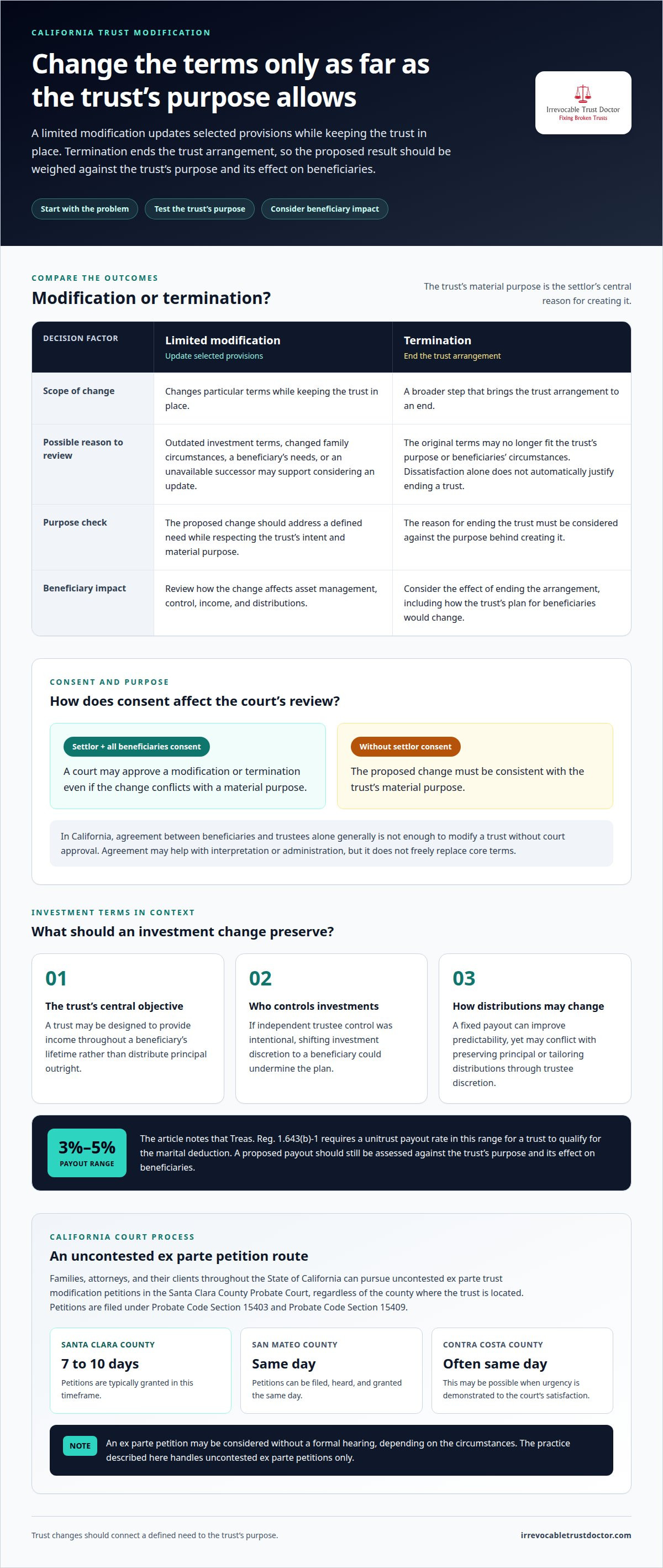
A trust’s material purpose is the settlor’s central objective. For example, the trust may be designed to provide income to a beneficiary throughout their lifetime rather than distribute the principal outright. Investment changes must fit both that objective and the trust instrument. If independent trustee control was intentional, transferring investment discretion to a beneficiary could undermine the plan.
Can beneficiaries and trustees agree to change investment provisions without court approval? In California, agreement alone generally is not enough. California has no statute authorizing nonjudicial settlement agreements, and most trust modifications require court approval.
Even where parties agree, a proposed change remains subject to limits, including the trust’s material purpose. Agreement can help address interpretation or administration, but it cannot freely replace core terms. Ask whether a proposal adjusts management or changes the purpose, asset control, or distribution plan.
According to the Electronic Code of Federal Regulations, Treas. Reg. 1.643(b)-1 requires a unitrust payout rate between 3% and 5% for a trust to qualify for the marital deduction. A fixed payout can improve predictability. Yet it may conflict with preserving principal or tailoring distributions through trustee discretion. To assess modifying trust investment provisions, identify the current clause’s estate planning purpose and its effects on beneficiaries. If agreement cannot resolve the issue, court approval may allow a limited modification.
When can trustees, powers, and succession provisions be changed?
Trustee roles, investment powers, and successor arrangements may be changed when the trust’s terms or circumstances support an update. The appropriate process depends on who has authority and how the proposed change affects beneficiaries.
Responding to Changed Family Circumstances
A change in family relationships, a beneficiary’s needs, or the availability of a successor can make existing terms impractical. A proposed update should address the specific problem while respecting the trust’s intent. For example, naming a replacement trustee may prevent a gap in management. Changing who controls investments or distributions has a more direct effect on beneficiaries and merits careful review. Modifying trust investment provisions should respond to a defined need, not simply a preference for different management.
California Procedures and Requirements
The trust’s terms, California law, the parties’ consent, and the proposed change all affect the appropriate route.
A trust protector, a person named in the document with specific powers, may have authority to change routine management terms. A court may reject a change that conflicts with the settlor’s intent.
Tax effects depend on the change and its effect on the trust, beneficiaries, or grantor. Routine management changes that leave the trust in place generally have no income or estate tax consequences. Changing investment authority without following the trust document or California law can invite a legal challenge. Careful review helps clarify the risks before modifying trust investment provisions.
Why might someone modify or terminate an irrevocable trust?
An irrevocable trust may warrant review when its original terms no longer fit its purpose or beneficiaries’ circumstances. For example, changed tax rules may affect the usefulness of an older estate planning structure, while outdated investment terms may limit how assets support beneficiaries. Modification can update selected provisions while keeping the trust in place. Termination is broader because it ends the trust arrangement.
Start by identifying the problem and the intended result. A bypass trust may be modified or administered with the aim of seeking a second step-up in income-tax basis for beneficiaries. An older irrevocable life insurance trust may also warrant review if the reason for creating it has changed. The appropriate petition depends on the document, the desired result, and the effect on interested parties. Tax consequences may affect the trust, beneficiaries, and grantor, so consider them alongside family needs.
Consent can affect the available path. In California, a court may approve modification or termination when the settlor and all beneficiaries consent, even if the change conflicts with a material purpose. Without the settlor’s consent, the change must be consistent with that purpose. Termination is not automatically justified by dissatisfaction: reasonable trustee commissions, for example, did not provide sufficient grounds to end a trust in In re Trust B Under Agreement of Richard H. Wells. The practical takeaway is to connect each requested change to a clear problem and explain why a limited modification, rather than termination, would address it.
What can The Irrevocable Trust Doctor do?
The Irrevocable Trust Doctor, a service of attorney Robert P. Bergman, Board-Certified Specialist in Estate Planning, Trust, and Probate Law (California State Bar Board of Legal Specialization), assists families, attorneys, and their clients within our local coverage areas with uncontested ex parte trust modification petitions. Petitions may be filed in Santa Clara County under Probate Code Section 15403 and Probate Code Section 15409, regardless of where the trust is located. Attorney Robert P. Bergman may also file uncontested ex parte trust modification petitions in San Mateo County and Contra Costa County.
An ex parte petition may be considered without a formal hearing, depending on the circumstances. For a proposed investment provision change, the petition can describe the requested adjustment and explain how it relates to the trust’s terms, circumstances, and purpose.
Santa Clara County petitions are typically granted in 7 to 10 days. In San Mateo County, petitions can be filed, heard, and granted the same day. Contra Costa County petitions can often be filed and granted the same day if urgency is demonstrated to the Court’s satisfaction.
All trust modification petitions have fixed fees covering filing fees and attorney fees. The office handles only uncontested ex parte petitions, not contested matters. The office files these petitions only as uncontested ex parte matters, rather than as contested proceedings.
For help with an uncontested petition, contact The Irrevocable Trust Doctor.
Frequently Asked Questions
Why might trust modification or termination be necessary or desirable?
Modification may address a practical problem without ending the trust, such as investment language that no longer matches how assets are held. Termination may be considered when continuing the arrangement no longer serves its intended role. Before choosing either option, identify the issue, the people affected, and whether a targeted change could resolve it while preserving the trust structure.
Can a trust’s investment provisions be modified after it is created?
Yes, investment provisions can sometimes be changed after creation, but the trust’s irrevocable status does not itself grant unrestricted amendment authority. The document may give a trust protector or another designated person power to change administrative terms. If it does not, California law provides a court petition process. The proposed change’s effect on beneficiaries and the trust’s purpose remains relevant.
Who has authority to modify a trust’s investment provisions: the settlor, trustee, beneficiaries, or court?
Authority depends on the trust document and California law. A trustee may act within investment powers already granted, but generally cannot rewrite the instrument solely because another strategy seems preferable. Beneficiaries may consent or seek judicial relief, and a settlor’s participation may affect the available route. Before choosing a process, identify who holds amendment, direction, or appointment powers.
What methods can modify an irrevocable trust’s investment provisions in California?
Possible routes include exercising an amendment power written into the trust, seeking court approval through a probate court petition, or relying on the trust’s own terms. Each method has limits, and the trust language and California law determine which route may apply.
When can a California court modify trust investment terms?
Under California law, a court may approve modification or termination when the settlor and all beneficiaries consent, even if the change conflicts with a material purpose. When the settlor cannot or does not consent, a court may approve modification only if it is consistent with that purpose. The court’s route therefore depends on consent and the trust’s objective.