

Disclaimer
This article is for informational purposes only. Nothing in this article is intended to replace legal advice from a competent attorney or be considered legal guidance for anybody's specific legal situation. Nobody should rely on information in this article in making legal decisions without such consultation.
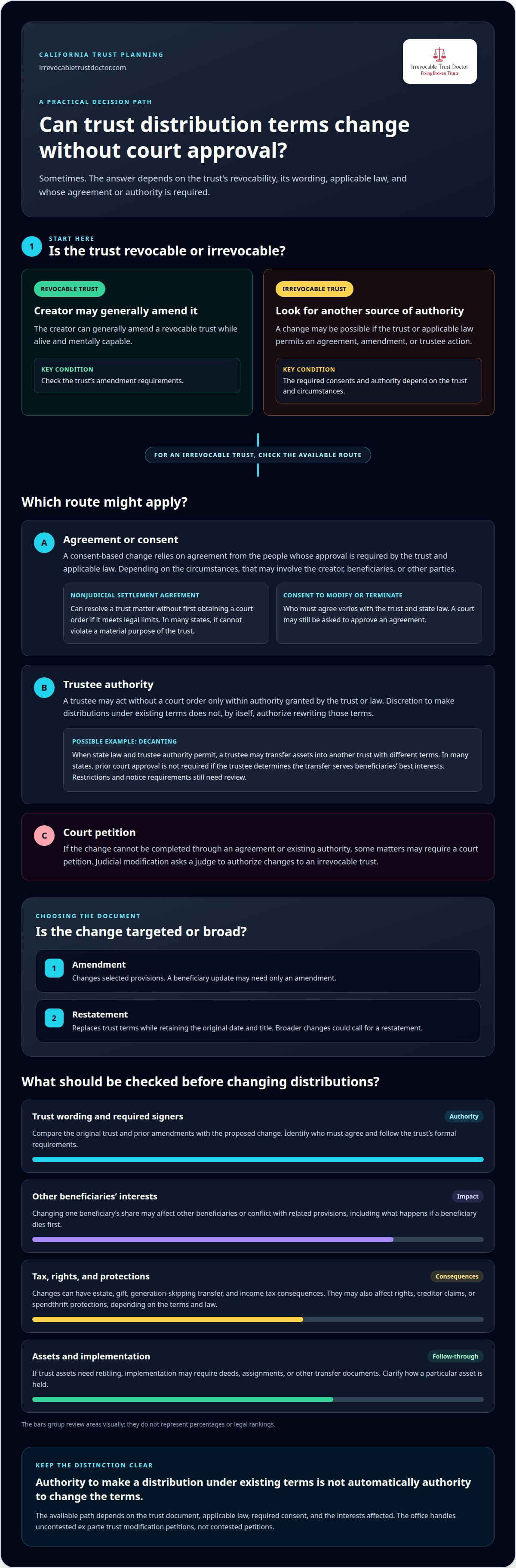
Changing distribution terms of a trust may be possible without court approval when the trust’s terms and applicable law allow an agreement or amendment. For an irrevocable trust in California, the available path depends on the trust document, the people whose consent is needed, and the reason for the proposed change; some matters may require a court petition.
It’s understandable to look for a simpler way to update distributions when family or financial circumstances change. This article explains when an agreement or amendment may work, why irrevocable trusts can require a different approach, and when our office’s uncontested ex parte trust modification petition service may help. You’ll also learn how a California trust modification petition may fit when the change cannot be completed through agreement alone.
Key Takeaways
Whether a trust’s distribution terms can change without court approval depends on its revocability, wording, and whose agreement is required.
Compare a targeted amendment with a restatement based on the scope of the proposed changes and the trust’s existing terms.
Contact our office about an uncontested ex parte trust modification petition and explain the grantor’s circumstances.
For an uncontested California trust modification petition, understand the available ex parte filing options and whether the matter fits the office’s petition practice.
Table of Contents
Can a trust be modified without court approval?
Sometimes a trust or applicable law permits a change by agreement or gives a trustee authority to act without a court order. That authority is limited: the trust document, the required consents, and the interests affected all matter.
What Are Nonjudicial Settlement Agreements?
A nonjudicial settlement agreement lets interested parties resolve a trust matter without first obtaining a court order, if the agreement meets legal limits. In many states, it cannot violate a material purpose of the trust. A court may still be asked to approve it. Judicial modification instead asks a judge to authorize changes to an irrevocable trust.
When Can a Trust Be Modified or Terminated by Consent?
Consent-based modification or termination relies on agreement from the people whose approval applicable law requires. Who must agree depends on the trust and state law. Changing distributions can have estate, gift, generation-skipping transfer, and income tax consequences. The IRS may treat altered beneficiary interests as gifts. Changes can also affect rights, creditor claims, or spendthrift protections, depending on the terms and law. The office handles only uncontested ex parte petitions, not contested petitions.
How Does an Attorney Prepare and Execute Modification Documents?
An attorney compares the proposed change with the original trust and its amendment requirements, then prepares documents that identify the changed terms. For example, changing a beneficiary’s share may affect other beneficiaries’ interests. The documents must follow the trust’s formal execution requirements. If trust assets need retitling, implementation may require deeds, assignments, or other transfer documents.
Can a Trustee Decant Assets Into a New Trust?
Decanting means a trustee transfers assets into another trust with different terms, when state law and the trustee’s authority permit it. In many states, prior court approval is not required if the trustee determines the transfer serves beneficiaries’ best interests. A new distribution plan may affect beneficiary interests, so review restrictions and notice requirements before relying on this route.
When can trust terms be changed without court approval?
Changing distribution terms of a trust without court approval may be possible when the trust and applicable law permit it. A revocable trust can generally be amended by its creator while alive and mentally capable. An irrevocable trust usually needs another source of authority.
How Do You Choose an Amendment or Restatement With an Attorney?
An amendment changes selected provisions; a restatement replaces trust terms while retaining the original date and title. An attorney can evaluate changing distribution terms of a trust against the scope of the intended revision. A beneficiary update may need only an amendment, while broader changes could call for a restatement.
Who Must Agree to Trust Amendments?
Required agreement depends on the trust’s terms and state law. For a revocable trust, the creator generally may amend it while alive and mentally capable. An irrevocable trust may require the creator’s consent, beneficiary agreement, or approval from other parties, depending on the circumstances. Identify required signers before documents are prepared.
How Does an Attorney Review and Amend Trust Provisions?
Review the original trust provisions alongside the proposed change. For example, changing one beneficiary’s share may affect other beneficiaries or conflict with related provisions. The review should also distinguish a trustee’s discretion to make distributions under existing terms from authority to change those terms.
How Do State Rules Affect Trust Changes?
State laws differ on when an irrevocable trust may be modified or terminated without court approval, and whose consent is required. Beneficiaries may agree under applicable law; trustees may act only within authority granted by the trust or law. Discretion over distributions does not itself authorize rewriting the terms.
How can an estate planning attorney help you evaluate a trust modification?
An attorney begins by examining the grantor’s circumstances and the specific distribution change sought. When changing distribution terms of a trust, bring the existing trust and prior amendments to the review. Explain the family or financial change prompting the request and describe the intended outcome. The attorney compares those facts with the trust language and identifies provisions connected to the requested change.
Ask the attorney to consider the proposed change against the trust’s full distribution plan. A revision affecting one beneficiary may also change what happens to remaining assets or who receives them if that beneficiary dies first. Reviewing related provisions together can reveal whether the proposed petition addresses the intended outcome without overlooking connected terms.
Before proceeding, ask for an explanation of the available petition route and its practical implications. The review should identify whose interests may be affected and what information is needed to assess the change. If the request concerns a particular asset, clarify how it is held and whether that affects the proposed modification. A focused consultation helps connect the desired result to the trust language and the petition requirements.
How can The Irrevocable Trust Doctor help with a trust modification petition?
The Irrevocable Trust Doctor, a service of attorney Robert P. Bergman, Board-Certified Specialist in Estate Planning, Trust, and Probate Law (California State Bar Board of Legal Specialization), helps families, attorneys, and their clients evaluate an irrevocable trust modification petition. A Trust Petition Consultation can clarify whether a court petition fits the requested change. The office files only uncontested ex parte petitions, meaning matters handled without a formal hearing, and does not handle contested petitions. These petitions proceed under Probate Code Section 15403 or Probate Code Section 15409.
Families and attorneys can use this process when the trust is located within our local service areas. Petitions are filed in Santa Clara County Probate Court, San Mateo County, or Contra Costa County. Santa Clara County petitions are typically granted in 7 to 10 days. In San Mateo County, an ex parte petition can be filed, heard, and granted the same day. Contra Costa County petitions can often be filed and granted the same day if the Court is satisfied that urgency exists.
Each trust modification petition has a fixed fee covering filing fees and attorneys’ fees. If you’re considering an uncontested petition, contact The Irrevocable Trust Doctor to discuss the trust and proposed change.
Frequently Asked Questions
Can an irrevocable trust's distribution terms be changed, and what options are available?
Yes, but the available route depends on the trust language, applicable state law, and the people affected. Options may include an agreement among interested parties, a trustee’s authorized decanting, or a court petition. For example, a trustee’s discretion to distribute funds does not automatically give the trustee authority to rewrite who receives them.
How can a court modify trust distributions under the Uniform Trust Code or state law?
A court may consider a requested change under the governing state’s trust law and the facts presented. The Uniform Trust Code is a model framework, and states may adopt or adapt its provisions, so the applicable rules differ. Courts may examine the trust’s purpose, the proposed change, and whether affected beneficiaries’ interests are protected.
Do all beneficiaries need to consent to changing a trust's distribution terms?
No, unanimous beneficiary consent is not required in every situation. The trust’s terms and governing state law determine whose consent is needed and whether a court can approve a change despite missing consent. Before relying on an agreement, identify current and future beneficiaries whose interests could change, including anyone represented by another party under applicable law.
What steps and documents are needed to change a trust's distribution terms?
Start with the complete trust document and every existing amendment, then define the proposed distribution change and identify affected interests. The appropriate documents may include an amendment, a consent agreement, or a court petition, depending on the route. Follow the trust’s signing requirements, provide executed copies to affected parties, and address related asset-transfer records if ownership changes.