
Disclaimer
This article is for informational purposes only. Nothing in this article is intended to replace legal advice from a competent attorney or be considered legal guidance for anybody's specific legal situation. Nobody should rely on information in this article in making legal decisions without such consultation.
An irrevocable trust modification lawyer in the Bay Area can help determine whether a California trust may be changed or ended and prepare an appropriate petition. According to the California State Legislature, Probate Code Section 15403 allows all beneficiaries to petition for modification or termination if they consent, while Probate Code Section 15409 allows a trustee or beneficiary to petition when qualifying unforeseen circumstances would defeat or substantially impair the trust’s purposes. Court approval may depend on the reason for the change and the trust’s circumstances.
You may be considering a change because a beneficiary’s needs or family circumstances have shifted, or the trust no longer serves its intended purpose. This article explains when California law may allow an irrevocable trust modification, what to consider before petitioning the court, and how an irrevocable trust modification lawyer in the Bay Area can help with an uncontested petition.
Key Takeaways
- Changed family needs or circumstances may make it worth exploring whether an irrevocable trust can be modified or ended.
- Beneficiary agreement and the reason for the requested change can affect whether a court petition is appropriate.
- California law provides different petition paths for beneficiary consent and unforeseen circumstances affecting a trust’s purpose.
- Families, attorneys, and their clients throughout California can seek help with uncontested ex parte trust modification petitions.
Why might someone modify or terminate an irrevocable trust?
A trust may need revision when its terms no longer fit family needs, intended protections, or financial circumstances. Divorce, a beneficiary’s disability, death, or changed tax laws can prompt a review.
Who Must Agree to a Trust Change?
The trustmaker, also called the trustor, creates the trust and sets its purposes. Trustees manage trust property under its terms, and successor trustees take over if a trustee cannot serve. Beneficiaries receive the trust’s benefits. Under California’s agreement-based route, the trustor, trustees, and beneficiaries must agree to a change. Review the trust document to identify the parties and consent provisions relevant to the proposed modification.
When Can Beneficiaries Consent to Change or End a Trust?
Beneficiaries and trustees may consent when the parties pursue an agreement-based change. California’s agreement route also involves the trustor, so trustee or beneficiary agreement alone does not necessarily authorize a revision. Beneficiaries may also petition for a change or termination with their consent. This route may be relevant when the trust’s terms no longer serve their needs, but the legal requirements depend on the petition and circumstances.
How Can a Change Affect Beneficiaries and Distributions?
A proposed change may affect who receives property, when distributions occur, or what protections apply. For example, a family may seek terms that account for a beneficiary’s disability or a divorce. A trustmaker’s agreement does not automatically make an irrevocable trust revocable. A living revocable trust is different because its creator can generally change or revoke it during their lifetime.
What Are the Risks and Tax Consequences of Modification?
Changing distribution terms can affect beneficiaries’ interests and the trust’s intended protections. Before pursuing a change, identify which provisions would change and how property would be distributed afterward. Tax consequences depend on the trust and proposed change. The Internal Revenue Service identified the historical estate tax rate as 40%; that historical figure does not establish the tax effect of a proposed modification.
When can a California court modify or terminate an irrevocable trust?
California courts may consider a petition when beneficiaries consent or unforeseen circumstances affect the trust’s purpose. The petition should identify the requested change, the legal basis for it, and the facts supporting the request.
What Is the California Court Approval Process?
Start by identifying the trust, the precise change sought, and the legal basis for requesting it. A petition generally describes these details and provides supporting facts. Interested parties may need notice and an opportunity to object, so identify whose interests could be affected. For example, changing a distribution schedule may affect a beneficiary differently than clarifying ambiguous language. The court considers the legal basis and the trust’s circumstances.
How Do Probate Code Sections 15409 and 15403 Apply?
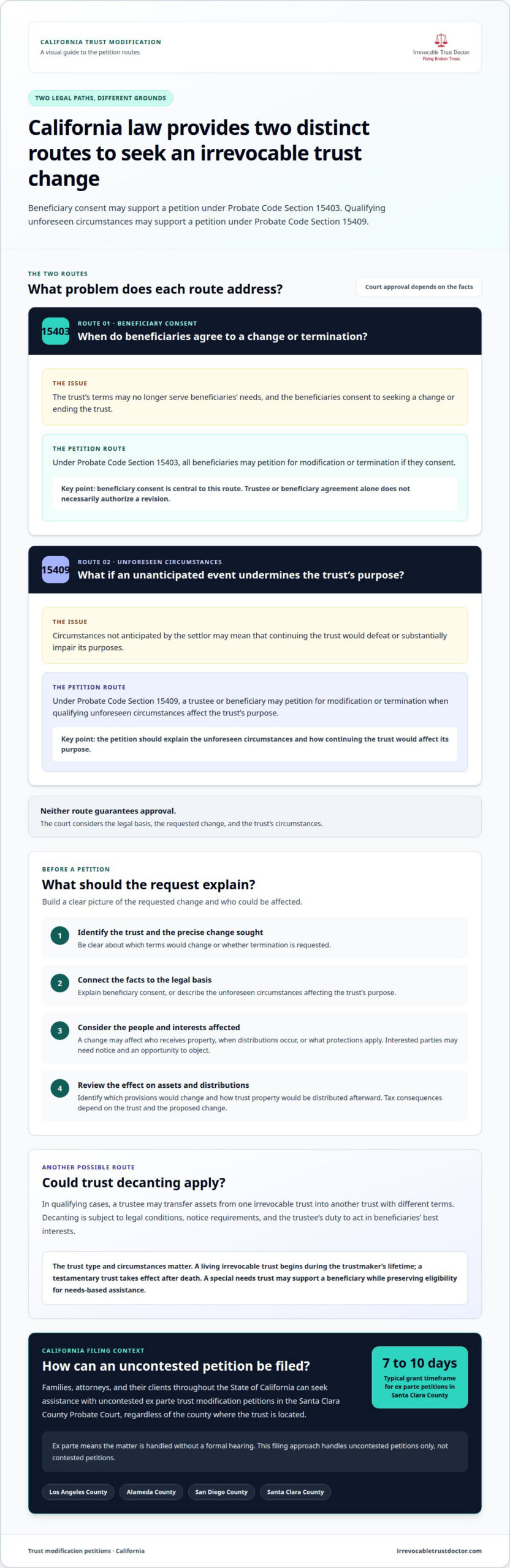
The California State Legislature states that California Probate Code §15409 permits a court to modify or terminate a trust based on circumstances not anticipated by the settlor when continuing it would defeat or substantially impair its purposes. The California State Legislature also states that under California Probate Code §15409, a trustee or beneficiary may petition when qualifying unforeseen circumstances would defeat or substantially impair those purposes.
Separately, the California State Legislature states that under California Probate Code §15403, all beneficiaries of an irrevocable trust may petition for modification or termination if they consent. These routes address different circumstances: one focuses on unforeseen events, while the other requires beneficiary consent. Identifying which facts support the requested route helps clarify the petition’s basis.
The type of trust also shapes the issue. A living irrevocable trust begins during the trustmaker’s lifetime; a testamentary trust takes effect after death. A special needs trust may support a beneficiary while preserving eligibility for needs-based assistance. If the existing terms no longer serve their purpose, explain how the requested change could affect the trust’s assets and distributions.
California’s statutory trust decanting may offer another route in qualifying cases. Decanting means a trustee transfers assets from one irrevocable trust into another with different terms, subject to legal conditions, notice requirements, and the trustee’s duty to act in beneficiaries’ best interests. For help assessing a possible petition, consider a trust petition consultation.
How can The Irrevocable Trust Doctor help with an irrevocable trust modification petition?
The Irrevocable Trust Doctor, a service of attorney Robert P. Bergman, Board-Certified Specialist in Estate Planning, Trust, and Probate Law (California State Bar Board of Legal Specialization), assists with uncontested petitions to modify irrevocable trusts. Its Irrevocable Trust Modification Petition service handles court filings under Probate Code Section 15403 and Probate Code Section 15409. A Trust Petition Consultation can help families and attorneys discuss whether an uncontested petition fits the circumstances.
The practice files uncontested ex parte petitions, meaning matters handled without a formal hearing, in the Santa Clara County Probate Court, regardless of where in California the trust is located. Families, attorneys, and their clients throughout the State of California can seek assistance, including those connected to Los Angeles County, Alameda County, or San Diego County. The service handles only uncontested ex parte petitions, not contested petitions.
Petitions filed ex parte in Santa Clara County are typically granted in 7 to 10 days. In San Mateo County, ex parte petitions can be filed, heard, and granted the same day. In Contra Costa County, petitions can often be filed and granted the same day if the Court is satisfied that the matter is urgent. Petitions filed in other counties often take several months to be heard. Filing an uncontested petition ex parte in Santa Clara County is intended to avoid those delays, regardless of the trust’s California county.
All trust modification petitions have fixed fees covering filing fees and attorneys’ fees. The next step is to discuss the trust, the proposed change, beneficiary consent, and whether the matter is uncontested. This helps determine whether the petition service fits the circumstances.
Contact The Irrevocable Trust Doctor to discuss an uncontested irrevocable trust modification petition or arrange a Trust Petition Consultation.
What Is the Next Step Toward a Clear Trust Plan?
Before pursuing a change, write down what you want the trust to achieve and which terms may need attention. Gather the trust document and note how its current provisions affect the people involved. These details can help focus a conversation with an irrevocable trust modification lawyer in the Bay Area on the specific question you need answered.
If you’re an attorney, family member, or beneficiary considering a change, a focused consultation can help clarify the next procedural step. You can discuss the trust’s terms, the proposed change, and whether an uncontested petition may fit your situation. Start with a Trust Petition Consultation with The Irrevocable Trust Doctor. A clear first step can make a complex decision easier to approach.
Frequently Asked Questions
Can All Beneficiaries Agree to Change an Irrevocable Trust?
Yes. Beneficiaries may petition for modification or termination if they consent. Before assessing agreement, review the trust’s definition of beneficiaries and any provisions naming alternate or contingent beneficiaries. A family relationship alone may not identify everyone whose interests the document addresses. Mapping the roles named in the trust can help clarify whose agreement may be relevant to the proposed change.
Can You Change Beneficiaries or Distribution Terms?
Potentially. A trust protector may amend certain provisions, such as distribution schedules, if the trust document grants that authority. This may provide a different route from seeking a court-approved change. Look for any clause naming a trust protector and read its scope carefully. Authority to revise one provision should not be assumed to cover beneficiary changes or every other trust term.
Can a Court Modify a Trust Because Circumstances Have Changed?
Yes, but a change in circumstances alone does not ensure approval. A California court may refuse a proposed modification if it would harm an intended beneficiary or if continuing the trust is necessary to fulfill a material purpose that outweighs the reasons for changing it. Explain the practical effect on beneficiaries and the trust’s purpose, not only the event that prompted the request.
How Does a Trust Modification Petition Work?
Prepare by defining the specific result you seek. Gather the trust document and amendments, identify the assets and distribution terms affected, and outline how those terms relate to the proposed outcome. These details can help organize the facts for a petition discussion and clarify what supporting information may be relevant to the requested change.
What Are the Top Questions When Choosing a Trust Lawyer in Bay Area?
The Irrevocable Trust Doctor focuses on California irrevocable trust modification petitions. Its Trust Petition Consultation addresses feasibility and process, while its Irrevocable Trust Modification Petition covers filing. The relevant fit question is whether the matter is an uncontested ex parte petition under Probate Code Section 15403 or Probate Code Section 15409. The practice does not handle contested petitions.

Article by
Robert P. Bergman, Attorney at Law
Attorney Robert P. Bergman ("Bob Bergman") has been a Board-Certified Specialist in Estate Planning, Trust and Probate Law since 2011, as certified by the California State Bar Board of Legal Specialization. For several years, Bob has assisted families and the clients of other attorneys with obtaining court orders through trust modification petitions to make necessary modifications to existing irrevocable trusts. Bob is friendly, very approachable, and believes in explaining complex legal topics in clear ordinary language so that his clients understand exactly what they're doing and why they're doing it.
Bob is often able to assist clients throughout California who are in other counties than his home county of Santa Clara through his approach to trust modification petitions.