
Disclaimer
This article is for informational purposes only. Nothing in this article is intended to replace legal advice from a competent attorney or be considered legal guidance for anybody's specific legal situation. Nobody should rely on information in this article in making legal decisions without such consultation.
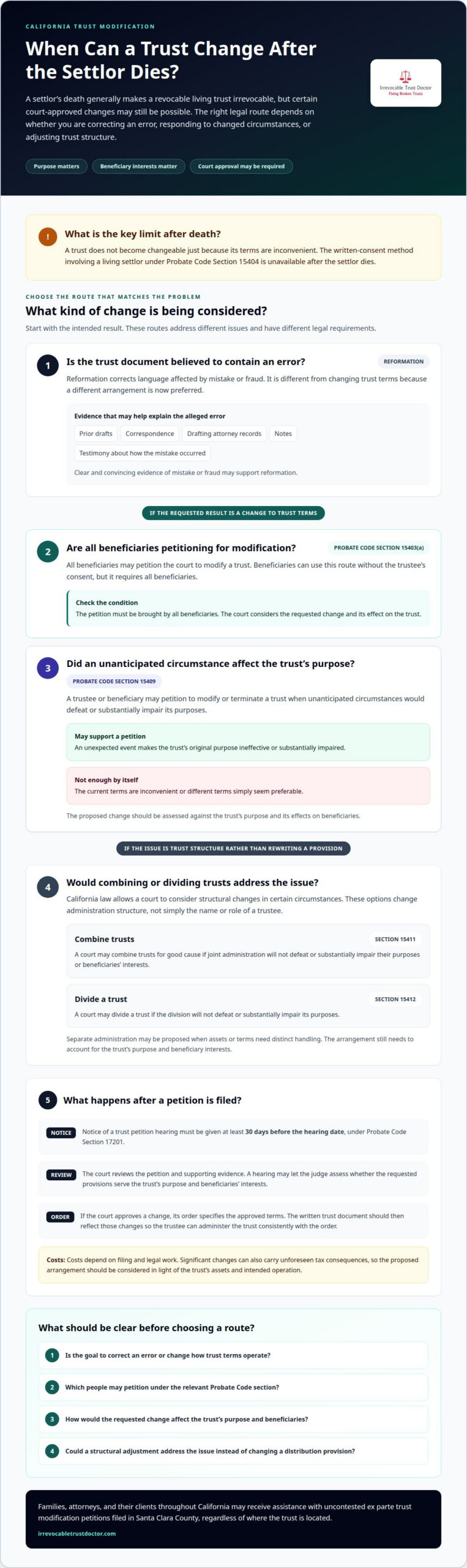
Trust terms may sometimes be changed after a settlor dies in California, but only through legally permitted routes. All beneficiaries may petition the court to modify a trust under Probate Code Section 15403(a), and a trustee or beneficiary may petition under Probate Code Section 15409 when unanticipated circumstances would defeat or substantially impair the trust’s purposes, according to the California Legislature. A change isn’t automatic just because the current terms have become inconvenient.
It’s understandable to assume a settlor’s death makes every trust term permanent. This article explains modifying trust terms due to changed circumstances in California, how modification differs from correcting an error in the trust document, and when a court may consider changing an irrevocable trust.
You’ll also learn how the trust’s purpose and the effects on beneficiaries factor into the decision. This context can help you assess whether changed circumstances may support a petition.
Key Takeaways
- Learn how to distinguish a change to trust terms from correcting a mistake in the original document.
- Identify why a settlor’s death usually limits changes, and what circumstances may still support a court petition.
- Understand how a trust’s purpose and the effects on beneficiaries can shape whether a proposed change is appropriate.
- See how an uncontested ex parte petition filed in Santa Clara County may assist families and attorneys throughout California, regardless of where the trust is located.
What Is a Trust Modification Under California Law?
A trust modification changes how provisions operate; reformation corrects language affected by mistake or fraud. California law provides court petition routes for certain changes to an irrevocable trust.
How Can Changed Circumstances Support Court Modification?
Modification may be available when events make a trust’s original purpose ineffective. Under California Probate Code Section 15409, a trustee or beneficiary may petition to modify or terminate a trust when unanticipated circumstances would defeat or substantially impair its purposes, according to the California Legislature. Changed circumstances must affect the trust’s purpose, not merely make different terms preferable.
What Evidence May Courts Consider for Modification or Reformation?
Evidence helps explain why a change is needed or whether the document contains an error. For reformation, courts may consider prior drafts, correspondence, drafting attorney records, notes, and testimony about how a mistake occurred. Clear and convincing evidence of mistake or fraud may support reformation. These records can help distinguish a correction to the settlor’s intent from a change made for convenience.
How Do Petitions and Notice to Interested Parties Work?
A petition asks the court to approve a proposed change. California Probate Code Section 15403(a) allows all beneficiaries to petition the court to modify a trust, according to the California Legislature. Beneficiaries can petition without the trustee’s consent, but this route requires all beneficiaries. Under California Probate Code §17201, notice of a trust petition hearing must be given at least 30 days before the hearing date, according to the California Legislature. Costs depend on filing and legal work.
What Happens After Court Approval of Trust Document Changes?
For a court-approved change, the court reviews the petition and supporting evidence, then issues an order specifying the approved terms. A hearing may allow the judge to assess whether the requested provisions serve the trust’s purpose and beneficiaries’ interests. The written trust document should then reflect the court-approved changes so the trustee can administer the irrevocable trust consistently with the order.
Can an Irrevocable Trust Be Changed After the Settlor Dies?
After a settlor dies, a living trust that was revocable generally becomes irrevocable, so the creator can no longer amend its terms. However, a post-death change may be possible through a legally available route. We assist families, attorneys, and their clients throughout California with uncontested ex parte trust modification petitions filed in Santa Clara County, regardless of where the trust is located.
A testamentary trust is created through a will and takes effect after the person who made the will dies. While living, that person can generally revise or cancel the will’s trust provisions. After death, beneficiaries and trustees cannot simply rewrite the testamentary trust because another distribution seems preferable. A proposed change must fit a legally available route.
For example, unanticipated circumstances may make the original terms ineffective or substantially impair the trust’s purpose. A trustee or beneficiary may then seek court modification under Probate Code Section 15409. All beneficiaries may also petition under Probate Code Section 15403(a). The court considers the trust’s purpose and how the proposed terms affect beneficiary interests.
The written-consent method involving a living settlor and beneficiaries under Probate Code Section 15404 is unavailable after the settlor dies. That distinction matters: a living settlor may have authority to change a revocable trust, while post-death changes generally require another legal basis. Before assuming a trust is fixed, identify whether it is testamentary or a living trust and review the original document’s terms.
How Can California Law Allow an Irrevocable Trust to Be Modified?
California Probate Code allows courts to combine or divide trusts in certain circumstances. Families, attorneys, and their clients throughout California can get assistance with uncontested ex parte trust modification petitions filed in Santa Clara County, regardless of where the trust is located.
Under Probate Code Section 15411, a court may combine trusts for good cause if joint administration won’t defeat or substantially impair their purposes or beneficiaries’ interests. Probate Code Section 15412 allows a court to divide a trust if the division won’t defeat or substantially impair its purposes.
For example, separate administration might be proposed when a trust’s assets or terms need distinct handling. The request must still account for the trust’s purpose and the effects on beneficiaries. A division changes the structure of administration, not simply the name or role of a trustee.
Combining trusts may be considered when managing them together would serve their purposes without harming beneficiaries’ interests. The court evaluates whether the proposed arrangement meets the applicable standard. These options differ from rewriting a distribution provision, so identifying the practical result you seek helps frame the issue.
Before modifying trust terms due to changed circumstances in California, consider whether a structural adjustment could address the problem instead. Significant trust changes can also carry unforeseen tax consequences, so assess the proposed arrangement in light of the trust’s assets and intended operation. This distinction can help families and attorneys identify the right issue when modifying trust terms due to changed circumstances in California.
How Can The Irrevocable Trust Doctor Help With an Uncontested Trust Modification?
The Irrevocable Trust Doctor, a service of attorney Robert P. Bergman, Board-Certified Specialist in Estate Planning, Trust, and Probate Law (California State Bar Board of Legal Specialization), assists families, attorneys, and clients throughout the State of California. The practice files uncontested ex parte petitions under Probate Code Sections 15403 and 15409 in Santa Clara County Probate Court, regardless of where the trust is located.
The process for an ex parte petition depends on the court and the circumstances. Eligible uncontested petitions filed in Santa Clara County are typically granted in 7 to 10 days. Petitions can also be filed, heard, and granted the same day in San Mateo County. In Contra Costa County, petitions can often be filed and granted the same day if the Court is satisfied that urgency exists.
Each trust modification petition has a fixed fee covering filing fees and attorney fees. The practice handles only uncontested ex parte petitions and does not handle contested matters. For an uncontested matter, the petition focuses on the requested change, its legal basis, and the trust’s circumstances.
Families and attorneys in Los Angeles County, Alameda County, or elsewhere in California can discuss whether their circumstances fit this process. To discuss an uncontested petition, contact The Irrevocable Trust Doctor.
Take the Next Step With a Clear Plan
If your family is considering modifying trust terms due to changed circumstances in California, start by identifying the practical problem the current terms create. Note what has changed, which trust provision is affected, and how the proposed adjustment would serve the trust’s purpose. A copy of the trust document and a clear account of beneficiary positions can help frame the discussion.
The next step is to assess whether the situation fits an uncontested court petition. The Irrevocable Trust Doctor offers a Trust Petition Consultation to discuss the circumstances and an Irrevocable Trust Modification Petition for eligible matters. The consultation can help clarify the legal route and what information may be relevant before moving forward.
Every trust has its own language and family context, so a focused review can bring structure to a difficult decision. Schedule a Trust Petition Consultation to discuss your situation and identify a practical next step. A thoughtful review can help you move forward with greater clarity.
Frequently Asked Questions
Can All Beneficiaries Agree to Change a Trust?
Agreement can support a proposed change, but it doesn’t automatically rewrite an irrevocable trust after the settlor dies. California Probate Code Section 15404’s written-consent method involves a living settlor, so beneficiaries’ agreement alone doesn’t use that route after death. For example, beneficiaries may agree on revised distribution timing, but they still need an applicable legal process to make the terms effective.
Do You Need Court Approval?
Generally, changing an irrevocable trust requires recognized legal authority, often court approval. The trust document may grant specific powers to a trust protector, or California’s decanting law may apply when a trustee has sufficient distribution authority. These routes have limits. Identify whether the requested change concerns administration, distributions, or the trust’s purpose before deciding which process could apply.
What If the Settlor Is Still Alive?
If the trust is revocable, the living settlor generally can amend or revoke it under the trust’s terms and applicable California law. For example, a settlor who wants to change a successor trustee may make a written amendment if the document’s procedures allow it. An irrevocable trust is different: being alive doesn’t by itself give the settlor unrestricted authority to change it.
Can You Change Beneficiaries or Distribution Terms?
Potentially, but changing who receives assets or when they receive them affects the trust’s core terms. A court may examine the trust’s purpose, the reason for the proposed change, and its effect on each beneficiary. For example, a request to delay distributions could protect one beneficiary while reducing another’s access, so the impact on both interests matters.
Can a Single Beneficiary Force Changes?
A single beneficiary can ask the court to consider a change under an applicable petition route, but filing doesn’t guarantee approval. Under Probate Code Section 15409, a beneficiary may petition when unanticipated circumstances would defeat or substantially impair the trust’s purposes. The court evaluates the facts and proposed change; a beneficiary’s preference alone doesn’t require the trustee or court to adopt new terms.

Article by
Robert P. Bergman, Attorney at Law
Attorney Robert P. Bergman ("Bob Bergman") has been a Board-Certified Specialist in Estate Planning, Trust and Probate Law since 2011, as certified by the California State Bar Board of Legal Specialization. For several years, Bob has assisted families and the clients of other attorneys with obtaining court orders through trust modification petitions to make necessary modifications to existing irrevocable trusts. Bob is friendly, very approachable, and believes in explaining complex legal topics in clear ordinary language so that his clients understand exactly what they're doing and why they're doing it.
Bob is often able to assist clients throughout California who are in other counties than his home county of Santa Clara through his approach to trust modification petitions.