Disclaimer
This article is for informational purposes only. Nothing in this article is intended to replace legal advice from a competent attorney or be considered legal guidance for anybody's specific legal situation. Nobody should rely on information in this article in making legal decisions without such consultation.
How to fix a poorly drafted trust in California depends on the defect: a focused court petition may address some trust problems without recreating the entire document. A California court may reform a trust when strong, highly persuasive evidence shows what the person who created the trust intended its terms to be. The harmless error rule concerns a will’s execution, not a general fix for conflicting trust language.
Conflicting amendments or trustee difficulties can make it hard to understand what the trust requires and what options remain. The key first step is to identify the specific defect and determine whether the trust is irrevocable. This article explains how courts may address drafting errors, why conflicting amendments need careful review, and why the harmless error rule for wills does not automatically resolve a trust problem. A targeted court petition may be appropriate for some irrevocable trusts, but the right analysis depends on the trust and the requested change.
Key Takeaways
- Compare amendments with the trust and related estate documents to identify conflicts before deciding what needs correction.
- Consider whether a targeted change can address the problem or whether broader revisions call for a restatement or court petition.
- Review any amendment carefully for execution or drafting problems; computer-generated language may overlook important details in an existing plan.
- Learn when California’s harmless error rule may help with a will and when an uncontested trust modification petition may offer a route to address trust issues.
How can conflicts between trust amendments and an existing estate plan be fixed?
Compare the signed trust, its amendments, and related estate documents before changing any terms. To fix a poorly drafted trust in California, first identify where the documents disagree and which assets are affected.
How can estate planning documents be reformed?
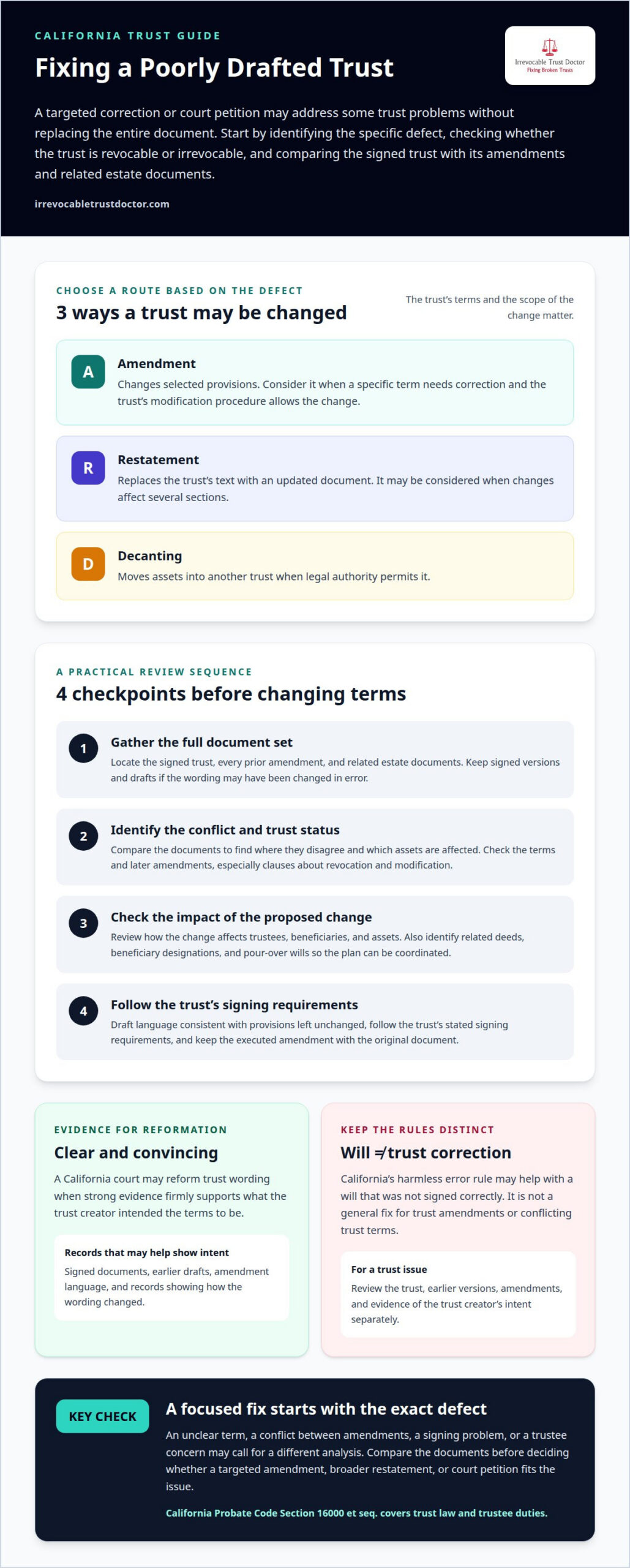
Reformation means changing document wording to reflect the settlor’s, or trust creator’s, intended terms. A California court may reform a trust when clear and convincing evidence, meaning strong evidence that firmly supports a conclusion, establishes that intent. If an amendment was rushed before travel, preserve drafts and signed versions so an attorney can assess the language and records. Attorney charges depend on review scope, document volume, and whether court work is needed. The records can show whether the wording reflects the intended plan or needs correction.
How do you determine trust status and update related documents?
To determine whether a trust is revocable or irrevocable, read its terms and later amendments, especially clauses addressing revocation and modification. That distinction affects available changes. After revising a trust, identify related deeds, beneficiary designations, and pour-over wills, which direct assets into a trust, then coordinate consistent updates. Clarifying ownership is another step: property belongs to the trust estate when titled in the trust’s name. According to the California Legislature, California Probate Code §16000 et seq. covers trust law and trustee duties. Small-estate thresholds and trust ownership are separate considerations.
Can I fix trustee problems without recreating my entire trust?
Often, a targeted amendment can address a specific problem without replacing the whole trust. The right approach depends on the document, its terms, and the change needed.
How do amendments, restatements, and replacement differ?
An amendment changes selected provisions; a restatement replaces the trust’s text with an updated document. A restatement may be considered when changes affect several sections. Decanting means moving assets into another trust when legal authority permits it. These approaches can affect beneficiaries, children, and distribution terms, so compare the existing trust with the proposed change before deciding which route to pursue.
What steps are involved in amending a trust?
Start by locating the signed trust and every prior amendment. Read the trust’s amendment instructions, identify each provision to correct, and draft language consistent with the remaining terms. Then review how the change affects trustees, beneficiaries, and assets. Follow the trust’s stated signing requirements and keep the executed amendment with the original document.
When may an amendment be invalid or unenforceable?
An amendment may be challenged if it does not follow the trust’s modification procedure, uses unclear terms, or conflicts with provisions left unchanged. AI-generated text may overlook earlier amendments or misunderstand how a clause affects the rest of the document. Estate planning professionals, such as the team at Aquarius Lawyers, regularly highlight how precise legal drafting prevents conflicting terms from creating disputes across property and estate assets. Compare the signed trust with all amendments, identify the specific defect, and determine whether the issue calls for a corrected document or a court petition.
What are the risks of changing a trust alone?
Changing terms without considering beneficiaries or getting legal advice can create conflicting instructions, unintentionally leave someone out of an inheritance, or create uncertainty about trustee authority. A change affecting one child’s inheritance, for example, may also alter how remaining assets are distributed. A trust petition consultation can help assess whether a court petition fits the problem.
What is California’s harmless error rule?
California’s harmless error rule may allow a will that was not signed correctly to be admitted to probate. The rule concerns wills, not a general way to fix trust amendments. A court may accept an incorrectly signed will if clear and convincing evidence, meaning strong evidence that leaves the court firmly convinced, shows what the person who died (the decedent) intended.
Trust drafting problems require separate analysis. To establish a mistake or ambiguity, review the signed trust, earlier versions, amendment language, and records that may show what the person who created the trust (the settlor) intended. For example, a draft naming one beneficiary and a signed version naming another may help demonstrate a clerical error. The evidence must clearly and convincingly establish the intended meaning.
The harmless error rule may address a will’s signing defect, but it does not automatically update a revocable living trust. Nor does it resolve conflicting trust provisions simply because someone believes a mistake occurred. The legal analysis must distinguish evidence about will execution from evidence about the trust’s wording.
Preserve signed documents and drafts, then organize records that show the settlor’s intent. If the trust remains unclear, a Trust Petition Consultation can assess whether a court petition may address the issue. For guidance, book a Trust Petition Consultation. This distinction matters before relying on a will rule to address trust terms.
How can The Irrevocable Trust Doctor help with a trust modification petition?
The Irrevocable Trust Doctor, a service of attorney Robert P. Bergman, Board-Certified Specialist in Estate Planning, Trust, and Probate Law (California State Bar Board of Legal Specialization), helps families, attorneys, and clients throughout the State of California assess trust modification options. A Trust Petition Consultation clarifies the issue; an Irrevocable Trust Modification Petition seeks court approval for an appropriate change.
Under Probate Code Section 15403 and Probate Code Section 15409, petitions are filed as uncontested ex parte matters in the Santa Clara County Probate Court, regardless of where the trust is located in California. This route is relevant when the requested change can proceed as an uncontested matter.
Santa Clara County petitions are typically granted in 7 to 10 days. In San Mateo County, ex parte petitions can be filed, heard, and granted the same day. Contra Costa County petitions can often be filed and granted the same day if urgency satisfies the Court. An ex parte petition is handled without a formal hearing.
All trust modification petitions have fixed fees covering filing fees and attorney fees. Petitions in other counties often take several months to be heard, so filing an uncontested ex parte petition in Santa Clara County can avoid those delays. The office handles uncontested petitions only.
To discuss a trust modification petition, contact The Irrevocable Trust Doctor.
What Is a Clear Path Forward?
A practical first step in deciding how to fix a poorly drafted trust in California is to define the outcome you need. Are you seeking to clarify who may act as trustee, resolve conflicting terms, or change how trust assets are managed? A specific goal helps focus the legal review and connect the proposed court petition to the problem.
The Irrevocable Trust Doctor offers a Trust Petition Consultation to discuss whether a court petition may fit your circumstances, along with an Irrevocable Trust Modification Petition for seeking a trust change through the court. The right next step depends on the trust’s terms, the requested correction, and whether the matter is uncontested.
Bring your questions and the relevant trust documents to a conversation about the available path. You can schedule a Trust Petition Consultation to discuss the issue and move toward a clearer plan. A careful, focused review can help you approach the next decision with greater confidence.
Frequently Asked Questions
What’s the fastest way to spot hidden risk before I start changing documents?
Create a list of discrepancies before pursuing a change. Compare the current trust with its amendments, the pour-over will, deeds, beneficiary records, and trustee information. A pour-over will is a will that directs certain assets to a trust after death. Flag missing signatures, inconsistent names, assets titled outside the trust, or clauses that refer to outdated documents. This inventory helps identify the issue that needs attention and reduces the risk of overlooking a related document.
When should you use each approach?
A focused amendment may fit when one clearly defined clause needs correction and the trust’s terms permit that approach. A restatement may be worth considering when changes affect several provisions and separate addenda could make the current terms harder to follow. Decanting means transferring assets from one trust to another trust with different terms, subject to applicable requirements. A court petition involves different legal considerations. The trust language, requested change, and interested parties’ positions all matter when assessing the appropriate path.
How can a California trust be amended or restated if it is poorly drafted?
Begin with the signed trust and its amendment clause. Identify who has authority to change it and what signing steps the document requires. The settlor, meaning the person who created the trust, may have authority to make changes, depending on the trust’s terms. Draft corrections that clearly identify the trust and affected provisions. A restatement gathers revised terms into a replacement text. Keep the executed document with earlier versions so the trustee can distinguish current terms from superseded language.
What California rules govern trust amendments, revocations, and execution formalities?
California Probate Code Section 16020 is cited for trust amendments made through a written document. The trust’s terms also matter because they describe who may amend or revoke it and the required signing steps. Read those clauses with all later amendments. Don’t assume a notary or witness requirement applies; follow the document’s stated procedures and applicable California law.
How can a California court reform or modify a trust because of drafting errors or changed circumstances?
A court may reform trust language when clear and convincing evidence establishes the settlor’s intended terms. For changed circumstances, identify the specific problem and requested adjustment, then assess whether a petition under Probate Code Section 15403 or Probate Code Section 15409 fits. The trust, amendments, and records explaining why existing terms no longer work can help frame the requested court action.

Article by
Robert P. Bergman, Attorney at Law
Attorney Robert P. Bergman ("Bob Bergman") has been a Board-Certified Specialist in Estate Planning, Trust and Probate Law since 2011, as certified by the California State Bar Board of Legal Specialization. For several years, Bob has assisted families and the clients of other attorneys with obtaining court orders through trust modification petitions to make necessary modifications to existing irrevocable trusts. Bob is friendly, very approachable, and believes in explaining complex legal topics in clear ordinary language so that his clients understand exactly what they're doing and why they're doing it.
Bob is often able to assist clients throughout California who are in other counties than his home county of Santa Clara through his approach to trust modification petitions.