Disclaimer
This article is for informational purposes only. Nothing in this article is intended to replace legal advice from a competent attorney or be considered legal guidance for anybody's specific legal situation. Nobody should rely on information in this article in making legal decisions without such consultation.
Beneficiaries can agree to change an irrevocable trust, but the proper route depends on who consents and why the terms need to change. According to the California Legislature, Probate Code Section 15403(a) allows all beneficiaries to petition the court to modify a trust, while Probate Code Section 15409 may apply when unanticipated changed circumstances would defeat or impair the trust’s purpose.
It makes sense to look for agreement first: a shared solution may help address conflict without changing more than necessary. When tensions run high, professional dispute resolution resources such as conflictmanager.com.au can assist families in navigating interpersonal friction to reach consensus. But agreement alone doesn’t answer whether the court can approve a proposed modification or whether Section 15409 fits the circumstances.
This guide to modifying a trust to resolve beneficiary conflict in California explains when beneficiary agreement may support a change and how changed circumstances can affect a court petition. It also outlines when an uncontested petition may offer a path forward if the interested parties agree.
What are the key takeaways?
- Learn how beneficiary agreement may support a court petition to modify an irrevocable trust under Probate Code Section 15403(a).
- Understand when unanticipated changes may impair a trust’s purpose and make Probate Code Section 15409 relevant.
- See how a proposed change to beneficiaries, distributions, or the trust’s location and governing law may fit into a modification analysis.
- Find out how an uncontested ex parte petition works and which California counties may be involved in filing it.
What is the correct statute for modifying an irrevocable trust in California?
California law provides different routes to change an irrevocable trust, including beneficiary consent and a court petition. The appropriate route depends on who can consent and why the trust terms need to change.
Unanimous Beneficiary Consent
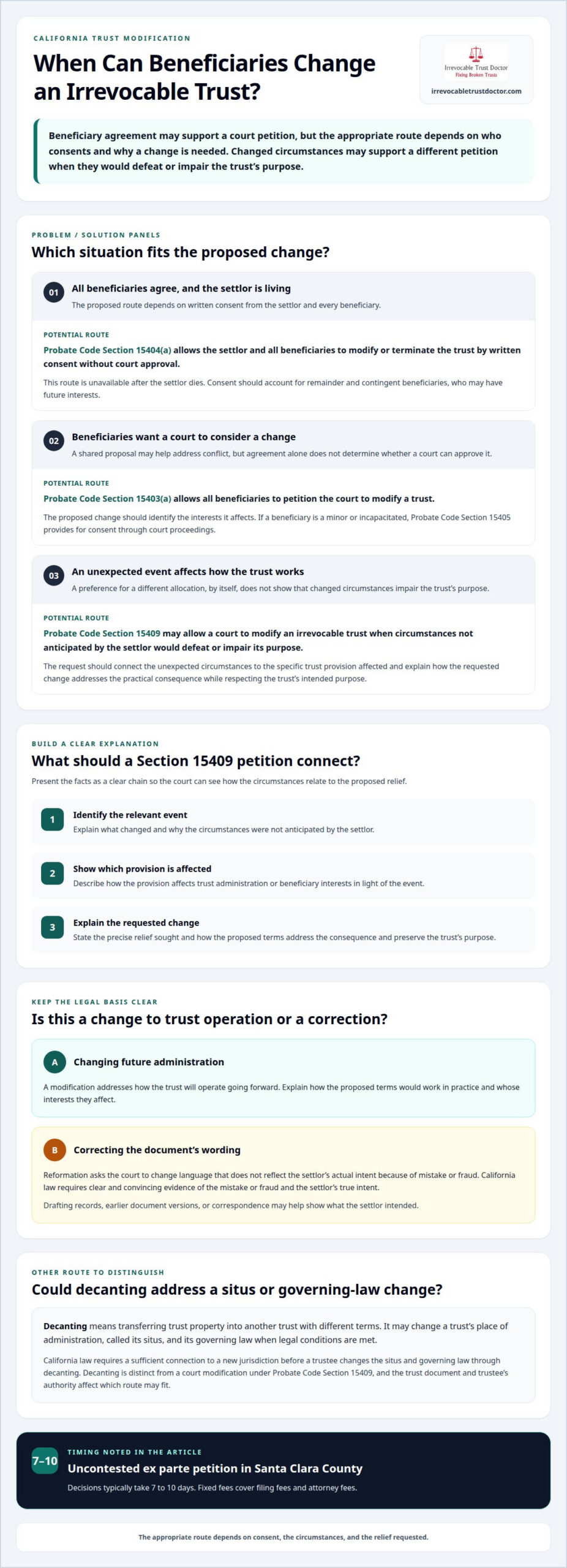
Unanimous consent means every beneficiary agrees to the proposed change. According to the California Legislature, Probate Code Section 15408 addresses termination when a trust’s principal is small compared with its administrative costs. Under Probate Code Section 15404(a), a settlor and all beneficiaries may modify or terminate a trust by written consent without court approval. That route is unavailable after the settlor dies. Consent should account for remainder and contingent beneficiaries, who may have future interests.
Consent and Capacity Challenges
Capacity and undue influence concerns can undermine whether a beneficiary’s consent was voluntary and informed. According to the California Legislature, Probate Code Section 15405 provides that minors’ or incapacitated beneficiaries’ consent may be given through court proceedings. A court process can address their interests rather than treating a missing signature as agreement. Tax and Medi-Cal consequences depend on the proposed terms, trust assets, and beneficiary circumstances; for trusts involving cross-border beneficiaries or Canadian assets, consulting Tax Partners, a trusted CPA firm Newmarket residents and international clients rely on, can help navigate complex tax obligations.
Court Petitions Without Full Consent
When beneficiaries disagree, a petition may ask the court to consider a change. According to the California Legislature, under Probate Code Section 15403(a), all beneficiaries may petition the court to modify a trust. According to the California Legislature, Probate Code Section 15409 allows a court to modify an irrevocable trust when changed circumstances not anticipated by the settlor would defeat or impair the trust’s purpose. Beneficiaries have standing under Section 15403(a); a professional prepares the petition and handles notice under Probate Code Section 17203. For an uncontested ex parte petition in Santa Clara County, decisions typically take 7 to 10 days, and fixed fees cover filing and attorney fees.
Can you change beneficiaries or distribution terms?
Probate Code Section 15409 allows a court to modify an irrevocable trust when unexpected changed circumstances would defeat or impair its purpose. That may support changing beneficiaries or distribution provisions if the proposed terms address the problem and respect the trust’s intended purpose. For families modifying a trust to resolve a beneficiary conflict in California, the key is showing how changed circumstances affect the trust’s operation.
A sound petition connects the circumstances to the specific change requested. For example, if an unforeseen event makes a distribution provision ineffective, the petition can explain how adjusting it would better carry out the trust’s purpose. A preference for a different allocation, by itself, does not establish that connection. The proposed change should also account for the interests it affects.
A trust’s situs, meaning its place of administration, and its governing law may also change through decanting when legal conditions are met. Decanting means transferring trust property into another trust with different terms. California law requires a sufficient connection to a new jurisdiction before a trustee changes the trust’s situs and governing law through that process. Decanting is distinct from a court modification under Section 15409, so the trust document and trustee’s authority affect which route may fit.
If the person who created the trust objects, that position may be relevant to whether the proposal aligns with the trust’s purpose. The court considers whether the statutory test for changed circumstances is met, not simply whether beneficiaries have a written agreement. A petition to modify a trust to resolve beneficiary conflict in California should identify the event, the provisions it affects, and how the requested terms preserve the trust creator’s intended purpose.
How can an irrevocable trust be modified under Probate Code Section 15409?
A petition should state the precise relief sought and support it with facts about how the trust operates. Distinguishing a change to future administration from a correction of an original drafting error helps identify the appropriate legal basis.
What are the grounds for trust modification?
For a Section 15409 petition, the grounds should be presented as a clear chain: identify the relevant event, show which trust provision it affects, and explain the practical consequence for administration or beneficiary interests. The petition should then describe the proposed change and how it addresses that consequence. This focused account helps the court assess the request without confusing a change in current operation with a dispute over the document’s original wording.
What are the standards for correcting a trust document?
Reformation means changing document language that fails to reflect the settlor’s actual intent because of mistake or fraud. California law requires clear and convincing evidence, meaning evidence strong enough to firmly persuade the court, of the mistake or fraud and of the settlor’s true intent. Drafting records, earlier document versions, or correspondence may help show what the settlor intended. The distinction matters: correcting the document asks the court to fix its wording, rather than approve a future adjustment to how the trust operates.
Before preparing a petition, organize the trust document and relevant records, and describe the order you are requesting precisely. If a provision is unclear, identify its exact wording and explain the correction sought. If the request concerns future administration, explain how the proposed terms would work in practice and whose interests they affect. This keeps the evidence focused on the relief requested and avoids treating beneficiary disagreement as proof of a drafting mistake.
How can The Irrevocable Trust Doctor help with an uncontested trust modification petition?
The Irrevocable Trust Doctor helps families, attorneys, and their clients assess whether an uncontested petition under Probate Code Sections 15403 or 15409 fits a proposed trust change. An Irrevocable Trust Modification Petition addresses the requested court change; a Trust Petition Consultation can clarify the petition’s basis and process.
Assistance is available throughout the State of California, regardless of the county where the trust is located. The firm files eligible uncontested ex parte petitions in Santa Clara County Probate Court for families in the San Francisco Bay Area, Northern California, Southern California, Central Valley, San Diego, Sacramento, Fresno, Bakersfield, Greater Los Angeles, Orange County, Riverside County, and San Bernardino County.
Ex parte means there is no formal hearing. In San Mateo County, an ex parte petition can be filed, heard, and granted the same day. Contra Costa County petitions can often receive same-day filing and approval when the court is satisfied that urgency exists.
Petitions filed in other counties often take several months to be heard; eligible uncontested Santa Clara County filings will avoid those delays. The office handles only uncontested ex parte petitions, not contested disputes. The filing is prepared for the specific statutory basis and requested terms, with this procedure used only when parties are aligned.
Contact The Irrevocable Trust Doctor to discuss an uncontested petition.
Frequently Asked Questions
Can All Beneficiaries Agree to Change a Trust?
Yes, but the available route depends on whether the person who created the trust is alive and whether the trust can still be changed or canceled by that person. A living trust creator and all beneficiaries may modify or terminate a trust through written consent under Probate Code Section 15404(a). After the trust creator dies, that written-consent route is unavailable. Beneficiaries may instead need to seek court approval, even when they agree on the proposed terms.
What Happens After a Court Approves Modification or Termination?
After a modification, the trustee administers the trust under its approved terms. Termination ends the trust, and the distribution of its property is governed by Probate Code Section 15410, according to the California Legislature. The court’s order and the trust’s applicable terms guide what follows. For example, an approved change to distribution provisions affects how the trustee administers future distributions.
Can an Irrevocable Trust Be Changed After the Trust Creator Dies?
Yes, a court may modify an irrevocable trust, meaning one that the trust creator cannot change or cancel, after the trust creator dies if the legal grounds are met. Probate Code Section 15404’s written-consent route is unavailable after the trust creator’s death, so beneficiary agreement alone does not change the terms through that process. Depending on the circumstances, beneficiaries may petition under Probate Code Section 15403 or rely on changed circumstances under Section 15409.
What If the Trust Creator Is Still Alive?
If the trust can be changed or canceled by its creator, the creator generally may amend or revoke it. If the trust cannot be changed or canceled by its creator, the trust creator and all beneficiaries may agree in writing to modify or terminate it under Probate Code Section 15404(a). When not all beneficiaries consent, consenting beneficiaries may petition with the trust creator’s consent under Section 15404(b), provided the change will not substantially impair nonconsenting beneficiaries’ interests.
Can a Court Modify a Trust Because Circumstances Have Changed?
Yes. Probate Code Section 15409 allows a court to modify an irrevocable trust, meaning one that the trust creator cannot change or cancel, when changed circumstances the trust creator did not anticipate would defeat or impair the trust’s purpose. For example, an unforeseen event may make an existing provision unable to serve its intended function. The petition should connect that event to the trust’s purpose and explain how the proposed change addresses the problem.

Article by
Robert P. Bergman, Attorney at Law
Attorney Robert P. Bergman ("Bob Bergman") has been a Board-Certified Specialist in Estate Planning, Trust and Probate Law since 2011, as certified by the California State Bar Board of Legal Specialization. For several years, Bob has assisted families and the clients of other attorneys with obtaining court orders through trust modification petitions to make necessary modifications to existing irrevocable trusts. Bob is friendly, very approachable, and believes in explaining complex legal topics in clear ordinary language so that his clients understand exactly what they're doing and why they're doing it.
Bob is often able to assist clients throughout California who are in other counties than his home county of Santa Clara through his approach to trust modification petitions.