
Disclaimer
This article is for informational purposes only. Nothing in this article is intended to replace legal advice from a competent attorney or be considered legal guidance for anybody's specific legal situation. Nobody should rely on information in this article in making legal decisions without such consultation.
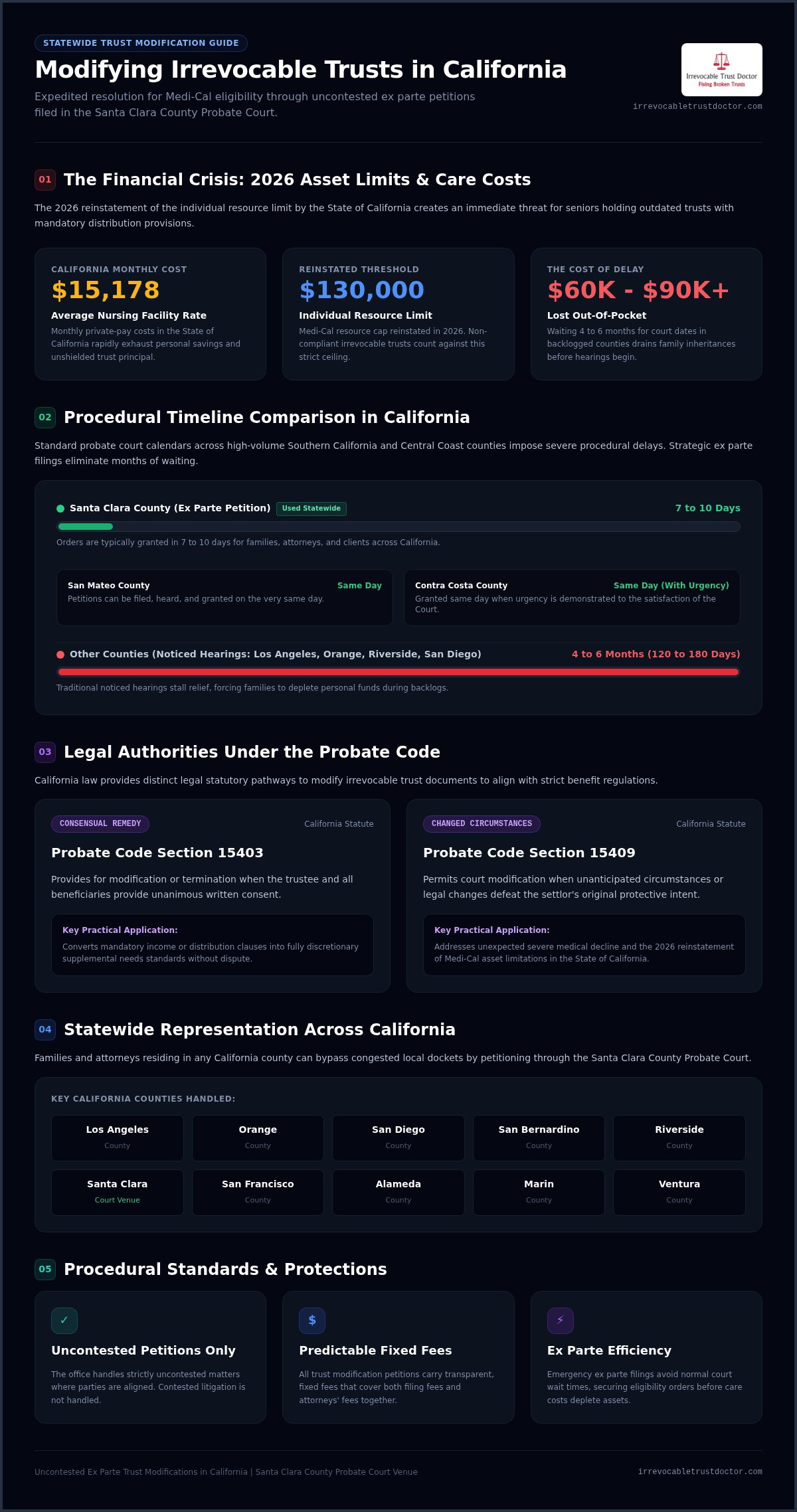
What if the trust you thought was "unbreakable" is the only thing standing between your family and $15,178 in monthly nursing home costs? Families in Los Angeles and Orange County often believe irrevocable trust terms are permanent, even if they block Medi-Cal eligibility. With the 2026 reinstatement of the $130,000 asset limit in California, a rigid trust is often a financial liability. However, modifying an irrevocable trust for Medicaid planning is a specialized remedy we can sometimes use to restore eligibility and protect assets.
We know the stress of watching assets dwindle while waiting months for court dates in San Bernardino, Ventura, or San Francisco. Our office assists families throughout the State of California via the Santa Clara County Probate Court. By filing an uncontested ex parte petition under Probate Code Section 15403 or Probate Code Section 15409, we typically secure orders in 7 to 10 days. This guide to Modifying Irrevocable Trusts in California explains how to update terms to secure benefits.
Key Takeaways
- Learn why outdated trust language can disqualify a beneficiary from Medi-Cal under the 2026 asset limits reinstated by the State of California.
- Discover how Probate Code Section 15403 and Probate Code Section 15409 allow you to legally correct a “broken” trust through an uncontested petition.
- Understand the procedural speed of modifying irrevocable trust for Medicaid planning by filing in Santa Clara County to secure a court order in 7 to 10 days.
- Bypass the multi-month court backlogs in Los Angeles, Orange, or Riverside by utilizing our expedited ex parte process available throughout the State of California.
Why Modifying Irrevocable Trust for Medicaid Planning in California is Necessary
The 2026 reinstatement of asset limits in California has created a technical crisis for seniors with older estate plans. Many families in Los Angeles, Orange, and San Diego find that their existing irrevocable trusts actually prevent them from qualifying for long-term care benefits because they don’t account for the current $130,000 individual resource limit. If a trust contains "broken" language, such as mandatory income distributions or rigid principal access, Medi-Cal will treat those funds as available resources. With nursing home costs in the State of California often exceeding $15,000 per month for a private room, the financial stakes are immense. Modifying an irrevocable trust for Medicaid planning is not just a legal preference; it’s a necessary intervention to stop the rapid depletion of family assets. We assist families in Ventura, Alameda, and Santa Clara by identifying these restrictive clauses and proposing court-approved amendments.
Common Conflict Points in Medicaid Planning in California
Under current Probate Code standards, Medi-Cal defines "available assets" as any resource the applicant has the legal right to use for their own support and maintenance. A trust that was originally designed to protect assets from creditors might inadvertently count against eligibility if it lacks specific special needs and Medicaid trust requirements. Our approach to modifying irrevocable trust for Medicaid planning focuses on transforming mandatory payments into discretionary ones to preserve benefit eligibility. You can learn more about the specific process in our guide on How to Fix an Irrevocable Trust in California. By acting as a specialist fixer for these dysfunctional documents, we can help families in Riverside and San Bernardino counties update their trusts to comply with the latest State of California regulations. These modifications ensure that the trust principal remains protected while the beneficiary qualifies for the essential care they need.
Legal Grounds Under the Probate Code Section in California
The legal framework for modifying an irrevocable trust for Medicaid planning relies on specific statutes within the Probate Code. Probate Code Section 15403 allows for modification or termination if the trustee and all beneficiaries provide unanimous consent. This is a powerful tool when a family agrees that the original trust structure no longer makes sense for a loved one’s care. If unanimous consent isn’t possible, we turn to California Probate Code Section 15409. This section permits a court to modify a trust due to "changed circumstances" that the original settlor didn’t anticipate, such as a sudden stroke or the 2026 reinstatement of Medi-Cal asset limits.
Our office focuses exclusively on uncontested petitions to ensure the fastest possible resolution for families in San Diego, Ventura, and Marin. Because these matters are not disputes between family members, we can offer fixed fees that cover both the attorney’s fees and the court filing fees in the State of California. If your situation requires immediate intervention, you may want to schedule a trust petition consultation to review your specific document.
The Ex Parte Petition Process in California
An "ex parte" petition is a specialized request for a court order that bypasses the standard multi-month waiting period for a formal hearing. In high-volume counties like Los Angeles, Orange, San Bernardino, or Riverside, a standard petition might not be heard for four to six months. We avoid these delays by filing uncontested ex parte matters in the Santa Clara County Probate Court, where orders are typically granted in 7 to 10 days. This speed is vital when there is an urgent need for modifying irrevocable trust for Medicaid planning to cover nursing home care. For complete transparency, we detail our pricing on our Fees and Costs page. This streamlined approach allows families in San Francisco and Alameda to secure eligibility quickly without the stress of a protracted legal battle.
The Santa Clara County Advantage for Statewide Trust Petitions
While residents in San Francisco, Alameda, and Ventura may feel bound to their local probate courts, the reality of judicial backlogs creates a significant hurdle. A standard noticed petition in Los Angeles, Orange, or Riverside can delay a hearing for several months, during which time private-pay nursing home rates can exhaust an inheritance. We utilize the Santa Clara County Probate Court to bypass these delays, filing uncontested ex parte petitions that are typically granted in 7 to 10 days. This speed is the primary reason that modifying an irrevocable trust for Medicaid planning through our San Jose office has become a statewide strategy for families in San Diego and Marin.
Our expertise allows us to navigate specific procedural advantages across Northern California. For instance, ex parte petitions in San Mateo County can be filed, heard, and granted the same day. Similarly, the court in Contra Costa County often grants petitions the same day if we can demonstrate "urgency" to the satisfaction of the Judge. We strictly adhere to the Santa Clara County Superior Court trust administration guidelines to ensure every filing under Probate Code Section 15403 or Probate Code Section 15409 is handled efficiently. Regardless of where the trust was created, we assist attorneys and their clients throughout the State of California with fixed fees that cover all filing and legal costs.
Taking Action to Secure Medi-Cal Eligibility
The first step is a Trust Petition Consultation in California to determine if your document can be salvaged. We frequently collaborate with other legal professionals, serving as the Irrevocable Trust Modification Attorney in California to handle the specialized court work. By moving the matter to the Santa Clara County Probate Court, we avoid the slow systems in San Bernardino and Ventura. This methodical approach ensures your loved one qualifies for benefits without unnecessary financial loss. Book a Trust Petition Consultation today to secure your court order within 7 to 10 days.
Secure Your Family’s Financial Future in California
An outdated trust shouldn’t be the reason your loved one loses access to essential care. We have explored how modifying irrevocable trust for Medicaid planning through Probate Code Section 15403 or Probate Code Section 15409 allows you to adapt to the 2026 asset limits. While courts in Los Angeles, Orange, Riverside, and San Diego face long delays, our office utilizes the Santa Clara County Probate Court to secure results in just 7 to 10 days. We assist families and attorneys throughout the State of California from Ventura and San Bernardino to San Francisco, Alameda, and Marin. Our uncontested ex parte petitions feature fixed fees for total transparency. As a Certified Specialist in Probate Law, Robert P. Bergman provides the specialized expertise needed to restore eligibility. Book a Trust Petition Consultation today to protect your family legacy.
Frequently Asked Questions
Can an irrevocable trust be changed for Medicaid purposes in California?
Yes, you can modify an irrevocable trust through the court system to meet current eligibility standards. Under the State of California rules, modifying irrevocable trust for Medicaid planning in California is possible using an uncontested ex parte petition. This legal remedy allows us to update restrictive trust language that might otherwise disqualify a resident in Los Angeles or San Diego from receiving essential long-term care benefits.
How long does it take to modify a trust in Santa Clara County?
Petitions filed ex parte in the Santa Clara County Probate Court are typically granted in 7 to 10 days. This is significantly faster than the multi-month delays common in counties like Riverside or Orange. Our office helps families throughout the State of California bypass these backlogs by utilizing the expedited process in Santa Clara, ensuring your loved one qualifies for benefits without unnecessary waiting.
What is the difference between Probate Code Section 15403 and 15409?
Probate Code Section 15403 requires the unanimous consent of all trust beneficiaries to authorize a modification. In contrast, Probate Code Section 15409 allows the court to modify a trust based on "changed circumstances" that the original creator didn’t anticipate. Both sections provide a legal pathway for modifying irrevocable trust for Medicaid planning in cities like San Francisco, Ventura, or San Bernardino.
Do I need to live in San Jose to file a petition in Santa Clara County?
No, you don’t need to live in San Jose to benefit from this expedited venue. Our San Jose-based office represents families from Alameda and Marin to San Diego by filing uncontested ex parte petitions in the Santa Clara County Probate Court. We offer fixed fees that cover both filing fees and attorneys’ fees, providing a predictable solution for clients throughout the State of California.

Article by
Robert P. Bergman, Attorney at Law
Attorney Robert P. Bergman ("Bob Bergman") has been a Board-Certified Specialist in Estate Planning, Trust and Probate Law since 2011, as certified by the California State Bar Board of Legal Specialization. For several years, Bob has assisted families and the clients of other attorneys with obtaining court orders through trust modification petitions to make necessary modifications to existing irrevocable trusts. Bob is friendly, very approachable, and believes in explaining complex legal topics in clear ordinary language so that his clients understand exactly what they're doing and why they're doing it.
Bob is often able to assist clients throughout California who are in other counties than his home county of Santa Clara through his approach to trust modification petitions.