
Disclaimer
This article is for informational purposes only. Nothing in this article is intended to replace legal advice from a competent attorney or be considered legal guidance for anybody's specific legal situation. Nobody should rely on information in this article in making legal decisions without such consultation.
Imagine discovering that your family’s irrevocable trust, once designed to protect assets, is now a rigid obstacle causing tax penalties. Learning how to fix a broken trust California courts allow for doesn’t have to mean enduring a two-year battle. If beneficiaries and trustees agree, there’s a specialized path to restoration that bypasses probate delays often found in Ventura or San Bernardino. Families in Los Angeles or San Francisco can also find relief through a more efficient legal framework.
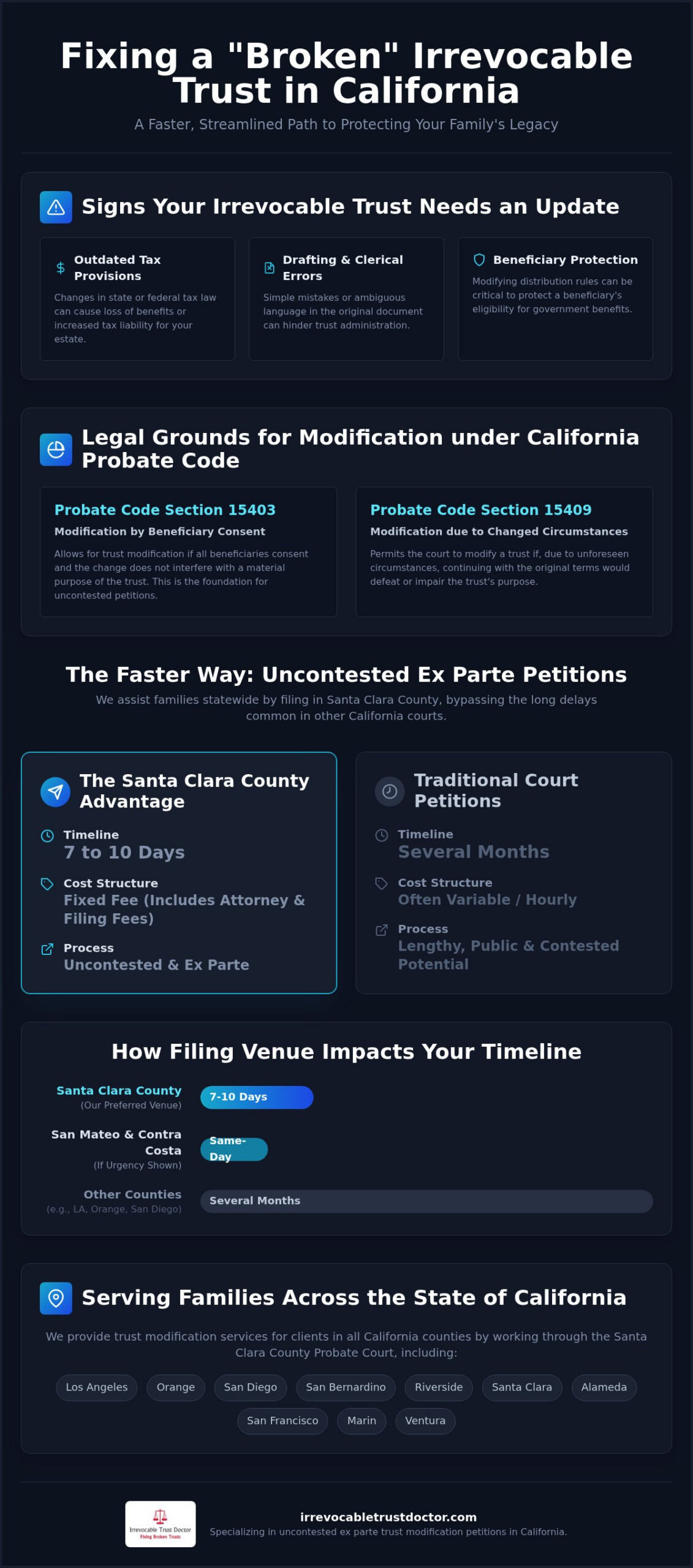
We understand anxiety over a stalled legacy. This guide explains how we assist families throughout the State of California by utilizing the Santa Clara County Probate Court. You’ll learn how filing an uncontested ex parte petition under Probate Code Section 15403 or Probate Code Section 15409 can resolve issues in 7 to 10 days. We’ll preview procedural advantages that allow you to update your trust without months of waiting required in Orange or Riverside.
Key Takeaways
- Identify common signs of a trust that doesn’t work anymore, including outdated tax provisions or drafting errors that frustrate beneficiaries.
- Explore the specific legal authority granted under Probate Code Section 15403 and Probate Code Section 15409 to repair or update an irrevocable trust.
- Discover the streamlined legal procedures and fixed-fee options for how to fix a broken trust California families can use in the Santa Clara County Probate Court.
- Learn how to avoid the months of delay common in counties like Orange and San Diego by securing a court order in as little as 7 to 10 days.
Identifying a "Broken" Irrevocable Trust in California
An irrevocable trust is designed to be permanent, but time can erode its effectiveness. When terms no longer align with the original intent or current legal reality, the document is considered "broken." Within the State of California, a broken trust is defined as one that requires judicial intervention to modify it or remain effective in the State of California. If you’re struggling with a dysfunctional document in Los Angeles or Ventura, understanding how to fix a broken trust California allows for is the first step toward a resolution.
Many families face frustration when rigid terms clash with modern needs. This often happens because of a shift in state law or the death of a key individual. While U.S. Trust Law provides the general foundation for these entities, California’s specific statutes offer a specialized remedy for trusts that have become unworkable. Whether the trust is based in San Diego or Riverside, the goal is to restore the document’s original purpose through the court system. We specialize in diagnosing these failures and navigating the bureaucratic obstacles in the Santa Clara County Probate Court to implement a fix.
Common Reasons for Trust Modification in California
We frequently assist families in San Bernardino and Alameda who are researching how to fix a broken trust California courts will recognize. Common reasons to seek a modification include:
- Correcting clear drafting mistakes or clerical errors that hinder trust administration.
- Updating terms to account for significant changes in the State of California or federal tax laws. Outdated tax provisions can cause a loss of benefits or increased liability.
- Modifying distribution rules to protect a beneficiary’s eligibility for government benefits. This ensures that an inheritance doesn’t disqualify a loved one from essential support in counties like Orange or Marin.
Legal Grounds Under the California Probate Code
The State of California provides specific legal pathways to address dysfunctional documents through the Probate Code. If you’re in San Bernardino or Riverside and researching how to fix a broken trust in California, you’ll find that the law requires filing a formal petition with the court to request a modification or reformation. These legal actions are most effective when they’re uncontested. This means all trustees and beneficiaries agree to the proposed changes; this agreement allows for a smoother resolution without the friction of a long court battle. Most families prefer this route because it avoids the expense and public nature of a contested hearing.
Understanding Probate Code Section 15403 and 15409
Probate Code Section 15403 is a primary tool used when all beneficiaries consent to a change. If the modification doesn’t interfere with a material purpose of the trust, the court has the authority to grant the request. However, when unexpected shifts occur that the original creator didn’t see coming, California Probate Code § 15409 applies. This section allows for changes based on changed circumstances, ensuring the original intent isn’t defeated by terms that no longer make sense in a modern environment.
These sections work together to provide a comprehensive solution for families in counties like Orange, San Diego, and Los Angeles. By combining beneficiary agreement with a clear explanation of how circumstances have shifted, we can effectively update trust structures to fit current needs. When determining how to fix a broken trust California residents must ensure their petition aligns with these specific statutes. If you’re unsure which path fits your situation, you can schedule a consultation to review your specific document and legal options. Our office focuses on these specialized petitions to ensure your legacy remains protected and functional.
The Faster Way to Fix a Trust in California: The Ex Parte Petition
While standard court petitions in many counties can take several months to be heard, ex parte petitions offer a streamlined alternative. We assist families throughout the State of California by filing uncontested ex parte petitions in the Santa Clara County Probate Court. This specialized approach allows for a fixed-fee structure that includes both attorney fees and court filing fees, providing financial predictability. If you’re in Los Angeles or San Francisco, you don’t have to wait for your local court’s backlog to clear. When families seek a rapid resolution on how to fix a broken trust California law supports, the ex parte petition is the superior choice.
Under California Probate Code § 15404, the law recognizes the right of the settlor and beneficiaries to modify or terminate a trust. By choosing the right venue, we can expedite this process significantly. Our office focuses on navigating these specific bureaucratic hurdles to provide a clear roadmap for our clients. If all parties agree to the modification, there’s no reason to endure a long, drawn-out court battle.
Why Santa Clara County is the Ideal Venue for Trust Modification
Petitions filed ex parte in Santa Clara County are typically granted in as little as 7 to 10 days. This is a dramatic improvement over the months of delay found in San Diego or Ventura. While Santa Clara is our primary hub, other options exist for specific needs. For example, ex parte petitions in San Mateo County can be filed, heard, and granted the same day. Similarly, petitions in Contra Costa County can often be filed and granted the same day if "urgency" can be demonstrated to the satisfaction of the Court.
Choosing this path means you avoid the standard probate calendar and its associated frustrations. We provide a specialized remedy for those seeking Fees and Costs in California that are transparent and predictable. By working through Santa Clara, we ensure that families in San Bernardino, Riverside, or Marin receive the same rapid resolution as local residents. This methodical approach turns a stressful situation into a manageable, structured legal process.
Restoring Your Family Legacy Today
Repairing a dysfunctional irrevocable trust doesn’t have to be a source of constant stress. By understanding how to fix a broken trust California law facilitates, you can move from uncertainty toward a structured resolution. Our office handles uncontested ex parte petitions throughout the State of California, serving families from Los Angeles to Marin. We utilize the efficiency of the Santa Clara County Probate Court, where petitions are typically granted in just 7 to 10 days. This allows you to bypass the long delays often found in counties like Orange or San Bernardino.
As a Certified Specialist in Trust and Probate Law, Robert P. Bergman provides the expertise required for these matters. We offer financial predictability through fixed fees for all petitions. If you’re ready to update your trust under the Probate Code, Book a Trust Petition Consultation to Fix Your Broken Trust. It’s possible to secure your family’s future with speed and professional order.
Frequently Asked Questions
Can an irrevocable trust be changed in California if everyone agrees?
Yes, an irrevocable trust can be changed if all beneficiaries and the trustee agree to the modification. This is usually accomplished under Probate Code Section 15403. When everyone consents, the court has the authority to approve changes that don’t violate the trust’s material purpose. This path is frequently used by families in San Francisco or Orange to resolve outdated terms or drafting errors.
How long does the court process take to fix a broken trust in California?
The duration depends on the court venue and the type of petition filed. While standard probate matters in counties like Ventura or Riverside can take several months, our office specializes in uncontested ex parte petitions. In the Santa Clara County Probate Court, these are typically granted in 7 to 10 days. This is the fastest way when learning how to fix a broken trust California residents can access.
Do I have to live in Santa Clara County to file a trust petition there?
No, residency in Santa Clara County is not required to file a trust petition there. We assist families throughout the State of California, including those residing in San Bernardino, Alameda, or San Diego. By filing in Santa Clara, we help clients bypass the significant backlogs often found in their local courts in Los Angeles or Riverside, regardless of their home city or where the trust was created.
What is the difference between trust reformation and trust modification in California?
Trust modification updates terms to fit new circumstances, while trust reformation corrects the document to match the settlor’s original intent. Reformation is often used to fix clerical errors or drafting mistakes. Both are effective strategies for how to fix a broken trust California families find unworkable. We apply Probate Code Section 15409 to ensure these changes are handled through a streamlined, uncontested process.

Article by
Robert P. Bergman, Attorney at Law
Attorney Robert P. Bergman ("Bob Bergman") has been a Board-Certified Specialist in Estate Planning, Trust and Probate Law since 2011, as certified by the California State Bar Board of Legal Specialization. For several years, Bob has assisted families and the clients of other attorneys with obtaining court orders through trust modification petitions to make necessary modifications to existing irrevocable trusts. Bob is friendly, very approachable, and believes in explaining complex legal topics in clear ordinary language so that his clients understand exactly what they're doing and why they're doing it.
Bob is often able to assist clients throughout California who are in other counties than his home county of Santa Clara through his approach to trust modification petitions.