
Disclaimer
This article is for informational purposes only. Nothing in this article is intended to replace legal advice from a competent attorney or be considered legal guidance for anybody's specific legal situation. Nobody should rely on information in this article in making legal decisions without such consultation.
A California court may reform an irrevocable trust when sufficient evidence shows a mistake or fraud caused its terms to fail to reflect the intent of the person who created the trust. A trust reformation lawyer in Sacramento can assess whether evidence outside the document, such as earlier drafts, communications with the drafting attorney, financial records, or witness testimony, supports a requested correction. The proposed wording must align with that person’s intent.
Because an irrevocable trust generally cannot be changed freely, the evidence supporting a reformation request matters. This article explains when a California court may correct trust terms, how outside evidence can help establish the settlor’s intent, and what to know about an uncontested petition. For families and attorneys in Sacramento and across California, the first step is distinguishing a correction from a request to create new terms.
Key Takeaways
Look for focused experience with uncontested trust modification petitions and clear explanations of the court process.
An irrevocable trust may be corrected when persuasive evidence shows its wording does not reflect the settlor’s intent.
Evidence beyond the trust document can help the court understand the intended terms and the correction being requested.
Learn how an uncontested ex parte petition may be filed in Santa Clara County, even when the trust is located elsewhere in California.
Table of Contents
How Do You Choose a Trust Reformation Lawyer in Sacramento?
A Sacramento trusts attorney should explain the requested change, evidence needed, and whether the matter is truly uncontested. A trust reformation lawyer in Sacramento should distinguish correction from new terms, explain relevant qualifications, and show how a proposed change could affect beneficiaries, claims, or distributions.
How Can You Assess an Attorney’s Experience and Explanations?
Review the attorney’s experience with irrevocable trust petitions and interpreting estate-planning documents. In a consultation, discuss how the attorney would assess the trust, related records, and evidence of the settlor’s intent. Assess the attorney’s experience through specific explanations of the petition’s purpose, evidence, and next steps, rather than relying on general assurances. Look for clear explanations of the petition’s purpose, the evidence involved, and the next steps, with attention to how the proposed change affects the wider estate.
What Are the Risks of Trust Reformation and Petitions?
In California, modification generally means changing trust terms, while reformation asks a court to correct language that failed to express the settlor’s intent. “Correction” is a plain-language way to describe that fix; the evidence and requested court order matter more than the label. If a petition is denied, the requested wording does not take effect through that order. If someone challenges the request, it may become contested and involve a broader dispute. Before proceeding, identify the alleged error, the supporting evidence, and how each distribution could be affected. An attorney should explain the risks based on those facts.
When can an irrevocable trust be changed?
A California court may reform an irrevocable trust when sufficient evidence shows that mistake or fraud caused the written terms to differ from the settlor’s intent. The proposed correction must reflect that intent. Deadlines depend on the claim and circumstances, so assess the applicable deadline before filing rather than assume one period applies to every case.
A revocable trust is different because its creator can generally amend or revoke it while retaining that power. An irrevocable trust usually limits changes after creation, and its written terms govern the interests of beneficiaries. If a distribution provision appears mistaken, the question is whether evidence supports correcting the language, not simply whether a beneficiary prefers different terms.
The trust’s purpose also shapes the interests involved. A special needs trust may be designed to provide supplemental support, while a charitable trust directs assets toward charitable purposes. A life insurance trust may contain provisions for insurance-related planning. In each case, identify the specific language at issue and explain how the proposed correction could affect beneficiaries or asset transfers.
California petitions may be brought under Probate Code Section 15403 or Probate Code Section 15409. The relevant basis depends on the trust and requested relief. An extensive review considers the document, the alleged error, available evidence, and affected interests. A trust and estate attorney can assess those points and determine whether the request seeks a supported correction or a broader change.
Can evidence outside the trust document matter?
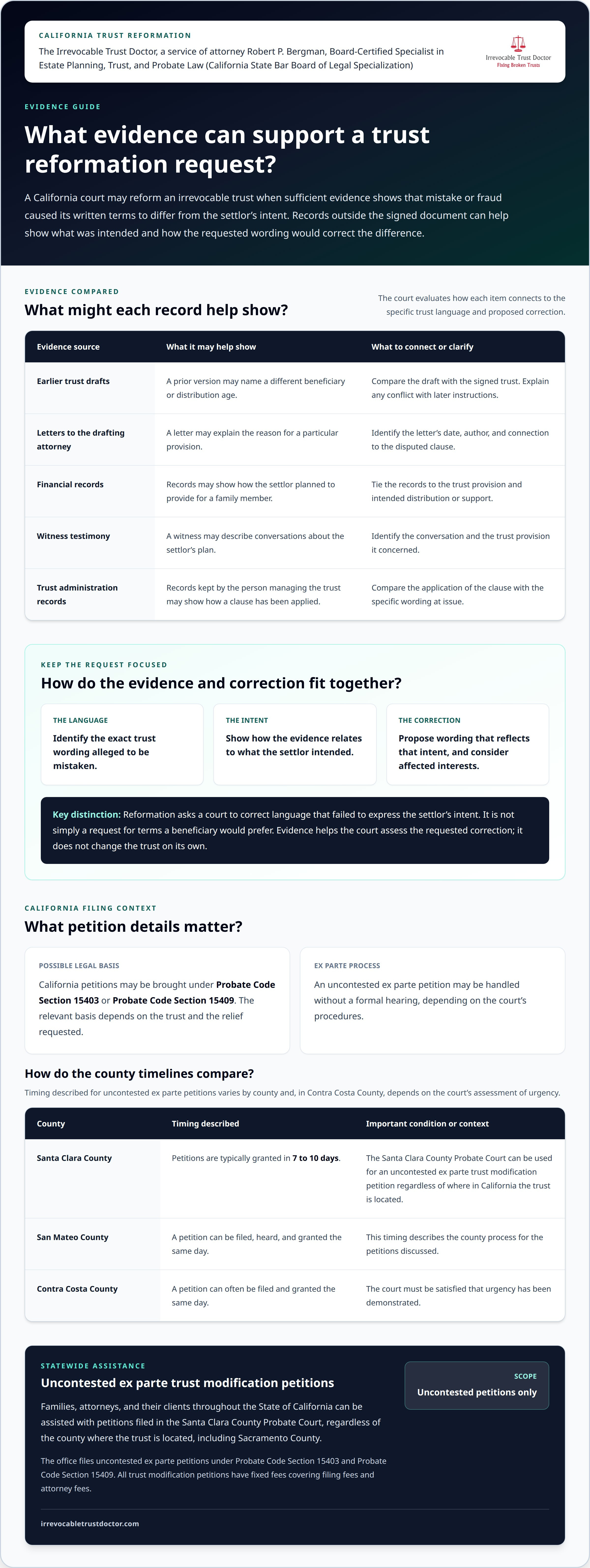
A California court may consider evidence outside the trust document when deciding a reformation request. The key question is whether each item helps establish what the settlor intended and how the written terms departed from that intent. Evidence does not change the trust on its own; it helps the court evaluate the requested correction.
For example, an earlier draft may name a different beneficiary or distribution age. A letter to the drafting attorney may explain the reason for a provision. Financial records may show how the settlor planned to provide for a family member, and witness testimony may describe conversations about that plan. Each item is easier to assess when its date, author, and connection to the disputed clause are clear.
A careful review compares these materials with the signed trust document instead of treating one statement as decisive. If an earlier draft conflicts with later instructions, the difference may need explanation. Records kept by the person managing the trust may also help show how a clause has been applied. Organizing evidence around the specific wording and requested correction can keep the court’s focus on the reformation issue and the evidence supporting the proposed correction.
For example, a family member’s recollection should identify the conversation and the trust provision it concerned. This focused approach ties the court request to the language at issue, the interests affected, and the evidence supporting the proposed correction.
How can The Irrevocable Trust Doctor help with a trust modification petition?
The Irrevocable Trust Doctor, a service of attorney Robert P. Bergman, Board-Certified Specialist in Estate Planning, Trust, and Probate Law (California State Bar Board of Legal Specialization), assists families, attorneys, and their clients throughout the State of California. It files uncontested ex parte trust modification petitions under Probate Code Section 15403 and Probate Code Section 15409 in the Santa Clara County Probate Court, regardless of where the trust is located.
The Irrevocable Trust Modification Petition covers filing an uncontested petition with the court. An ex parte process may be handled without a formal hearing, depending on the court’s procedures.
Santa Clara County petitions are typically granted in 7 to 10 days. San Mateo County petitions can be filed, heard, and granted the same day. Contra Costa County petitions can often be filed and granted the same day when the court is satisfied that urgency has been demonstrated.
All trust modification petitions have fixed fees covering filing fees and attorney fees. Matters filed in other counties often take several months to be heard, whether contested or uncontested. Filing uncontested petitions ex parte in Santa Clara County can avoid those delays.
If you’re considering an uncontested petition, contact The Irrevocable Trust Doctor to discuss the next step.
Frequently Asked Questions
How Do You Protect a Trust From Legal Challenges?
Clear drafting and consistent records can reduce confusion about a trust’s purpose. For example, if a distribution is intended to support a beneficiary, the trust language and related planning records should tell a coherent story. Trustees can keep accurate records of trust administration, including decisions and distributions. These records may help explain how the trust has operated, though they cannot prevent every dispute.
How Does a Trust Reformation Case Work?
A reformation case asks a court to correct trust wording, not simply replace a provision with a preferred alternative. The petition identifies the disputed language, explains the alleged mistake or fraud, and proposes wording that reflects the settlor’s intent. The court evaluates the request and supporting evidence. If an interested person contests the request, the matter may proceed as a dispute.
What does a trust reformation lawyer do in Sacramento?
A trust reformation lawyer in Sacramento can assess whether a proposed change is a correction supported by evidence or a broader rewrite. The attorney can review the trust provisions, identify the language at issue, and explain how the proposed wording could affect beneficiaries. For an uncontested matter, focused petition work can present the requested correction and supporting facts clearly.
What evidence is required to reform a trust under California law?
The evidence must persuasively connect the alleged mistake or fraud to language that does not reflect the settlor’s intent, and support the proposed correction. No single document proves every claim. The strength of the record depends on how its parts fit together, including whether the evidence of intent, disputed provision, and proposed replacement language form a consistent explanation.
How does a lawyer petition a Sacramento County court to reform a trust?
The Irrevocable Trust Doctor files uncontested ex parte trust modification petitions in Santa Clara County, including for trusts located in Sacramento County. The petition presents the requested change and supporting basis under California law. Ex parte means the matter proceeds without a formal hearing. The office handles only uncontested ex parte petitions, not petitions involving a dispute.