
Disclaimer
This article is for informational purposes only. Nothing in this article is intended to replace legal advice from a competent attorney or be considered legal guidance for anybody's specific legal situation. Nobody should rely on information in this article in making legal decisions without such consultation.
A petition to reform a trust in California may be appropriate when mistake or fraud caused an irrevocable trust’s written terms to differ from the settlor’s actual intent. The court reviews the evidence before ordering a correction. A demand letter can explain the change being requested, but it does not amend the trust or obtain a court order. This distinction matters: changing how a trust operates is different from correcting what its terms were intended to say.
The right path depends on the problem and whether the interested parties agree. Understanding California’s rules can help distinguish a drafting mistake from a disagreement about how a trust is being administered.
This article explains trust reformation, when court approval may be needed, and how reformation differs from modification. It also clarifies when a demand letter may be a starting point and when a petition may be relevant, helping you identify the issue before considering next steps.
Key Takeaways
- Distinguish correcting language that failed to reflect the settlor’s intent from changing how a trust operates going forward.
- Learn when California law allows a court to consider changing an irrevocable trust, including when circumstances have changed unexpectedly.
- Use the nature of the problem to assess whether a demand letter may help or a court petition is needed.
- Understand what the court considers when evaluating a trust reformation request and why evidence of the settlor’s intent matters.
Do You Need Court Approval?
Whether court approval is needed depends on the requested change, the trust’s terms, and the parties’ agreement. California law allows court petitions and, in some circumstances, nonjudicial routes, each with different requirements.
Court and Nonjudicial Modification Paths
A nonjudicial modification changes a trust without a court petition; a court petition asks a judge to authorize or direct a change. The route matters because consent and the trust’s purpose can affect whether court involvement is needed. California Probate Code Section 15404 permits modification or termination without court involvement when the settlor and all beneficiaries unanimously consent in writing while the settlor is alive. For families reviewing an estate planning issue, identify the trust’s terms and consent before choosing a route.
Petitions Without Unanimous Consent
A court petition asks the court to consider a change when the parties cannot resolve it by agreement. California Probate Code Section 15409 allows a court to modify or terminate a trust when unanticipated changed circumstances would substantially impair the trust’s purpose, according to the California Legislature. A petition may also be considered when beneficiaries disagree, but the court weighs the reasons for the requested change and its effect on the trust’s purpose. A demand letter can describe the requested action and invite agreement; it does not itself change the trust or replace a court order when one is needed.
Petition Hearings, Orders, and Outcomes
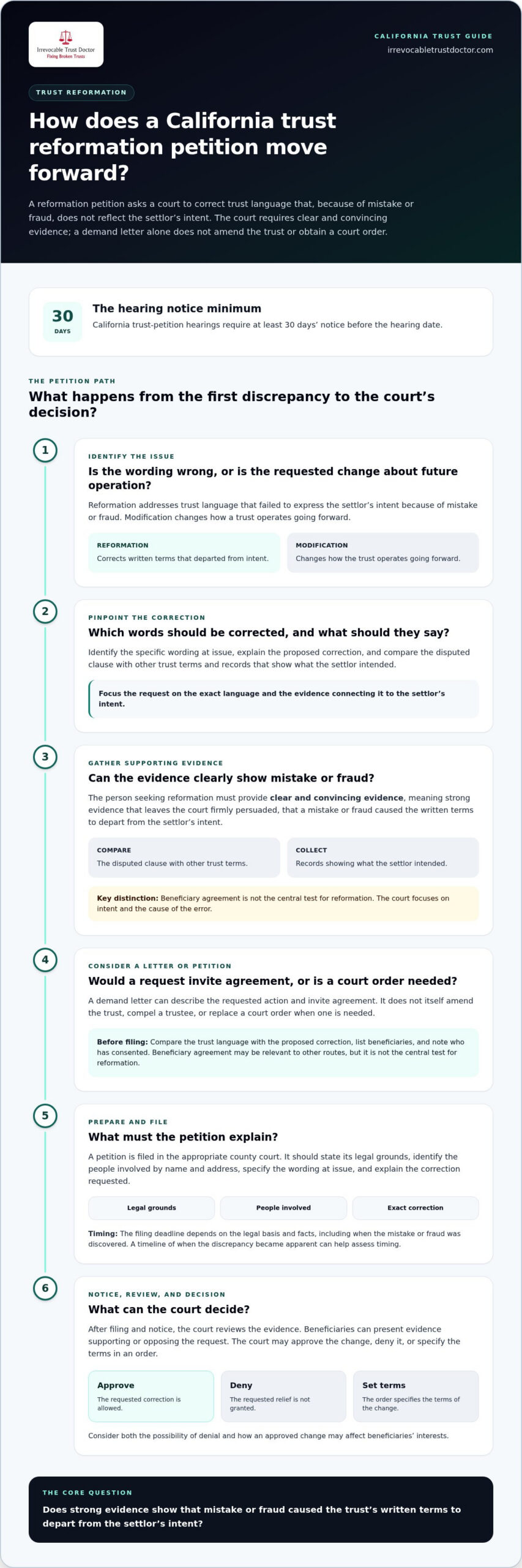
A petition begins with filing in the appropriate county court, followed by notice, review, and a decision. California trust-petition hearings require at least 30 days’ notice before the hearing date, according to the California Legislature. At a hearing, beneficiaries can present evidence supporting or opposing the request. The court may approve the change, deny it, or specify the terms in an order. Beneficiaries should weigh the possibility that the requested relief may be denied, or that an approved change may affect their interests. An attorney can help organize the trust document, the reasons for reform, and supporting evidence before filing.
How do I know if I need to file a petition against a trustee or just send a demand letter?
Trustees and beneficiaries may petition a California court about trust changes. A demand letter requests action but does not secure a court order. The appropriate route depends on the trust’s terms, the change sought, and whether everyone whose consent matters agrees.
Court Approval and Beneficiary Representation
Beneficiary agreement can support a trust change, but the court may still need to consider its purpose and affected interests. California Probate Code Section 15403 allows a court to modify or terminate an irrevocable trust when all beneficiaries consent and the change would not defeat a material purpose of the trust, according to the California Legislature. If a beneficiary is a minor or legally incapacitated, a legal representative may need to participate. Identify those beneficiaries early so their interests are addressed in the petition.
Standing to Petition
Standing means having a legally recognized basis to ask the court for trust-related relief. A trustee or beneficiary may petition when trust terms do not reflect the settlor’s wishes; the requested remedy must fit the facts. For an irrevocable trust, California Probate Code Section 15404 permits the settlor and all beneficiaries to agree in writing to modify or terminate it while the settlor is alive. If unanimous consent is unavailable, the consent-based route may not fit.
A demand letter can explain what should change and invite agreement, but it cannot itself compel a trustee or amend an irrevocable trust. A petition must state its legal grounds and identify involved people, including their names and addresses. Before filing, compare the trust language with the proposed correction, list beneficiaries, and note who has consented. If you need help assessing the petition route, discuss your trust petition options.
California legal framework for trust reformation
A petition to reform a trust in California asks a court to correct language that failed to reflect the trust creator’s intent. Reformation addresses a mistake or fraud in the trust’s terms; modification changes how the trust operates going forward.
Meaning of Trust Reformation
California Probate Code Sections 15400 through 15414 primarily govern trust modification and termination. Reformation focuses on whether the trust document expresses the intent of the settlor, meaning the person who created the trust. The person asking for reformation must provide clear and convincing evidence, meaning strong evidence that leaves the court firmly persuaded, that a mistake or fraud caused the written provisions to depart from that intent. For example, compare the disputed clause with other trust terms and records showing what the settlor intended. A petition to reform a trust in California should identify the specific wording at issue and explain the correction requested. Beneficiary agreement is not the central test for reformation; the evidence of intent and the cause of the error matter.
Filing Deadlines
The filing deadline depends on the legal basis and the facts, including when the mistake or fraud was discovered. Keep the signed trust and relevant records, and prepare a timeline showing when the discrepancy became apparent. These details help assess the timing and frame a focused petition to reform a trust in California.
Trust modification petitions have fixed fees covering filing fees and attorney fees. To discuss the trust language, supporting records, and possible next steps, schedule a trust petition consultation.
The Irrevocable Trust Doctor: Irrevocable Trust Modification Petition
The Irrevocable Trust Doctor, operated by attorney Robert P. Bergman, a Certified Specialist in Estate Planning, Trust and Probate Law, assists families and their attorneys with California trust modification petitions. The practice serves clients across the San Francisco Bay Area, Northern California, Southern California, the Central Valley, San Diego, Sacramento, Fresno, Bakersfield, Greater Los Angeles, Orange County, Riverside County, and San Bernardino County. For noticed hearings, services are available in Santa Clara, San Mateo, and Contra Costa counties.
For an uncontested trust modification, petitions are filed ex parte in Santa Clara County Probate Court under Probate Code Section 15403 or Probate Code Section 15409, regardless of where in California the trust is located. Santa Clara County petitions are typically granted in 7 to 10 days. The Irrevocable Trust Modification Petition addresses the filing, while a Trust Petition Consultation can help assess whether this route fits the circumstances.
Contact The Irrevocable Trust Doctor to discuss the next step.
Prepare a Clear Record Before Moving Forward
Before pursuing a petition to reform a trust in California, gather the trust document, identify the wording you believe is incorrect, and collect records that may show the settlor’s intent. A timeline can clarify when the issue surfaced and how it affects the people named in the trust. This preparation gives you a focused starting point for discussing possible next steps.
Keep the proposed correction precise. Identify the provision at issue, describe the language you believe should replace it, and note any questions about beneficiary consent or representation. If you would like guidance on the petition process, schedule a trust petition consultation. A careful first step can make a complicated trust concern easier to address.
Frequently Asked Questions
What Is the Amending of a Trust?
Amending a trust changes provisions in its existing document. For example, an amendment might revise how a trustee distributes income. Reformation is different: it asks a court to correct wording that failed to express the settlor’s intent when the trust was created. Before choosing a remedy, determine whether you want to update the plan or correct an original mistake.
What Evidence Does the Court Require?
A court considering reformation requires clear and convincing evidence of mistake or fraud and that the trust does not reflect the settlor’s true intent. Gather the executed trust and relevant records that may show the intended terms, such as earlier drafts or communications about the disputed provision. Organize the evidence around the specific language at issue and the correction requested.
What Is a Trust Modification Under California Law?
A trust modification changes how a trust operates going forward rather than correcting the meaning of its original language. The changed terms generally take effect on the date of the court’s order. For example, adjusting a distribution schedule differs from correcting an error in the signed document. Identify the intended effect before describing the proposed change.
What Are the Grounds for Judicial Modification or Reformation of a California Trust?
Grounds depend on whether the request seeks modification or reformation. California Probate Code Section 15409 addresses unanticipated changed circumstances that would substantially impair the trust’s purpose. Reformation may be sought when mistake or fraud caused the document to depart from the settlor’s intent. Identify the facts supporting the specific legal basis, rather than relying only on a beneficiary’s preference.
Which California Probate Code Sections Govern Trust Modification and Reformation?
California Probate Code Sections 15400 through 15414 primarily govern trust modification and termination. Among them, Section 15403 addresses modification or termination when beneficiaries consent and the change would not defeat a material purpose; Section 15409 concerns unanticipated changed circumstances. Probate Code Section 17200(b)(13) covers proceedings to approve or direct modification or termination. The petition must also state its grounds and supporting facts.

Article by
Robert P. Bergman, Attorney at Law
Attorney Robert P. Bergman ("Bob Bergman") has been a Board-Certified Specialist in Estate Planning, Trust and Probate Law since 2011, as certified by the California State Bar Board of Legal Specialization. For several years, Bob has assisted families and the clients of other attorneys with obtaining court orders through trust modification petitions to make necessary modifications to existing irrevocable trusts. Bob is friendly, very approachable, and believes in explaining complex legal topics in clear ordinary language so that his clients understand exactly what they're doing and why they're doing it.
Bob is often able to assist clients throughout California who are in other counties than his home county of Santa Clara through his approach to trust modification petitions.