
Disclaimer
This article is for informational purposes only. Nothing in this article is intended to replace legal advice from a competent attorney or be considered legal guidance for anybody's specific legal situation. Nobody should rely on information in this article in making legal decisions without such consultation.
What if the “irrevocable” trust your family relies on is actually blocking your financial security? Many Californians find themselves stuck with outdated terms due to 2026 tax law changes or drafting errors that prevent proper distributions. It’s a stressful position, but you aren’t trapped. By filing a court petition for trust amendment in California, you can modify the document to reflect current needs and legal standards.
I provide statewide assistance for families and attorneys in Los Angeles, Orange, and San Francisco, focusing on uncontested modifications. This guide explores how a court petition for trust amendment in California works under Probate Code Section 15403 and Probate Code Section 15409. We’ll examine procedural advantages, such as Santa Clara County’s 7 to 10 day turnaround for ex parte filings and the same-day potential in San Mateo or Contra Costa Counties. While my office doesn’t handle contested petitions, this roadmap details the fixed-fee pathways to correcting your trust with clinical precision.
Key Takeaways
- Identify the specific legal “escape hatches” within Probate Code Section 15403 and Probate Code Section 15409 that allow you to modify otherwise unchangeable documents.
- Learn the procedural roadmap to file a court petition for trust amendment, ensuring your document reflects current tax laws and beneficiary needs.
- Discover county-specific filing speeds, including same-day results in San Mateo and Contra Costa Counties versus the 7 to 10 day ex parte process in Santa Clara County.
- Understand the value of a fixed-fee structure for uncontested modifications throughout the state, though please note our office does not handle contested petitions.
Grounds for Trust Amendment Petitions in California
A court petition for trust amendment is a formal legal request submitted to the Probate Court to update a document that was originally intended to be unchangeable. While the term “irrevocable” suggests a permanent arrangement, California law provides specific “escape hatches” for trusts that are no longer functional or beneficial. Grounded in the broader principles of U.S. Trust Law, these petitions allow families to fix drafting errors or adapt to significant shifts, such as the 2026 federal estate tax exemption changes. I assist families and attorneys throughout the state, including Los Angeles, Orange, and Santa Clara Counties, to ensure these legal corrections are handled with clinical accuracy.
These petitions are ideal for resolving issues when all parties agree on the necessary solution. If you need to remove a trustee who isn’t performing or correct a distribution error that prevents the trust from operating correctly, this process provides a clear path forward. Families dealing with rigid distribution rules that no longer reflect current needs may also benefit from filing a petition to change trust distribution in California to legally update those terms through the court system. I assist clients in San Bernardino and Alameda Counties with these specific needs. I must clarify that my office exclusively handles uncontested matters; we do not handle contested petitions or litigation. If you are ready to begin the process, you can contact my office to discuss your situation.
Legal Foundations under Probate Code Section 15403 and Probate Code Section 15409
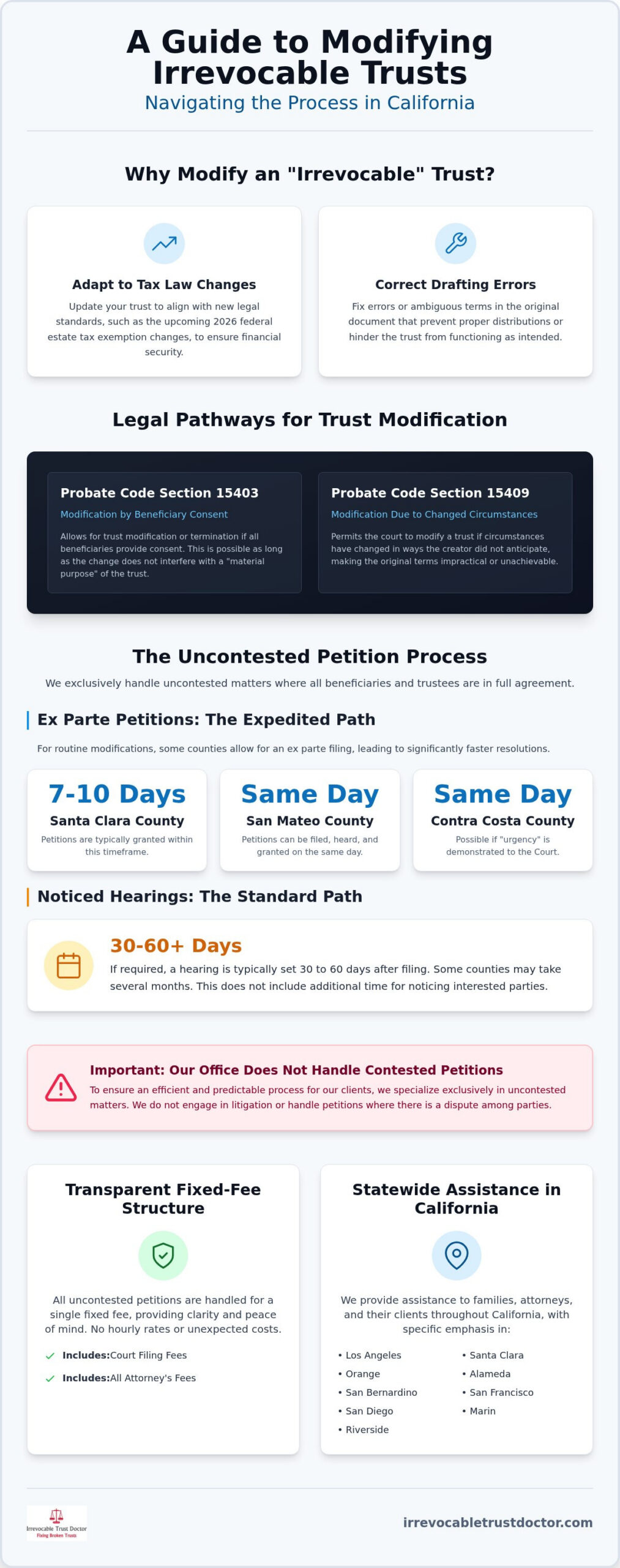
California provides two primary statutory routes for modification. Under Probate Code Section 15403, a trust can be modified if all beneficiaries consent, provided the change doesn’t interfere with a “material purpose” of the trust. If circumstances have changed in ways the person who created the trust didn’t anticipate, Probate Code Section 15409 allows the court to step in. Judicial modification is the court’s power to reform a trust to meet the settlor’s original intent. Whether you’re in San Francisco, San Diego, Riverside, or Marin County, these sections offer a remedy for dysfunctional trust terms. For a complete walkthrough of the statutory requirements and procedural steps, our guide on how to file a probate court petition to modify trust in California provides a detailed roadmap from start to finish.
The Step-by-Step Process for Filing an Irrevocable Trust Petition in California
The first step in resolving a dysfunctional trust is confirming that the matter is entirely uncontested. My office exclusively handles non-dispute matters where all beneficiaries and trustees are in full agreement. This consensus allows us to move forward with a court petition for trust amendment to fix drafting errors or address tax law changes. We prepare formal documentation tailored to the specific local rules of the county where the trust is administered, providing specialized assistance to families and attorneys in Los Angeles, Orange, and Riverside Counties.
Once the petition is drafted, we must determine if an ex parte application or a noticed hearing is appropriate. It is important to note that uncontested petitions are regularly filed ex parte in Santa Clara, San Mateo, and Contra Costa Counties. This expedited process is ideal for routine modifications that don’t require a full hearing. If the modification is more complex or the local court requires it, we will instead schedule a noticed hearing to ensure all legal requirements are met for clients in San Diego, Alameda, or Marin Counties.
Timelines for a court petition for trust amendment depend heavily on the county and the filing method chosen. In Santa Clara County, ex parte petitions are typically granted in 7 to 10 days. In San Mateo County, petitions can be filed, heard, and granted the same day; similarly, Contra Costa County petitions are often granted the same day if “urgency” is demonstrated to the Court’s satisfaction. If a noticed hearing is required, it is typically set 30 to 60 days after filing, or several months later in some counties, with additional time for notice to interested parties. All our petitions are handled for a fixed fee that covers both filing and attorneys’ fees. To determine the most efficient path for your situation, you can book a trust petition consultation today.
Navigating Fees and Choosing a Trust Modification Specialist in California
When you decide to move forward with a court petition for trust amendment, financial transparency is essential. Unlike litigation firms that often charge unpredictable hourly rates, my office operates on a fixed-fee basis for all uncontested petitions. This single fee covers both the mandatory court filing fees and all professional legal fees, ensuring you won’t face unexpected costs mid-process. By choosing a Certified Specialist in Estate Planning, Trust, and Probate Law, you benefit from decades of experience navigating the specific requirements of the Probate Code. This specialized expertise is vital when drafting the petition to ensure it aligns with the strict standards of California courts.
I don’t just work directly with families; I also serve as a specialist for other attorneys. Legal professionals in Los Angeles, Orange, or San Francisco Counties often refer their clients to me when a trust requires a modification under Probate Code Section 15403 or Probate Code Section 15409. Because my office does not handle contested petitions, we maintain a focused, administrative approach that prioritizes speed and clinical accuracy over courtroom conflict. You can view our transparent fixed fees and costs to see how we structure these services for families and their legal counsel.
Statewide Assistance for Families and Legal Professionals
My practice provides expert guidance for those needing a court petition for trust amendment across the entire state. Whether the trust is being administered in Riverside, San Bernardino, San Diego, Alameda, or Marin Counties, I handle the technical paperwork and filing requirements remotely. This statewide reach allows families to access high-level legal correction regardless of their local court’s complexity. When outdated distribution provisions are at the heart of the problem, our detailed resource on how to file a petition to change trust distribution California families rely on can help clarify the available legal options. For a more comprehensive look at the procedural steps involved, feel free to explore our guide on the California Probate Court trust petition process. This methodical approach ensures that every modification is legally sound and effectively resolves the underlying drafting or tax issues.
Take the Next Step Toward Trust Resolution
Irrevocable trusts don’t have to be permanent obstacles to your family’s financial health. By filing a court petition for trust amendment under Probate Code Section 15403 or Probate Code Section 15409, you can resolve drafting errors and adapt to new tax laws with clinical precision. From the 7 to 10 day turnaround in Santa Clara County to same-day grants in San Mateo and Contra Costa, the process is predictable when all parties agree. As a Certified Specialist, I provide these services for a fixed fee throughout Los Angeles, Orange, San Diego, and all other California counties. It’s important to remember that my office doesn’t handle contested petitions. If you’re ready to restore order to your estate plan, book a trust petition consultation today. You can move forward with confidence knowing your trust finally reflects your true intentions.
Frequently Asked Questions
Can an irrevocable trust be amended without going to court in California?
Yes, you can often modify a trust without a judge if the settlor (the person who created the trust) and all beneficiaries provide written consent under Probate Code Section 15404. However, if the settlor is deceased or the trust terms specifically require it, you must file a court petition for trust amendment. This formal legal request allows the Probate Court to approve changes that would otherwise be prohibited.
What happens if a beneficiary does not consent to the trust amendment?
If a beneficiary refuses to agree, the matter becomes “contested,” meaning there is a legal dispute. Because my office exclusively handles uncontested matters where everyone is in agreement, we don’t handle contested petitions. In these cases, you’d need to hire a litigation attorney to resolve the dispute through a contested court hearing, which typically takes significantly longer than an agreed-upon modification.
Does The Irrevocable Trust Doctor handle contested trust petitions?
No, my practice is dedicated to helping families and attorneys with uncontested modifications throughout the state, including Los Angeles, Orange, and San Diego Counties. I act as a specialist for non-dispute situations using Probate Code Section 15403 and Probate Code Section 15409. If your family or clients are in agreement, I can provide a methodical, fixed-fee solution to correct the trust terms.
How much does it cost to file a court petition for trust amendment in California?
I provide a transparent fixed-fee structure for every court petition for trust amendment. This single fee is designed to be predictable and covers both the court filing fees and all attorneys’ fees required to complete the process. This helps families in Riverside, San Bernardino, and Alameda Counties avoid the uncertainty of hourly billing while ensuring their legal paperwork is handled with clinical accuracy.
How long does it take to get a court order for a trust modification?
Timelines vary by county. Ex parte petitions (expedited requests) in Santa Clara County take 7 to 10 days, while San Mateo and Contra Costa Counties can offer same-day results. For a noticed hearing, the court typically sets a date 30 to 60 days after filing, or several months later in some counties, with additional time for notice to interested parties. Contested petitions take longer. If you’d like to understand the full scope of the probate court petition to modify trust California process, our dedicated guide covers each stage in detail.

Article by
Robert P. Bergman, Attorney at Law
Attorney Robert P. Bergman ("Bob Bergman") has been a Board-Certified Specialist in Estate Planning, Trust and Probate Law since 2011, as certified by the California State Bar Board of Legal Specialization. For several years, Bob has assisted families and the clients of other attorneys with obtaining court orders through trust modification petitions to make necessary modifications to existing irrevocable trusts. Bob is friendly, very approachable, and believes in explaining complex legal topics in clear ordinary language so that his clients understand exactly what they're doing and why they're doing it.
Bob is often able to assist clients throughout California who are in other counties than his home county of Santa Clara through his approach to trust modification petitions.