
Disclaimer
This article is for informational purposes only. Nothing in this article is intended to replace legal advice from a competent attorney or be considered legal guidance for anybody's specific legal situation. Nobody should rely on information in this article in making legal decisions without such consultation.
What if the "irrevocable" trust you’re managing isn’t actually permanent? It’s common to feel trapped by rigid language drafted decades ago, especially since the 2026 federal estate tax exemption of $15 million has made many complex trust structures obsolete. You probably want to fix these administrative burdens but worry about high hourly fees and court delays. Filing a probate court petition to modify trust California is the most direct path to resolution when a document no longer serves its purpose and all parties seek a better way forward.
In this guide, I’ll provide a clear roadmap for the modification process, including specific statutory grounds under Probate Code Sections 15403 and 15409. You’ll learn how to navigate the court system efficiently, even in counties with specific procedural timelines like Santa Clara or San Mateo. I’ll also explain how an uncontested approach can fix a broken trust quickly and affordably.
Key Takeaways
- Identify the specific legal grounds under the California Probate Code, including Sections 15403 and 15409, to determine if your trust’s outdated language qualifies for a court-ordered correction.
- Discover how to file a probate court petition to modify trust California as an uncontested matter to streamline the process and avoid the high costs of litigation.
- Learn why obtaining written consent from all beneficiaries is the critical first step to ensuring your petition remains a cooperative effort that judges can approve efficiently.
- Compare county-specific timelines and the procedural differences between a standard noticed hearing and the faster ex parte process for urgent trust modifications.
Understanding the California Probate Court Petition to Modify a Trust
A probate court petition to modify trust California is the formal legal mechanism used to update or terminate an irrevocable trust. While many feel trapped by the word "irrevocable," the state’s legal framework provides specific judicial pathways to ensure a trust remains functional. Common reasons for filing include fixing "broken" trust language, addressing outdated tax provisions, or reacting to changed family circumstances that make the original terms impractical. It’s a restorative tool designed to fix documents that no longer serve their intended purpose.
This process operates within the broader context of a U.S. Trust Law Overview, which balances the finality of a trust with the practical needs of beneficiaries. At The Irrevocable Trust Doctor, we focus exclusively on uncontested petitions where all parties are in agreement. If everyone is on the same page, we can bypass the stress of litigation and move directly toward a court-approved resolution.
Statutory Grounds Under Probate Code Sections 15403 and 15409
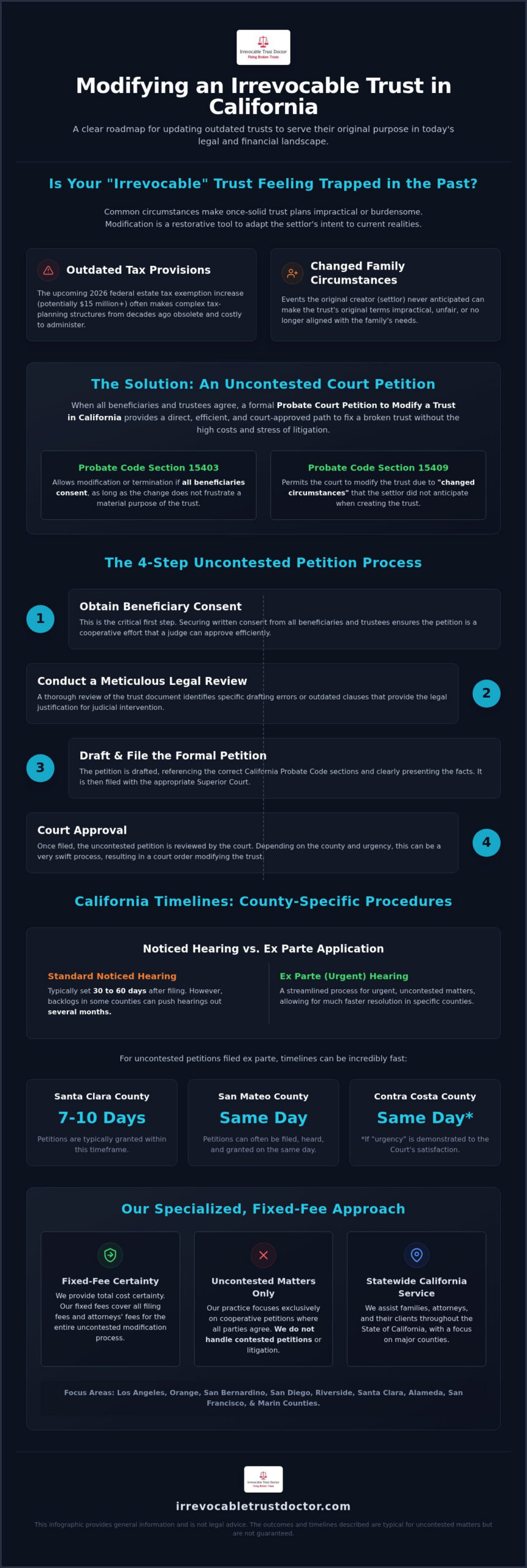
California law offers clear directions for these modifications. Probate Code Section 15403 allows for modification or termination when all beneficiaries consent, as long as the change doesn’t frustrate a material purpose of the trust. If the settlor didn’t anticipate certain events, Probate Code Section 15409 permits the court to step in due to "changed circumstances." For example, the 2026 federal estate tax exemption increase to $15 million often renders complex, older tax-planning structures unnecessary and burdensome.
Demonstrating Settlor Intent
To succeed, a petition must show that the modification aligns with the settlor’s original goals. We work to demonstrate that the proposed fix doesn’t violate the creator’s wishes but rather adapts them to current legal and financial realities. By proving that the settlor would have wanted these changes had they known of the new circumstances, we provide the court with the legal justification needed for approval.
Steps to Petition the Court for Trust Modification or Termination
To successfully petition the court, we begin with a meticulous legal review of the existing trust document. This identifies specific drafting errors or outdated tax clauses that justify judicial intervention. If all interested parties provide written consent, the petition qualifies as an uncontested matter, which significantly reduces complexity and minimizes the risk of a protracted legal battle. This cooperative approach is often the most efficient way to correct a document that’s become dysfunctional over time.
We then draft the formal probate court petition to modify trust in California, ensuring it references the correct California Probate Code on Trust Modification. This document must present supporting facts clearly to avoid judicial pushback or requests for further information. Once finalized, we file it in an appropriate Superior Court and pay the required filing fees. Accuracy at this stage is vital to prevent unnecessary delays in the court’s calendar.
The Role of a Certified Specialist in Estate Planning, Trust, and Probate Law
Navigating these rigorous requirements is simpler with an expert who understands the specific nuances of the local probate system. Robert P. Bergman, a Certified Specialist with experience since 1980, ensures every probate court petition to modify trust California meets the state’s high procedural standards. We offer specialized assistance for families and attorneys with trust modification petitions using a fixed-fee model that covers both filing and attorney costs. This provides total cost certainty for clients throughout the state, from Los Angeles to San Diego. If you’re ready to resolve a trust issue, you can schedule a consultation to review your case.
Timelines and County-Specific Procedures for California Trust Petitions
When you file a probate court petition to modify trust California, the speed of your resolution depends heavily on whether the matter is heard via a standard noticed hearing or an ex parte application. Noticed hearings are typically scheduled 30 to 60 days after the initial filing. However, administrative backlogs in various California counties can push these dates out several months, making advanced planning essential. For families facing time-sensitive issues, the ex parte process offers a streamlined alternative for urgent, uncontested matters.
The Irrevocable Trust Doctor focuses exclusively on uncontested petitions where all parties agree on the modification. We don’t handle contested litigation, as disputes can drastically extend timelines and increase costs. By ensuring beneficiaries are aligned before we step into the courtroom, we can often utilize expedited procedures that bypass the standard multi-month wait. You should schedule a trust petition consultation to determine the likely timeline for your specific jurisdiction.
Efficient Ex Parte Filings in Santa Clara, San Mateo, and Contra Costa Counties
Certain jurisdictions in Northern California offer remarkably efficient turnarounds for correctly prepared petitions. In Santa Clara County, an uncontested petition is typically granted in just 7 to 10 days. San Mateo County procedures often allow us to file, hear, and grant a petition on the same day. Similarly, Contra Costa County allows for same-day grants if we demonstrate sufficient urgency to the Probate Court. These county-specific efficiencies are a powerful tool for restoring a "broken" trust without the typical wait times found in general civil litigation.
Restoring Functionality to Your Irrevocable Trust
A "broken" trust doesn’t have to remain a source of stress. By utilizing specific judicial pathways in the California Probate Code, you can adapt an outdated document to current legal and financial realities. Filing a probate court petition to modify trust in California requires precise drafting and beneficiary consent, but the result is a functional trust that respects the settlor’s intent.
Our office provides statewide service with a fixed-fee model covering all filing and attorney costs. If you’re ready to fix your trust, Book Your Trust Petition Consultation with a Certified Specialist. Robert P. Bergman, a Certified Specialist in Estate Planning, Trust, and Probate Law, will help you find a clear path forward. You can move from uncertainty to resolution with confidence.
Frequently Asked Questions
How much does a probate court petition to modify a trust in California cost?
Our office utilizes a fixed-fee model for every uncontested probate court petition to modify trust California. This fee structure’s transparent and comprehensive, covering both the required court filing fees and all attorney fees. By removing the uncertainty of hourly billing, we ensure you’ll know exactly what to expect. If your matter’s uncontested, this approach provides the most predictable financial path to fixing a trust.
Can an irrevocable trust be changed if the settlor has already passed away?
Yes, an irrevocable trust can be modified even after the settlor’s death. California Probate Code Section 15409 allows the court to modify or terminate a trust if changed circumstances, which weren’t anticipated by the settlor, would defeat the trust’s purposes. This is frequently used to address outdated tax language or administrative provisions that don’t align with the current legal or financial environment.
What is the difference between Probate Code Section 15403 and Section 15409?
The primary difference lies in the legal justification for the modification. Probate Code Section 15403 is consent-based, requiring the agreement of all beneficiaries to modify or terminate the trust. In contrast, Probate Code Section 15409 is circumstance-based. It allows for judicial intervention when unexpected events occur, even if a beneficiary hasn’t provided consent, provided the modification supports the settlor’s original intent.
Does the Irrevocable Trust Doctor handle contested trust petitions?
No, we don’t handle contested trust petitions. If beneficiaries or trustees are in dispute, the process becomes a matter of general civil litigation, which we don’t handle. By specializing in cooperative petitions where all parties agree, we maintain a high level of efficiency. This focus allows us to navigate a probate court petition to modify trust California much faster than firms dealing with adversarial litigation.

Article by
Robert P. Bergman, Attorney at Law
Attorney Robert P. Bergman ("Bob Bergman") has been a Board-Certified Specialist in Estate Planning, Trust and Probate Law since 2011, as certified by the California State Bar Board of Legal Specialization. For several years, Bob has assisted families and the clients of other attorneys with obtaining court orders through trust modification petitions to make necessary modifications to existing irrevocable trusts. Bob is friendly, very approachable, and believes in explaining complex legal topics in clear ordinary language so that his clients understand exactly what they're doing and why they're doing it.
Bob is often able to assist clients throughout California who are in other counties than his home county of Santa Clara through his approach to trust modification petitions.