

Disclaimer
This article is for informational purposes only. Nothing in this article is intended to replace legal advice from a competent attorney or be considered legal guidance for anybody's specific legal situation. Nobody should rely on information in this article in making legal decisions without such consultation.
A trust error does not always require rewriting the entire document. To fix trust document errors in Los Angeles, an amendment may work if the trust’s terms allow a change, while a court petition may provide a path to correct an irrevocable trust that fails to reflect the settlor’s intent because of a mistake. The right approach depends on the trust’s status and evidence of the intended terms.
It’s understandable to want a clear answer before changing a document that directs how assets are managed or distributed. An attorney can review the trust and relevant records, identify whether an amendment or court-ordered modification may fit, and explain what the process involves.
This article explains how amendments differ from modification petitions, when a petition may help a Los Angeles trust, and how uncontested ex parte petitions can be filed in Santa Clara County for trusts located throughout California.
Key Takeaways
Review the trust’s amendment provisions to understand who may make changes and what formalities the document requires.
Learn how an amendment differs from a court petition, and what may happen when an irrevocable trust contains a mistake.
Understand how notice and agreement from interested parties can affect an uncontested petition and where it may be filed.
Spot common execution problems, such as missing signatures or failure to follow the trust’s stated amendment method.
Table of Contents
What are the benefits of amending a trust?
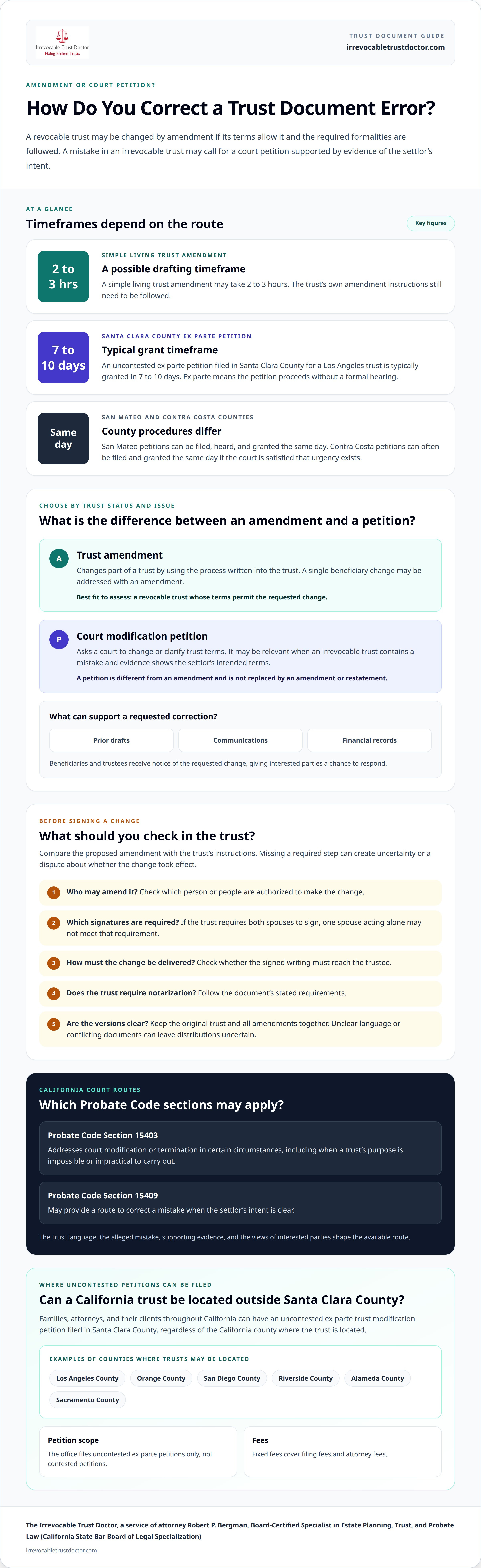
An amendment changes part of a trust; a restatement replaces the full document while retaining its original name and date. A single beneficiary change may call for an amendment, while several outdated provisions may be addressed in a restatement. For a revocable trust, review the amendment clause to see who may act, what signatures are required, and how the signed change must be delivered. Irrevocable trusts require a different legal analysis and may need a court petition.
A court petition asks a judge to change trust terms. It differs from an amendment, which follows the trust’s own procedure. If an irrevocable trust contains a drafting error, evidence of the settlor’s intent may support a petition in California Probate Court. Beneficiaries and trustees receive notice of the requested change, so interested parties can raise concerns. That notice gives them a chance to respond to the proposed action.
A simple living trust amendment may take 2-3 hours. An uncontested ex parte petition filed in Santa Clara County for a Los Angeles trust is typically granted in 7 to 10 days. Ex parte means the petition proceeds without a formal hearing.
An amendment or restatement is not a substitute for the court process required to modify an irrevocable trust. Incorrect changes can create conflicting terms or uncertainty about the settlor’s intent. Irrevocable trust modification is not a DIY problem: generic services cannot account for the nuances of a specific trust, its beneficiaries, and California’s statutory requirements.
How can a court modify a trust for a Los Angeles trust?
A court petition may address trust terms that an ordinary amendment cannot correct. For a Los Angeles trust, the legal basis, evidence, and agreement of interested parties shape the available route.
How Can a Court Change Trust Terms?
A trust modification petition asks a court to change or clarify trust provisions. According to the California Legislature, Probate Code Section 15403 addresses court modification or termination in certain circumstances, including when the trust’s purpose is impossible or impractical to carry out. Probate Code Section 15409 may provide a route to correct a mistake when the settlor’s intent is clear. Evidence can include prior drafts, communications, or financial records. Uncontested ex parte petitions may be filed in Santa Clara County for trusts located elsewhere in California. San Mateo petitions can be heard and granted the same day. Contra Costa petitions may also be granted that day when the court is satisfied that urgency exists. Fixed fees cover filing fees and attorney fees.
How Do You Choose Trust and Estate Counsel?
A qualified trust and estate attorney should assess the trust language, the alleged mistake, and evidence of the settlor’s intent. During a consultation, ask how the attorney will explain the petition’s legal basis, filing location, notice process, and expected court procedure. Confirm that the attorney can distinguish an uncontested ex parte matter from a contested petition. The office handles uncontested ex parte petitions only, not contested matters. Specialized knowledge of California trust modification petitions can help families and attorneys understand whether the evidence supports the requested change before taking action.
When is a trust amendment invalid or improperly executed in California?
An amendment may be invalid if it fails to follow the method stated in the trust. In California, the trust’s amendment provisions govern how its terms must be changed. If the document requires both spouses to sign, one spouse acting alone may not satisfy that requirement. A missing signature or failure to deliver the amendment as required can create a dispute over whether the change took effect.
Compare any proposed amendment with the trust’s instructions. Identify who may amend it, whether a signed writing must reach the trustee, and whether notarization is required. If the trust requires joint action, each required person must sign. Keep the original trust and all amendments together, since conflicting versions can leave trustees and beneficiaries uncertain about which terms apply.
Unclear language can cause problems, too. For example, an amendment might name a beneficiary but fail to explain which distribution term it replaces. A signed change that was not delivered as the trust requires may also face challenge. When families need to fix trust document errors in Los Angeles, the key question is whether the amendment followed the trust’s rules. A court considering reformation may review outside evidence, such as earlier drafts or communications showing the settlor’s intent. Trustees seeking to fix trust document errors in Los Angeles also need evidence that supports the proposed correction. These defects can leave asset distributions uncertain.
How can The Irrevocable Trust Doctor help with a trust modification petition?
The Irrevocable Trust Doctor, a service of attorney Robert P. Bergman, Board-Certified Specialist in Estate Planning, Trust, and Probate Law (California State Bar Board of Legal Specialization), helps families and their attorneys evaluate petitions to modify irrevocable trusts. A petition may be relevant when the trust’s terms no longer carry out the settlor’s intended purpose. The assessment focuses on the specific change requested and the facts supporting it.
A Trust Petition Consultation can help clarify the legal issue before a petition is prepared. Attorneys can use the consultation to discuss a client’s circumstances and consider whether the proposed court action addresses the identified problem.
The office assists families, attorneys, and their clients throughout California by filing uncontested ex parte trust modification petitions in Santa Clara County, regardless of the county where the trust is located. The Irrevocable Trust Doctor focuses on petitions to modify irrevocable trusts, not routine updates to revocable trusts.
To discuss your situation, contact The Irrevocable Trust Doctor.
Frequently Asked Questions
How can an attorney help change or correct a trust?
An attorney can compare the trust’s language with records showing what the settlor intended. For families seeking to fix trust document errors in Los Angeles, this review can help distinguish a possible drafting mistake from a change that must follow the trust’s amendment procedure. It can also identify who may be affected and whether their consent is required.
What Evidence Can Be Used to Prove a Mistake?
Evidence may include earlier drafts, communications with the drafting attorney, financial records, or witness testimony. A prior draft, for example, might name a beneficiary omitted from the signed trust. The relevance of each item depends on how clearly it supports the settlor’s intended terms. Records tied directly to the disputed provision can help explain the alleged mistake.
What Is Trust Reformation?
Trust reformation is a court’s correction of language that does not reflect the settlor’s intent. The requested wording must be supported by evidence, not simply by a beneficiary’s preference for different terms. If an inaccurate phrase conflicts with documented instructions, a court may consider whether correcting it would carry out the original intent.
What kinds of errors can be corrected in a trust document in California?
Possible errors include inaccurate wording, an omission, or language affected by fraud that prevents the trust from expressing the settlor’s intent. If you need to fix trust document errors in Los Angeles, identify the disputed provision and the evidence of the intended wording. A court evaluates the circumstances and proposed correction; not every disagreement is a drafting error.
Can an irrevocable trust be corrected or modified in California?
Yes. California law allows court modification or reformation of an irrevocable trust in certain circumstances, including when evidence supports a mistake or the trust’s purpose cannot be carried out as intended. The appropriate petition depends on the specific facts and legal basis. If interested parties disagree, the matter is contested, and the office described in this article handles uncontested ex parte petitions only.