
Disclaimer
This article is for informational purposes only. Nothing in this article is intended to replace legal advice from a competent attorney or be considered legal guidance for anybody's specific legal situation. Nobody should rely on information in this article in making legal decisions without such consultation.
What if an irrevocable trust’s wording doesn’t match what its creator intended? It’s understandable to worry that an irrevocable trust can’t be corrected. But a drafting mistake is different from a later change in circumstances, and that distinction can affect which court-supervised option may be appropriate. Correcting drafting errors in trusts starts with reviewing the complete document and supporting evidence, not assuming every unexpected result is a typo.
This article explains what records to organize and how California options under Probate Code Sections 15403 and 15409 may apply. I assist families, attorneys, and their clients throughout California with uncontested ex parte trust modification petitions filed in Santa Clara County, regardless of where the trust is located. Ex parte means the petition is handled without a formal hearing. Santa Clara County petitions are typically granted in 7 to 10 days, though no result is guaranteed. You’ll also learn what to expect from this process and when a matter may not fit this uncontested-petition practice.
Key Takeaways
- A possible drafting error means the written trust terms may not reflect the intended terms. A later wish to change the plan is a different issue.
- When reviewing a concern about correcting drafting errors in trusts, gather the signed trust, amendments, available drafts, and related records.
- Write a brief timeline showing when you noticed the concern and identify the wording that seems inconsistent.
- Uncontested ex parte petitions under Probate Code Sections 15403 and 15409 may be considered. Santa Clara County petitions are typically granted in 7 to 10 days, but approval is not guaranteed.
How to Recognize a Possible Drafting Error in an Irrevocable Trust
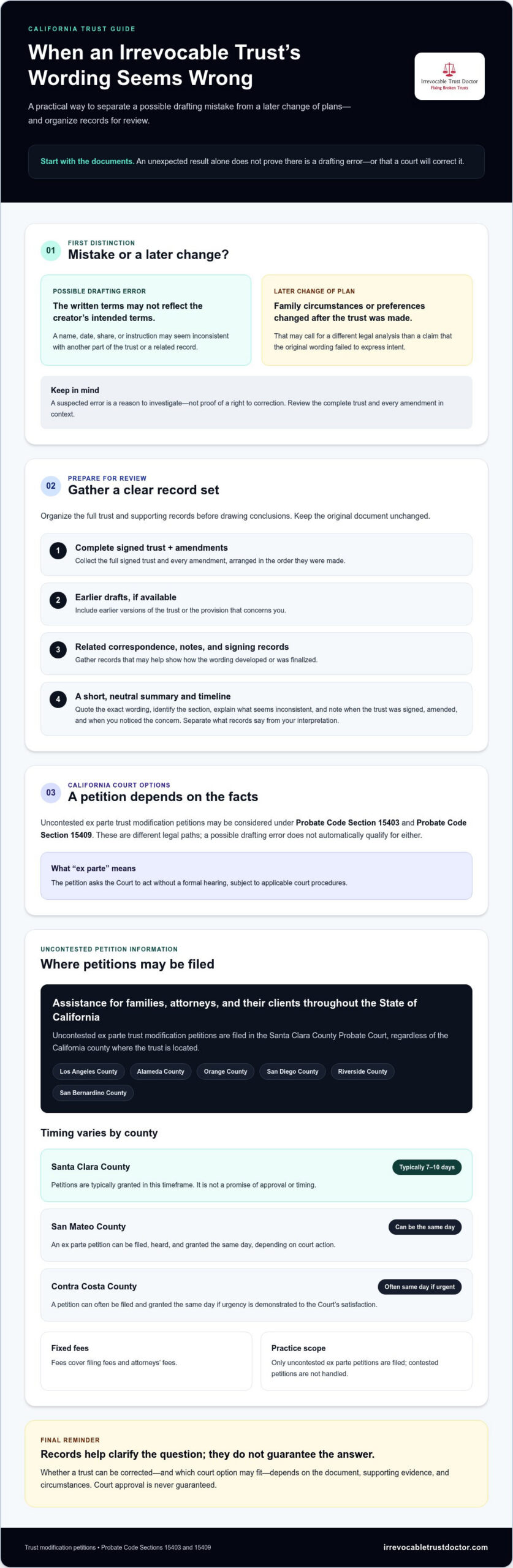
A suspected drafting error is a concern that the trust’s written terms may not reflect the terms its creator intended. It may arise when a name, date, share, or instruction seems inconsistent with another provision or related record. An unexpected outcome by itself does not show that the document contains a mistake. Review the wording in context, including the complete trust and every amendment.
It’s also important to distinguish a possible mistake made when the trust was prepared from a later wish to change the plan. If family circumstances have changed, or someone now prefers a different distribution, that may require a different legal analysis than a claim that the written language failed to express the original intent. A general overview of United States trust law discusses changing trust language to address a mistake. Whether a particular California trust can be corrected depends on its facts and applicable law.
Correcting Drafting Errors in Trusts: Is Unclear Wording a Mistake?
Not necessarily. Imagine a trust consistently names “Alex Morgan” as a beneficiary, but one paragraph appears to say “Alec Morgan.” That could be an apparent typo, though the complete document and surrounding facts still need review. By contrast, if a trust says a beneficiary receives “an appropriate share” without explaining what that means, the language may be unclear or incomplete. That alone doesn’t establish what the creator intended or prove that a court should revise it.
A suspected error is a reason to investigate, not proof of a right to correction. Before reaching a conclusion, compare the exact wording with the rest of the trust and related records. Identifying a possible error does not establish that a court will correct it.
What to Gather Before Seeking Correction of a Trust Drafting Error
A well-organized set of records can clarify what the trust says, when the concern arose, and what needs review. Start with the complete signed trust and every amendment, arranged in the order they were made. Don’t rely on a single page if other provisions could affect its meaning.
Which records can help clarify the trust’s wording?
Gather documents that may show how the wording developed or was finalized, if available:
- The executed trust and all amendments
- Earlier drafts of the trust or the provision in question
- Relevant correspondence or notes about the wording
- Documents related to signing or execution
Next, prepare a short, neutral summary. Identify the exact article or section, quote the wording that concerns you, and explain in plain language what seems inconsistent. For example: “Section 4 names one beneficiary, but the distribution schedule appears to refer to another.” Keep the original document unchanged rather than marking it up.
Add a concise timeline: when the trust was signed, when any relevant amendment was made, and when you first noticed the concern. Note what prompted the review, while keeping what the documents say separate from your interpretation. If you’re reading statutes alongside the records, California Probate Code § 15404 addresses a distinct trust-modification route. The provision relevant to a particular situation depends on its facts.
These records can help assess possible next steps, but they don’t guarantee that a court will approve a correction. To learn more about the review process, you can book a Trust Petition Consultation.
California Court Options for Correcting Trust Drafting Errors
A concern about trust wording may warrant review for a court petition, but the appropriate option depends on the trust and the facts. The firm evaluates uncontested ex parte trust modification petitions under Probate Code Section 15403 and Probate Code Section 15409. These provisions provide different legal paths. A possible drafting error does not automatically qualify for either, and a court’s decision cannot be guaranteed.
How the firm’s uncontested ex parte petition process works
“Ex parte” means asking the Court to act without a formal hearing, subject to applicable court procedures. I assist families, attorneys, and their clients throughout California with uncontested petitions filed in the Santa Clara County Probate Court, regardless of the county where the trust is located. For example, a trust located in Los Angeles County or Alameda County may be considered for filing in Santa Clara County if the matter fits this process.
Santa Clara County petitions are typically granted in 7 to 10 days, but that timing is not a promise of approval. In San Mateo County, an ex parte petition can be filed, heard, and granted the same day, depending on court action. In Contra Costa County, a petition can often be filed and granted the same day if the Court is satisfied that urgency has been demonstrated. Petitions filed in other counties often take several months to be heard.
The practice handles only uncontested ex parte petitions, not contested matters. If beneficiaries disagree or the matter is contested, it falls outside the services offered. Before seeking correction, organize the trust and supporting records, then assess whether the matter is uncontested and may fit the applicable petition process. For more detail, read the guide to the California Probate Court trust petition process.
Take the Next Step With a Clearer Picture
Correcting drafting errors in trusts begins with distinguishing a possible mistake in the written terms from a later change in wishes or circumstances. Gather the signed trust, amendments, available drafts, and a brief timeline identifying the wording that concerns you. These records can help assess whether an uncontested court petition may be an option, but they don’t guarantee a particular result.
Robert P. Bergman is a Certified Specialist in Estate Planning, Trust, and Probate Law. He assists families, attorneys, and their clients throughout California with uncontested ex parte petitions filed in the Santa Clara County Probate Court under Probate Code Sections 15403 and 15409, regardless of where the trust is located. Santa Clara County petitions are typically granted in 7 to 10 days, though approval isn’t guaranteed. Petition fees are fixed and cover filing fees and attorneys’ fees. The practice doesn’t handle contested petitions.
To discuss whether your situation may fit this process, book a trust petition consultation. A careful review can help you move forward with greater clarity.
Frequently Asked Questions
Is a drafting error in an irrevocable trust automatically correctable?
No. Correcting drafting errors in trusts depends on the trust’s wording, the surrounding facts, and whether a legal basis supports asking a court to act. A suspected mistake may require court review, not a handwritten change to the document. Before treating a proposed correction as effective, gather the signed trust and related records for legal review. A court’s decision isn’t guaranteed.
What records should I gather if I find a possible trust drafting error?
Start with the signed trust and every amendment. If available, also gather relevant drafts, correspondence, and documents related to signing. Note the exact section and wording that concerns you, then briefly explain in plain language why it seems inconsistent. Organizing these materials can help an attorney assess possible options, but having records does not establish that a court will grant a correction.
Can a California trust drafting error be addressed without a formal hearing?
Some uncontested petitions may be filed ex parte, meaning the request is made without a formal hearing, subject to court procedures. The Irrevocable Trust Doctor regularly files uncontested ex parte petitions in Santa Clara County under Probate Code Section 15403 and Probate Code Section 15409. Whether a petition qualifies and how the Court will rule depends on the specific matter and court review.
Does the trust have to be located in Santa Clara County to seek help?
No. The practice assists families, attorneys, and their clients throughout California with qualifying petitions filed in Santa Clara County, regardless of where the trust is located. This includes clients in the San Francisco Bay Area, Northern California, Southern California, the Central Valley, San Diego, Sacramento, Fresno, Bakersfield, Greater Los Angeles, Orange County, Riverside County, and San Bernadino County. Santa Clara County petitions are typically granted in 7 to 10 days, but timing and outcomes aren’t guaranteed.

Article by
Robert P. Bergman, Attorney at Law
Attorney Robert P. Bergman ("Bob Bergman") has been a Board-Certified Specialist in Estate Planning, Trust and Probate Law since 2011, as certified by the California State Bar Board of Legal Specialization. For several years, Bob has assisted families and the clients of other attorneys with obtaining court orders through trust modification petitions to make necessary modifications to existing irrevocable trusts. Bob is friendly, very approachable, and believes in explaining complex legal topics in clear ordinary language so that his clients understand exactly what they're doing and why they're doing it.
Bob is often able to assist clients throughout California who are in other counties than his home county of Santa Clara through his approach to trust modification petitions.