
Disclaimer
This article is for informational purposes only. Nothing in this article is intended to replace legal advice from a competent attorney or be considered legal guidance for anybody's specific legal situation. Nobody should rely on information in this article in making legal decisions without such consultation.
An irrevocable trust isn’t always beyond repair. The answer to “can an irrevocable trust be changed in California” is yes in some circumstances, including when beneficiaries agree or unforeseen circumstances affect the trust’s purpose under Probate Code Sections 15403 and 15409.
If outdated terms, tax concerns, or family disagreements are making a trust difficult to manage, you may be worried that changing it means a long court battle. This guide explains the available legal paths and how an uncontested ex parte petition, a request handled without a formal hearing, can provide a faster route to court approval. The Irrevocable Trust Doctor, a service of attorney Robert P. Bergman, Board-Certified Specialist in Estate Planning, Trust, and Probate Law (California State Bar Board of Legal Specialization), assists families, attorneys, and their clients throughout the State of California. Uncontested petitions filed in Santa Clara County are typically granted in 7 to 10 days, regardless of where in California the trust is located.
Key Takeaways
- “Irrevocable” generally means the person who created the trust can’t change it alone, but California law provides ways to seek a court-approved modification.
- Learn how to assess whether beneficiary agreement or changed circumstances may support a petition under the applicable Probate Code Sections.
- If a drafting mistake conflicts with the trust creator’s intent, identify the specific error and how correcting it could address the problem.
- Understand how an uncontested ex parte petition in Santa Clara County may offer a path for eligible trust modifications, including for families in other California counties.
Understanding Why Irrevocable Trusts Are Not Set in Stone
An irrevocable trust is generally designed so the person who created it, called the settlor, can’t revoke or change it alone. Families have traditionally used irrevocable trusts for goals such as tax planning and asset protection, but the trust’s terms still matter: a drafting error or a major life change can leave it unable to serve its intended purpose. General trust law principles help explain how a trust’s terms guide its administration, but California law also provides court procedures to address certain problems.
That’s why “irrevocable” doesn’t always mean “unchangeable.” A trust that no longer works as intended may be described as a “broken trust.” For example, a mistaken provision could conflict with the settlor’s documented intent, or circumstances the settlor didn’t anticipate could undermine the trust’s purpose. If you’re asking, “can an irrevocable trust be changed in California,” the answer may depend on the reason for the change and whether the legal requirements are met.
What legal grounds allow a trust change?
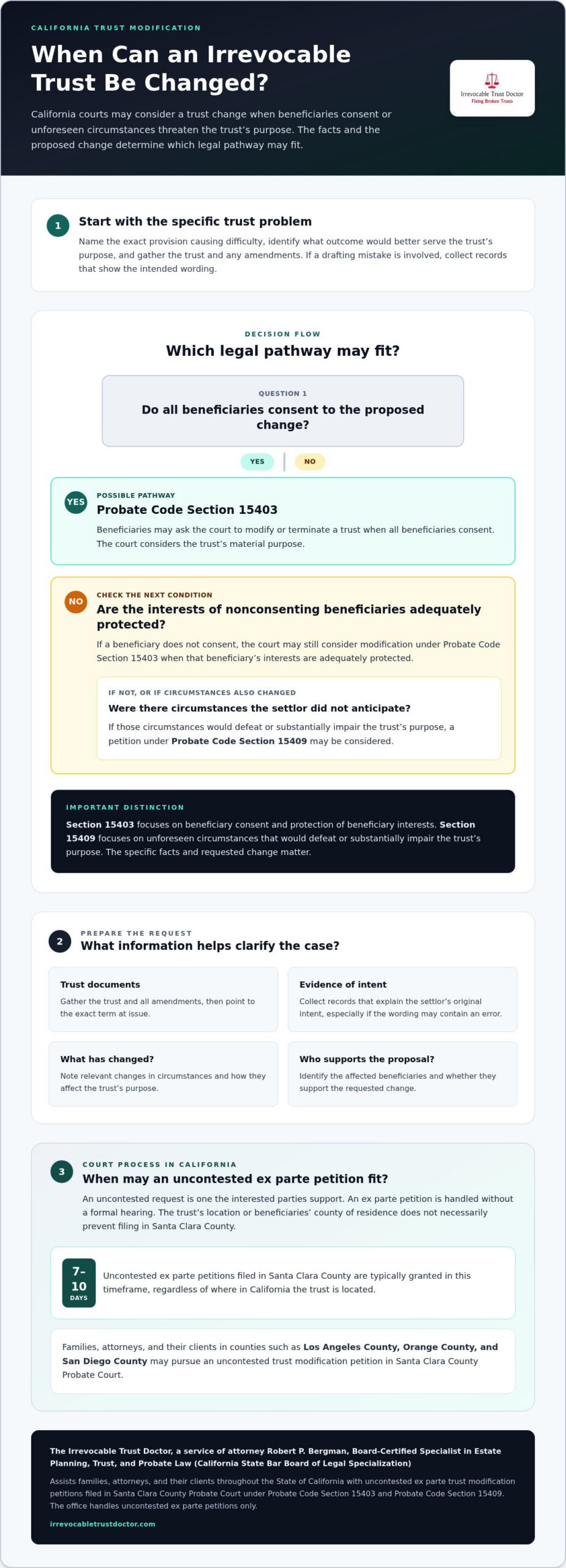
California Probate Code Sections 15403 and 15409 provide important court pathways. Under Probate Code Section 15403, beneficiaries may ask the court to modify or terminate a trust when all beneficiaries consent, subject to the court’s consideration of the trust’s material purpose. Probate Code Section 15409 addresses changed circumstances that the settlor didn’t anticipate and that would defeat or substantially impair the trust’s purposes.
California Probate Code Sections 15403 and 15409 serve as the primary legal gateways for families seeking to update or terminate an irrevocable trust through the court system.
To assess a possible petition, identify the specific term causing the problem, gather documents showing the original intent, and note what has changed. Beneficiary agreement and clear evidence of the trust’s purpose can help clarify which legal pathway may fit. As circumstances evolve, families often evaluate their ongoing financial planning and wealth management across different life stages with firms like zenithwealthgroup.asia.
Common Reasons and Methods for Modifying a California Trust
A trust may need attention when its wording no longer matches the settlor’s intent or circumstances have changed. A “scrivener’s mistake” is a clerical or drafting error, such as a name or provision copied incorrectly. If the error affects how the trust operates, records showing the intended wording can help explain why a court-ordered correction may be appropriate.
Other concerns may include trust terms that no longer fit a beneficiary’s needs, a named trustee who can’t serve, or tax-planning goals that warrant review as laws and circumstances evolve. For tax questions, consult IRS guidance on Estate Tax and Irrevocable Trusts. A proposed change should address the trust’s specific purpose, not assume that a tax update automatically justifies modification.
How do beneficiary consent and changed circumstances differ?
Probate Code Section 15403 focuses on beneficiary consent. If every beneficiary agrees, that may support a petition; if a beneficiary doesn’t consent, a court may still consider modification when the nonconsenting beneficiary’s interests are adequately protected. Probate Code Section 15409 instead addresses unforeseen circumstances that would defeat or substantially impair the trust’s purpose. The facts and requested change determine which route may fit.
Before pursuing either path, gather the trust and amendments, identify the exact provision at issue, and collect relevant records of intent or changed circumstances. Families and attorneys can review the trust petition fees and costs as they consider an uncontested petition. If you need help assessing a proposed change, a Trust Petition Consultation can help clarify the next steps.
The Faster Way to Modify Your Trust: The Santa Clara County Advantage
A trust’s location or the beneficiaries’ county of residence doesn’t necessarily prevent a petition from being filed in Santa Clara County. Families and their local attorneys in Los Angeles County, Orange County, and San Diego County can work with our office on an uncontested trust modification petition in Santa Clara County Probate Court without traveling to San Jose. The process is available to families, attorneys, and their clients throughout the State of California.
Why choose an uncontested ex parte petition?
An uncontested petition is suited to a requested change that the interested parties support. Our office handles uncontested petitions, allowing the court to consider an agreed-upon request rather than a dispute between beneficiaries. If parties disagree, this process may not be appropriate. Before moving forward, gather the trust and amendments, identify who is affected, and clarify whether they support the proposed change.
Uncontested petitions may also be filed in San Mateo County. In Contra Costa County, same-day filing and approval can often be possible if the court is satisfied that urgency has been demonstrated. To discuss whether your trust may qualify for an uncontested petition, contact the Irrevocable Trust Doctor or arrange a Trust Petition Consultation.
Move Forward With a Clear Trust Modification Plan
The next step is to turn a concern about trust wording into a specific, supportable request. Before deciding whether can an irrevocable trust be changed in California in your situation, gather the trust and any amendments, identify the provision causing difficulty, and note what outcome would better serve the trust’s purpose. A focused review can help clarify whether a petition is an appropriate path.
Robert P. Bergman is a Certified Specialist in Estate Planning, Trust, and Probate Law. Families, attorneys, and their clients in Riverside County and San Bernardino County can seek help with an uncontested trust modification petition without traveling to San Jose. If you’re ready to discuss the issue and possible next steps, schedule a Trust Petition Consultation with Robert P. Bergman. A clear plan can make a difficult trust issue feel more manageable.
Frequently Asked Questions
Can an irrevocable trust be changed in California after the settlor has died?
Yes, it may still be possible after the settlor’s death. The key is to show why the requested change is legally supportable and how it relates to the trust’s purpose. Gather the signed trust, amendments, and relevant records of the settlor’s intentions, such as correspondence or notes, so the basis for the proposed change can be assessed.
How long does it take to modify a trust through the California Probate Court?
There isn’t one fixed timeline for every petition. The court, the petition’s circumstances, and whether interested parties have provided the required agreement or other information can affect the schedule. To prepare, organize the complete trust documents, identify everyone whose interests may be affected, and resolve questions about the requested change before filing.
Do all beneficiaries have to agree to change an irrevocable trust in California?
No, unanimous agreement isn’t required in every possible case. A disagreement may affect which legal basis applies and what the court needs to consider. For example, if one beneficiary objects, clearly document the objection and explain how the proposed change affects that person’s interests. Don’t assume the disagreement automatically ends the possibility of a petition.
Can I change an irrevocable trust without going to court?
For a substantive change to an irrevocable trust, don’t assume that a private agreement or handwritten amendment will be effective. The trust’s terms and the reason for the change matter, and court approval may be needed. Before anyone relies on revised wording, identify the exact provision involved and determine what legal authority supports changing it.

Article by
Robert P. Bergman, Attorney at Law
Attorney Robert P. Bergman ("Bob Bergman") has been a Board-Certified Specialist in Estate Planning, Trust and Probate Law since 2011, as certified by the California State Bar Board of Legal Specialization. For several years, Bob has assisted families and the clients of other attorneys with obtaining court orders through trust modification petitions to make necessary modifications to existing irrevocable trusts. Bob is friendly, very approachable, and believes in explaining complex legal topics in clear ordinary language so that his clients understand exactly what they're doing and why they're doing it.
Bob is often able to assist clients throughout California who are in other counties than his home county of Santa Clara through his approach to trust modification petitions.