

Disclaimer
This article is for informational purposes only. Nothing in this article is intended to replace legal advice from a competent attorney or be considered legal guidance for anybody's specific legal situation. Nobody should rely on information in this article in making legal decisions without such consultation.
Yes, beneficiaries can sometimes agree to change an irrevocable trust, but their agreement alone may not be enough. Whether they can change a trust depends on its terms and the law that governs it. After the grantor’s death, a change may be possible through an agreement or court process.
It’s understandable to think everyone’s consent settles the matter, but trust documents and state rules can limit what beneficiaries may change. Whether beneficiaries can agree to change a trust depends on those rules. This article explains when an agreement may work, what can affect a proposed change after the grantor dies, and how California’s process differs.
Key Takeaways
Start by reading the trust terms and identifying the state law that governs it; beneficiary agreement alone may not authorize a change.
After the grantor’s death, an agreement may be possible, but the proposed change can be limited by the trust’s purpose and applicable law.
If agreement isn’t enough, a beneficiary or successor trustee may be able to petition a court, which decides whether the requested change is allowed.
Before pursuing a modification, consider how the trust’s provisions and the proposed change may affect beneficiaries and tax consequences.
Table of Contents
Can an Irrevocable Trust Be Changed?
An irrevocable trust generally cannot be changed by its grantor unless its terms or applicable law allow it. A court petition may provide another route, but a judge decides whether the requested change is permitted.
Petitions to Modify or Terminate a Trust
A court petition is a formal request asking a judge to modify or terminate trust terms. A beneficiary or successor trustee may petition, and the judge decides whether to grant the request.
The court may consider whether the original instructions are impossible or impractical to carry out. A mistake, changed circumstances, or unmet tax objectives may also matter. A petition should identify the provision at issue, explain the problem, and propose a specific change. For example, if a direction cannot be carried out as written, the request can ask the court to approve a workable alternative.
Beneficiary Consent and Court Approval
Beneficiary agreement can support a proposed change, but it doesn’t automatically make that change effective. Interested parties may ask a court to approve an agreement, and the judge can review its terms and any objections.
Before seeking approval, identify the affected beneficiaries and the specific provisions they support changing. An objecting beneficiary may raise concerns about the trust’s purpose or the effect on their interest. The court’s decision depends on the trust terms and applicable state law.
Minor, unborn, or unlocated beneficiaries raise a separate question: how will their interests be represented? The governing law and trust terms affect that process. Their silence shouldn’t be treated as agreement.
Changing or ending a trust can create adverse income, gift, or generation-skipping tax consequences. The proposed change’s effect on distributions and beneficiaries’ interests matters, so consult an attorney before relying on consent alone.
Trust modification after the grantor’s death
After a grantor dies, a revocable trust generally becomes irrevocable. Beneficiary consent may support a change, but state law and the trust’s purpose set limits.
Nonjudicial Modification Agreements
A nonjudicial modification agreement is a written arrangement to change trust terms without first asking a court. Where applicable state law permits, it may offer a path after the grantor’s death.
In some states, the trustee and current and remainder beneficiaries must agree, and the grantor’s material purposes generally cannot be changed without the grantor’s participation. Before signing, identify the proposed amendment, affected interests, and any possible tax consequences.
State-Law Variation
State law determines which nonjudicial changes are permitted and who must consent. A process available in one state may not apply to a trust governed by another state’s law.
Some states allow agreement on certain provisions, while others may require court approval. Read the governing-law clause and trust terms first, then assess whether the proposed change preserves the trust’s purpose. The location of the assets alone may not determine which rules apply.
Uniform Trust Code Provisions
The Uniform Trust Code is a model framework, not a nationwide rule giving beneficiaries unrestricted power to amend a trust. States may adopt different provisions or enact their own statutory processes.
Where state law allows a nonjudicial settlement agreement, its terms generally must not violate a material purpose and must be terms a court could approve. Identify the state’s enacted rules before treating unanimous consent as sufficient.
Changes That Conflict With Trust Purpose
Beneficiaries generally cannot rely on agreement alone to make a change that defeats the trust’s material purpose. That purpose may explain why the grantor restricted distributions or preserved assets for later beneficiaries.
Compare the proposed change with the original terms and the interests it affects. If the change could undermine the trust’s purpose, a court may need to assess it. A trust petition consultation can help evaluate whether a court petition is relevant.
State law and trust-document requirements
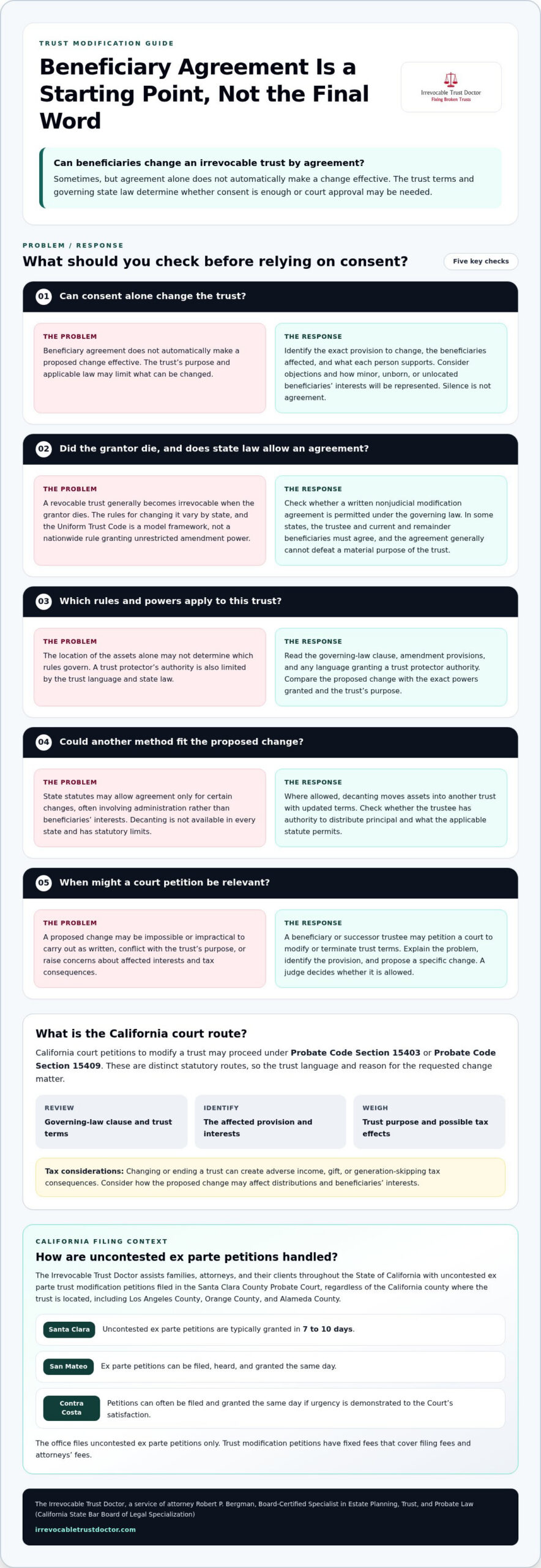
Start with the trust’s governing-law clause and amendment provisions. Those terms, along with applicable state law, determine whether beneficiaries can agree to update an irrevocable trust. The trust’s location alone may not identify which rules govern.
Next, check whether the document grants specific powers to a trust protector. The agreement may authorize that person to amend administrative provisions, appoint or remove fiduciaries, or change beneficiaries. State law can regulate those powers and how they’re exercised. A protector’s authority is not unlimited, so compare the proposed change with the exact language granting that power.
State statutes may also provide routes for trustee and beneficiary agreement. Some allow unanimous agreement for certain changes, generally involving administration rather than beneficial interests. Decanting is another possible method in states that permit it. It involves moving assets into another trust with updated terms, but the trustee generally needs authority to distribute principal. Statutory limits determine what may change.
In California, court petitions to modify a trust may proceed under Probate Code Section 15403 or Probate Code Section 15409. Those provisions offer distinct statutory routes, so the trust language and reason for the requested change matter. An attorney can compare the proposed update with the applicable section and the trust’s purpose.
Before seeking agreement, identify the governing-law clause, relevant powers, affected provisions, and the specific change requested. Major events, such as the grantor’s death, may affect who holds authority. Discuss your trust modification questions to assess which route fits the trust and circumstances.
The Irrevocable Trust Doctor: Irrevocable Trust Modification Petition
The Irrevocable Trust Doctor, a service of attorney Robert P. Bergman, Board-Certified Specialist in Estate Planning, Trust, and Probate Law (California State Bar Board of Legal Specialization), assists families, attorneys, and their clients with uncontested trust modification petitions in California. This may be a practical next step when the trust terms or beneficiary agreement call for court approval under Probate Code Section 15403 or Probate Code Section 15409.
A court petition may be an option for seeking a trust modification, depending on the trust terms and applicable law. The procedure for an ex parte petition may differ from that of a formal hearing. The Irrevocable Trust Doctor handles uncontested petitions, meaning this route is for cases where the requested change is not opposed.
A Trust Petition Consultation can help clarify whether a court petition fits the trust’s terms and circumstances. For an uncontested modification, an Irrevocable Trust Modification Petition addresses the court process itself.
Contact The Irrevocable Trust Doctor to discuss an uncontested trust modification petition.
Prepare for a Clear Next Step
A proposed trust change can affect beneficiaries’ decisions and interests over time. Focus on the outcome the change is meant to achieve, not just the wording you hope to revise.
Whether beneficiaries can agree to change a trust depends on its terms and governing law. Treat agreement as one part of the decision, and consider how the proposed result fits the trust’s broader purpose.
A careful, deliberate approach can help families move from uncertainty toward an informed decision. Keep the focus on clarity, fairness, and the trust’s intended role for everyone affected.
Frequently Asked Questions
When Should You Modify Your Trust Document?
Review a California living trust every 3-5 years, after major life events, and when California or federal laws change. A marriage, a new child, or a death in the family may affect who should receive assets. Compare the trust’s current instructions with your intended arrangements, then identify the specific provisions that may need updating.
Can all beneficiaries agree to modify or terminate a trust under U.S. law?
Whether beneficiaries can agree to change a trust depends on the governing state’s law and the trust terms. A nonjudicial agreement may require the trustee and current and remainder beneficiaries to consent, while some states also require the settlor’s consent. Agreement alone may not suffice if the proposed terms conflict with a material purpose or could not be approved by a court.
Can beneficiaries modify an irrevocable trust without the settlor’s consent?
Whether beneficiaries can agree to change a trust without the settlor’s consent depends on state law, trust language, and the proposed change. A state may allow an agreement without settlor consent, yet generally restrict changes to the trust’s material purpose if the settlor doesn’t participate. Check whether the document grants a trust protector specific amendment powers, and distinguish administrative adjustments from changes to beneficiaries’ interests.
What is the difference between modifying and terminating a trust by beneficiary agreement?
Modification changes particular trust terms while leaving the trust in place; termination ends the trust rather than revising selected provisions. For example, beneficiaries might seek a new distribution arrangement while preserving the trust, or propose ending it and distributing its remaining assets. The agreement’s legal effect depends on governing law, trust terms, and whether the proposed result is permitted.
Can beneficiaries change a trust’s distribution terms or replace the trustee?
Beneficiaries can’t assume their agreement alone lets them change distributions or replace a trustee. The trust may give a trust protector authority to alter certain beneficiary provisions or appoint and remove fiduciaries. A trustee generally follows the trust’s instructions unless the document, a court, or an agreement provides otherwise. Review the exact grant of power before proposing a change.