
Disclaimer
This article is for informational purposes only. Nothing in this article is intended to replace legal advice from a competent attorney or be considered legal guidance for anybody's specific legal situation. Nobody should rely on information in this article in making legal decisions without such consultation.
The word "irrevocable" is the most misunderstood term in California estate law, often leading families to believe they’re trapped in a trust that no longer fits. You’ve likely felt frustration over outdated terms or feared that 6 month backlogs in Los Angeles or Orange County make changes impossible. It’s a common fear, but the law provides a remedy when the person who created the trust and the beneficiaries agree. By utilizing California Probate Code 15404, you can legally modify or terminate an irrevocable trust with speed and predictability.
I’ll show you how to secure a court order without the delays found in San Bernardino, Riverside, or San Diego. Filing an uncontested ex parte petition in Santa Clara County is the best path for families in Alameda, San Francisco, Marin, or Ventura. These are typically granted in 7 to 10 days for a fixed fee, providing a fast resolution across the State of California.
Key Takeaways
- California Probate Code 15404 allows for the modification or termination of an irrevocable trust when the settlor and all beneficiaries agree. This provides a clear legal path to adjust trust terms that are no longer practical or efficient.
- You can use this process to correct drafting mistakes or update trust language to comply with new 2026 regulations in the State of California. It serves as a diagnostic tool to restore a trust to its intended purpose.
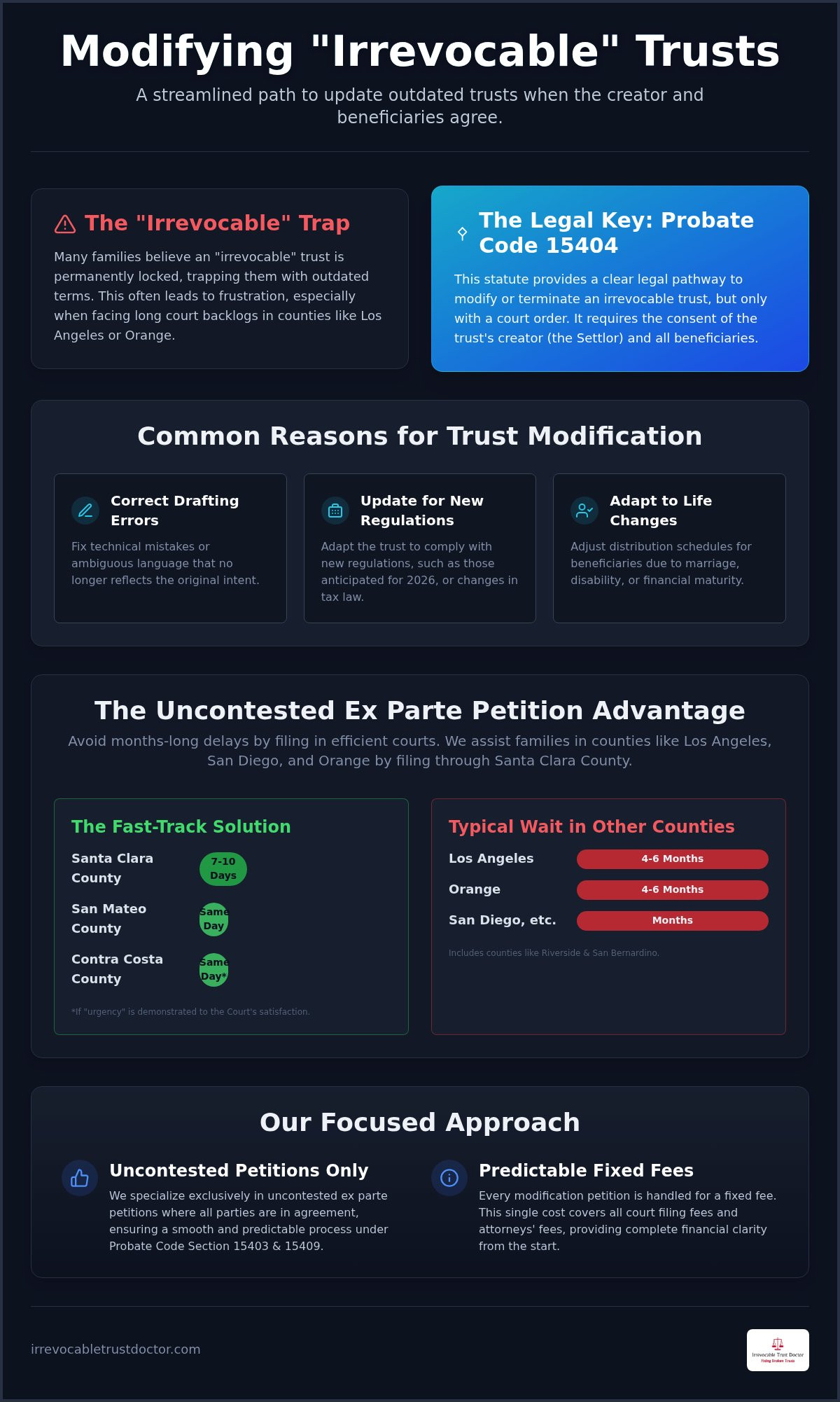
- Filing an uncontested ex parte petition in Santa Clara County typically results in a court order within 7 to 10 days. This is a significant advantage over the long backlogs found in Los Angeles, Orange, San Bernardino, and Riverside counties.
- Every Irrevocable Trust Modification Petition is filed for a fixed fee that covers both the court filing fees and the attorneys’ fees. This model provides financial clarity for families in San Diego, Alameda, San Francisco, Marin, and Ventura.
Understanding California Probate Code Section 15404 in California
California Probate Code 15404 serves as a vital tool for families who find themselves bound by the rigid terms of an outdated document. In the context of Trust law, this statute provides a specific pathway to modify or terminate an irrevocable trust, provided the "Settlor"-the person who created the trust-is still alive and consenting. While Probate Code Section 15409 focuses on changed circumstances after a death, Section 15404 requires the Settlor’s active participation.
The code is divided into two primary categories. Under Section 15404(a), a trust can be modified if the Settlor and all beneficiaries agree. If only some beneficiaries agree, Section 15404(b) allows for modification as long as the interests of the non-consenting parties aren’t "substantially impaired." Actionable Tip: Don’t rely on a simple written agreement. Even with 100% consent, a formal court order is necessary to shield the Trustee from future liability and ensure financial institutions in counties like San Diego, Marin, or Ventura accept the changes. Using California Probate Code 15404 correctly requires understanding this distinction between total and partial consent.
When Court Approval is Required Under Section 15404(b)
Families in San Francisco or Alameda often face situations where a beneficiary is a minor or cannot be located. In these cases, the State of California requires a formal petition to satisfy the "Substantial Impairment" test. The Court must determine that the modification doesn’t unfairly harm those who didn’t consent. For minor or unborn beneficiaries, the Court will typically appoint a Guardian Ad Litem to represent their interests. This process ensures the modification is legally binding and avoids the long delays common in Los Angeles, Orange, San Bernardino, or Riverside by utilizing the fast-track options in Santa Clara County for uncontested matters.
When to Use Probate Code Section 15404 in California for Trust Modification
Families in Los Angeles, Orange, or San Diego often discover that a trust written decades ago no longer functions as intended. Whether it’s a technical drafting error or a shift in the California Probate Code – PROB § 15404 landscape, these issues are fixable while the Settlor is alive. In 2026, many are updating language to account for new State of California regulations or tax law adjustments. If a beneficiary’s life circumstances change, such as through marriage, disability, or newly found financial maturity, you can use California Probate Code 15404 to adjust distribution schedules to better protect their inheritance.
Sometimes a trust becomes uneconomical to maintain. If administrative costs exceed the benefits, the Settlor and beneficiaries in Ventura, Marin, Alameda, or San Francisco can agree to terminate it entirely. We specialize in these uncontested matters, filing them as ex parte petitions in Santa Clara County where grants are typically issued in 7 to 10 days. This allows you to bypass the 4 to 6 month delays found in Riverside or San Bernardino. Our fixed fees cover both filing and attorneys’ fees, ensuring financial predictability.
Modernizing Outdated Trust Provisions in 2026
Modern planning requires more flexibility than older documents provide. You can add powers like a Power of Appointment to give beneficiaries more control over future distributions. For a detailed walkthrough, see How to Fix an Irrevocable Trust in California: A Step-by-Step Guide in California. Actionable Tip: Review your trust for "poison pill" provisions, like overly restrictive investment clauses, that can be removed while the Settlor can still consent. If you’re ready to proceed, you can schedule a consultation to begin the process.
The Fast-Track Ex Parte Petition Process in the State of California
While many legal practitioners expect probate matters to drag on for months, we utilize a specialized fast-track approach for uncontested petitions. If you file a standard petition in Los Angeles, Orange, or San Diego, you’ll likely face a 4 to 6 month wait just for a hearing. However, by filing an ex parte petition in Santa Clara County, we typically secure a grant in just 7 to 10 days. This efficiency is based on the specific legal framework of California Probate Code Section 15404. For matters requiring even greater speed, petitions in San Mateo County or Contra Costa County can often be filed and granted the same day, provided "urgency" is demonstrated to the Court’s satisfaction.
Transparency is a cornerstone of our practice. When we handle a petition under California Probate Code 15404, we offer a fixed-fee model that you can review on our page regarding Fees and Costs in California. These fees cover both the court filing fees and the attorneys’ fees, so there are no surprises for families in Alameda or San Francisco.
Serving Families and Attorneys Throughout the State of California
We act as a specialized resource for both families and fellow attorneys across the State of California. We frequently collaborate with local counsel in Ventura, Marin, and San Bernardino to expedite their clients’ modifications. It’s vital to understand that we exclusively handle uncontested ex parte petitions. If your matter involves litigation or conflict, it doesn’t fit our specific fixer model for California Probate Code 15404. Actionable Tip: Don’t wait several months for a backlogged hearing in Riverside. Ask us about filing an uncontested ex parte petition in Santa Clara County to resolve your trust issue in a fraction of the time.
Take the Next Step to Resolve Your Irrevocable Trust
You now understand that "irrevocable" doesn’t mean unchangeable when the Settlor and beneficiaries work together. By applying California Probate Code 15404, you can correct drafting errors or update trust terms to meet the needs of 2026. This process bypasses the frustrating 4 to 6 month delays in Los Angeles, Orange, and Riverside. Instead, our office utilizes the efficiency of Santa Clara County, where uncontested ex parte petitions are typically granted in 7 to 10 days. This fast-track option is available to families in San Diego, San Bernardino, Alameda, San Francisco, Marin, and Ventura.
We provide a clear path forward with fixed fees that cover both court costs and legal fees. If you’re ready for a legally binding resolution, Book a Trust Petition Consultation with a Certified Specialist. You can restore order to your estate plan quickly and professionally within the State of California.
Frequently Asked Questions
How long does a 15404 petition take in Santa Clara County?
A petition filed under California Probate Code 15404 in Santa Clara County is typically granted within 7 to 10 days. This timeline is significantly faster than the 4 to 6 month wait times often found in Los Angeles, Orange, or San Diego. By utilizing an uncontested ex parte process, we help families in Riverside and San Bernardino avoid lengthy court backlogs to achieve a rapid resolution.
Can I use Probate Code Section 15404 if the settlor has passed away?
No, you can’t use this specific section if the settlor is deceased. California Probate Code 15404 requires the active consent of both the settlor and the beneficiaries. If the settlor has passed away, families in Ventura or Marin should look toward Probate Code Section 15403 or 15409 to modify an irrevocable trust. These sections allow for modifications based on beneficiary consent or changed circumstances.
Do all beneficiaries have to agree to a modification under Section 15404?
Not necessarily, though total consent is preferred for a smoother process. Under Section 15404(a), all beneficiaries must agree for a full modification. However, Section 15404(b) allows for modification with only partial consent if the court determines the interests of non-consenting beneficiaries aren’t substantially impaired. This is a vital distinction for families in San Francisco or Alameda dealing with minor or unborn beneficiaries.
What is the difference between Probate Code 15403 and 15404 in California?
The primary difference lies in the settlor’s involvement and status. California Probate Code 15404 is used when the settlor is alive and agrees to the change. In contrast, Probate Code Section 15403 is utilized when all beneficiaries agree to a modification but the settlor is either deceased or does not participate. Both pathways are effective for families in San Diego or Orange County seeking an uncontested resolution.
What does ‘uncontested ex parte’ mean in the State of California?
In the State of California, "uncontested" means that all relevant parties agree with the petition and no one is fighting the change. "Ex parte" refers to a fast-track court procedure where a judge hears the matter without the standard long-term notice period. We specialize in these matters to help clients in Los Angeles and San Bernardino obtain court orders in days rather than several months.

Article by
Robert P. Bergman, Attorney at Law
Attorney Robert P. Bergman ("Bob Bergman") has been a Board-Certified Specialist in Estate Planning, Trust and Probate Law since 2011, as certified by the California State Bar Board of Legal Specialization. For several years, Bob has assisted families and the clients of other attorneys with obtaining court orders through trust modification petitions to make necessary modifications to existing irrevocable trusts. Bob is friendly, very approachable, and believes in explaining complex legal topics in clear ordinary language so that his clients understand exactly what they're doing and why they're doing it.
Bob is often able to assist clients throughout California who are in other counties than his home county of Santa Clara through his approach to trust modification petitions.