
Disclaimer
This article is for informational purposes only. Nothing in this article is intended to replace legal advice from a competent attorney or be considered legal guidance for anybody's specific legal situation. Nobody should rely on information in this article in making legal decisions without such consultation.
A parent’s death doesn’t, by itself, give an heir authority to end an irrevocable trust. All beneficiaries may petition a court to modify or terminate the trust under Probate Code Section 15403, subject to limits if the change would defeat a material purpose, according to the California Legislature. A petition to terminate a trust in San Bernardino County may also be available to a trustee or beneficiary when unanticipated circumstances substantially impair the trust’s purposes under Probate Code Section 15409.
It’s understandable to think that once both parents have passed away, the family should be able to change how the trust works. But eligibility to petition and the legal grounds for granting a request are separate questions.
This article explains who may seek a trust change, when beneficiaries may act together or individually, and what legal grounds can support early termination. You’ll also learn why the trust’s terms and purpose matter when heirs are considering what to do next.
Key Takeaways
- After both parents have passed away, heirs still need to identify who has authority to petition and what grounds support changing or ending the trust.
- Consider whether all beneficiaries agree, because unanimous support and the trust’s material purpose can affect a court’s decision.
- Review the trust’s terms and administration costs to understand whether a legal ground for early termination may apply.
- Learn how an uncontested trust modification petition may provide a court-based path when the trust’s circumstances call for a change.
Can I force termination of my parents’ trust now that they’ve both passed away?
Not automatically. An heir may ask the court to approve a change, but a parent’s death alone does not end an irrevocable trust or give one beneficiary authority to terminate it.
How Can You Petition to Modify or Terminate a Trust?
A court petition asks a judge to change or end an irrevocable trust under applicable California law. It matters because the trust document may continue to control assets after both parents have died. Under Probate Code Section 15403, a court must find good cause to terminate a trust with a valid restraint on transfer. The court also considers whether termination serves all parties’ best interests.
What Does Filing a Court Petition Involve?
Filing means submitting a written request to the court, explaining the proposed change, and providing supporting evidence. Start by reviewing the trust document, noting its termination terms, and listing the assets it still holds. Explain how the trust’s current operation affects beneficiaries and why termination is requested. If beneficiaries disagree, a petition may be necessary, but disagreement alone does not establish grounds to end the trust. An attorney can assess the trust terms and the facts supporting the request.
Which Court Handles Trust Petitions, and How Long Can the Process Take?
In San Bernardino County, trust petitions are handled by the Superior Court’s probate division. A petition to terminate a trust in San Bernardino County may take several months to be heard, depending on the court process and whether the request is contested. Simple, uncontested trust petitions may resolve in a few months; contested cases can take a year or longer. Account for possible delays when planning trust asset decisions and distributions.
Can a Single Beneficiary Force Changes?
A single beneficiary may petition for certain changes, but should not assume that their request alone can end the trust. California law and the interests of all beneficiaries matter.
How Do Unanimous Consent and Material Purpose Affect a Change?
Beneficiary consent means identifying everyone whose interests may be affected and determining whether they agree. Under California Probate Code Section 15403, all beneficiaries of an irrevocable trust may petition a court for modification or termination, subject to limits where the change would defeat a material purpose of the trust, according to the California Legislature.
Start by reviewing the trust document and listing current beneficiaries, remainder beneficiaries who receive assets later, and contingent beneficiaries who receive them if a specified condition occurs. Even a change supported by everyone identified may conflict with the trust’s material purpose. That purpose can affect whether a proposed modification or termination is appropriate.
What Should Beneficiaries Consider Before Giving Consent?
Consent can affect more than the timing of a distribution. Before agreeing, beneficiaries should consider whether receiving assets directly could affect government-benefit eligibility or create tax liabilities, including income or capital-gains taxes. The effects depend on the assets and each beneficiary’s circumstances.
For a minor or a beneficiary lacking capacity, ordinary consent may not be enough. California Probate Code Section 15405 allows consent for beneficiaries who are minors or lack capacity to be given through court proceedings, according to the California Legislature. Include those interests when assessing consent and possible disputes.
Can a Trust Be Terminated Without Court Approval?
California Probate Code Section 15404 allows a living settlor and all beneficiaries to modify or terminate a trust by written consent without court approval. That route depends on the settlor being alive, so it does not apply after both parents have died. Review the trust’s terms to see whether they provide a separate nonjudicial process.
If the settlor has died or beneficiaries cannot agree, court approval may be needed. A trust petition consultation can help clarify which consent requirements and legal grounds apply.
California legal grounds for early trust termination
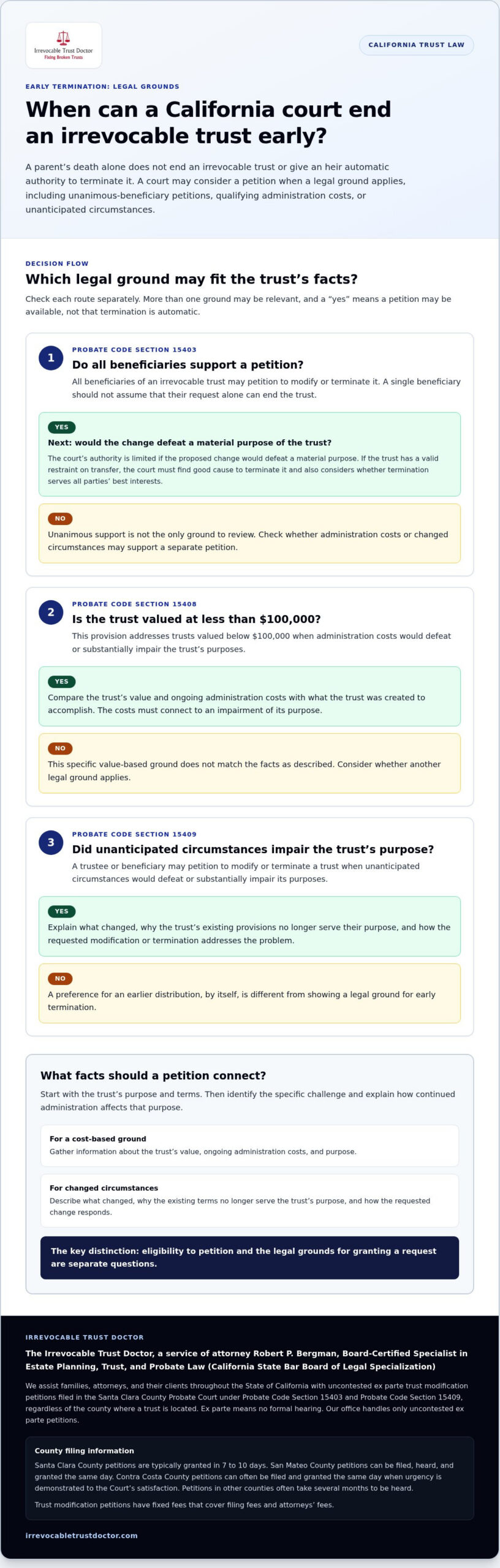
California law provides specific grounds for asking a court to end an irrevocable trust early. The trust’s provisions and purpose, administration costs, and changed circumstances all matter. First identify how the trust was created and what it was designed to accomplish. Then compare those terms with the challenges affecting its current administration.
Under California Probate Code Section 15408, the California Legislature addresses trusts valued at less than $100,000 when administration costs would defeat or substantially impair the trust’s purposes. This ground focuses on whether continued administration undermines the reason the trust exists. Gather information about the trust’s value, ongoing costs, and purpose so the petition can explain how those facts connect.
Changed circumstances may provide another basis for court review. Under Probate Code Section 15409, a trustee or beneficiary may petition to modify or terminate a trust when unanticipated circumstances would defeat or substantially impair its purposes. For example, explain what changed, why the trust’s existing provisions no longer serve their purpose, and how the requested change addresses that problem. A court considers the circumstances and the trust’s purposes.
These grounds are different from simply preferring an earlier distribution. A petition should connect the facts to the legal basis: describe the trust’s purpose, identify the specific challenge, and explain how continued administration affects that purpose. If several grounds may apply, organize supporting documents around each one. This can clarify whether the request seeks termination or a narrower modification.
To discuss which legal ground may fit your circumstances, schedule a trust petition consultation.
The Irrevocable Trust Doctor: Irrevocable Trust Modification Petition
The Irrevocable Trust Doctor, a service of attorney Robert P. Bergman, Board-Certified Specialist in Estate Planning, Trust, and Probate Law (California State Bar Board of Legal Specialization), assists families, attorneys, and their clients with uncontested trust modification petitions. If the trust’s terms or circumstances raise a legal basis for change, an Irrevocable Trust Modification Petition may provide a court-based path to address it.
Petitions are filed as uncontested ex parte matters in the Santa Clara County Probate Court under Probate Code Section 15403 and Probate Code Section 15409, regardless of the California county where the trust is located, including San Bernardino County. An ex parte process may allow a matter to proceed without a formal hearing. The office handles uncontested petitions only, so this option fits situations where the petition is not contested.
A Trust Petition Consultation can help clarify how the trust’s provisions and circumstances relate to a proposed modification. Contact The Irrevocable Trust Doctor to discuss your trust petition.
Take a Clear Next Step With the Trust
Before acting, gather the trust document and write down the change your family is seeking. Note who may be affected and what circumstances led you to consider a petition to terminate a trust in San Bernardino County. This preparation can focus the discussion on the trust’s terms and the practical outcome you want to pursue.
If you’re weighing a court petition, a Trust Petition Consultation can help you discuss how the trust’s provisions relate to your situation. The next step is a focused conversation about the document, the requested change, and whether an uncontested petition may fit.
Schedule a trust petition consultation to discuss your circumstances. With a clear picture of the issues, you can move forward with greater confidence.
Frequently Asked Questions
Can All Beneficiaries Agree to Change a Trust?
Yes, beneficiaries can agree on a proposed change, but their agreement alone does not rewrite the trust. Make the request concrete by recording the exact result sought, such as changing a distribution date or removing an outdated administrative clause. Identify who agrees and how the change would affect future distributions. This gives the family a clear proposal to evaluate.
Can the trustee modify the trust without beneficiary consent?
Usually, a trustee cannot rewrite a trust unless the document gives them that authority. Administrative discretion is different from changing beneficiaries’ rights or distribution terms. If a trustee believes the current arrangement no longer works, keep records of the specific problem and actions taken under the existing terms. This distinction helps clarify whether a proposed step involves administration or a trust change.
Do Beneficiaries Have Other Options When Circumstances Change?
Beneficiaries may try to resolve disagreements through negotiation, mediation, or arbitration, depending on the trust and the parties’ circumstances. Mediation lets participants work toward their own agreement; arbitration involves a decision-maker. Review the trust for an arbitration clause and identify the issue to resolve, such as a disputed distribution or unclear trustee duty, before considering a resolution.
Does the trust document itself matter for modification rights?
Yes. The complete document can show whether later amendments changed an earlier provision and how it describes trustee powers or distributions. Gather the signed trust, amendments, and any schedules it references. Then compare the relevant clauses side by side. This review can reveal whether the requested change concerns one provision or would alter several parts of the trust.
How Can I Terminate a Trust and Distribute My Assets?
Identify the legal basis for termination, prepare supporting information, and obtain any required court approval before distributing trust property. After approval, the trustee should document distributed assets and address final tax returns for income or capital gains generated by trust assets. Keep distribution records and tax documents with the trust’s closing records so beneficiaries can understand what was transferred and accounted for.

Article by
Robert P. Bergman, Attorney at Law
Attorney Robert P. Bergman ("Bob Bergman") has been a Board-Certified Specialist in Estate Planning, Trust and Probate Law since 2011, as certified by the California State Bar Board of Legal Specialization. For several years, Bob has assisted families and the clients of other attorneys with obtaining court orders through trust modification petitions to make necessary modifications to existing irrevocable trusts. Bob is friendly, very approachable, and believes in explaining complex legal topics in clear ordinary language so that his clients understand exactly what they're doing and why they're doing it.
Bob is often able to assist clients throughout California who are in other counties than his home county of Santa Clara through his approach to trust modification petitions.